

BMW i7 Quick Overview
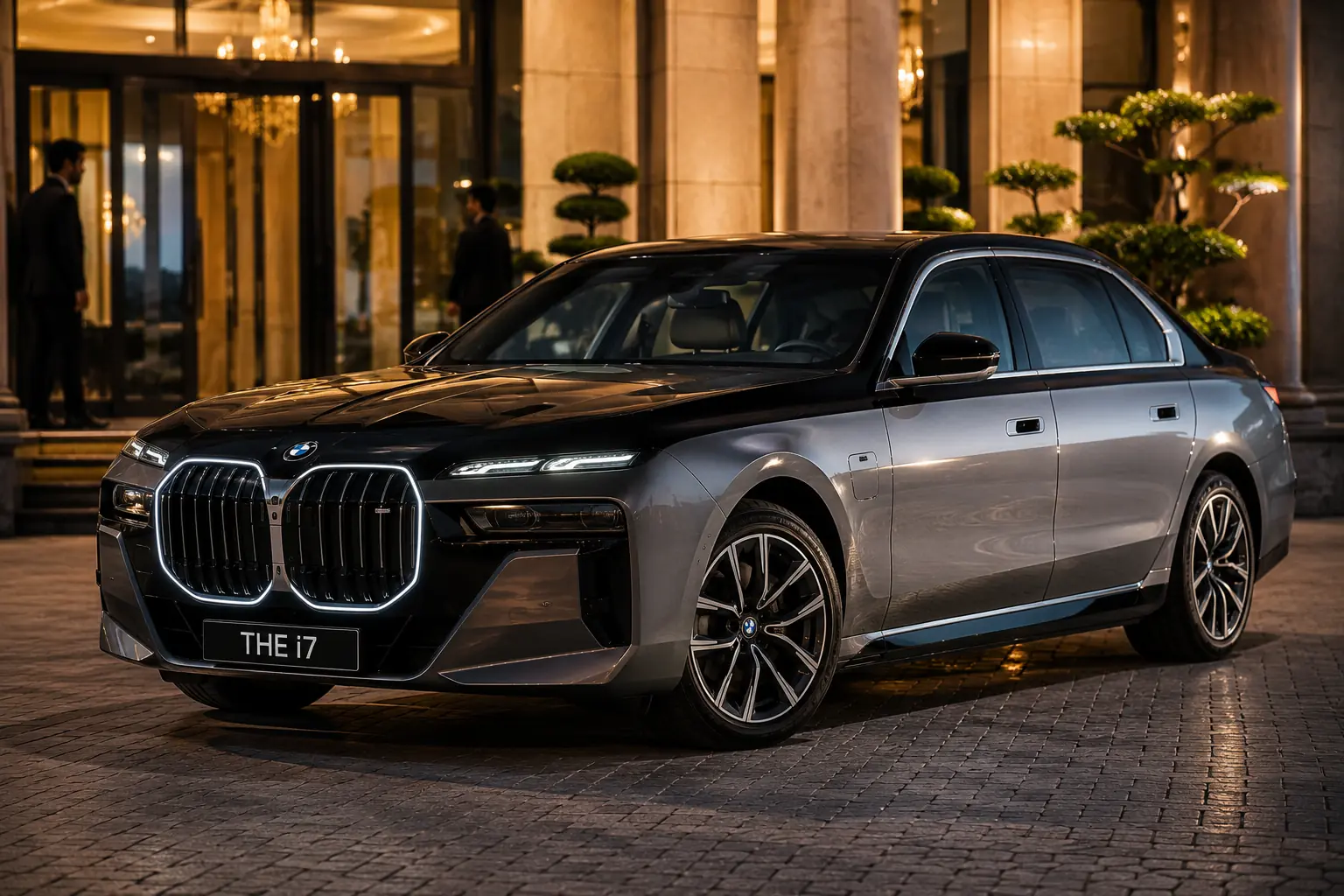
The 2026 BMW i7 is India’s flagship ultra-luxury electric limousine, priced between ₹2.05 Crore and ₹2.58 Crore (ex-showroom). Built on a specialized long-wheelbase platform, every variant houses a massive 101.7 kWh usable battery pack. It delivers a highly stable real-world highway and city range of 465 km to 550 km, pairing whisper-quiet ride refinement with an industry-first 31.3-inch rear theater screen.
BMW i7 Price Guide 2026: Real-World Range, Theatre Screen Interior, Running Costs & Is It Worth Buying?
For decades, the peak of chauffeur-driven transportation in India was defined by traditional multi-cylinder petrol or diesel luxury barges. However, corporate tycoons, tech founders, and elite fleet managers are realizing that even the most refined combustion engines cannot match the absolute silence, instantaneous torque, and lack of vibration offered by a dedicated electric layout.
The BMW i7 represents the pinnacle of this shift. It isn’t an experimental sports car or a compromised crossover box; it is a full-sized, unapologetic luxury limousine that happens to run entirely on electrons. In 2026, it stands out as the ultimate rolling boardroom, matching elite rear-seat theater tech with long-legged cruising capability.
Why the BMW i7 Commands the Ultra-Luxury Segment
The i7 does not treat electric power as a gimmick; its electrical architecture gives it engineering advantages that are immediately noticeable from the rear seat:
Absolute Mechanical Isolation: Without piston movements, turbo lag, or transmission shift shocks, the cabin operates in complete silence, serving as a highly calming mobile sanctuary.
Elite Ride Architecture: Standard adaptive two-axle air suspension with automatic self-leveling coordinates with rear-wheel steering to glide over broken urban tarmac while making a 5.3-meter limousine feel as agile as a compact sedan.
The Power of the Big Pack: Housing an enormous 101.7 kWh usable battery matrix, it packs the pure energy density required to completely eliminate range anxiety during long-distance inter-state travel.
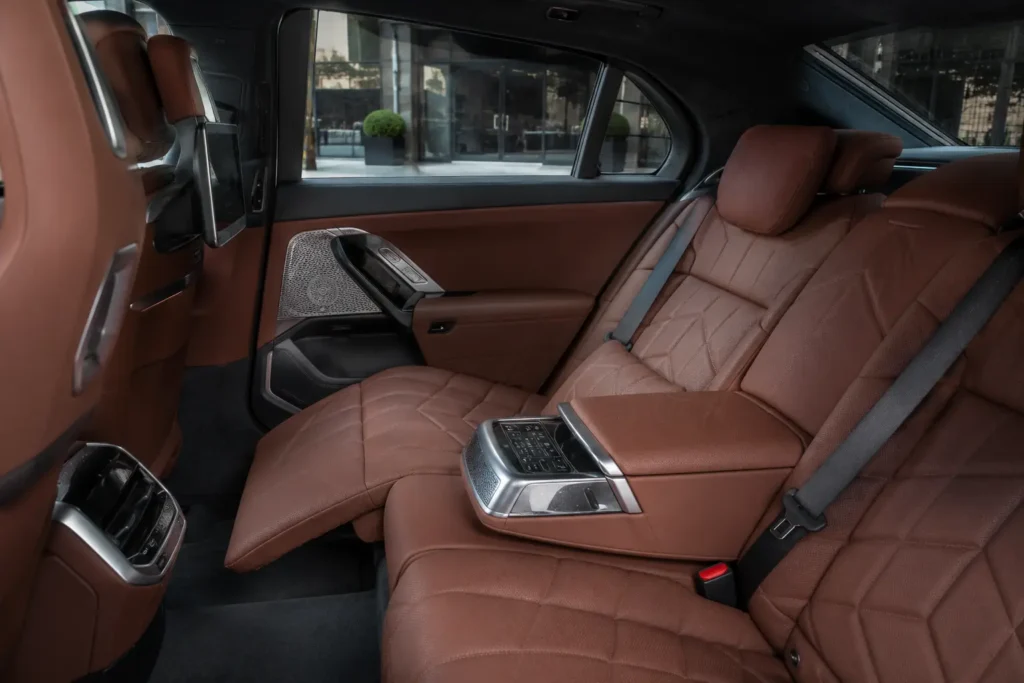
BMW i7 Price List & Variants (2026)
The portfolio structures cleanly across the single-motor eDrive50 and the ultra-high-performance dual-motor M70 xDrive setups.
| Variant Name | Battery Capacity (Usable) | Drivetrain Layout | Power Output | Ex-Showroom Price |
| i7 eDrive50 M Sport | 101.7 kWh | Single Motor RWD | 536 bhp | ₹2.05 Crore |
| i7 M70 xDrive | 101.7 kWh | Dual Motor AWD | 650 bhp | ₹2.58 Crore |
The Luxury EV Registration Advantage: Standard luxury multi-cylinder petrol vehicles in the ₹2 Crore bracket face severe state registration penalties and high luxury cess additions. Because the i7 runs purely on battery power, it benefits from India’s flat 5% GST mandate on electric cars and qualifies for complete road tax waivers in progressive states, saving buyers up to ₹30 Lakh on-road.
Interior Architecture: The First-Class Rolling Lounge
The cabin of the i7 drops conventional luxury templates entirely, utilizing a high-tech combination of glass, leather, and cinema tech.
1. The 31.3-Inch Rear Theater Screen
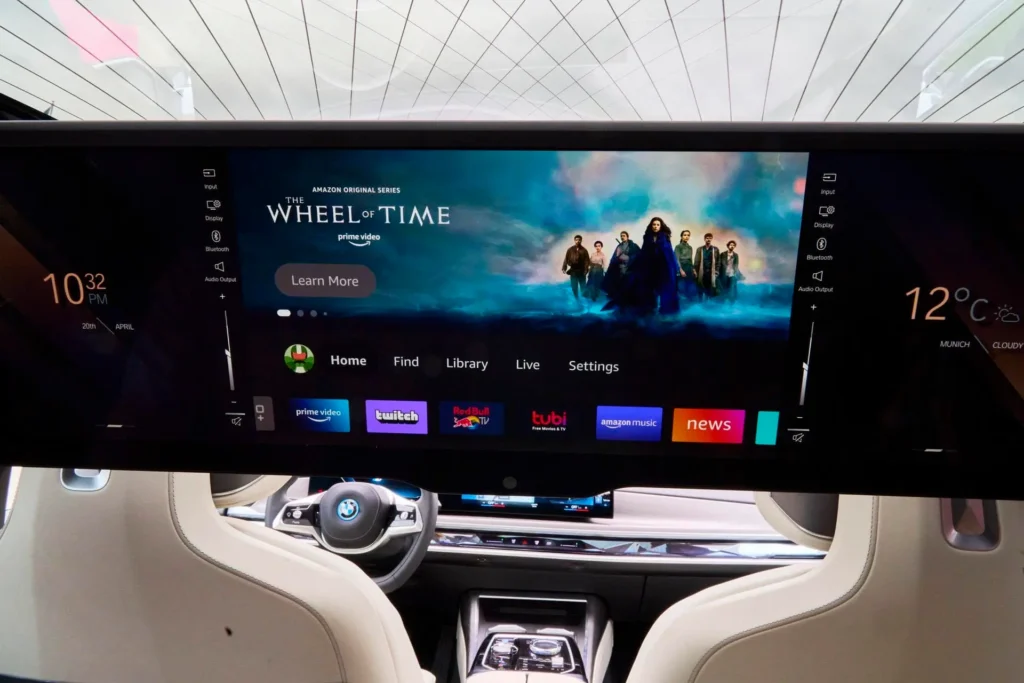
The defining feature of the i7 is the BMW Theatre Screen—a massive 31.3-inch ultra-wide 8K display that folds down from the roof for rear passengers. Running built-in Amazon Fire TV and paired with high-speed internet, it integrates with a 36-speaker Bowers & Wilkins Diamond Surround Sound system that features physical bass shakers built directly into the seat frames, turning the rear bench into a private cinema.
2. The Interaction Bar and Front Cockpit
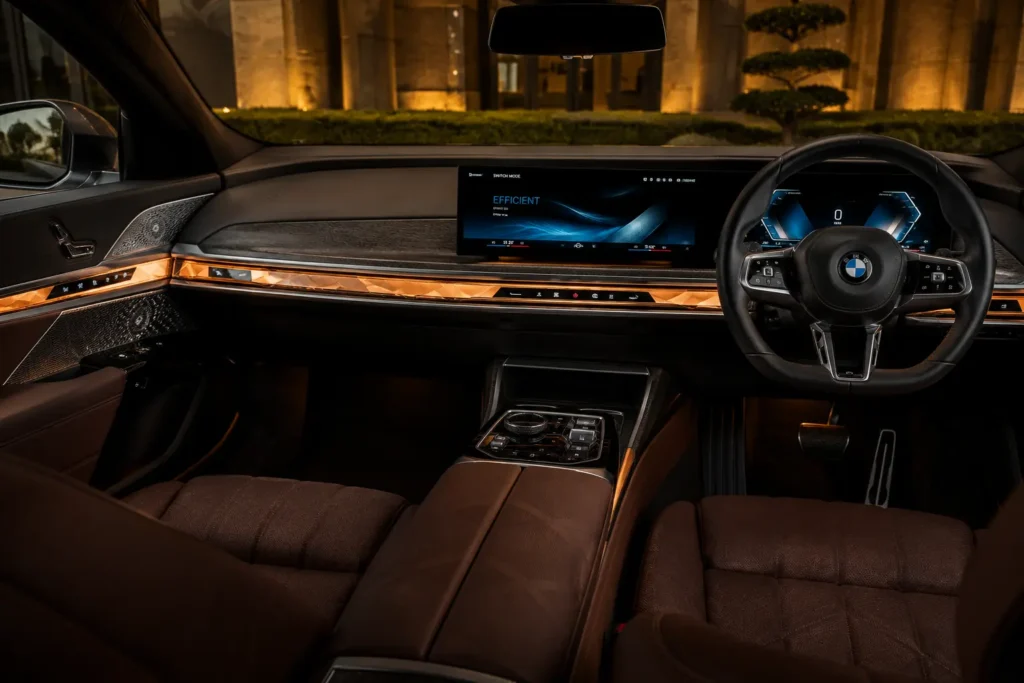
Up front, the driver is greeted by a beautiful sweeping BMW Curved Display combining a 12.3-inch instrumentation deck and a 14.9-inch central infotainment screen running the latest BMW Operating System. Running through the center of the dashboard is the faceted, crystal-styled BMW Interaction Bar, which acts as hidden ambient lighting while housing touch-sensitive controls for climate vents and door operations.
3. Executive Lounge Comfort & Storage
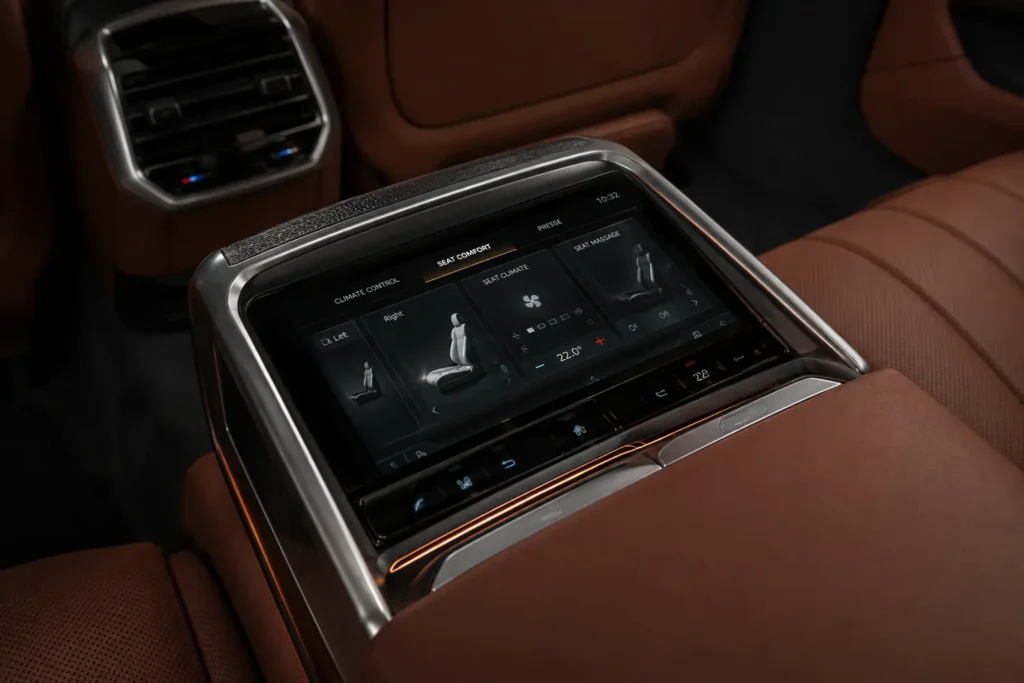
The left rear seat features the full Executive Lounge console, allowing the passenger to recline the backrest up to 42.5 degrees while a powered leg rest telescopes outwards. Touchscreen panels built directly into the rear door armrests allow passengers to control massage, climate, and window blinds.
The vehicle houses a generous 500-liter boot capacity, providing ample space for premium luggage sets.
Real-World Range & Charging Experience
A large, heavy vehicle weighing close to 2.7 tonnes requires careful management of its energy reserves, making an honest, data-backed range calculation critical.
Real Urban Loops vs. Expressway Consumption
While the official ARAI claim stands at an impressive 560 km to 625 km, actual real-world tracking across mixed Indian conditions yields highly consistent data:
City Chauffeur Loops: The single-motor eDrive50 returns a highly dependable 465 km to 500 km of real-world city range on a full charge. Frequent stop-and-go crawls trigger smooth energy regeneration, keeping efficiency stable during low-speed crawling.
Steady Highway Touring: Because of its large, imposing front grille and heavy profile, maintaining steady driving speeds above 100 km/h increases wind resistance significantly, dropping the dual-motor M70 xDrive’s highway range closer to 400 km to 430 km. Operating the multi-zone climate control continuously in peak summer heat results in a standard 12% efficiency drop.
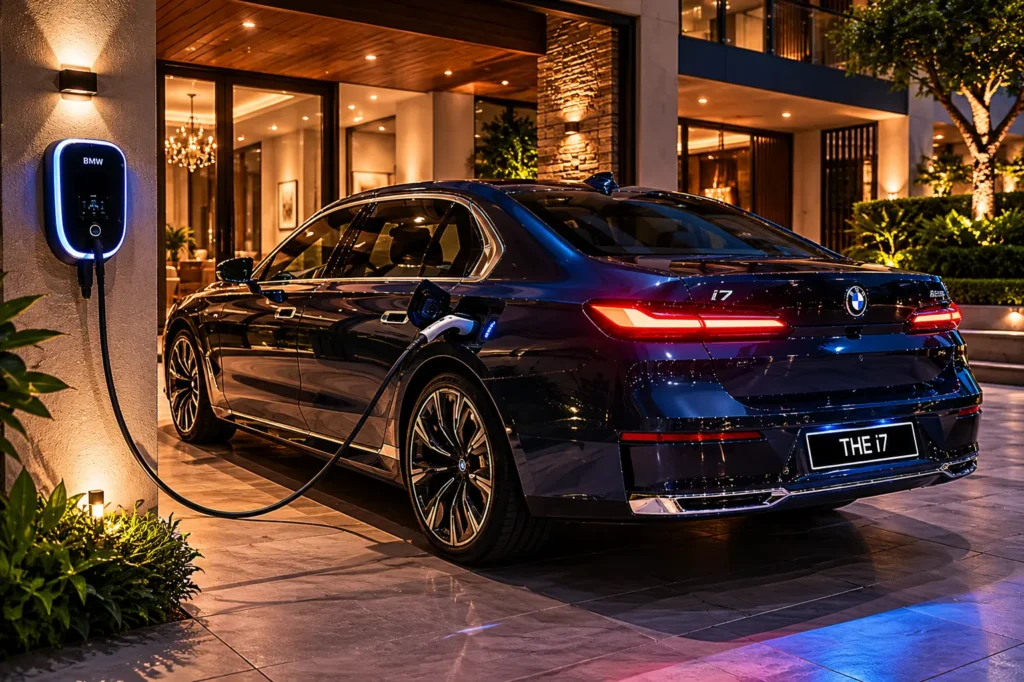
Charging Infrastructure Timelines
The 400V battery cell architecture manages high-capacity charging curves efficiently:
High-Capacity Public DC Fast Charging: The i7 handles up to 195 kW DC fast-charging input. Hooked up to a commercial 150 kW public fast charger, the battery can replenish from 10% to 80% in just 34 to 38 minutes.
Standard AC Wall Box (11 kW): Included standard with your vehicle purchase, it plugs into standard three-phase home/office lines to completely top up the massive battery pack overnight from empty in approximately 11 hours.
BMW i7 Full Technical Specifications Table
| Technical Parameter | i7 eDrive50 M Sport | i7 M70 xDrive Flagship |
| Powertrain Motor Layout | Single Motor (Rear-Wheel Drive) | Dual Motors (All-Wheel Drive) |
| Peak Power Output | 536.40 bhp | 650.39 bhp |
| Peak Torque Output | 745 Nm (Instantaneous) | 1,015 Nm (In Launch Mode) |
| Battery Pack Capacity | 101.7 kWh Usable (105.7 Gross) | 101.7 kWh Usable (105.7 Gross) |
| Acceleration (0-100 km/h) | 4.7 Seconds | 3.7 Seconds (Supercar Class) |
| Maximum Top Speed | 250 km/h (Electronically Limited) | 250 km/h (Electronically Limited) |
| Suspension Configuration | Adaptive 2-Axle Air Suspension | Adaptive 2-Axle Air Suspension |
| Tyre & Wheel Configuration | 245/45 R20 Front – 275/40 R20 Rear | 255/40 R21 Front – 285/35 R21 Rear |
| Dimensions (L x W x H) | 5,391 mm x 1,950 mm x 1,544 mm | 5,391 mm x 1,950 mm x 1,544 mm |
| Wheelbase Capacity | Massive 3,215 mm Length | Massive 3,215 mm Length |
Running Cost Comparison: i7 vs Petrol V8 Luxury Sedans
Let’s calculate the operational math for an executive commuter covering a standard monthly distance of 1,500 km over a 5-year ownership tenure.
Scenario A: The BMW i7 eDrive50 (Home/Office AC Charging)
Average domestic/commercial power tariff: ₹8 per unit (kWh).
Fully topping up the 101.7 kWh battery uses roughly 110 units (allowing for standard minor charging losses), costing ₹880.
Covering 1,500 km requires roughly 3 full charging cycles.
Monthly Power Bill: ~₹2,640 (Approx. ₹1.76 per km).
Scenario B: Traditional Petrol Luxury Sedan (7 Series V8 / S-Class Class)
Average cost of high-octane premium fuel: ₹110 per liter.
Real-world urban fuel economy for a heavy luxury V8: 6 km/l.
Fuel needed for 1,500 km: 250 Liters.
Monthly Fuel Bill: ₹27,500 (Approx. ₹18.33 per km).
5-Year Cumulative Operational Fuel Cost Savings
[Premium Petrol V8 Sedan: ₹27,500/mo]
====> 5-Year Total: ₹16.50 Lakh
[BMW i7 EV Power Charging: ₹2,640/mo]
==> 5-Year Total: ₹1.58 Lakh
----------------------------------
Net Operational Household Savings over 5 Years: ₹14.92 Lakh
Maintenance Cost & Long-Term Ownership
Ultra-luxury combustion cars feature highly complex mechanical items like twin-turbo plumbing, intricate multi-stage automatic gearboxes, complicated air-filtration lines, and high-pressure fuel injectors. The i7 drops these vulnerabilities entirely.
Routine Garage Visits: Annual maintenance checkups focus primarily on basic cabin air filter replacements, suspension calibration checkups, tire rotations, and full high-voltage software diagnostics. Expect bills to range smoothly between ₹8,000 and ₹12,000.
Battery Durability and Warranty: BMW protects the liquid-cooled battery pack with an extensive 8-year or 1,60,000 km warranty, providing strong long-term security and helping hold a stable resale profile.
BMW i7 Pros & Cons
Advantages
Unmatched Cabin Quietness: The electric drivetrain removes engine noise, creating a calming cabin environment.
First-Class Theatre Tech: The folding 31.3-inch 8K screen transforms the rear seat into a private cinema.
Exceptional Rear Legroom: The extensive 3,215mm wheelbase provides elite space to recline fully.
Significant Tax Subsidies: The flat 5% EV GST dramatically lowers your initial purchase premium over petrol rivals.
Plush Ride Quality: Two-axle adaptive air suspension flattens out road irregularities effortlessly.
Disadvantages
Polarizing Front Grille Design: The aggressive, illuminated kidney grille aesthetic does not appeal to conservative tastes.
Enormous Exterior Footprint: Its 5.4-meter length can make maneuvering through tight older city lanes challenging.
Complex Touch Menus: Simple actions like adjusting air vents require using touchscreen slider sub-menus, which can be fussy.
Heavy Kerb Weight: Tipping the scales at 2.7 tonnes makes its presence felt during urgent, sudden directional transitions.
Who Should Buy the BMW i7?
Recommended For:
Chauffeur-Driven Corporate Executives: Ideal for professionals who spend their daily commute working or relaxing in the rear cabin.
Tech-Forward Luxury Buyers: Drivers wanting elite, cutting-edge software integration, heads-up displays, and high-end audio performance.
High-Utilization Premium Garages: Commuters covering over 1,200 km monthly who want elite status alongside massive running cost savings.
Not Recommended For:
Self-Driving Urban Owners: If you plan to navigate the car yourself daily through dense, narrow city center traffic or older parking structures.
Apartment Residents Lacking Private Power Points: Relying purely on public commercial fast chargers increases your operational costs and reduces daily convenience.
Questions Buyers Commonly Ask about BMW i7
What is the real on-road price of the BMW i7 in India?
While ex-showroom pricing starts at ₹2.05 Crore, comprehensive luxury insurance, local registration documentation, and handling fees bring final metro on-road numbers to between ₹2.14 Crore and ₹2.68 Crore depending on your state’s EV tax incentives.
What is the true real-world range of the BMW i7 eDrive50?
In standard urban stop-and-go chauffeur routes with active AC use, you can safely expect a highly dependable 465 km to 500 km of actual range on a single charge.
Does the theater screen block the driver’s rear view?
Yes. When the 31.3-inch screen is folded down, it blocks the center rearview mirror entirely. To fix this, BMW routes a live rear video feed directly into a digital camera display inside the central mirror frame.
Is it safe to drive through waterlogged streets?
Yes. Both the high-voltage electric motor and the under-floor battery enclosure carry a strict weatherproofing safety rating, keeping high-voltage assemblies safely sealed against moisture entry during monsoon street flooding.
How does it compare to the Mercedes EQS Sedan?
While the Mercedes EQS offers a more aerodynamic shape and slightly longer real-world range, the BMW i7 provides a more traditional, imposing sedan silhouette, far superior rear head clearance, and the exclusive rear theater screen layout.
Final Verdict: Is the BMW i7 Worth Buying in 2026?
The BMW i7 represents a highly successful and logical shift into the ultra-luxury segment. It doesn’t treat electric power as an afterthought; it uses a massive structural battery architecture that maximizes third-row room, cabin refinement, and body stability.
If your daily routine involves high-frequency executive commuting, corporate travel, or managing a large premium garage with a dedicated overnight charging space, the massive fuel savings, incredible rear legroom, and absolute cabin quietness make it an exceptional investment under a ₹2.5 Crore budget. However, if you plan to drive yourself daily through dense urban lanes or prefer a low-profile aesthetic, standard luxury crossovers might suit your lifestyle better. Ultimately, let your real-world rear-seat requirements guide your final choice.
“Running cost matters more than fuel type when daily commuting is involved.”
Helpful Resources for Indian EV Car Buyers
- Bharat NCAP Official Website — India’s official crash-testing and vehicle safety rating platform. Includes adult and child occupant scores, crash-test protocols, and tested vehicle lists.
- Global NCAP – Safer Cars for India — Global crash-test program that pushed Indian manufacturers toward safer vehicle structures and occupant protection standards.
- Reserve Bank of India (RBI) — Official source for repo rates, lending rules, and banking regulations in India. (rbi.org.in)
- TransUnion CIBIL — Check your credit score and track your loan eligibility before applying for a car loan.
- AutomotiveZone Mileage Cost Calculator — Estimate real fuel costs based on your driving mileage.
- AutomotiveZone Monthly Car Expense Calculator — Calculate total monthly car ownership cost including EMI, fuel, and maintenance.
- AutomotiveZone Fuel Cost Calculator — Instantly estimate petrol, diesel, or CNG expenses based on mileage, fuel price, and trip distance.
- AutomotiveZone EV vs Petrol Cost Calculator — Compare electric vehicle charging costs with petrol fuel expenses to see long-term savings.
- AutomotiveZone EV Charging Cost Calculator — Calculate home and fast-charging electricity costs for your EV using battery size and electricity tariff.
- AutomotiveZone Car Resale Value Estimator — Estimate your car’s current market resale value based on age, mileage, ownership, and condition.
Disclaimer: Prices, mileage, safety ratings, loan rates, and ownership costs are approximate and may vary by location, variant, and market conditions in 2026. Some visuals may be AI-generated for illustration. Please verify final details with authorized dealers before purchase.
Calculate BMW i7 Charging Cost
Estimate monthly charging expenses, electricity consumption, and long-term running cost savings for the BMW i7 luxury electric sedan.
Calculate BMW i7 Charging Cost →