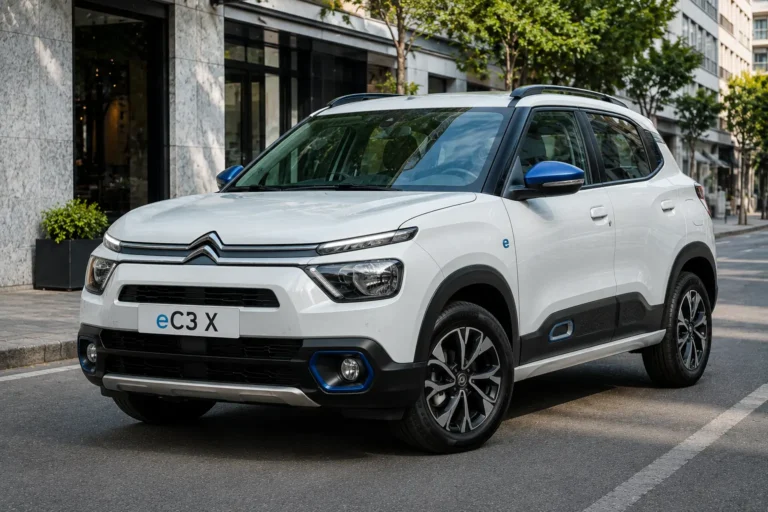

EV
Maruti Suzuki e Vitara at a Glance
The Maruti Suzuki e Vitara is available in India with an ex-showroom price ranging from ₹15.99 Lakh to ₹20.01 Lakh. Alternatively, under Maruti’s Battery-as-a-Service (BaaS) platform, the upfront cost drops to ₹10.99 Lakh, with an additional running battery rental fee starting at ₹3.99 per km. Delivering a real-world city range of 350 km to 420 km, it represents Maruti’s first major move into the electric SUV India market.
Why Maruti Suzuki Entering the EV Segment Matters in India

For years, Indian car buyers looking for electric vehicles under ₹20 Lakh had to look primarily at Tata Motors or MG. Maruti Suzuki’s entrance into the EV segment with the e Vitara changes the landscape, bringing its massive service network and long-term reliability into the electric conversation.
- Insulation from Fuel Costs: With traditional fuel prices heavily stressing middle-class household budgets, an efficient commuter vehicle is increasingly necessary.
- A Shift in Focus: Known historically for light, mileage-focused cars, Maruti built the e Vitara on a dedicated skateboard platform layout, prioritizing passenger space and frame strength.
- Immediate Market Acceptance: By launching directly into the highly competitive compact SUV class, Maruti is targeting buyers who want to switch from petrol to electric without losing corporate peace of mind.
Maruti Suzuki e Vitara Price List & Variants (2026)

The e Vitara line-up is structured cleanly across three core variants with two lithium-iron-phosphate (LFP) blade battery pack choices: 49 kWh and 61 kWh.
Maruti electric car price list configurations:
| Variant | Battery Capacity | Claimed ARAI Range | Upfront Price (With BaaS) | Standard Price (Without BaaS) |
| Delta | 49 kWh | 440 km | ₹10.99 Lakh | ₹15.99 Lakh |
| Zeta | 61 kWh | 543 km | ₹11.99 Lakh | ₹17.49 Lakh |
| Alpha | 61 kWh | 543 km | ₹14.29 Lakh | ₹19.79 Lakh |
| Alpha Dual Tone | 61 kWh | 543 km | ₹14.51 Lakh | ₹20.01 Lakh |
Maruti Suzuki e Vitara Variant Breakdown
1. Delta (The Entry Foundation)

Priced at ₹15.99 Lakh (or ₹10.99 Lakh under BaaS), this base variant handles core requirements well. It features the 49 kWh battery pack, digital displays, automatic climate control, and dual airbags. It works well if your daily driving pattern remains strictly inside municipal boundaries.
2. Zeta (The Balanced Choice)

Priced at ₹17.49 Lakh, the mid-tier variant steps up to the larger 61 kWh battery pack. It expands the feature list with wireless smartphone integration, alloy wheels, and keyless start functionality, making it the value-for-money recommendation for mixed use.
3. Alpha & Alpha Dual Tone (The Flagship Trims)

Topping out at ₹19.79 Lakh, the Alpha variant adds ventilated front seats, a 360-degree camera system, single-pane sunroof, semi-leatherette upholstery, and a Level 2 ADAS safety suite. It targets buyers who want a fully loaded modern cabin environment.
Maruti Suzuki e Vitara Specifications Table

| Specification Parameters | Detail and Capabilities |
| Battery Pack Options | 49 kWh / 61 kWh LFP Blade Cells |
| ARAI Claimed Range | 440 km (49 kWh) / 543 km (61 kWh) |
| Real-World Range | ~350 km (Delta) / ~420 km (Zeta & Alpha) |
| Peak Power Output | 142 bhp (49 kWh) / 172 bhp (61 kWh) |
| Peak Torque Output | 193 Nm |
| Drivetrain Layout | Front-Wheel-Drive (FWD for India) |
| DC Fast Charging Time | 10% to 80% in 45 minutes via 70kW charger |
| AC Home Charging Time | 6.5 Hours (49 kWh) / 9.2 Hours (61 kWh) via 7.4kW box |
| Boot Space Volume | 310 Liters |
| Crash Safety Validation | 5 Star Rating (Bharat NCAP) |
Real-World Range & Charging Experience

Laboratory estimates provide a good comparison benchmark, but real Indian roads introduce gridlock, summer heat, and varying driving styles that lower actual mileage.
Related: Tata Nexon EV
Urban Efficiency and Highway Drops
The 61 kWh battery delivers a reliable 420 km range inside typical city commuting environments. The electric motor is tuned smoothly, avoiding initial sudden jerks and providing a progressive throttle response that feels familiar to drivers transitioning from petrol vehicles.
However, sustained highway speeds past 95 km/h increase wind resistance and cause the range to drop to around 330–340 km. Furthermore, running the air conditioning during peak summer months puts a consistent load on the battery, resulting in a 12% efficiency drop.
The Charging Routine

Charging your car overnight via a standard 7.4kW AC home wall box takes roughly 9 hours for the larger battery pack. For highway travel, the e Vitara handles up to 70kW DC fast charging, allowing you to top up from 10% to 80% in about 45 minutes. Apartment charging setups still require clear permission from local residential housing societies, which remains a key step to finalize before purchasing.
Maruti Suzuki e Vitara Running Cost vs Petrol SUVs

Let’s calculate the real ownership expenses for an urban commuter covering 1,200 km per month.
Scenario A: Outright Purchase Model (Home Charging)
- Average urban domestic power tariff: ₹8 per unit (kWh).
- A full charge of the 61 kWh pack takes around 65 units (allowing for minor transmission losses), costing ₹520.
- Covering 1,200 km requires roughly 3 full charging cycles.
- Monthly Power Bill: ~₹1,560 (Approx. ₹1.30 per km).
Scenario B: The BaaS Rental Alternative
- Upfront ex-showroom price drops by up to ₹5 Lakh, but you pay a fixed battery usage fee of ₹4.39 per km (for the 61 kWh pack).
- Monthly BaaS mileage fee for 1,200 km: ₹5,268 + home electricity consumption (~₹1,560).
- Monthly BaaS Outgo: ~₹6,828 (Approx. ₹5.69 per km).
Scenario C: Traditional Petrol Compact SUV
- Average fuel cost: ₹102 per liter.
- Real-world urban fuel economy: 12 km/l.
- Fuel required for 1,200 km: 100 Liters.
- Monthly Fuel Bill: ₹10,200 (Approx. ₹8.50 per km).
5-Year Cumulative Fuel Cost Comparison (Outright Purchase vs Petrol)
[Petrol Compact SUV Cost: ₹10,200/mo] =====> 5-Year Total: ₹6.12 Lakh
[e Vitara Charging Cost: ₹1,560/mo] ==> 5-Year Total: ₹0.78 Lakh
-------------------------------------------------------------------------
Net Operational Savings over 5 Years: ₹5.34 Lakh
Maintenance Cost & Long-Term Ownership
Electric vehicles have far fewer moving parts than traditional internal combustion cars, doing away with complex gearboxes, engine pistons, fuel filters, and spark plugs.
- Periodic Servicing: Annual service check-ups focus primarily on fluid top-ups, suspension lubrication, cabin air filter replacements, and diagnostic scans. Expect bills to range between ₹3,000 and ₹5,000.
- Braking Systems: The mechanical brake pads last significantly longer (often past 55,000 km) because regenerative braking handles much of the initial stopping duty.
- Battery Warranty and Reliability: Maruti Suzuki protects the battery assembly with a solid 8-year or 1,60,000 km warranty. LFP blade cells are highly durable and are structurally designed to retain over 80% state-of-health across ten years of regular charging cycles.
Maruti Suzuki e Vitara Pros & Cons

Advantages
- Low Operational Running Costs: Home electricity lowering fuel expenses down to nearly ₹1.30 per km.
- Top Safety Rating: Earned a full 5 Star validation in Bharat NCAP testing, making it structurally robust.
- Approachable Power Delivery: Smooth and linear acceleration that is easy to manage for first-time EV owners.
- Vast Brand Footprint: Backed by Maruti’s extensive service network across India.
- Flexible Ownership Structure: The BaaS option lowers the initial financial entry barrier for buyers.
Disadvantages
- Limited Luggage Room: The 310-liter boot space is tighter than many petrol and electric compact SUV alternatives.
- Conservative Features: The cabin layout lacks some of the flashy elements found in newer start-up vehicles.
- Highway Travel Pauses: Fast charging requires planning your long-distance road trips around working highway stations.
- Rear Cabin Width: The rear seat shape is highly optimized for comfort for two adults, making three passengers a tight fit.
Maruti Suzuki e Vitara vs. Petrol SUVs: Which Makes Sense?

Your final decision should match your real-world usage patterns, rather than just vehicle specifications.
- The Urban Commuter Case: If your routine involves a 40–60 km daily cross-city trip through heavy town traffic, the e Vitara is highly practical. It removes gear-shift fatigue and lowers your monthly operational expenses.
- The Rare Long-Distance Case: If your household requires a single vehicle for spontaneous 600 km interstate highway journeys into areas with limited charging stations, a standard petrol SUV remains the simpler option for now.
Also Check out: MG Windsor EV Price
Who Should Buy the Maruti Suzuki e Vitara?

Recommended For:
- High-Mileage Commuters: Drivers covering more than 1,000 km monthly get a quick return on their initial investment.
- First-Time EV Buyers: Perfect for those who want to transition to electric power but require a predictable driving feel and a dependable brand name.
- Safety-Prioritizing Families: Buyers who value a proven 5-star crash test rating and a stable driving position.
Not Recommended For:
- Apartment Residents Lacking Private Power Points: Relying solely on public fast chargers increases your monthly running costs and lowers daily convenience.
- Heavy Luggage Travelers: Families who frequently take long road trips with multiple large suitcases will find the 310-liter boot restrictive.
Questions Buyers Commonly Ask
What is the entry-level Maruti e Vitara price in India?
The entry-level Delta variant (49 kWh) starts at ₹15.99 Lakh ex-showroom. Under the BaaS option, the vehicle price drops to ₹10.99 Lakh, with battery usage billed separately.
What is the real-world range of the Maruti Suzuki e Vitara?
The 49 kWh battery delivers roughly 350 km of real-world city range, while the larger 61 kWh variants provide a dependable 420 km under normal city driving conditions.
Can I charge the Maruti e Vitara comfortably at home?
Yes. Every variant comes with home charging compatibility, connecting to a standard 15A domestic wall plug or a dedicated 7.4kW AC charger box.
Is the e Vitara model safe for family use?
Yes, it is structurally robust and has secured a full 5 Star rating from Bharat NCAP, making it one of the safest vehicles in Maruti’s current lineup.
Is it cheaper to maintain than a traditional petrol SUV?
Yes, routine annual maintenance bills are roughly 40% lower over five years because the electric drivetrain has fewer moving mechanical parts.

Final Verdict: Is the Maruti Suzuki e Vitara Worth Buying in 2026?
The Maruti Suzuki e Vitara is an effective, practical choice for urban buyers. It doesn’t try to look overly futuristic; instead, it focuses on what daily commuters need most: smooth power, a highly refined driving experience, a 5-star safety layout, and predictable running costs.
If you have a dedicated garage space to charge overnight and your daily routine involves a clear cross-city commute, it stands out as an excellent option to lower your monthly transportation bills. However, if your family needs a massive boot for heavy luggage or plans to use it primarily for highway travel, ensure you plan your routes around commercial fast chargers. Running cost matters more than fuel type when daily commuting is involved, so let your monthly mileage guide your final choice.
Helpful Resources for Indian EV Car Buyers
- Bharat NCAP Official Website — India’s official crash-testing and vehicle safety rating platform. Includes adult and child occupant scores, crash-test protocols, and tested vehicle lists.
- Global NCAP – Safer Cars for India — Global crash-test program that pushed Indian manufacturers toward safer vehicle structures and occupant protection standards.
- Reserve Bank of India (RBI) — Official source for repo rates, lending rules, and banking regulations in India. (rbi.org.in)
- TransUnion CIBIL — Check your credit score and track your loan eligibility before applying for a car loan.
- SBI Car Loans — View latest interest rates, eligibility criteria, and loan offers from State Bank of India.
- HDFC Bank Car Loans — Explore car loan options, EMIs, and financing plans from HDFC Bank.
- ICICI Bank Car Loans — Compare new and used car loan offers along with repayment options.
- Policybazaar Car Insurance — Compare insurance plans, premiums, and add-on coverage options in one place.
- Acko Car Insurance — Get quick online quotes and renewal estimates for car insurance.
- AutomotiveZone Mileage Cost Calculator — Estimate real fuel costs based on your driving mileage.
- AutomotiveZone Monthly Car Expense Calculator — Calculate total monthly car ownership cost including EMI, fuel, and maintenance.
Disclaimer: Prices, mileage, safety ratings, loan rates, and ownership costs are approximate and may vary by location, variant, and market conditions in 2026. Some visuals may be AI-generated for illustration. Please verify final details with authorized dealers before purchase.
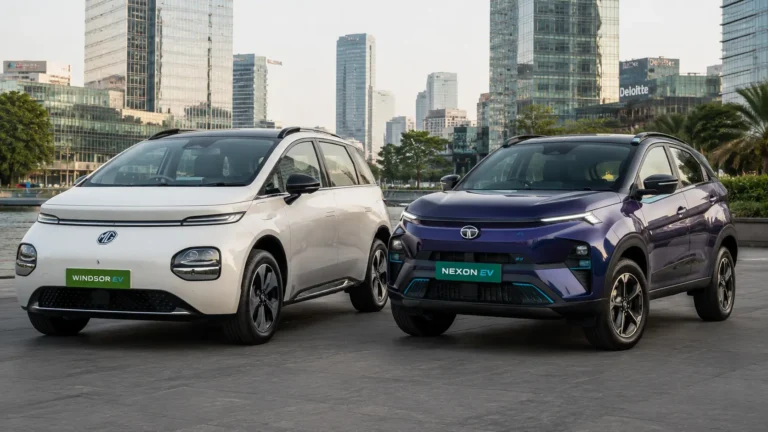
MG Windsor EV at a Glance
The MG Windsor EV is retailing between ₹14.00 Lakh and ₹18.50 Lakh (ex-showroom) for private buyers in 2026. Alternatively, its innovative Battery-as-a-Service (BaaS) option lowers the upfront vehicle cost to ₹9.99 Lakh, separating the battery cost into a per-kilometer usage rental. Delivering a real-world city range of 240 km to 310 km, this electric crossover focuses on exceptional rear-seat space and minimal running costs, though highway trip planning requires careful infrastructure mapping.
Why MG Windsor EV Is Getting Attention in India

With petrol and diesel prices remaining high across Indian metros, middle-class family budgets are facing heavy pressure from daily cross-city commuting. While buyers typically choose traditional MPVs or compact SUVs for family duties, high recurring fuel costs are pushing electric alternatives directly into mainstream family conversations.
The MG Windsor EV occupies a unique niche between entry-level electric hatchbacks and larger electric SUVs under ₹20 Lakh. Unlike upright, boxy SUVs, its crossover layout prioritizes cabin length and floor efficiency. MG is targeting practical family car India buyers who value maximum legroom, smooth automatic performance, and low daily operational costs over off-road styling.
MG Windsor EV Price List & Variants (2026)
The line-up includes standard variants equipped with a 38 kWh battery pack and the long-range Pro variants utilizing a 52.9 kWh pack. A dedicated fleet-focused “Commute” variant launched on April 10, 2026, starting at ₹13.49 Lakh.
| Variant Name | Battery Capacity | Claimed ARAI Range | Ex-Showroom Price | Key Variant Focus |
| Excite | 38 kWh | 332 km | ₹14.00 Lakh | Essential City Mobility / Budget Families |
| Exclusive | 38 kWh | 332 km | ₹15.53 Lakh | Balanced Value / Connected Technology |
| Essence | 38 kWh | 332 km | ₹16.53 Lakh | Comfort Features / Urban Family Chauffeur |
| Exclusive Pro | 52.9 kWh | 449 km | ₹17.38 Lakh | Extended Range / Intercity Commuters |
| Essence Pro | 52.9 kWh | 449 km | ₹18.50 Lakh | Top-Tier Tech / Advanced ADAS Safety |
MG Windsor EV Variant Breakdown
1. Excite (The Budget Foundation)
Priced at ₹14.00 Lakh, the base trim delivers essential family needs like 6 standard airbags, automatic climate control, and rear AC vents. It uses a 10.1-inch center screen and fabric seats, making it a highly logical option for local urban runs.
2. Exclusive (The Balanced Sweet Spot)
Priced at ₹15.53 Lakh, this mid-tier trim brings large 18-inch alloy wheels, a massive 15.6-inch infotainment console, and a 360-degree camera system. It offers the best feature-to-price ratio for tech-conscious families navigating tight city lanes.
3. Essence & Pro Variants (The Flagship Experience)
Ranging from ₹16.53 Lakh to ₹18.50 Lakh, the top trims bring a fixed panoramic glass roof, front ventilated seats, and wireless charging. The Pro models are highly recommended for highway users as they add a larger 52.9 kWh battery pack, faster 60kW charging speeds, and Level 2 ADAS driver aids.
MG Windsor EV Specifications Table
| Specification Parameters | Details and Capabilities |
| Battery Pack Type | 38 kWh / 52.9 kWh Lithium-Iron-Phosphate (LFP) |
| Claimed ARAI Range | 332 km to 449 km |
| Real-World Range | 240 – 250 km (38 kWh) / 290 – 310 km (52.9 kWh) |
| Peak Power Output | 134 bhp (100 kW) |
| Peak Torque Output | 200 Nm |
| DC Fast Charging Support | 45 kW (Standard) / 60 kW (Pro Variants) |
| Standard AC Charging | 6.5 Hours to 9.5 Hours (via 7.4kW Home Wall Box) |
| Total Boot Space Volume | 579 Liters (Expandable via 60:40 split fold) |
| Seating Comfort Highlight | “Aero Lounge” rear seats with 135-degree recline angle |
Real-World Range & Charging Experience

Lab-certified range numbers rarely align perfectly with the chaotic realities of Indian road networks. In actual urban traffic conditions, the standard 38 kWh variant delivers a predictable 240–250 km range with the air conditioning running consistently.
Urban stop-and-go crawls actually favor the drivetrain due to aggressive energy recovery from the adjustable regenerative braking system. However, peak summer temperatures past 42°C force the thermal management setup to work harder, triggering a 12–15% drop in efficiency. Cruising at speeds above 95 km/h on open expressways increases wind drag and depletes battery reserves quickly.

While public fast chargers are expanding along main highways, infrastructure reliability remains a concern. Public station queues during holiday travel windows can disrupt tightly packed intercity trip timelines. For home charging, setting up the standard AC wall box in apartment complexes requires clear permission from residential housing societies, which presents a significant initial setup hurdle.
MG Windsor EV Running Cost vs Petrol MPVs/SUVs

Let’s analyze the true middle-class family budget math for a standard monthly driving distance of 1,200 km.
Scenario A: Outright Purchase Model (Home Charging)
- Average domestic power tariff: ₹8 per unit (kWh).
- To charge the 38 kWh battery fully consumes around 42 units of electricity (including minor grid drop-off), costing ₹336.
- Covering 1,200 km requires roughly 5 charging cycles.
- Monthly Electricity Bill: ~₹1,680 (Approx. ₹1.40 per km).
Scenario B: The BaaS Subscription Model Cost
- Upfront vehicle cost drops by roughly ₹4 Lakh, but you pay a battery rental fee of ₹3.90 to ₹4.50 per km.
- Monthly BaaS mileage fee for 1,200 km: ~₹4,680 + home charging power (~₹1,680).
- Monthly BaaS Outgo: ~₹6,360 (Approx. ₹5.30 per km).
Scenario C: Traditional Petrol Family Car (Ertiga / Carens class)
- Average price of fuel: ₹102 per liter.
- Real-world urban fuel economy: 12 km/l.
- Fuel needed for 1,200 km: 100 Liters.
- Monthly Fuel Bill: ₹10,200 (Approx. ₹8.50 per km).
5-Year Cumulative Fuel Cost Savings (Outright Purchase vs Petrol)
[Petrol Family Car Cost: ₹10,200/mo]
=======> 5-Year Total: ₹6.12 Lakh
[Windsor EV Charging Cost: ₹1,680/mo]
==> 5-Year Total: ₹0.84 Lakh
-------------------------------------------------------------------------
Net Household Savings Over 5 Years: ₹5.28 Lakh

MG Windsor EV Maintenance Cost & Long-Term Ownership
Electric drivetrains drop complex mechanical assemblies like gearboxes, fuel pumps, catalytic converters, and spark plugs, simplifying your periodic garage visits.
- Routine Servicing: Annual maintenance routines involve basic software scans, cabin air filter updates, and suspension inspections. Average bills range between ₹3,000 and ₹5,000.
- Component Lifespan: Regenerative deceleration minimizes heavy wear on the mechanical brake pads, extending their replacement timeline past 55,000 km.
- Battery Safety and Degradation: MG protects the battery architecture with an 8-year or 1,60,000 km warranty. LFP cells are structurally stable in warm climates and engineered to keep over 80% capability across a decade of use, maintaining stable resale values.
MG Windsor EV Pros & Cons
Advantages
- Very Low Running Costs: Home electrical charging lowers per-kilometer costs to around ₹1.40.
- Class-Leading Passenger Space: The flat floor structure provides immense rear knee room and legroom.
- Sofa-Like Rear Comfort: The 135-degree reclining second row is highly comfortable for family use.
- Massive Luggage Capacity: A deep 579-liter boot volume handles large vacation suitcases with ease.
- Easy Ingress/Egress: Crossover ride height makes entry easy for elderly family members compared to low sedans.
Disadvantages
- Higher Upfront Premium: Outright purchase price is significantly higher than basic petrol cars.
- Long-Distance Travel Pauses: Highway journeys require mandatory 45-minute fast-charging stops.
- Range Fluctuations at Speed: Sustained speeds above 100 km/h drain battery reserves quickly.
- No Factory Spare Tyre: Relies entirely on temporary puncture repair kits, creating stress on remote roads.
- Digital-Heavy Controls: Air conditioning and mirror adjustments are buried inside the touchscreen menu.
MG Windsor EV vs Petrol Cars: Which Makes More Sense?
Your buying decision should rest strictly on your monthly mileage profile rather than general automotive trends.
- The Urban Commuter Case: If your routine involves a 40–60 km cross-city workplace run through dense bumper-to-bumper city corridors, the Windsor EV is highly practical. It removes gear-shift stress and effectively lowers your monthly transport outgo.
- The Spontaneous Highway Case: If your household relies on a single vehicle for unexpected long-distance family travel into rural areas lacking fast-charging stations, a traditional petrol MPV remains the more convenient option.
Who Should Buy the MG Windsor EV?

Recommended For:
- Daily City Office Commuters: Drivers covering more than 1,000 km monthly get the fastest return on their investment.
- Chauffeur-Driven Professionals: The sofa-like rear seat recline is ideal for those who spend their travel time in the second row.
- Space-Prioritizing Large Families: Households needing optimal legroom and large trunk space for heavy cargo.
Not Recommended For:
- On-Street Public Parking Users: If your apartment complex cannot support a dedicated, metered home charging station.
- Low Utilization Drivers: If your vehicle covers less than 600 km a month, the operational fuel savings will not easily offset the initial upfront purchase premium.
Key Questions Buyers Commonly Ask
What is the actual MG Windsor EV price on-road in India?
While ex-showroom figures start at ₹14.00 Lakh, varying state taxes, regional registration costs, and comprehensive insurance packages bring final metro on-road numbers between ₹14.9 Lakh and ₹19.7 Lakh across India.
What is the real-world range of the MG Windsor EV?
The standard 38 kWh trims deliver a realistic 240–250 km inside the city with active AC use. The larger 52.9 kWh Pro models push this limit to a realistic 290–310 km.
How much does it cost to charge the MG Windsor EV fully at home?
A full top-up on the 38 kWh pack consumes roughly 42 units of power. At a standard household rate of ₹8 per unit, a complete cycle costs approximately ₹336.
Does the car suffer from heating issues in slow traffic?
No. Because there is no internal combustion engine radiating thermal heat, the vehicle remains cool at complete standstills, with the liquid-cooled battery system managing thermal cycles efficiently.
Is the Windsor EV practical for highway driving?
It is capable, but demands discipline. You must monitor driving speeds beneath 90 km/h to protect your range and map your route based on functioning public DC fast chargers.
Is the MG Windsor EV Worth Buying in 2026?
The MG Windsor EV works effectively as a family-first electric vehicle. By ignoring aggressive SUV body profiles, it focuses entirely on what urban families value most: real legroom, low running costs, and an incredibly quiet cabin environment.
If you have a dedicated parking slot to install a home charging box and your monthly travel regularly clears 1,000 kilometers, it is a highly practical and comfortable investment for your household budget. However, if you are drawn to it purely because of the low BaaS marketing price, evaluate the long-term per-kilometer rental math carefully. Running cost matters more than fuel type when daily commuting is involved, so let your real-world odometer needs guide your final choice.
Helpful Resources for Indian EV Car Buyers
- Bharat NCAP Official Website — India’s official crash-testing and vehicle safety rating platform. Includes adult and child occupant scores, crash-test protocols, and tested vehicle lists.
- Global NCAP – Safer Cars for India — Global crash-test program that pushed Indian manufacturers toward safer vehicle structures and occupant protection standards.
- Reserve Bank of India (RBI) — Official source for repo rates, lending rules, and banking regulations in India. (rbi.org.in)
- TransUnion CIBIL — Check your credit score and track your loan eligibility before applying for a car loan.
- SBI Car Loans — View latest interest rates, eligibility criteria, and loan offers from State Bank of India.
- HDFC Bank Car Loans — Explore car loan options, EMIs, and financing plans from HDFC Bank.
- ICICI Bank Car Loans — Compare new and used car loan offers along with repayment options.
- Policybazaar Car Insurance — Compare insurance plans, premiums, and add-on coverage options in one place.
- Acko Car Insurance — Get quick online quotes and renewal estimates for car insurance.
- AutomotiveZone Mileage Cost Calculator — Estimate real fuel costs based on your driving mileage.
- AutomotiveZone Monthly Car Expense Calculator — Calculate total monthly car ownership cost including EMI, fuel, and maintenance.
Disclaimer: Prices, mileage, safety ratings, loan rates, and ownership costs are approximate and may vary by location, variant, and market conditions in 2026. Some visuals may be AI-generated for illustration. Please verify final details with authorized dealers before purchase.
Tata Nexon EV at a Glance
The Tata Nexon EV is priced between ₹12.49 Lakh and ₹17.49 Lakh (ex-showroom) for 2026. Available in 30 kWh (Medium Range) and 45 kWh (Long Range) battery options, it delivers a real-world city range of 190 km to 320 km. Its low running cost of ₹1.33 per km offers substantial financial savings over petrol alternatives for daily commuters.
Tata Nexon EV Price Guide 2026: Real-World Range, Running Cost & Is It Worth Buying?

Choosing a compact SUV used to be a straight choice between petrol and diesel. However, with fuel prices staying consistently high across India, electric vehicles have firmly entered the mainstream family conversation.
The Tata Nexon EV has been the anchor of this shift, serving as the default choice for middle-class households stepping into electric mobility. In 2026, the updated line-up brings refined battery choices and smarter technology packages to maintain its competitive edge in the compact electric SUV India market.
Why Tata Nexon EV Is Popular in India

The high market share of the Nexon EV isn’t an accident. Tata Motors utilized an existing 5-star crash-rated platform, minimizing development times and passing the cost advantages onto the car buyer.
- Fuel Price Inflation: With standard fuels costing over ₹100 per liter in metros, traditional combustion running costs are a heavy recurring burden for daily drivers.
- The SUV Form Factor: High ground clearance, a commanding view, and a cabin large enough for an Indian family make it highly practical for urban environments.
- Subsidies and Incentives: Continued state road tax waivers and lower institutional registration fees keep the initial on-road price manageable compared to internal combustion equivalents.
Tata Nexon EV Price List & Variants (2026)

The portfolio divides into two battery configurations: the Medium Range (MR) with a 30 kWh pack and the updated Long Range (45) with a high-density 45 kWh pack.
| Variant Name | Battery Capacity | Claimed MIDC Range | Ex-Showroom Price |
| Creative Plus MR | 30 kWh | 275 km | ₹12.49 Lakh |
| Fearless MR | 30 kWh | 275 km | ₹13.29 Lakh |
| Fearless Plus MR | 30 kWh | 275 km | ₹13.79 Lakh |
| Creative 45 | 45 kWh | 489 km | ₹13.99 Lakh |
| Fearless Plus S MR | 30 kWh | 275 km | ₹14.29 Lakh |
| Empowered MR | 30 kWh | 275 km | ₹14.79 Lakh |
| Fearless 45 | 45 kWh | 489 km | ₹14.99 Lakh |
| Empowered LR / 45 | 45 kWh | 489 km | ₹15.99 Lakh |
| Empowered Plus 45 | 45 kWh | 489 km | ₹16.99 Lakh |
| Empowered Plus A 45 | 45 kWh | 489 km | ₹17.49 Lakh |
Tata Nexon EV Variant Breakdown

Navigating the 13 variants requires looking past the cosmetic changes to focus on your core driving distance.
The Budget Entry: Creative Plus MR
Starting at ₹12.49 Lakh, this trim offers essential safety gear like 6 airbags, electronic stability control, and a basic touch interface. It is highly practical if your driving is strictly inside city limits.
The Value Sweet Spot: Creative 45 & Fearless 45
Priced between ₹13.99 Lakh and ₹14.99 Lakh, these mid-tier variants pair the larger 45 kWh battery with functional conveniences like automatic climate control, cruise control, and rear AC vents. They offer the best balance of highway capability and sensible pricing.
The High-Tech Trims: Empowered Plus A 45
Sitting at ₹17.49 Lakh, the top-tier variants add high-end electronics like Level 2 ADAS (Advanced Driver Assistance Systems), ventilated front seats, a 360-degree camera network, and a panoramic sunroof layout.

Tata Nexon EV Specifications Table
| Technical Specification | Medium Range (MR) | Long Range (45) |
| Battery Pack Type | 30 kWh Lithium-Ion | 45 kWh Lithium-Ion |
| Claimed MIDC Range | 275 km | 489 km |
| Real-World Range | 190 – 210 km | 300 – 320 km |
| Peak Power Output | 127 bhp | 142 bhp |
| Peak Torque Output | 215 Nm | 215 Nm |
| DC Fast Charging (10-80%) | 56 minutes (50 kW) | 40 minutes (60 kW) |
| Boot Space Volume | 350 Liters | 350 Liters |
Real-World Range & Charging Experience

The gap between lab-tested range and Indian road reality remains a major consideration for first-time buyers.
City Efficiency vs. Highway Realities
In urban stop-and-go traffic, the vehicle performs efficiently. Regenerative braking reclaims energy smoothly, enabling the 45 kWh model to easily clear 310 km in standard town traffic.

However, highway driving alters this performance. Maintaining speeds around 100 km/h on open expressways creates continuous high aerodynamic drag, dropping the real range of the 45 kWh pack to about 250–260 km.
Environmental and Infrastructure Load
High summer temperatures in plains like Lucknow or Delhi require significant power from the battery cooling management. Running the AC on maximum cold drops total efficiency by roughly 12%.

For home charging, the included wall box completes a full overnight top-up in 6 to 7 hours for the large battery. Public fast charging continues to improve, but network uptime and fluctuating charge speeds at third-party stations require drivers to plan highway travel carefully.
Tata Nexon EV Running Cost vs Petrol SUVs

Let’s break down the operational math for a typical middle-class family covering 1,200 km per month.
The EV Charging Math
- Average urban electricity tariff: ₹8 per unit.
- A full charge of the 45 kWh pack requires roughly 50 units (including minor charging drops), costing ₹400.
- Covering 1,200 km requires 4 full charging cycles.
- Monthly Electricity Bill: ₹1,600 (Approx. ₹1.33 per km).
The Petrol SUV Comparison
- Average fuel price: ₹102 per liter.
- Real-world urban mileage for a compact petrol SUV: 12 km/l.
- Fuel needed for 1,200 km: 100 liters.
- Monthly Fuel Bill: ₹10,200 (Approx. ₹8.50 per km).
5-Year Cumulative Savings Outlook
[Petrol SUV Fuel Cost: ₹10,200/mo]
=======> 5-Year Total: ₹6.12 Lakh
[Nexon EV Power Cost: ₹1,600/mo]
==> 5-Year Total: ₹0.96 Lakh
----------------------------------------------------------------------
Net Financial Outflow Savings: ₹5.16 Lakh
This structural operational gap allows high-mileage users to completely offset the higher upfront on-road price within the first 30 to 36 months of ownership.
Maintenance Cost & Long-Term Ownership
Electric vehicles drop thousands of moving parts found in traditional engines, such as fuel injectors, pistons, spark plugs, and complex multi-speed gearboxes.

- Routine Servicing: Annual dealership visits involve software diagnostic scans, cabin filter updates, and basic suspension checks. Standard bills hover between ₹3,000 and ₹4,500.
- Brake and Component Lifespan: Because regenerative deceleration handles a lot of the initial braking force, physical brake pads often last past 50,000 km.
- Battery Degradation and Protection: Tata backs the battery assembly with an 8-year or 1,60,000 km warranty. Modern LFP (Lithium Iron Phosphate) cells handle high heat well and are designed to retain over 80% capacity even after a decade of regular use.
Related: True Total Cost of Car Ownership in India
Tata Nexon EV Pros & Cons
Advantages
- Very Low Running Costs: Drops monthly commuting expenses by nearly 80% compared to petrol options.
- Smooth Urban Performance: Immediate electric torque ensures seamless acceleration without transmission lag.
- Excellent Cabin Solitude: A quiet powertrain significantly reduces driver fatigue in noisy bumper-to-bumper traffic.
- High Safety Standard: Built on a reinforced structure that holds an established 5-star crash test validation.
Disadvantages
- Higher Entry Price: Requires a significant upfront budget compared to entry-level internal combustion vehicles.
- Highway Charging Pauses: Out-of-station highway charging stops add mandatory 40-50 minute breaks to long-distance road trips.
- Range Fluctuations: Driven speeds above 95 km/h reduce range quickly, demanding a conservative driving style on expressways.
Tata Nexon EV vs. Petrol SUVs: The Strategic Choice

Your final decision should rest on your specific driving patterns rather than tech trend novelty.
- The Urban Case: If your routine consists of a 40–60 km daily office commute across busy city corridors, the EV is highly practical. It saves you money every day and offers a relaxed, automatic driving experience.
- The Long-Distance Case: If your garage relies on a single vehicle that frequently handles spontaneous 600 km highway runs into rural sectors with sparse charging availability, a petrol SUV remains more practical for now.
Who Should Buy the Tata Nexon EV?

Recommended For:
- High-Mileage Commuters: Drivers covering more than 1,000 km monthly see immediate financial benefits.
- Urban Families: Perfect for daily school runs, local shopping trips, and general city use.
- Solo Corporate Drivers: Ideal for long cross-city workplace commutes through heavy traffic zones.
Not Recommended For:
- Apartment Residents Lacking Dedicated Power Access: Relying exclusively on commercial public fast chargers increases costs and reduces day-to-day convenience.
- Low-Utilization Drivers: If your car covers less than 500 km a month, the fuel savings won’t justify the initial upfront price premium.
Key Questions Buyers Commonly Ask
What is the starting Tata Nexon EV price in India?
The entry-level Creative Plus MR variant starts at ₹12.49 Lakh ex-showroom. On-road pricing varies by state due to differing local road tax structures and registration subsidies.
What is the realistic range of the Tata Nexon EV Long Range?
While the certified claim stands at 489 km, real-world highway driving delivers a reliable 250–260 km, while urban traffic stretches the range closer to 310 km.
Can I charge the Tata Nexon EV safely at home?
Yes. Every model can plug into a standard home wall box or a regular 15A three-pin power outlet. A full overnight charge takes roughly 9 to 12 hours depending on the battery capacity.
Is the vehicle expensive to insure compared to normal SUVs?
Because electric cars have higher upfront values and specialist high-voltage parts, initial insurance premiums run roughly 15% higher than standard petrol variants.
How long will the battery pack realistically survive?
Modern LFP chemistry packs are engineered to last between 1,500 and 2,000 charge cycles. For an average user, this translates to over 10–12 years of regular operational life before seeing noticeable range reduction.
Final Verdict: Is the Tata Nexon EV Worth Buying in 2026?
The Tata Nexon EV makes clear financial sense if your driving profile matches its strengths. If you have a dedicated parking space to set up a home charger and a daily cross-city commute, it is one of the smartest ways to insulate your household budget from fuel price hikes.
However, if you are buying it primarily as a status symbol or plan to take it on long highway trips without checking charging maps, the infrastructure limitations can be frustrating. Calculate your real monthly mileage first: if your odometer regularly clears 1,000 kilometers a month, the Nexon EV is a practical, comfortable, and highly rewarding investment for the long run.
Helpful Resources for Indian EV Car Buyers
- Bharat NCAP Official Website — India’s official crash-testing and vehicle safety rating platform. Includes adult and child occupant scores, crash-test protocols, and tested vehicle lists.
- Global NCAP – Safer Cars for India — Global crash-test program that pushed Indian manufacturers toward safer vehicle structures and occupant protection standards.
- Reserve Bank of India (RBI) — Official source for repo rates, lending rules, and banking regulations in India. (rbi.org.in)
- TransUnion CIBIL — Check your credit score and track your loan eligibility before applying for a car loan.
- SBI Car Loans — View latest interest rates, eligibility criteria, and loan offers from State Bank of India.
- HDFC Bank Car Loans — Explore car loan options, EMIs, and financing plans from HDFC Bank.
- ICICI Bank Car Loans — Compare new and used car loan offers along with repayment options.
- Policybazaar Car Insurance — Compare insurance plans, premiums, and add-on coverage options in one place.
- Acko Car Insurance — Get quick online quotes and renewal estimates for car insurance.
- AutomotiveZone Mileage Cost Calculator — Estimate real fuel costs based on your driving mileage.
- AutomotiveZone Monthly Car Expense Calculator — Calculate total monthly car ownership cost including EMI, fuel, and maintenance.
Disclaimer: Prices, mileage, safety ratings, loan rates, and ownership costs are approximate and may vary by location, variant, and market conditions in 2026. Some visuals may be AI-generated for illustration. Please verify final details with authorized dealers before purchase.
Quick Summary for Busy Readers
The 2026 Tata Punch EV is positioned as a highly practical electric vehicle for daily city commuting. With an ex-showroom price starting at ₹9.69 Lakh (or ₹6.49 Lakh under the Battery-as-a-Service model), it offers a realistic urban range of 200 km to 270 km depending on the battery size. It significantly lowers running expenses compared to petrol alternatives, though upfront costs and public charging infrastructure remain key factors for buyers to weigh.
Tata EV Price Guide 2026: Tata Punch EV Price, Running Cost & Is It Worth Buying?

The Tata Punch EV features an entry-level price of ₹9.69 Lakh, maximizing value via two distinct battery options (30 kWh and 40 kWh). It targets middle-class buyers trying to shield themselves from unpredictable petrol prices. While its real-world city range of 200–270 km handles regular commutes effortlessly, cross-country travel requires careful scheduling due to regional highway charging gaps.
Why Tata EVs Are Becoming Popular in India

Tata Motors controls a massive share of the Indian electric car passenger market. This dominance is driven by a clear multi-powertrain strategy, converting established, high-safety internal combustion engine (ICE) platforms into electric vehicles.
- Fuel Price Shifts: With city fuel bills scaling past ₹7,000 monthly for average users, a low per-kilometer cost drives the economic push toward battery power.
- Targeted Infrastructure: Tata’s collaboration with power distribution firms has steadily expanded dedicated public charging plazas along main interstate routes.
- Government Fiscal Benefits: Lowered GST rates (5% on EVs versus up to 48% on internal combustion cars) and state-specific road tax waivers make the transaction viable.
Tata EV Price List in India (2026)
The brand’s electric lineup stretches from budget-conscious hatchbacks to long-range options. Below are the standard ex-showroom price configurations across the portfolio:

| Model | Variant Range (Ex-Showroom) | Battery Capacities Available | Target Buyer Persona |
| Tata Tiago EV | ₹7.99 Lakh – ₹11.14 Lakh | 19.2 kWh / 24 kWh | Purely City Commuters / First-Time Buyers |
| Tata Tigor EV | ₹12.49 Lakh – ₹13.75 Lakh | 26 kWh | Fleet Operators / Small Families |
| Tata Punch EV | ₹9.69 Lakh – ₹12.59 Lakh | 30 kWh / 40 kWh | Urban SUV Intenders / Tech-Focused Households |
| Tata Nexon EV | ₹12.49 Lakh – ₹17.49 Lakh | 30 kWh / 45 kWh | Highway Tourers / Feature-First Buyers |
| Tata Curvv EV | ₹16.99 Lakh – ₹19.49 Lakh | 45 kWh / 55 kWh | Lifestyle Expresses / Long-Distance Commuters |
Tata Punch EV Price & Variant Breakdown

The variant matrix divides cleanly into two battery sub-architectures: the Standard Range (30 kWh) and the Long Range (400 kWh).
1. Smart & Smart Plus (30 kWh Battery)
- Pricing Setup: Starting from ₹9.69 Lakh.
- Core Delivery: Focused on core functionality. Includes 6 standard airbags, Electronic Stability Program (ESP), and LED headlamps.
- Best Suited For: Fleet daily drivers or strictly hyper-local city errands where home charging handles the routine.
2. Adventure & Empowered (Available in 30 kWh & 40 kWh)
- Pricing Setup: Ranging between ₹10.89 Lakh and ₹12.29 Lakh.
- Core Delivery: Balances tech with value. Adds a larger 10.25-inch infotainment deck, regenerative braking adjustments via paddle shifters, and cruise control options.
- Best Suited For: Balanced city-highway driving. The 40 kWh configuration provides extra headroom for spontaneous weekend weekend road trips.
3. Empowered Plus S (40 kWh Battery Flagship)
- Pricing Setup: Topping off at ₹12.59 Lakh.
- Core Delivery: Packs a voice-assisted sunroof, ventilated front leatherette seats, and a 360-degree camera setup.
- Best Suited For: Buyers prioritizing a high-tech cabin environment along with maximum battery range.
The 2026 BaaS (Battery-as-a-Service) Component
Tata also introduces the option to buy the vehicle chassis at an upfront deduction (starting at ₹6.49 Lakh), where the battery pack is rented separately via a structured ₹2.60 per km platform charge. This shifts a portion of the initial financial burden to operational expenses.
Tata Punch EV Specifications Table

| Specification Parameters | Standard Range Variant | Long Range Variant |
| Battery Pack Size | 30 kWh (Liquid Cooled) | 40 kWh (Liquid Cooled) |
| MIDC Claimed Range | 365 km | 468 km |
| C75 Real-World Range | 210 – 225 km | 290 – 315 km |
| Peak Power Output | 88 bhp | 129 bhp |
| Peak Torque Output | 114 Nm | 154 Nm |
| DC Fast Charging Time | 10% to 80% in 26 minutes | 10% to 80% in 26 minutes |
| Standard AC Charging | 9.4 Hours (15A Point) | 12.1 Hours (15A Point) |
| Boot Space Volume | 366 Liters | 366 Liters |
Real-World Range & Charging Experience

Brochure claims are generated under sterile laboratory environments. The operational parameters drop linearly when exposed to real-world Indian road challenges.
Everyday Traffic Consumption
The Standard Range delivers 215 km inside congested metro loops like Bengaluru or Mumbai. High cabin air-conditioning demands during peak summer months drop efficiency by up to 15%. Unlike ICE vehicles, continuous stop-and-go gridlock works efficiently for EVs due to energy harvesting from active regeneration modes.
The Home Charging Workflow

Over 90% of EV charging occurs overnight at residential parking bays. Running a standard 15A three-pin outlet will fully top up the 30 kWh pack in about 9.5 hours. It requires consistent planning but removes the typical ritual of visiting public fuel stations.
Tata Punch EV Running Cost vs Petrol Cars
Let’s analyze the financial numbers for a driver covering 1,200 km per month over a 5-year period.

Scenario A: The Electric Vehicle Setup
- Average domestic electricity tariff: ₹8 per unit (kWh).
- Energy needed for 1,200 km: Approximately 6 full charges of the 30 kWh pack (180 units total).
- Monthly Outgo: ₹1,440 (Translates to ₹1.20 per km).
Scenario B: The Traditional Petrol Setup
- Average cost of fuel: ₹102 per Liter.
- Real-world urban fuel economy: 14 km/l.
- Monthly Outgo: ₹8,742 (Translates to ₹7.28 per km).
Cumulative Total Financial Gap
[Petrol Car Monthly Cost: ₹8,742]
==============> Total 5-Year Cost: ₹5.24 Lakh
[Punch EV Monthly Cost: ₹1,440]
===> Total 5-Year Cost: ₹0.86 Lakh
-------------------------------------------------------------------------------
Net Operational Fuel Savings over 5 Years: ₹4.38 Lakh
This structural saving helps bridge the ₹2.50 Lakh price gap paid over a similarly specified petrol sub-compact variant within approximately 30 to 36 months of operation.
Tata Punch EV Maintenance Cost & Ownership

Electric drivetrains drop complex engine components like gearboxes, catalytic converters, pistons, and timing chains, reducing mechanical maintenance points.
- Scheduled Service Expenses: Annual physical evaluation involves cabin filter swaps, brake fluid check-ups, and suspension diagnostic routines. Expect bills ranging between ₹2,500 and ₹4,000.
- The Component Wear Pattern: Regenerative braking minimizes physical pressure on mechanical brake assemblies, extending the life of brake pads up to 60,000 km. Tyres wear slightly faster due to immediate electric torque delivery.
- Battery Degradation and Warranty Safety: Tata bundles a standard 8-year or 1,60,000 km warranty on the 30 kWh architecture. Long Range models get an optional unlimited-kilometer lifetime package. Modern Lithium-Iron-Phosphate (LFP) cells are designed to retain over 80% structural state-of-health even after 8 years of standard use.
Tata Punch EV Pros & Cons

Advantages
- Low Operational Costs: Per-kilometer cost drops to nearly ₹1.20 when using home electricity sources.
- Urban Drivability: The single-speed automatic transmission delivers immediate power without shifting delays.
- High Crash Rating: It scores a full 5-star safety rating built on a high-tensile, reinforced floor architecture.
- Spacious Boot Configuration: It retains a functional 366-liter luggage room since the battery cells fit neatly below the floor.
Disadvantages
- Higher Entry Barriers: Upfront on-road pricing demands a noticeable premium over entry ICE hatchbacks.
- Interstate Highway Charging Delays: Fast chargers are often occupied or experience power drops during peak holiday travel periods.
- Real-World Drop-Off: Aggressive driving speeds past 95 km/h increase battery consumption quickly, reducing range.
Tata Punch EV vs Petrol Cars: Which Makes More Sense?

Your choice depends strictly on your driving patterns, not brand loyalty.
- Choose the Punch EV if: Your driving is focused within city limits, your monthly running clears 1,000 km, and you have a dedicated, secure parking spot with an accessible electrical outlet.
- Choose a Petrol Car if: You have a one-car garage for unpredictable highway touring, live in rented apartments lacking designated charging setups, or drive less than 600 km a month.
Who Should Buy the Tata Punch EV?

Recommended For:
- Daily Office Commuters: Delivers optimal cost insulation for high-frequency, long-distance cross-city trips.
- Nuclear Urban Families: Fits perfectly as a secondary vehicle for local grocery runs, school drops, and general city errands.
- Tech-First Buyers: Appealed by silent drivetrains, cabin pre-cooling smartphone integrations, and digital instrumentation.
Not Recommended For:
- High-Frequency Inter-State Travelers: Long highway charging pauses add noticeable time to tight itineraries.
- On-Street Public Parking Users: Relying solely on third-party commercial charging points increases costs and affects daily convenience.

Check out: EV Charging cost calculator
Key Questions Buyers Commonly Ask
Q1. What is the actual Tata Punch EV price on-road in India?
While ex-showroom numbers look uniform from ₹9.69 Lakh, local state road taxes and insurance parameters bring final metro on-road numbers between ₹10.3 Lakh and ₹13.4 Lakh depending on state subsidies.
Q2. What is the real-world range of the Tata Punch EV?
The Standard Range delivers 200–215 km under continuous city use with the air conditioning running. The Long Range model pushes to a realistic 290–305 km.
Q3. How much money does it cost to charge a Tata Punch EV at home?
A full charge on the 30 kWh setup consumes roughly 32 units of electricity (accounting for minor transmission losses). At an average rate of ₹8 per unit, it costs roughly ₹256 for a full charge.
Q4. Does the vehicle have heating issues in slow traffic?
No. Since there is no internal combustion thermal cycle, the car stays completely cool at structural standstills. The liquid-cooled thermal management system stabilizes cell temperatures efficiently.
Q5. Can the Punch EV charge safely in the rain?
Yes. Both the charging receiver and the battery management assemblies carry strict IP67 weatherproof ratings, isolating electrical components from wet weather.

Is the Tata Punch EV Worth Buying in 2026?
The Tata Punch EV makes clear financial sense if you use it as a high-utilization urban vehicle. It offers excellent safety, instant acceleration, and minimal maintenance costs.
However, if you are stretching your budget on a long-tenure loan just for the novelty of owning an electric vehicle, the math won’t add up. An EV is an operational investment. Calculate your real monthly mileage: if it crosses 1,000 kilometers, buy the Punch EV without hesitation. For lower usage, a simple petrol hatchback or a CNG alternative remains the more future-proof financial option.
- Target Target 250km: Real-world tracking shows the 40 kWh model is the safer choice for weekend suburban travel.
- Home Infrastructure First: Do not finalize your purchase until your residential society confirms permission for an active meter connection.
- BaaS Check: Evaluate the subscription model if upfront capital limits your initial purchase capacity.
Running Cost Snapshot
The Tata Punch EV (priced from ₹9.69 Lakh ex-showroom) is an efficient city cruiser with a real-world range of 200–300 km. Running costs drop to ₹1.20 per km, offering clear 5-year savings over petrol models for drivers covering more than 1,000 km monthly.
Helpful Resources for Indian EV Car Buyers
- Bharat NCAP Official Website — India’s official crash-testing and vehicle safety rating platform. Includes adult and child occupant scores, crash-test protocols, and tested vehicle lists.
- Global NCAP – Safer Cars for India — Global crash-test program that pushed Indian manufacturers toward safer vehicle structures and occupant protection standards.
- Reserve Bank of India (RBI) — Official source for repo rates, lending rules, and banking regulations in India. (rbi.org.in)
- TransUnion CIBIL — Check your credit score and track your loan eligibility before applying for a car loan.
- SBI Car Loans — View latest interest rates, eligibility criteria, and loan offers from State Bank of India.
- HDFC Bank Car Loans — Explore car loan options, EMIs, and financing plans from HDFC Bank.
- ICICI Bank Car Loans — Compare new and used car loan offers along with repayment options.
- Policybazaar Car Insurance — Compare insurance plans, premiums, and add-on coverage options in one place.
- Acko Car Insurance — Get quick online quotes and renewal estimates for car insurance.
- AutomotiveZone Mileage Cost Calculator — Estimate real fuel costs based on your driving mileage.
- AutomotiveZone Monthly Car Expense Calculator — Calculate total monthly car ownership cost including EMI, fuel, and maintenance.
Disclaimer: Prices, mileage, safety ratings, loan rates, and ownership costs are approximate and may vary by location, variant, and market conditions in 2026. Some visuals may be AI-generated for illustration. Please verify final details with authorized dealers before purchase.
The Petrol vs CNG Cars Real Difference in Short
In 2026, CNG cars are significantly cheaper to run, costing approximately ₹2.60–₹3.20 per km, compared to ₹5.50–₹7.00 per km for petrol cars. However, CNG models like the Maruti Alto K10 cost roughly ₹90,000–₹1,00,000 more upfront. For a typical city commuter driving 1,200 km per month, the fuel savings can recover the extra cost in about 3 to 4 years.
Why Fuel Choice Matters More in 2026
If you are standing in a showroom in May 2026, the decision between petrol and CNG isn’t just about “mileage”—it’s a long-term financial strategy. With petrol prices hovering near ₹100–₹110 per litre and high-density urban traffic becoming the norm, the “running cost” of a car can easily surpass its monthly EMI.

For the middle-class Indian buyer, every rupee saved at the pump is a rupee that can go into savings or household expenses. However, the budget segment (under ₹5 lakh ex-showroom) has shrunk, and choosing the wrong fuel type can lead to either high daily bills (petrol) or an unnecessarily high upfront debt (CNG).
Petrol vs CNG Cars Under ₹5 Lakh: Available Options
In 2026, the list of new cars under ₹5 lakh has dwindled. If you are looking for factory-fitted CNG, your options are almost exclusively from the Maruti Suzuki stable.
- Maruti Suzuki Alto K10: The most popular choice. The petrol variants are well within the ₹5 lakh bracket, while the base CNG variant (LXi S-CNG) sits right at the ceiling.
- Maruti Suzuki S-Presso: Offers a “tall-boy” stance. Like the Alto, the petrol fits the budget easily, but the CNG variant requires a stretch.
- Renault Kwid: Strictly a petrol-only contender in 2026. While it offers SUV-like styling, the lack of a factory CNG option makes it a “luxury” for those with very high daily running.
Price Comparison Table (Ex-Showroom May 2026)
| Car Model | Petrol (Base/Mid) | CNG (Base) | Price Gap |
| Maruti Alto K10 | ₹3.99 Lakh (LXi) | ₹4.82 Lakh (LXi) | ₹83,000 |
| Maruti S-Presso | ₹4.26 Lakh (LXi) | ₹5.12 Lakh (LXi) | ₹86,000 |
| Renault Kwid | ₹4.70 Lakh (RXE) | N/A | – |
Note: On-road prices for CNG models typically cross the ₹5.5 lakh mark due to higher registration and insurance costs.
Running Cost Comparison: Which Saves More Money?

To find out which is cheaper, let’s look at the “Per Kilometer” math. Assuming Petrol is ₹105/L and CNG is ₹80/kg (approximate May 2026 averages).
- Petrol Running Cost: With a real-world city mileage of 15 kmpl, you spend ₹7.00 per km.
- CNG Running Cost: With a real-world city mileage of 25 km/kg, you spend ₹3.20 per km.
The Monthly Impact:
If you drive 1,500 km a month:
- Petrol Bill: ₹10,500
- CNG Bill: ₹4,800
- Monthly Savings: ₹5,700
At this rate, you recover the ₹90,000 premium paid for the CNG car in roughly 16 months. If you drive only 500 km a month, it will take you over 4 years to break even.
Mileage Comparison: Petrol vs CNG (Real-World)

Manufacturers often quote lab-tested figures (ARAI), but Indian traffic tells a different story.
| Fuel Type | City Mileage | Highway Mileage |
| Petrol (Manual) | 14–16 kmpl | 21–22 kmpl |
| Petrol (AMT) | 15–17 kmpl | 20–22 kmpl |
| CNG (Manual) | 22–24 km/kg | 32–34 km/kg |
Insight: Using the AC constantly in peak Indian summers can drop these figures by 10-15%.
Performance & Driving Experience Differences

This is where the “cost-saving” comes at a price.
- The Power Lag: In a car like the Alto K10, switching to CNG results in a 10-15% drop in power. You will feel this most when trying to overtake on a highway or climbing a steep flyover with four passengers.
- Engine Refinement: Petrol engines are naturally smoother. CNG can occasionally feel “jerky” at low speeds, though modern factory-fitted kits have significantly reduced this.
- The “Queue” Factor: In cities like Delhi or Lucknow, CNG stations often have long wait times. If you value your time, this “hidden cost” is real.

Maintenance & Long-Term Ownership Cost
“CNG is high maintenance” is a common myth, but it does require more attention.
- Spark Plugs & Filters: CNG burns hotter than petrol. You will need to replace spark plugs and air filters more frequently (every 10,000–15,000 km).
- Cylinder Testing: Every 3 years, you are legally required to get your CNG cylinder hydro-tested. This costs roughly ₹3,000–₹5,000.
- Suspension Wear: The 60kg cylinder in the back puts constant load on the rear suspension. Over 5 years, you might see slightly higher wear on the shock absorbers.
Related: True Total Cost of Car Ownership in India
Boot Space & Practicality Compromises

For a family man, this is the dealbreaker.
In an entry-level hatchback like the Alto, the CNG tank takes up almost 80% of the boot space. You can barely fit two laptop bags, let alone a suitcase for a trip. If your family frequently travels with luggage, the petrol variant (or a used car from a higher segment) is the only logical choice.
Which Makes More Sense for Different Buyers?

- Daily Office Commuters (High Mileage): CNG. If you drive 40km+ daily, the fuel savings are too massive to ignore.
- Occasional/Weekend Drivers: Petrol. You save ₹1 Lakh upfront and avoid the hassle of CNG queues and boot space loss.
- First-Time Buyers: Petrol. It’s easier to drive (no power lag) and simpler to maintain while you learn the ropes of car ownership.
- Small Families (with luggage needs): Petrol. The “boot-less” reality of a small CNG car makes grocery runs and airport trips a nightmare.
Pros & Cons of Petrol Cars
Advantages
- Full boot space available for luggage.
- Smoother, more refined driving experience.
- Lowest initial purchase price.
Disadvantages
- High monthly fuel bills (the “second EMI”).
- Lower resale value in high-mileage markets.
Pros & Cons of CNG Cars
Advantages
- Extremely low running cost (nearly 50% cheaper than petrol).
- Environmentally friendlier (lower CO2 emissions).
- Strongest resale value for city commuters.
Disadvantages
- Almost zero boot space in small cars.
- Long refueling queues in some cities.
- Noticeable power drop under full load.
Key Questions Buyers Commonly Ask
Is CNG cheaper than petrol in India?
Yes, in terms of running cost per km. However, it is more expensive to buy initially.
Is Alto K10 CNG worth buying?
Only if your monthly running exceeds 800–1,000 km. For lower usage, stick to the petrol variant to save on initial costs.
Are CNG cars safe?
Factory-fitted CNG cars are very safe. They come with leak detection sensors and high-quality high-pressure lines that aftermarket kits often lack.
Which has lower maintenance?
Petrol cars have slightly lower maintenance costs because they don’t require periodic cylinder testing or frequent spark plug changes.

Final Decision: What Should You Actually Buy?
The choice isn’t between two fuels; it’s between Time and Money.
If you are a heavy city user who wants the lowest possible monthly bills, CNG is your winner. It will hurt your wallet at the time of purchase, but it will heal it every single month thereafter.
However, if you are a budget-conscious family that needs space for bags and prefers a smooth, hassle-free driving experience for weekend trips, Petrol remains the most practical choice under ₹5 lakh. In 2026, don’t buy a CNG car just because it’s a trend; buy it only if your odometer demands it.
Ownership Reality: Before you sign the cheque, check your nearest CNG station at 6 PM. If the queue is 30 minutes long, that’s 30 minutes of your life you’ll lose every few days to save ₹200. Is your time worth more?
Helpful Resources for Indian Car Buyers
- Bharat NCAP Official Website — India’s official crash-testing and vehicle safety rating platform. Includes adult and child occupant scores, crash-test protocols, and tested vehicle lists.
- Global NCAP – Safer Cars for India — Global crash-test program that pushed Indian manufacturers toward safer vehicle structures and occupant protection standards.
- Reserve Bank of India (RBI) — Official source for repo rates, lending rules, and banking regulations in India. (rbi.org.in)
- TransUnion CIBIL — Check your credit score and track your loan eligibility before applying for a car loan.
- SBI Car Loans — View latest interest rates, eligibility criteria, and loan offers from State Bank of India.
- HDFC Bank Car Loans — Explore car loan options, EMIs, and financing plans from HDFC Bank.
- ICICI Bank Car Loans — Compare new and used car loan offers along with repayment options.
- Policybazaar Car Insurance — Compare insurance plans, premiums, and add-on coverage options in one place.
- Acko Car Insurance — Get quick online quotes and renewal estimates for car insurance.
- AutomotiveZone Mileage Cost Calculator — Estimate real fuel costs based on your driving mileage.
- AutomotiveZone Monthly Car Expense Calculator — Calculate total monthly car ownership cost including EMI, fuel, and maintenance.
Disclaimer: Prices, mileage, safety ratings, loan rates, and ownership costs are approximate and may vary by location, variant, and market conditions in 2026. Some visuals may be AI-generated for illustration. Please verify final details with authorized dealers before purchase.
In 2026, the choice between a hatchback and an entry sedan under ₹5 lakh is largely a trade-off between city agility and boot space. Hatchbacks like the Maruti Alto K10 or S-Presso dominate this budget, offering superior mileage and easier parking. Entry sedans, while offering better “status” and highway stability, are nearly impossible to find new at this price, often requiring a stretch or looking at the used market.
1. Hatchback vs Sedan: What Really Changes?

For the Indian middle-class buyer, the car isn’t just transport; it’s an extension of the family. The fundamental difference between these two body styles lies in the three-box vs. two-box design.
A hatchback is a “two-box” car where the passenger and luggage areas are one. A sedan is a “three-box” car with a dedicated boot. In the real world, this means a sedan offers more “prestige” and a quiet trunk for luggage, while a hatchback offers the flexibility of folding seats and a compact footprint that is a godsend in bumper-to-bumper city traffic.
2. Price Reality Under ₹5 Lakh in India (2026)
Let’s be investigative: In 2026, the “₹5 Lakh Sedan” is a disappearing species. Due to rising input costs and safety mandates, most entry-level sedans like the Maruti Dzire, Tata Tigor, or Honda Amaze now start well above ₹6.5 Lakh on-road.
If you are strictly under a ₹5 Lakh budget (ex-showroom), you are realistically looking at:
- Top-spec Hatchbacks: Maruti Alto K10, Maruti S-Presso, or Renault Kwid.
- Base-spec Sedans: Virtually non-existent in the new car market; you might only find base trims during massive year-end clearances.
- The Used Market: This is where the “Sedan under 5L” dream actually lives in 2026.
3. Space & Practicality Comparison

When you’re carrying a family of four plus a weekend’s worth of luggage, the sedan’s boot is its biggest weapon. However, for daily city runs, the hatchback’s “tall-boy” design (like in the S-Presso) can sometimes offer more headroom than a low-slung sedan.
| Feature | Budget Hatchback (e.g., Alto K10) | Entry Sedan (e.g., Base Tigor) |
| Boot Space | ~214 Liters | ~419 Liters |
| Seating | Best for 4 adults | Comfortable for 4 + a child |
| Parking | Fits in the tightest spots | Needs a proper parking slot |
| Turning Radius | ~4.5 Meters | ~4.9 – 5.1 Meters |
4. Mileage Comparison: Which is More Fuel Efficient?
In India, “Kitna deti hai?” remains the ultimate question. Hatchbacks are lighter and typically use smaller 1.0L engines, giving them a clear edge in fuel economy.
| Scenario | Hatchback (1.0L) | Entry Sedan (1.2L) |
| City Traffic | 18 – 20 kmpl | 14 – 16 kmpl |
| Highway | 23 – 25 kmpl | 19 – 21 kmpl |
| AC Load Impact | Noticeable power drop | More stable performance |
The Reality: If your commute is primarily in city traffic, a hatchback will save you roughly ₹1,500–₹2,000 per month in fuel costs compared to a sedan.
Related Reading: 7 Tips to Increase Car Fuel Efficiency by 20%
5. Maintenance & Ownership Cost
As a journalist who has spoken to hundreds of fleet owners and mechanics, I can confirm: Hatchbacks are the cheapest to keep.
- Service Costs: A Maruti hatchback service typically costs ₹4,500–₹6,000. Sedans, even entry-level ones, use slightly more expensive parts and more engine oil.
- Insurance: Sedans attract a higher “Third Party” premium and have a higher IDV (Insured Declared Value), making the annual renewal 15-20% more expensive than a hatchback.
- Spare Parts: Front and rear bumpers for hatchbacks are mass-produced and significantly cheaper to replace after those inevitable city scratches.
6. Driving Experience in Indian Conditions

The Hatchback Advantage: It is the “Urban Ninja.” You can squeeze into gaps in traffic and park in spots that a sedan owner would drive past in frustration. For beginners, the visibility in a hatchback is usually superior.
The Sedan Advantage: It is the “Highway Cruiser.” Because of the longer wheelbase and the extra “box” at the back, sedans feel more planted at speeds of 80-100 kmph. They suffer less from the “bouncing” effect that lightweight hatchbacks experience on flyover joints or undulating roads.

7. Safety Comparison
Don’t be fooled by the extra length; a sedan isn’t automatically safer.
- Structural Safety: Most cars under ₹5 Lakh (hatchbacks) are built to meet minimum safety standards.
- The Boot Factor: In a rear-end collision, the sedan’s extra boot acts as a “crumple zone,” providing a layer of protection for rear-seat passengers that a hatchback lacks.
- Stability: Sedans are less prone to tipping during sudden lane changes at high speeds due to their lower center of gravity.
8. Which Makes More Sense for Different Buyers?

- First-Time Buyers: Hatchback. It’s easier to learn on, cheaper to dent/scratch, and fits your initial budget comfortably.
- Small Families (2 Adults + 2 Kids): Hatchback. You don’t need a massive boot for school runs or grocery shopping.
- Frequent Highway Users: Sedan. If you travel between cities once a month, the extra stability and luggage space are worth the stretch.
- Senior Citizens: Tall-boy Hatchback. The higher seating of an S-Presso is much easier on the knees than the low seats of a sedan.
Explore more: How Your CIBIL Score Affects Auto Loan Approval in India

9. Hatchback vs Sedan Under ₹5 Lakh Pros & Cons
Hatchback
- Pros: Exceptional mileage, easiest to park, lowest maintenance, light clutch for traffic.
- Cons: Limited boot space, feels “basic” on highways, low status appeal.
Entry Sedan
- Pros: Massive luggage space, better highway poise, higher “big car” status, safer in rear-end hits.
- Cons: Higher purchase price, harder to park, lower city mileage, higher insurance costs.
What Most Car Buyers Want to Know
Is a hatchback better than a sedan in India?
For 90% of urban Indians, yes. The ease of parking and higher fuel efficiency make it the more logical daily driver.
Which is cheaper to maintain under ₹5 Lakh?
The hatchback is consistently cheaper to maintain due to lower part costs and lower insurance premiums.
Is boot space worth choosing a sedan?
Only if you travel with 3-4 bags frequently. For daily use, most people find that a hatchback’s 200-liter boot is sufficient for groceries and a laptop bag.
What is the best first car under ₹5 Lakh?
The Maruti Alto K10 or Renault Kwid are the most balanced choices for first-time owners in 2026.
Final Decision: What Should You Actually Buy?

The choice depends on your usage, not just the body style.
If you are a first-time buyer living in a crowded metro like Mumbai or Bangalore, the Hatchback is the most sensible financial and practical decision. It saves you money at the pump and time in the parking lot.
However, if you are a “one-car family” that takes frequent road trips to your hometown or likes the social prestige of a “three-box” car, the Entry Sedan is worth the extra investment—even if it means looking at a 2-year-old certified used model to stay under that ₹5 Lakh cap.
my Take: Under ₹5 Lakh, buy the best Hatchback you can afford, rather than the cheapest Sedan you can find.
Helpful Resources for Indian Car Buyers
- Bharat NCAP Official Website — India’s official crash-testing and vehicle safety rating platform. Includes adult and child occupant scores, crash-test protocols, and tested vehicle lists.
- Global NCAP – Safer Cars for India — Global crash-test program that pushed Indian manufacturers toward safer vehicle structures and occupant protection standards.
- Reserve Bank of India (RBI) — Official source for repo rates, lending rules, and banking regulations in India. (rbi.org.in)
- TransUnion CIBIL — Check your credit score and track your loan eligibility before applying for a car loan.
- SBI Car Loans — View latest interest rates, eligibility criteria, and loan offers from State Bank of India.
- HDFC Bank Car Loans — Explore car loan options, EMIs, and financing plans from HDFC Bank.
- ICICI Bank Car Loans — Compare new and used car loan offers along with repayment options.
- Policybazaar Car Insurance — Compare insurance plans, premiums, and add-on coverage options in one place.
- Acko Car Insurance — Get quick online quotes and renewal estimates for car insurance.
- AutomotiveZone Mileage Cost Calculator — Estimate real fuel costs based on your driving mileage.
- AutomotiveZone Monthly Car Expense Calculator — Calculate total monthly car ownership cost including EMI, fuel, and maintenance.
Disclaimer: Prices, mileage, safety ratings, loan rates, and ownership costs are approximate and may vary by location, variant, and market conditions in 2026. Some visuals may be AI-generated for illustration. Please verify final details with authorized dealers before purchase.
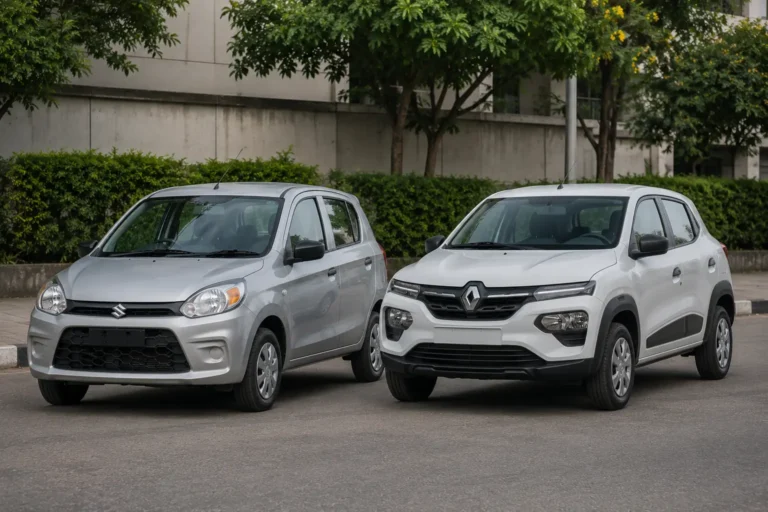
In 2026, the choice between the Maruti Alto K10 vs Renault Kwid comes down to priorities. The Alto K10 is the winner for those seeking the highest mileage, lowest maintenance, and best resale value. The Renault Kwid is superior for buyers who want SUV-inspired styling, more cabin space, and a better feature list. For most first-time Indian buyers, the Alto K10 remains the safer financial bet.

1. Alto K10 vs Renault Kwid: Quick Comparison at a Glance
| Feature | Maruti Alto K10 | Renault Kwid |
| Starting Price (Ex-Sh) | ~₹3.99 Lakh | ~₹4.70 Lakh |
| Real Mileage (City) | 18–20 kmpl | 16–18 kmpl |
| Engine | 1.0L K10C (67 PS) | 1.0L SCe (68 PS) |
| Maintenance | Lowest in India | Moderate |
| Boot Space | 214 Liters | 279 Liters |
| Ground Clearance | 160 mm | 184 mm |
| Safety Rating | 2-Star (Global NCAP) | 1-Star (Global NCAP) |
2. Price Comparison: Which is More Affordable?
In 2026, “under ₹5 Lakh” effectively refers to the ex-showroom price. Once you add RTO, insurance, and the mandatory safety kits, the on-road price for both will hover between ₹5.2 Lakh and ₹5.8 Lakh.
The Alto K10 is generally cheaper by ₹30,000 to ₹50,000 across comparable variants. Maruti also offers more frequent consumer discounts and a wider range of lower-spec variants, making it the most accessible new car in India today.
3. Engine & Performance Comparison

Both cars use 1.0-liter, 3-cylinder petrol engines, but they behave very differently in traffic.
- Maruti Alto K10: The K10C engine is a gem. It is refined, has excellent low-end “pep,” and feels very eager to move. In city traffic, you’ll find yourself shifting gears less often.
- Renault Kwid: The SCe engine has a slightly “rattly” idle and feels more labored when the AC is on full blast. However, once it gains momentum on the highway, it feels stable.
The Verdict: Maruti’s engine refinement and smooth AMT (Automatic) gearbox make it the easier car to drive in bumper-to-bumper traffic.
4. Mileage Comparison: Which Saves More Fuel?

For a budget buyer, mileage is the second EMI.
| Driving Condition | Alto K10 (Real World) | Renault Kwid (Real World) |
| City Traffic | 18.5 kmpl | 16.2 kmpl |
| Highway (80 kmph) | 23.0 kmpl | 20.5 kmpl |
| CNG Option | Yes (33.8 km/kg) | No |
The Alto K10 is significantly more fuel-efficient. If you drive 1,000 km a month, the Alto could save you roughly ₹1,200–₹1,500 every month on fuel alone compared to the Kwid.
Related: ARAI Mileage vs Real Mileage
5. Maruti Alto K10 vs Renault Kwid: Maintenance & Ownership Cost
This is where Maruti Suzuki pulls a massive lead.
- Service Network: You can find a Maruti mechanic in almost every village in India. Renault’s network is good in cities but sparse in rural areas.
- Spare Parts: Maruti parts are mass-produced and cheaper. A Kwid headlight or bumper will likely cost 20–30% more than an Alto’s.
- Resale Value: A 5-year-old Alto K10 will sell within 24 hours at a high price. The Kwid sees sharper depreciation.
Car ownership guide: True Total Cost of Car Ownership in India
6. Comfort & Space: Which is Better for Families?

If you frequently travel with four adults, the Renault Kwid is the clear winner.
- Cabin Width: The Kwid feels noticeably wider. Three people in the back is still tight, but it’s more manageable than the cramped rear of the Alto.
- Storage: The Kwid offers a 279-liter boot, which is massive for this segment. The Alto’s 214-liter boot is strictly for grocery bags and one small trolley.
- Ride Quality: The Kwid’s suspension is tuned for Indian potholes. It glides over broken roads better than the stiff-legged Alto.
7. Features Comparison: What Do You Get?

The Kwid has always punched above its weight in features.
- Kwid Highlights: 8-inch touchscreen, Android Auto/Apple CarPlay, fully digital instrument cluster, and a reverse parking camera in mid-trims.
- Alto K10 Highlights: 7-inch SmartPlay studio, steering-mounted controls, and a more basic but highly functional cabin.
The Kwid feels like a “modern car,” whereas the Alto feels like a “functional tool.”
Related Reading: Top Cheapest Cars in India Under ₹5 Lakh
8. Safety Comparison: Which is Safer?
Both cars meet mandatory Indian safety standards (Dual Airbags, ABS with EBD, and Rear Parking Sensors). However, they are lightweight vehicles.
- Structure: Neither is designed for high-speed highway crashes. They are city cars.
- Ground Clearance: The Kwid’s 184mm clearance is a safety feature in itself during the Indian monsoon, helping you navigate flooded streets where the Alto might stall.
9. City Driving & Practical Use

- Parking: The Alto K10 is narrower and easier to tuck into tiny spots.
- Visibility: The Kwid offers a more SUV-like “commanding” view, which is helpful for beginners to judge the car’s corners.
- Turning Radius: Both are excellent, but the Alto feels slightly more agile when making quick U-turns in narrow lanes.
10. Which Car Should You Buy?

Buy the Maruti Alto K10 if:
- You want the highest possible mileage.
- You are on a very tight budget for maintenance.
- You plan to sell the car in 3–4 years and want the best resale.
- This is your first car and you want a “fill it, shut it, forget it” experience.
Buy the Renault Kwid if:
- You love SUV styling and road presence.
- You often travel with a full family and need boot space.
- You want modern features like a large touchscreen.
- You live in an area with very poor roads or high speed breakers.
11. Pros & Cons of Maruti Alto K10 vs Renault Kwid
Maruti Alto K10
Pros: Excellent engine refinement, best-in-class mileage, vast service network.
Cons: Very narrow cabin, small boot, dated interior design.
Renault Kwid
Pros: Stunning SUV-like looks, class-leading ground clearance, spacious boot.
Cons: Engine is noisy/vibrates, lower resale value, expensive spares.
Common Questions Buyers Ask
Which is better: Alto K10 or Kwid?
For reliability and mileage, the Alto K10. For space and styling, the Renault Kwid.
Which car has better mileage?
The Maruti Alto K10 is the clear winner, especially with its S-CNG variant.
Is Kwid safer than Alto K10?
The Kwid has better ground clearance for bad roads, but both cars have low crash-test ratings (1-2 stars).
Which is best for first-time buyers?
The Alto K10 is generally recommended for its ease of driving and lower long-term financial risk.

Final Verdict
As an automotive journalist, my advice is simple: Calculate your usage.
If you are a city commuter looking to save every rupee on fuel and service, the Maruti Alto K10 is the smartest financial decision you will make. However, if you are a young buyer who wants a car that makes a statement and can handle the occasional weekend trip with luggage, the Renault Kwid offers a far more “complete” car experience.
Helpful Resources for Indian Car Buyers
- Bharat NCAP Official Website — India’s official crash-testing and vehicle safety rating platform. Includes adult and child occupant scores, crash-test protocols, and tested vehicle lists.
- Global NCAP – Safer Cars for India — Global crash-test program that pushed Indian manufacturers toward safer vehicle structures and occupant protection standards.
- Reserve Bank of India (RBI) — Official source for repo rates, lending rules, and banking regulations in India. (rbi.org.in)
- TransUnion CIBIL — Check your credit score and track your loan eligibility before applying for a car loan.
- SBI Car Loans — View latest interest rates, eligibility criteria, and loan offers from State Bank of India.
- HDFC Bank Car Loans — Explore car loan options, EMIs, and financing plans from HDFC Bank.
- ICICI Bank Car Loans — Compare new and used car loan offers along with repayment options.
- Policybazaar Car Insurance — Compare insurance plans, premiums, and add-on coverage options in one place.
- Acko Car Insurance — Get quick online quotes and renewal estimates for car insurance.
- AutomotiveZone Mileage Cost Calculator — Estimate real fuel costs based on your driving mileage.
- AutomotiveZone Monthly Car Expense Calculator — Calculate total monthly car ownership cost including EMI, fuel, and maintenance.
Disclaimer: Prices, mileage, safety ratings, loan rates, and ownership costs are approximate and may vary by location, variant, and market conditions in 2026. Some visuals may be AI-generated for illustration. Please verify final details with authorized dealers before purchase.
Quick Overview
In 2026, the sub-₹5 lakh car segment cheapest cars in India Under 5 lakh is dominated by the Maruti Suzuki Alto K10, Maruti S-Presso, and Renault Kwid. While inflation and safety norms have made these options rare, they remain the best for city commuting due to high mileage (up to 24 km/l) and low maintenance. If you prioritize resale and fuel economy, Maruti leads; for style and features, the Kwid is the top choice.
1. Why Cheapest Cars Are Becoming Rare in India
The dream of a “cheap” car is getting harder to reach in 2026. Stricter BS6 Phase 2 (and upcoming BS7) emission norms, along with mandatory safety features like dual airbags, ABS, and Electronic Stability Control (ESC), have pushed manufacturing costs significantly higher.
Furthermore, the Indian buyer’s obsession with SUVs has led manufacturers to focus on “Micro-SUVs” (like the Tata Punch or Hyundai Exter), leaving the entry-level hatchback segment with only a few survivors. Today, ₹5 lakh is effectively the “entry gate,” whereas it used to be the mid-segment budget.
2. Cheapest New Cars Available in India Under ₹5 Lakh

If you are looking for a brand-new car in 2026 with an ex-showroom price tag below ₹5 lakh, your choices are limited but highly specialized for urban life.
- Maruti Suzuki Alto K10: The undisputed mileage king. It’s narrow, peppy, and holds its value better than almost any asset in India.
- Maruti Suzuki S-Presso: A “tall-boy” hatchback that offers a high seating position and better ground clearance, making it easier for elderly passengers to enter and exit.
- Renault Kwid: The most “modern-looking” car in this bracket. It brings SUV-inspired styling to the entry-level segment and often offers better tech than its Maruti rivals.
3. Price Comparison Table (2026 Estimates)
| Car | Starting Price (Ex-Sh) | Engine | Fuel Type | Transmission | Claimed Mileage |
| Maruti Alto K10 | ₹3.99 Lakh | 1.0L K-Series | Petrol/CNG | MT/AMT | 24.39 km/l |
| Maruti S-Presso | ₹4.25 Lakh | 1.0L K-Series | Petrol/CNG | MT/AMT | 24.76 km/l |
| Renault Kwid | ₹4.70 Lakh | 1.0L SCe | Petrol | MT/AMT | 21.40 km/l |
Note: Prices vary by city. On-road prices typically add ₹60,000 to ₹90,000 for RTO, Insurance, and basic accessories.
4. Mileage Comparison: Which Cheap Car Saves the Most Fuel?

In 2026, with fuel prices staying stubbornly high, mileage is the primary “EMI” for most buyers.
- Real-World City Mileage: In cities like Bangalore or Mumbai, expect 17–19 km/l from the Maruti duo and about 15–16 km/l from the Kwid.
- CNG Practicality: Both the Alto and S-Presso come with factory-fitted S-CNG. If you drive more than 40 km a day, the CNG variants (returning 33+ km/kg) are the only way to keep running costs under ₹3 per km.
- The AC Impact: Small 1.0L engines feel the load of the AC. In peak Indian summers, expect a 10–15% drop in efficiency.
5. Real Ownership Costs Buyers Often Ignore
A budget car is about more than just the down payment. Here is the reality of your yearly outgoings:
- Service Costs: A Maruti service will cost you roughly ₹4,500 – ₹6,500 annually. Renault parts can be slightly more expensive, and their service network is less dense in Tier-3 cities.
- Insurance Renewals: Expect to pay ₹12,000 – ₹18,000 annually for comprehensive cover.
- Tyre Replacement: These cars use 13 or 14-inch tyres, which are the cheapest to replace (approx. ₹12,000 for a full set).
- Resale Value: A 5-year-old Alto K10 can still fetch you 60% of its original value, whereas the Kwid might see a sharper drop to 45–50%.
Related Reading: True total cost of car ownership
6. Which Cheap Car Offers the Best Value for Money?
- The Pragmatic Choice (Alto K10): It offers the best engine refinement and service peace of mind. It’s for the buyer who wants zero headaches.
- The Practical Choice (S-Presso): Best for families with seniors or those living in areas with bad roads/waterlogging, thanks to its 180mm ground clearance.
- The Aspirational Choice (Kwid): Best for young professionals or college students. It has an 8-inch touchscreen and a digital instrument cluster that feels much more “2026” than the Maruti cabins.
7. Features You Actually Get Under ₹5 Lakh

Don’t expect the world. In 2026, at this price point, you are paying for mobility, not luxury.
- What you get: Air conditioning, Power Steering, Digital Instrument Cluster, Dual Airbags, ABS with EBD, and Rear Parking Sensors.
- The Compromise: You will likely deal with manual rear windows, a lack of central locking on base trims, and very basic plastic quality.
- Sound Insulation: This is non-existent. You will hear the engine, the wind, and the traffic clearly inside the cabin.
8. Are Cheap Cars Still Good for City Driving?

Absolutely. This is where they thrive.
Their narrow tracks make them “lane-splitters” in car form. You can park an Alto in spots where a Creta or Harrier owner wouldn’t even dare to look. The light steering and short turning radius (4.5 meters) make them the ultimate tools for navigating narrow Indian galiyan (lanes).
9. Cheapest Automatic Cars in India

If you want an automatic (AMT) under ₹5 lakh, you are essentially looking at the Alto K10 VXi AMT or the S-Presso VXi AMT.
- Convenience: For beginners or office commuters in stop-go traffic, the AMT is a lifesaver.
- The Drawback: Budget AMTs are jerky. You will feel the “head-nod” during gear shifts. If you can handle a manual, it’s smoother and more fuel-efficient.
10. Which Budget Car Suits Different Buyers?

- First-Time Buyers: Alto K10. It is the easiest to learn on and has the most forgiving clutch.
- Small Families: S-Presso. The vertical space makes the cabin feel less claustrophobic than the Alto.
- Style-Conscious Buyers: Renault Kwid. It looks like a car from a segment above.
- Daily High-Mileage Commuters: Alto K10 S-CNG. The lowest running cost in India.
11. New Car vs. Used Car Under ₹5 Lakh

Should you buy a new Alto K10 or a 4-year-old Maruti Swift for the same ₹5 lakh?
- Choose New If: You want a full factory warranty, 0% chance of a hidden accident history, and the highest fuel efficiency.
- Choose Used If: you need more safety (sturdier build), a more powerful engine (1.2L vs 1.0L), and a more “status-driven” road presence.
12. Pros & Cons of Buying a Cheap Car in 2026
Pros
- Bulletproof Reliability: Engines that last 2 lakh+ km with basic care.
- Pocket-Friendly: Lowest insurance, service, and fuel bills.
- Agility: Best-in-class maneuverability.
Cons
- Safety Concerns: Lightweight build is not ideal for high-speed highways.
- NVH Levels: Noisy cabins at speeds above 80 km/h.
- Status: In a market moving toward SUVs, small hatchbacks are seen as “entry-level.”
Buyers favourite: ARAI Mileage vs Real Mileage
Common Questions Buyers Ask (FAQ)
Which is the cheapest car in India in 2026?
The Maruti Suzuki Alto K10 remains the most affordable mainstream car, starting at approximately ₹3.99 lakh (ex-showroom).
Which car gives the best mileage under ₹5 lakh?
The Maruti Alto K10 CNG is the winner, offering a claimed mileage of 33.85 km/kg. In petrol, it gives roughly 24 km/l.
Is Renault Kwid reliable?
Yes, Renault has refined the 1.0L engine over the years. However, its service network is not as vast as Maruti’s in rural India.
Are automatic cars available under ₹5 lakh?
Ex-showroom, yes. The Alto K10 VXi AMT sits right at the edge of the ₹5 lakh mark.
Can I get a safe car under ₹5 lakh?
In this budget, cars meet mandatory Indian safety standards but struggle in Global NCAP ratings. For better safety, you may need to stretch your budget to ₹7 lakh for a Tata Tiago.

Final Verdict: Are Cheap Cars Still Worth Buying in India?
In 2026, cheap cars are no longer “aspirational” purchases; they are high-utility tools.
If you are a city dweller looking for a car that is easy to park, costs almost nothing to run, and has a service center in every corner of the country, the Maruti Alto K10 or S-Presso are still worth every penny. However, if your usage involves frequent highway trips with family, the compromises in safety and power at this price point are significant. In that case, either look for a certified used car from a higher segment or stretch your budget to the ₹6.5 lakh range.
Note: Buy the Alto if you want a car that serves your wallet; buy the Kwid if you want a car that serves your personality.
Helpful Resources for Indian Car Buyers
- Bharat NCAP Official Website — India’s official crash-testing and vehicle safety rating platform. Includes adult and child occupant scores, crash-test protocols, and tested vehicle lists.
- TransUnion CIBIL — Check your credit score and track your loan eligibility before applying for a car loan.
- SBI Car Loans — View latest interest rates, eligibility criteria, and loan offers from State Bank of India.
- HDFC Bank Car Loans — Explore car loan options, EMIs, and financing plans from HDFC Bank.
- ICICI Bank Car Loans — Compare new and used car loan offers along with repayment options.
- AutomotiveZone Mileage Cost Calculator — Estimate real fuel costs based on your driving mileage.
- AutomotiveZone Monthly Car Expense Calculator — Calculate total monthly car ownership cost including EMI, fuel, and maintenance.
Disclaimer: Prices, mileage, safety ratings, loan rates, and ownership costs are approximate and may vary by location, variant, and market conditions in 2026. Some visuals may be AI-generated for illustration. Please verify final details with authorized dealers before purchase.
The Short Answer: Are Budget Cars Still Available?
As of May 2026, the list of new cars under ₹5 lakh (ex-showroom) has shrunk significantly due to stricter safety norms and rising material costs. The primary survivors are the Maruti Suzuki Alto K10, Maruti S-Presso, and Renault Kwid. While these models offer exceptional mileage and low maintenance, buyers should expect basic features and a budget-focused cabin experience.

Why Affordable Cars Are Disappearing in India
If you feel like the “common man’s car” is becoming an endangered species, you aren’t wrong. In 2020, you had a dozen options under ₹5 lakh; today, you can count them on one hand.
The shift is driven by three main factors:
- Regulatory Pressure: Transitioning to BS6 Phase 2 and now the early stages of BS7/WLTP readiness has made small engines more expensive to produce.
- Safety Mandates: Features that were once “premium”—like Electronic Stability Program (ESP), Hill Hold, and dual airbags—are now mandatory, pushing entry-level prices upward.
- The SUV Craze: Indian buyers are increasingly skipping the “basic hatchback” phase, moving straight to micro-SUVs like the Tata Punch or Hyundai Exter, which has led manufacturers to discontinue their cheapest models.
Which New Cars Are Still Available Under ₹5 Lakh?

In the current market, “under ₹5 lakh” almost exclusively refers to the ex-showroom price. Once you factor in RTO, insurance, and the now-essential high-security plates, the on-road price for most of these will hover between ₹5.2 lakh and ₹6 lakh.

1. Maruti Suzuki Alto K10 (₹3.70 – ₹5.45 Lakh)
The Alto remains the undisputed champion of the budget segment. In 2026, it is no longer the bare-bones vehicle of the past.
- The Engine: It uses the peppy 1.0-litre K10C DualJet engine, which is remarkably refined for its size.
- Who it’s for: First-time buyers who want zero mechanical headaches and the strongest resale value in the country.
2. Maruti Suzuki S-Presso (₹3.50 – ₹5.25 Lakh)
Often called a “micro-SUV” by Maruti, the S-Presso offers a tall-boy design that is far more practical for elderly passengers.
- The Advantage: High ground clearance (180mm) makes it surprisingly capable on broken rural roads and monsoon-flooded city streets.
- Who it’s for: Tall drivers or those who prefer a high seating position for better visibility in traffic.
3. Renault Kwid (₹4.30 – ₹5.99 Lakh)
The Kwid is arguably the best-looking car in this price bracket. Renault has kept it fresh with frequent “Anniversary Editions” and dual-tone paint schemes.
- The Tech: Even in lower trims, the Kwid often feels more “digital” than the Maruti duo, featuring a better-looking instrument cluster.
- Who it’s for: Buyers who want a budget car that doesn’t look like a budget car.

Real-World Ownership Costs: Beyond the Showroom
Buying a budget car is a financial decision, but owning one is a lifestyle commitment. In 2026, the cost of ownership remains the primary reason to stay in this segment.
| Model | Annual Maintenance (Yrs 1-5) | Real-World Mileage (City) |
| Maruti Alto K10 | ₹12,000 – ₹16,000 | 20-22 kmpl |
| Maruti S-Presso | ₹12,000 – ₹16,000 | 19-21 kmpl |
| Renault Kwid | ₹14,000 – ₹18,000 | 17-19 kmpl |
Expert Insight: Maruti’s spare parts ecosystem is unrivaled. You can find “Maruti Genuine Parts” in almost every taluka in India, which keeps long-term repair costs significantly lower than rivals.
Features vs. Compromises: What to Expect

In 2026, a ₹5 lakh car is a study in compromise. Here is what you get—and what you definitely don’t.
- What You Get: Air conditioning (effective but saps engine power), power steering, front power windows (usually in mid-trims), and basic safety kit (ABS with EBD, rear parking sensors).
- The Compromises: You will notice thin door pads, a lack of sound insulation (the cabin gets noisy at 80 km/h), and manual adjustments for side mirrors. In most base variants, you won’t even find a basic music system.
Are Budget Cars Still Safe Enough?
Safety is the biggest point of contention. While these cars meet the minimum legal requirements in India, their crash test ratings tell a different story.
- Maruti Alto K10: Holds a 2-star Global NCAP rating (as of the last major test).
- Renault Kwid: Has historically struggled with structural stability in high-speed impacts.
- The 2026 Reality: Most manufacturers have now added 6 airbags as an option, but the “base” variants under ₹5 lakh typically stick to two. These cars are excellent for city commutes (40-60 km/h) but are not recommended for frequent high-speed highway travel.
New Car vs. Used Car: The ₹5 Lakh Dilemma

If you have ₹5 lakh in your pocket, you face a tough choice: A brand-new Alto K10 or a 4-year-old Maruti Swift?
- Choose New If: You want a full factory warranty, 20+ kmpl mileage, and the peace of mind that no one else has “abused” the engine. It’s the safer bet for people who don’t know much about car mechanics.
- Choose Used If: You need more space, better safety (sturdier build), and a “big car” feel. A used Tiago or Baleno at ₹5 lakh will offer more features but will come with higher maintenance and lower fuel efficiency.
Common Questions Budget Car Buyers Ask
Which is the cheapest new car in India in 2026?
The Maruti Suzuki S-Presso and Alto K10 are currently the most affordable, with ex-showroom prices starting around ₹3.50 lakh to ₹3.70 lakh.
Is Alto K10 worth buying in 2026?
Yes, if your primary usage is city commuting and you want the lowest possible running costs. It is the gold standard for “A-to-B” transport in India.
Can I buy an automatic car under ₹5 lakh?
It’s nearly impossible to get an AMT (Automatic) on-road under ₹5 lakh. The ex-showroom price for the Alto K10 VXi AMT is around ₹4.95 lakh, pushing the on-road price closer to ₹5.6 lakh.
Which budget car has the lowest maintenance?
The Maruti Suzuki Alto K10 has the lowest maintenance cost in India, with scheduled services averaging between ₹4,000 and ₹6,000.

Final Verdict: Is it Still Worth Buying?
In 2026, a car under ₹5 lakh is a utility tool, not a status symbol. If you are a first-time buyer or someone looking for a second car purely for city errands, these cars are financially unbeatable. They offer the lowest “cost per kilometer” of any four-wheeler on the market.
However, if you plan to do frequent highway trips with family, we strongly recommend stretching your budget by ₹1.5 lakh to enter the territory of the Tata Tiago or Maruti Swift. The jump in safety and comfort is far greater than the jump in price.
Expert Takeaway: Go for the Alto if you want a car that works for you; go for the Kwid if you want a car that looks good for you.
Also Read: Best Cars Under ₹5 Lakh in India (2026 Edition): Top Budget Picks

Helpful Resources for Indian Car Buyers
- Bharat NCAP Official Website — India’s official crash-testing and vehicle safety rating platform. Includes adult and child occupant scores, crash-test protocols, and tested vehicle lists.
- TransUnion CIBIL — Check your credit score and track your loan eligibility before applying for a car loan.
- SBI Car Loans — View latest interest rates, eligibility criteria, and loan offers from State Bank of India.
- HDFC Bank Car Loans — Explore car loan options, EMIs, and financing plans from HDFC Bank.
- ICICI Bank Car Loans — Compare new and used car loan offers along with repayment options.
- AutomotiveZone Mileage Cost Calculator — Estimate real fuel costs based on your driving mileage.
- AutomotiveZone Monthly Car Expense Calculator — Calculate total monthly car ownership cost including EMI, fuel, and maintenance.
Disclaimer: Prices, mileage, safety ratings, loan rates, and ownership costs are approximate and may vary by location, variant, and market conditions in 2026. Some visuals may be AI-generated for illustration. Please verify final details with authorized dealers before purchase.
What You Need to Know (At a Glance)
Finding a new car under ₹5 lakh on-road in 2026 is extremely challenging due to rising input costs and safety norms. Most options are limited to entry-level variants of the Maruti Alto K10, Renault Kwid, and Maruti S-Presso. For a practical first-time purchase, buyers should expect a basic, fuel-efficient vehicle focused on city mobility.
Best Cars Under ₹5 Lakh in India (2026 Edition): Top Budget Picks for First-Time Buyers
Let’s be honest: the dream of owning a “cheap” car in India is getting harder to chase. In 2026, the ₹5 lakh price point—once the heart of the Indian car market—is now the “entry gate.” Between rising inflation and stricter government safety mandates, the options under this bracket have shrunk significantly.
Most first-time buyers today don’t struggle with choosing a car; they struggle with the on-road reality of their budget. If you have a hard limit of ₹5 lakh, you aren’t looking for a luxury suite on wheels; you’re looking for reliable, fuel-efficient, and easy-to-drive mobility. Here is the ground reality of what you can actually buy this year.
1. Why Cars Under ₹5 Lakh Are Becoming Rare in India
If you feel like cars have become twice as expensive in the last few years, you’re not wrong.
- Stricter Norms: Every car now needs mandatory safety features like dual airbags, ABS, and EBD, plus cleaner engines (BS6 Phase 2 and beyond).
- Manufacturing Costs: Steel and electronics prices have pushed ex-showroom tags higher.
- Shift in Focus: Most Indian buyers are moving toward the ₹6–₹8 lakh range for “Premium Hatchbacks,” leaving the entry-level segment with very few players.
Also Worth Reading: Best Cars Under ₹10 Lakh in India (2026 Edition)
2. What You Actually Get Under ₹5 Lakh in 2026

When you walk into a dealership with this budget today, you need to manage your expectations. A car under ₹5 lakh is a “Point A to Point B” machine.
- Features: You will likely get manual air conditioning, power steering (mostly), and an instrument cluster. Don’t expect touchscreens, alloy wheels, or automatic climate control.
- Performance: These cars typically feature 800cc to 1.0L engines optimized for city traffic and maximum mileage, not high-speed highway cruising.
- The “On-Road” Trap: A car with an ex-showroom price of ₹4.3 lakh will easily cross ₹5 lakh once you add RTO, Insurance, and basic accessories.
3. Best Cars Under ₹5 Lakh in India (2026)

Maruti Suzuki Alto K10
The undisputed king of the budget segment. It remains the most affordable mainstream car in India.
- Why it works: It’s narrow enough for the tightest lanes, gives incredible mileage, and has the strongest resale value.
- Running Cost: Expect nearly 20–22 km/l in real-world city conditions.
Renault Kwid
If you want a car that doesn’t “look” cheap, the Kwid is your best bet.
- Why it works: It has an SUV-inspired stance and better ground clearance than the Alto. It handles bad city roads surprisingly well for a small car.
- Inside: The cabin feels slightly more modern compared to its direct rivals.
Maruti Suzuki S-Presso
Maruti calls it a “Mini SUV,” but it’s essentially a tall-boy hatchback.
- Why it works: The high seating position is a godsend for beginners. You get a clear view of the bonnet, which makes parking and navigating traffic much easier.
- Practicality: It’s easier for elderly parents to get in and out of compared to the low-slung Alto.
4. Real Cost Breakdown: On-Road Price Reality
Most websites list “Ex-Showroom” prices. For a first-time buyer, that number is a lie. Here is what a typical entry-level car costs when you actually drive it home:
| Cost Component | Estimated Amount (Base Variant) |
| Ex-Showroom Price | ₹4,20,000 |
| RTO & Registration | ₹38,000 |
| Insurance (1 Yr Comprehensive + 3 Yr TP) | ₹24,000 |
| Basic Accessories (Mats, Covers, etc.) | ₹12,000 |
| Final On-Road Price | ₹4,94,000 |
Pro Tip: Dealerships often force “Handling Charges” or expensive accessory kits. You can negotiate these down or buy accessories outside to keep the cost under your 5-lakh ceiling.
Car Buying Guide: Hatchback vs Compact SUV – Which Should You Buy?
5. Mileage and Running Cost Expectations

In the budget segment, mileage is the second EMI.
In 2026, with petrol prices staying high, these cars are the only ones that keep your daily commute under ₹5 per kilometer.
- City Driving: 16–18 km/l.
- Highway Driving: 22–24 km/l.
- CNG Factor: While Maruti offers S-Presso and Alto in CNG, the “On-Road” price of a CNG variant will almost certainly cross ₹6 lakh. If you want to stay under 5L, you are strictly in Petrol territory.
6. Maintenance and Ownership Cost
The biggest advantage of buying an Alto or a Kwid is the “Peace of Mind” factor.
- Service Cost: A standard annual service at Maruti or Renault will cost you between ₹4,000 and ₹6,000.
- Spare Parts: Since these cars are made in massive volumes, spare parts are cheap and available at every local garage, not just official centers.
- Insurance Renewals: Being budget cars, your annual insurance renewal will be roughly ₹8,000–₹12,000, which is very manageable.
7. Safety Reality in ₹5 Lakh Cars
Let’s be investigate: safety in this segment is basic.
- The Equipment: You get dual airbags, ABS, and rear parking sensors because they are mandatory by law.
- The Structure: These cars are lightweight to maximize mileage. They are excellent for city speeds (40–60 km/h) but are not recommended for high-speed highway travel.
- The Choice: If safety is your #1 priority, you may need to look at the used car market for a sturdier hatchback like a 3-year-old Tata Tiago.
Safety Insight: Safest Cars Under ₹10 Lakh in India (2026 List)
8. Should You Buy Under ₹5 Lakh or Stretch?

Stay Under ₹5 Lakh If:
- This is purely a learning car for 1-2 years.
- You only drive in city traffic to the office or market.
- You are an individual or a small family of two.
Stretch to ₹6–₹7 Lakh If:
- You want a car that can handle highway trips safely.
- You want features like a music system, central locking, and power windows.
- You plan to keep the car for more than 5 years. (Cars like the Maruti Celerio or Tata Tiago offer much more value here).
9. Hidden Truth: Used Cars vs. ₹5 Lakh New Cars
Under ₹5 lakh, a used car often looks tempting.
- Used Car: You could get a 5-year-old Maruti Swift or a Hyundai Grand i10. More features, more power, better “status.”
- New Car: You get a 2-year warranty, that “new car smell,” and 0% chance of hidden mechanical failures from a previous owner.
- The Verdict: For a first-time buyer with no mechanical knowledge, stay with a new car. The reliability of a new Alto K10 beats the “gamble” of a used Swift any day.
What People Ask Before Buying
Which is the best car under ₹5 lakh in India?
The Maruti Suzuki Alto K10 remains the best overall pick for its reliability, massive service network, and incredible fuel efficiency.
Is ₹5 lakh enough to buy a car in 2026?
It is enough for the base variants of entry-level hatchbacks. However, you should ideally have a budget of ₹5.5 lakh to cover registration, insurance, and basic accessories comfortably.
Which car is cheapest to maintain in India?
Maruti Suzuki cars (Alto, S-Presso) have the lowest maintenance costs and the cheapest spare parts in the country.
Should I buy a new or used car under ₹5 lakh?
If you want zero headaches and a warranty, buy a new Alto K10. If you want more space and features, a used WagonR or Celerio is a good alternative.
Which car gives the best mileage under ₹5 lakh?
The Maruti Alto K10 typically delivers the best mileage, often exceeding 24 km/l on highways.
Final Word for Buyers
In 2026, a ₹5 lakh budget is about practicality over pride. Don’t chase fancy features; chase a car that starts every morning, fits in every parking spot, and doesn’t burn a hole in your pocket at the fuel pump. If you can stretch your budget by even ₹50,000, the world of the Maruti Celerio or Tata Tiago opens up—but if not, the Alto K10 is still a “First Car” you can be proud of.
Practical Insight: Don’t let the “basic” feel of these cars discourage you. Every car enthusiast in India likely started their journey in an entry-level hatchback. It’s not about how fast it goes, but where it takes you!
Helpful Resources for Indian Car Buyers
- Bharat NCAP Official Website — India’s official crash-testing and vehicle safety rating platform. Includes adult and child occupant scores, crash-test protocols, and tested vehicle lists.
- TransUnion CIBIL — Check your credit score and track your loan eligibility before applying for a car loan.
- SBI Car Loans — View latest interest rates, eligibility criteria, and loan offers from State Bank of India.
- HDFC Bank Car Loans — Explore car loan options, EMIs, and financing plans from HDFC Bank.
- ICICI Bank Car Loans — Compare new and used car loan offers along with repayment options.
- AutomotiveZone Mileage Cost Calculator — Estimate real fuel costs based on your driving mileage.
- AutomotiveZone Monthly Car Expense Calculator — Calculate total monthly car ownership cost including EMI, fuel, and maintenance.
Disclaimer: Prices, mileage, safety ratings, loan rates, and ownership costs are approximate and may vary by location, variant, and market conditions in 2026. Some visuals may be AI-generated for illustration. Please verify final details with authorized dealers before purchase.
Quick Reality Check (The 2026 Truth)
The showroom price of a car is just the tip of the iceberg. In India, a car with a ₹9 lakh ex-showroom price can realistically cost you ₹14 lakh to ₹16 lakh over 5 years once you factor in loan interest, insurance renewals, fuel, and the silent wealth-killer: depreciation.
Hidden Costs of Buying Cars Under ₹10 Lakh: EMI, Insurance & Maintenance Breakdown
You’ve done the research, visited the showroom, and finally found the perfect car for ₹8.5 lakh. The salesperson tells you the EMI is “just ₹14,000.” It sounds affordable, right?
But here is the reality most dealers don’t explain clearly: Buying a car is an event; owning a car is a recurring expense. For most middle-class Indian families, the “hidden” costs of car ownership can eat up 20% more of their monthly income than they originally planned. Let’s break down where your money actually goes.
1. Why Budget Car Buyers Often Underestimate Ownership Costs
Showrooms are designed to sell you an emotion, not a financial plan. Dealers often highlight the lowest possible EMI based on a 7-year tenure to make a car seem affordable.
The excitement of a new car often blinds first-time buyers to the long-term math. They budget for the car purchase but completely forget to budget for the life of the car. In the ₹10 lakh segment, these “forgotten” costs can add up to the price of a second small car over a decade.
2. The Real On-Road Price Shock
The “Ex-Showroom” price is a marketing number. The “On-Road” price is the reality. Between the two lies a gap of roughly 15% to 20%.
| Cost Component | Estimated Amount (for ₹8.5L Car) |
| Ex-showroom Price | ₹8,50,000 |
| RTO / Registration Charges | ₹85,000 |
| Insurance (1st Year) | ₹42,000 |
| Fastag / Handling / Documentation | ₹12,000 |
| Essential Accessories Pack | ₹18,000 |
| Extended Warranty | ₹12,000 |
| Final On-Road Price | ₹10,19,000 |
The Hidden Trap: Dealers often push “Handling Charges,” which the Supreme Court of India has deemed illegal. Always ask for a detailed breakup and negotiate these “hidden” fees.
3. EMI Reality: The Bank Owns Your Car First

Many buyers opt for a 7-year (84 months) loan to keep the EMI low. While this helps your monthly cash flow, it is a massive hidden cost.
The ₹9 Lakh Loan Trap (at 9.5% Interest):
- 5-Year Tenure: EMI is ~₹18,900. Total interest paid: ₹2.3 Lakh.
- 7-Year Tenure: EMI is ~₹14,700. Total interest paid: ₹3.3 Lakh.
By stretching your loan to 7 years just to “afford” the car, you are handing an extra ₹1 Lakh in pure profit to the bank.
4. Insurance Costs Nobody Talks About
Your first year of insurance is usually bundled into the on-road price. But from Year 2 onwards, it’s a direct hit to your savings.
- The Renewal Shock: As your car ages, you might think insurance gets cheaper. However, while the “Own Damage” premium drops, “Third-Party” rates are hiked by the government almost every year.
- Zero-Depreciation: If you want full protection (highly recommended in India), a Zero-Dep add-on can cost you ₹5,000–₹10,000 extra per year.
Buyer’s Guide: Safety-Rated Cars Under ₹10 Lakh: Best 5-Star Options in India
5. Fuel Cost: The Biggest Long-Term Expense

Fuel is your “second EMI.” For a car driven 1,000 km a month in a city like Bangalore or Delhi, the numbers are eye-opening.
- Petrol Reality: At ₹102/L and a real-world mileage of 14 km/l, you spend ₹7,200/month.
- CNG Reality: At ₹85/kg and a mileage of 22 km/kg, you spend ₹3,800/month.
Over 5 years, the petrol driver spends ₹4.3 Lakh, while the CNG driver spends ₹2.3 Lakh. If you chose petrol without doing the math, you just “lost” ₹2 Lakh.
Fuel Cost Comparison: Petrol vs CNG Cars Under ₹10 Lakh: Which Saves More Money?
6. Maintenance & Service Costs: The Hidden Annual Hit

“Free services” aren’t actually free. They only cover labor; you still pay for oil, filters, and consumables.
- Consumables: A standard service for a Tata or Maruti car will cost between ₹6,000 and ₹10,000 annually.
- The 40,000 km Wall: This is when “major” expenses hit. You’ll likely need a new set of tires (₹20,000) and a new battery (₹6,000).
- Brake Pads: In heavy city traffic (Mumbai/Bangalore), brake pads wear out every 15,000 km, costing about ₹3,000–₹5,000.
7. Depreciation: The Biggest Invisible Loss
Depreciation is the money you lose while you sleep. A car is not an investment; it is a depreciating asset.
- Year 1: Your car loses 15–20% of its value the moment you drive it home.
- Year 5: A ₹10 lakh car is typically worth only ₹5.5 lakh to ₹6 lakh.
Most owners ignore this because it’s not a monthly “bill,” but when you go to sell your car, that ₹4 lakh loss is a real hit to your net worth.
8. What Is the Real 5-Year Cost of a ₹10 Lakh Car?
Let’s look at the Total Economic Cost of owning a typical ₹9 lakh (On-Road) petrol car over 5 years:
| Expense Category | 5-Year Total Cost |
| Initial Down Payment | ₹2,00,000 |
| Loan Repayment (EMI + Interest) | ₹9,50,000 |
| Fuel (1,000 km/mo) | ₹4,30,000 |
| Insurance Renewals | ₹1,20,000 |
| Maintenance & Tires | ₹70,000 |
| TOTAL OUTFLOW | ₹17,70,000 |
Even after you subtract the resale value (~₹5.5 lakh), you have “consumed” over ₹12 lakh to own that ₹9 lakh car.
9. How Buyers Can Reduce Ownership Costs
You don’t have to go broke to own a car. Follow these simple rules:
- The 20/4/10 Rule: Pay 20% down, keep the loan to 4 years, and ensure total car costs don’t exceed 10% of your monthly income.
- Say No to “Teflon/Ceramic”: Dealers make huge margins on coatings. Most new cars don’t need them immediately.
- Compare Insurance Online: Never renew through the dealer. Use portals like PolicyBazaar to save up to 30%.
- Maintain Tire Pressure: Low pressure drops mileage by 5–10%. It’s the easiest way to save fuel money.
Common Buyer Questions About Car Ownership Costs
What is the real cost of owning a car in India?
The real cost includes the EMI, fuel, insurance, maintenance, and depreciation. For a ₹10 lakh car, expect a total monthly outflow of ₹25,000 to ₹32,000.
Is EMI the biggest expense in car ownership?
While EMI is the most visible, fuel and depreciation often cost more than the interest paid on a loan over a 5-year period.
Which cars have the lowest maintenance cost in India?
Maruti Suzuki and Hyundai typically have the most affordable and widely available service networks, leading to lower long-term maintenance costs.
How much should I budget monthly for a car?
A safe budget is roughly 1.5 to 1.8 times your EMI. If your EMI is ₹15,000, ensure you have at least ₹25,000 available for fuel and maintenance.
Which car has the best resale value in India?
Maruti Suzuki hatchbacks (like the Baleno/Swift) and Toyota models generally hold their value best in the Indian used car market.

Final Thoughts
A car is a symbol of freedom, but it shouldn’t become a financial cage. By understanding these hidden costs before you sign the papers, you can choose a car that fits your life, not just your dreams.
Calculate your 5-year TCO (Total Cost of Ownership) today, and drive with peace of mind tomorrow!
Helpful Resources for Indian Car Buyers
- Bharat NCAP Official Website — India’s official crash-testing and vehicle safety rating platform. Includes adult and child occupant scores, crash-test protocols, and tested vehicle lists.
- Global NCAP – Safer Cars for India — Global crash-test program that pushed Indian manufacturers toward safer vehicle structures and occupant protection standards.
- Reserve Bank of India (RBI) — Official source for repo rates, lending rules, and banking regulations in India. (rbi.org.in)
- TransUnion CIBIL — Check your credit score and track your loan eligibility before applying for a car loan.
- SBI Car Loans — View latest interest rates, eligibility criteria, and loan offers from State Bank of India.
- HDFC Bank Car Loans — Explore car loan options, EMIs, and financing plans from HDFC Bank.
- ICICI Bank Car Loans — Compare new and used car loan offers along with repayment options.
- Policybazaar Car Insurance — Compare insurance plans, premiums, and add-on coverage options in one place.
- Acko Car Insurance — Get quick online quotes and renewal estimates for car insurance.
- AutomotiveZone Mileage Cost Calculator — Estimate real fuel costs based on your driving mileage.
- AutomotiveZone Monthly Car Expense Calculator — Calculate total monthly car ownership cost including EMI, fuel, and maintenance.
Disclaimer: Prices, mileage, safety ratings, loan rates, and ownership costs are approximate and may vary by location, variant, and market conditions in 2026. Some visuals may be AI-generated for illustration. Please verify final details with authorized dealers before purchase.
If you are standing in a car showroom in India today, you are likely facing the “Dual Fuel” dilemma. With petrol prices staying stubbornly high and the ₹10 lakh budget being the most competitive segment, the choice between Petrol and CNG has never been harder.
Most buyers look at the sticker price and mileage figures, but the real financial difference appears over 5 years of ownership. Should you pay extra for a factory-fitted CNG variant, or stick with the smoother refinement of petrol?
If you’re also exploring the best cars under ₹10 lakh in India, this guide will help you understand which fuel type actually saves more money long-term.
Quick Verdict: Which Fuel Type Saves More Money?
In 2026, CNG cars remain the cheapest cars to run in India, delivering an average running cost of roughly ₹3.2–₹3.8 per km.
However, petrol cars still make more sense for:
- Low monthly running
- Frequent highway trips
- Buyers prioritizing refinement and convenience
For heavy city commuters, CNG savings can exceed ₹30,000 annually.
Why More Indians Are Choosing CNG Cars in 2026
The biggest reason is simple: fuel prices.
For middle-class Indian families, daily commuting costs have become a serious monthly expense.
What Changed Recently?
- Petrol prices remain close to ₹100/litre in many cities
- CNG infrastructure has expanded rapidly
- Factory-fitted CNG technology is now far more refined
- Twin-cylinder setups improved boot space practicality
CNG cars are no longer seen as “taxi cars.” They’ve become mainstream family vehicles.
If fuel efficiency is your top priority, also read: Most Fuel-Efficient Cars Under ₹10 Lakh in India (2026)
Petrol vs CNG Running Cost: Real India Numbers
Brochure mileage and real-world mileage are completely different things.

Indian traffic, AC usage, and stop-go driving reduce efficiency significantly.
Here’s what owners are realistically seeing in 2026:
| Fuel Type | Real Mileage | Average Fuel Price | Running Cost |
|---|---|---|---|
| Petrol | 15–17 km/l | ₹98–₹102/l | ₹5.8–₹6.5/km |
| CNG | 22–25 km/kg | ₹82–₹88/kg | ₹3.3–₹3.9/km |
What Does This Mean?
A CNG car can save approximately:
- ₹2.5–₹3 per km
- ₹2,500–₹3,500 every month for heavy users
- More than ₹1.5 lakh over 5 years
That’s a major difference for budget-conscious buyers.
Best Petrol Cars Under ₹10 Lakh for Lower Running Costs

Petrol still makes perfect sense for many Indian buyers.
Maruti Suzuki Swift
- Excellent fuel efficiency
- Smooth lightweight driving feel
- Better highway refinement
Hyundai Grand i10 Nios
- One of the smoothest petrol engines in the segment
- Ideal city hatchback
- Easy maintenance
Tata Punch Petrol
- SUV stance with strong safety
- Better for lower annual running
- Good urban practicality
If safety matters equally to you, check out: Safest Cars Under ₹10 Lakh in India (2026)
Why Petrol Still Works Well
Petrol cars are better for:
- Under 800–1000 km monthly usage
- Highway-focused driving
- Buyers avoiding CNG queues
- Drivers wanting smoother performance
Best CNG Cars Under ₹10 Lakh for Maximum Savings
For pure cost savings, CNG dominates.
Maruti WagonR CNG
- Lowest running cost in India
- Proven reliability
- Excellent resale value
Tata Tiago iCNG
- Twin-cylinder technology improves luggage space
- Better design and cabin feel
- Strong safety reputation
Maruti Dzire CNG
- Excellent family sedan
- Massive fuel savings
- Improved 5-star safety image
Why Factory-Fitted CNG Matters
Modern factory-fitted CNG cars are:
- Safer
- More reliable
- Better calibrated
- Covered under manufacturer warranty
Avoid aftermarket kits whenever possible.
Real Monthly Fuel Cost Comparison (1000 km/Month Example)
Let’s use a realistic middle-class commuting example.
Petrol Car Example
- Mileage: 16 km/l
- Petrol Price: ₹100/l
- Monthly Fuel Needed: ~62 litres
- Monthly Cost: ~₹6,200
CNG Car Example
- Mileage: 25 km/kg
- CNG Price: ₹85/kg
- Monthly Fuel Needed: ~40 kg
- Monthly Cost: ~₹3,400
Total Savings
| Period | Estimated Savings with CNG |
|---|---|
| Monthly | ₹2,800+ |
| Yearly | ₹33,000+ |
| 5 Years | ₹1.6 lakh+ |
For heavy city commuters, the math becomes very difficult to ignore.
Petrol vs CNG Maintenance: The Hidden Truth
A lot of buyers worry that CNG cars are expensive to maintain.
The reality is more balanced.
Petrol Cars
Advantages:
- Simpler servicing
- Better engine refinement
- Lower maintenance complexity
CNG Cars
Challenges:
- Slightly more service checks
- Spark plug wear
- Reduced boot space in some models
- Small power drop
However, modern factory-fitted CNG systems are dramatically better than older setups.
The maintenance difference is usually minor compared to the fuel savings.
City Commuters vs Highway Drivers: Which Fuel Type Makes More Sense?

Your usage pattern matters more than internet opinions.
CNG Makes More Sense For:
- Office commuting
- Daily city traffic
- High monthly running
- Cab/fleet-style usage
Petrol Makes More Sense For:
- Frequent highway trips
- Remote travel
- Performance-focused driving
- Buyers wanting hassle-free refueling
The Reality of CNG Queues
One hidden downside still exists:
- Long waiting lines at some pumps
- Limited highway availability
- Refueling inconvenience during rush hours
If practicality matters more than savings, petrol remains easier to live with.
Still deciding between hatchbacks and SUVs? Read: Hatchback vs Compact SUV Under ₹10 Lakh
What About Resale Value?
Factory-fitted CNG cars now have excellent resale demand.
Especially:
Why?
Because used-car buyers also want lower fuel expenses.
Important Warning
Aftermarket CNG kits can:
- Reduce resale value
- Create reliability concerns
- Raise safety questions
Factory-fitted options remain the safest choice.
Common Questions Buyers Ask
Which is cheaper to run: petrol or CNG?
CNG is significantly cheaper, costing roughly ₹3.5/km compared to petrol’s ₹6/km average.
Is CNG safe in modern cars?
Yes. Factory-fitted CNG systems now include advanced leak detection and safety shutoff mechanisms.
Does CNG reduce engine life?
Not significantly, provided servicing is done properly and on schedule.
Which fuel type gives better resale value?
Factory-fitted Maruti CNG cars currently have some of the strongest resale demand in India.
Is CNG practical for highway travel?
It’s improving, but petrol still offers better convenience and stronger highway performance.

Final Verdict: Petrol or CNG in 2026?
The answer depends entirely on your monthly driving pattern.
Choose Petrol If:
- You drive under 1,000 km/month
- You travel frequently on highways
- You value convenience and refinement
Choose CNG If:
- You drive daily in city traffic
- Fuel savings matter most
- Your running exceeds 1,200–1,500 km/month
For Indian city commuters, CNG has become one of the easiest ways to reduce monthly expenses without switching to an EV.
But for occasional users, petrol still offers the smoother and simpler ownership experience.
Before buying, calculate:
- Your monthly running
- Fuel availability in your area
- Long-term ownership plans
That simple math will usually reveal the right answer faster than any showroom sales pitch.
Helpful Resources for Indian Car Buyers
- Bharat NCAP Official Website — India’s official crash-testing and vehicle safety rating platform. Includes adult and child occupant scores, crash-test protocols, and tested vehicle lists.
- Global NCAP – Safer Cars for India — Global crash-test program that pushed Indian manufacturers toward safer vehicle structures and occupant protection standards.
- Reserve Bank of India (RBI) — Official source for repo rates, lending rules, and banking regulations in India. (rbi.org.in)
- TransUnion CIBIL — Check your credit score and track your loan eligibility before applying for a car loan.
- SBI Car Loans — View latest interest rates, eligibility criteria, and loan offers from State Bank of India.
- HDFC Bank Car Loans — Explore car loan options, EMIs, and financing plans from HDFC Bank.
- ICICI Bank Car Loans — Compare new and used car loan offers along with repayment options.
- Policybazaar Car Insurance — Compare insurance plans, premiums, and add-on coverage options in one place.
- Acko Car Insurance — Get quick online quotes and renewal estimates for car insurance.
- AutomotiveZone Mileage Cost Calculator — Estimate real fuel costs based on your driving mileage.
- AutomotiveZone Monthly Car Expense Calculator — Calculate total monthly car ownership cost including EMI, fuel, and maintenance.
Disclaimer: Prices, mileage, safety ratings, loan rates, and ownership costs are approximate and may vary by location, variant, and market conditions in 2026. Some visuals may be AI-generated for illustration. Please verify final details with authorized dealers before purchase.
Trending Now 🔥
View All →
EV
EV
MG Windsor EV Price Guide 2026: Real-World Range, Running Cost, Features & Is It Worth Buying?
EV
Tata Nexon EV Price Guide 2026: Range, Specs & Running Costs
EV
Tata EV Price Guide 2026: Tata Punch EV Price & Cost Analysis
Comparisons
Petrol vs CNG Cars Under ₹5 Lakh: 2026 Running Cost Comparison
Comparisons
Hatchback vs Sedan Under ₹5 Lakh: Real Comparison 2026
Expert Reviews ⭐️
Read All Reviews →Latest Bikes ⭐️
View All Bikes →
Expert Rating: 4.5/5
Bajaj Avenger 400: Expected Price, Launch Date, Specs & Cruiser Review
Expert Rating: 4.5/5
Yamaha R15 Review: Performance, Mileage, Features & Real-World Riding Experience
Expert Rating: 4.5/5
Bajaj Pulsar NS200 Review: Performance, Mileage, Features & Riding Experience
Expert Rating: 4.5/5
Royal Enfield Classic 350: Mileage, Comfort, Features & Real-World Riding Experience
Cars Under ₹10 Lakh 💰
View All Options →Cars Under ₹5 Lakh 💰
View All Options →Bikes Under ₹1 Lakh 💰
View All Options →Head-to-Head Comparisons 🥊
See All Comparisons →Automotive Tools 🛠️
EMI Calculator
Calculate your monthly car or bike loan EMI.
Mileage Calculator
Find out the exact running cost of your vehicle.
Car Resale Value
Get the exact car resale value.
Fuel Cost Calculator
Estimate fuel expenses for your trips and daily drives.
EV Charging Cost
Calculate the charging cost of your electric vehicle.
Car Loan Eligibility
Check how much car loan you may be eligible for.
Editor's Picks 🎯
Cars
Hidden Costs of Buying Cars Under ₹10 Lakh: Real Ownership Guide
Cars
🚗Best Cars Under ₹10 Lakh in India (2026 Edition): Mileage, Safety & Real Value Guide
Car Ownership
ARAI Mileage vs Real Mileage: Why Your Car Gives Lower Mileage
Car Ownership
True Total Cost of Car Ownership in India: Beyond EMI & Fuel Expenses
Car Ownership
Diesel vs Petrol Cars: Which Makes Financial Sense in 2026?
Cars
7 Tips to Increase Car Fuel Efficiency by 20% | Mileage Guide
Never Miss an Auto Update! 🚀
Join 50,000+ enthusiasts. Get the latest launches, price cuts, and expert reviews straight to your inbox.