
Quick Reality Check (The 2026 Truth)
The showroom price of a car is just the tip of the iceberg. In India, a car with a ₹9 lakh ex-showroom price can realistically cost you ₹14 lakh to ₹16 lakh over 5 years once you factor in loan interest, insurance renewals, fuel, and the silent wealth-killer: depreciation.
Hidden Costs of Buying Cars Under ₹10 Lakh: EMI, Insurance & Maintenance Breakdown
You’ve done the research, visited the showroom, and finally found the perfect car for ₹8.5 lakh. The salesperson tells you the EMI is “just ₹14,000.” It sounds affordable, right?
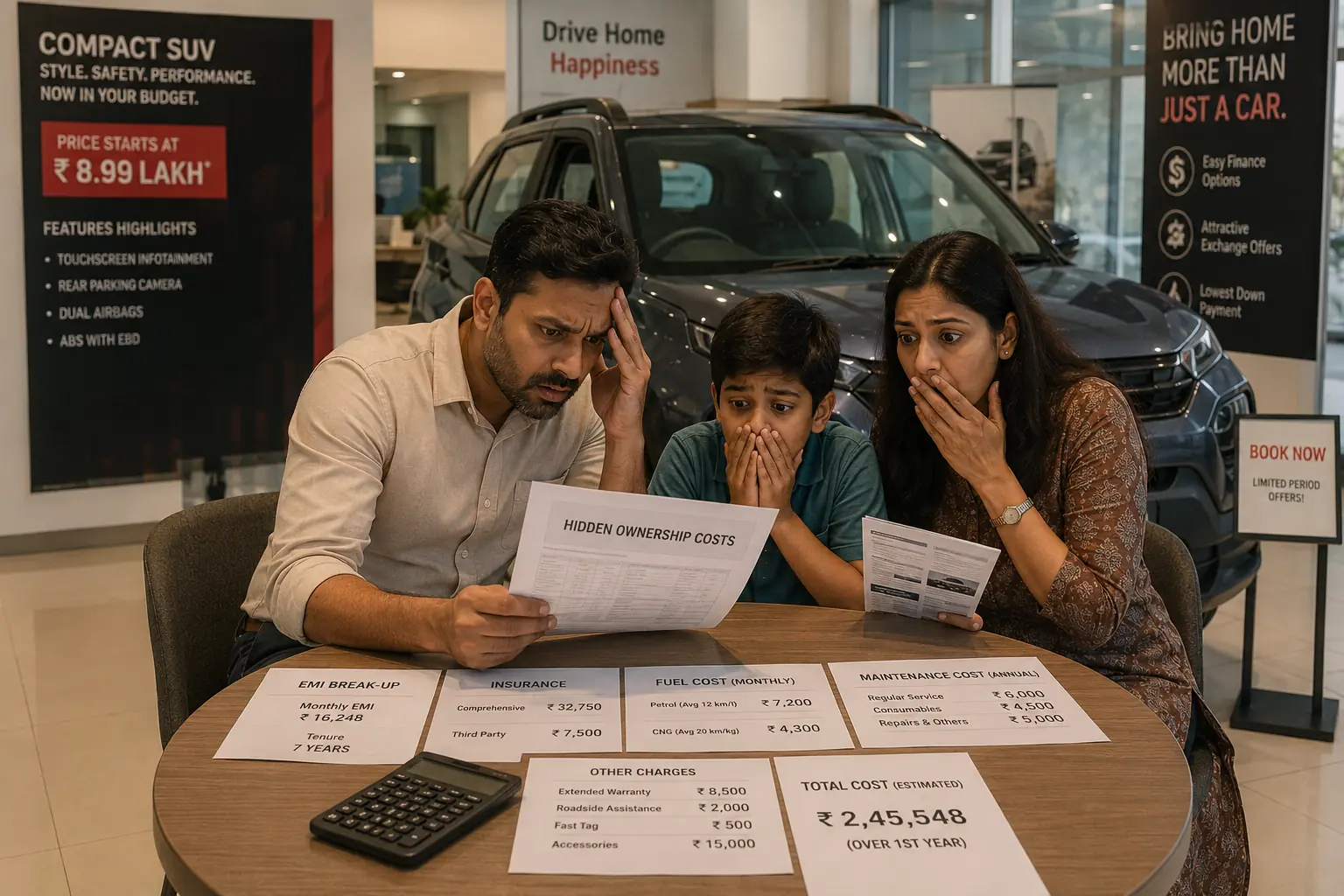
But here is the reality most dealers don’t explain clearly: Buying a car is an event; owning a car is a recurring expense. For most middle-class Indian families, the “hidden” costs of car ownership can eat up 20% more of their monthly income than they originally planned. Let’s break down where your money actually goes.
1. Why Budget Car Buyers Often Underestimate Ownership Costs
Showrooms are designed to sell you an emotion, not a financial plan. Dealers often highlight the lowest possible EMI based on a 7-year tenure to make a car seem affordable.
The excitement of a new car often blinds first-time buyers to the long-term math. They budget for the car purchase but completely forget to budget for the life of the car. In the ₹10 lakh segment, these “forgotten” costs can add up to the price of a second small car over a decade.
2. The Real On-Road Price Shock
The “Ex-Showroom” price is a marketing number. The “On-Road” price is the reality. Between the two lies a gap of roughly 15% to 20%.
| Cost Component | Estimated Amount (for ₹8.5L Car) |
| Ex-showroom Price | ₹8,50,000 |
| RTO / Registration Charges | ₹85,000 |
| Insurance (1st Year) | ₹42,000 |
| Fastag / Handling / Documentation | ₹12,000 |
| Essential Accessories Pack | ₹18,000 |
| Extended Warranty | ₹12,000 |
| Final On-Road Price | ₹10,19,000 |
The Hidden Trap: Dealers often push “Handling Charges,” which the Supreme Court of India has deemed illegal. Always ask for a detailed breakup and negotiate these “hidden” fees.
3. EMI Reality: The Bank Owns Your Car First
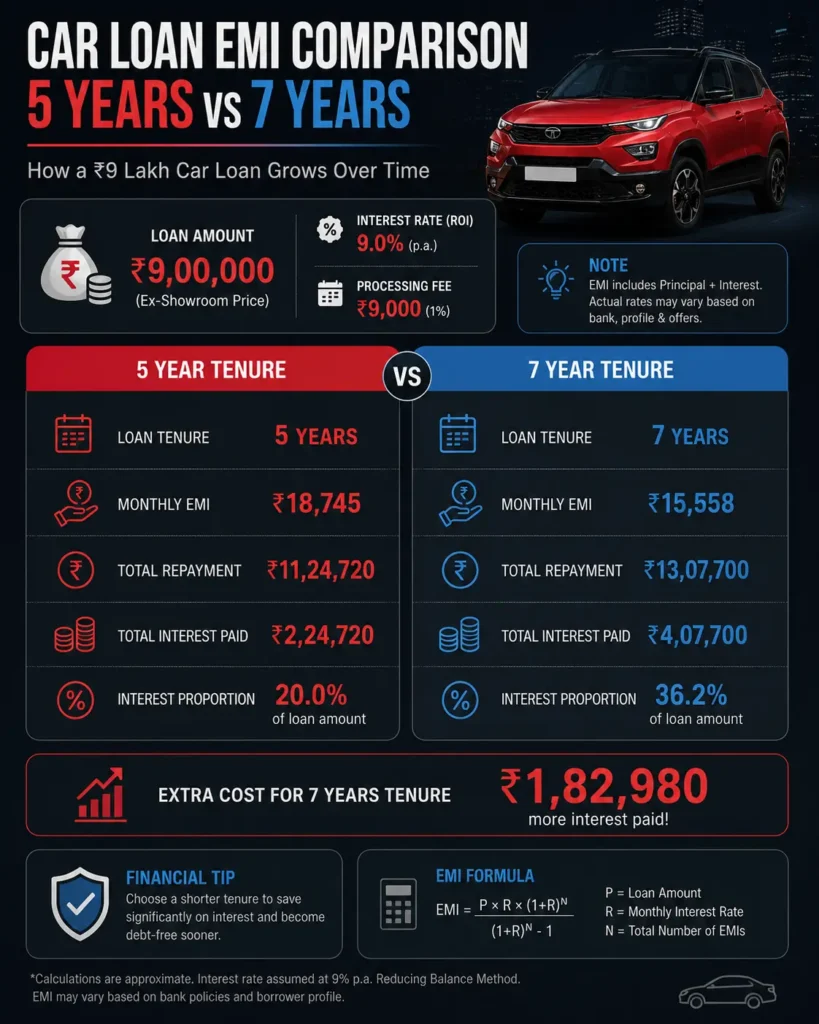
Many buyers opt for a 7-year (84 months) loan to keep the EMI low. While this helps your monthly cash flow, it is a massive hidden cost.
The ₹9 Lakh Loan Trap (at 9.5% Interest):
- 5-Year Tenure: EMI is ~₹18,900. Total interest paid: ₹2.3 Lakh.
- 7-Year Tenure: EMI is ~₹14,700. Total interest paid: ₹3.3 Lakh.
By stretching your loan to 7 years just to “afford” the car, you are handing an extra ₹1 Lakh in pure profit to the bank.
4. Insurance Costs Nobody Talks About
Your first year of insurance is usually bundled into the on-road price. But from Year 2 onwards, it’s a direct hit to your savings.
- The Renewal Shock: As your car ages, you might think insurance gets cheaper. However, while the “Own Damage” premium drops, “Third-Party” rates are hiked by the government almost every year.
- Zero-Depreciation: If you want full protection (highly recommended in India), a Zero-Dep add-on can cost you ₹5,000–₹10,000 extra per year.
Buyer’s Guide: Safety-Rated Cars Under ₹10 Lakh: Best 5-Star Options in India
5. Fuel Cost: The Biggest Long-Term Expense
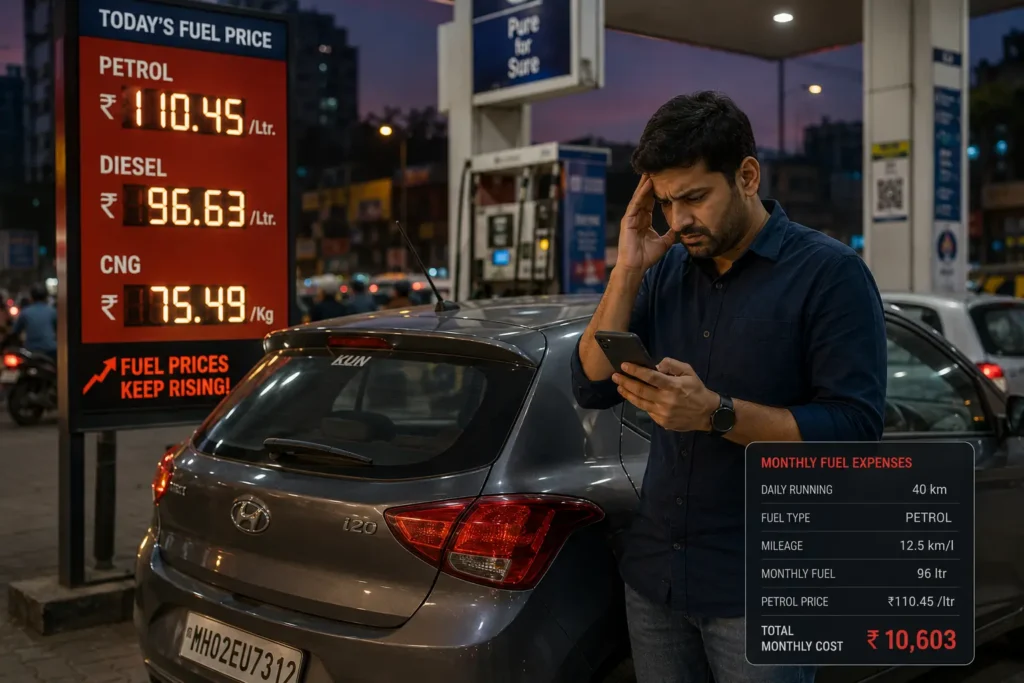
Fuel is your “second EMI.” For a car driven 1,000 km a month in a city like Bangalore or Delhi, the numbers are eye-opening.
- Petrol Reality: At ₹102/L and a real-world mileage of 14 km/l, you spend ₹7,200/month.
- CNG Reality: At ₹85/kg and a mileage of 22 km/kg, you spend ₹3,800/month.
Over 5 years, the petrol driver spends ₹4.3 Lakh, while the CNG driver spends ₹2.3 Lakh. If you chose petrol without doing the math, you just “lost” ₹2 Lakh.
Fuel Cost Comparison: Petrol vs CNG Cars Under ₹10 Lakh: Which Saves More Money?
6. Maintenance & Service Costs: The Hidden Annual Hit
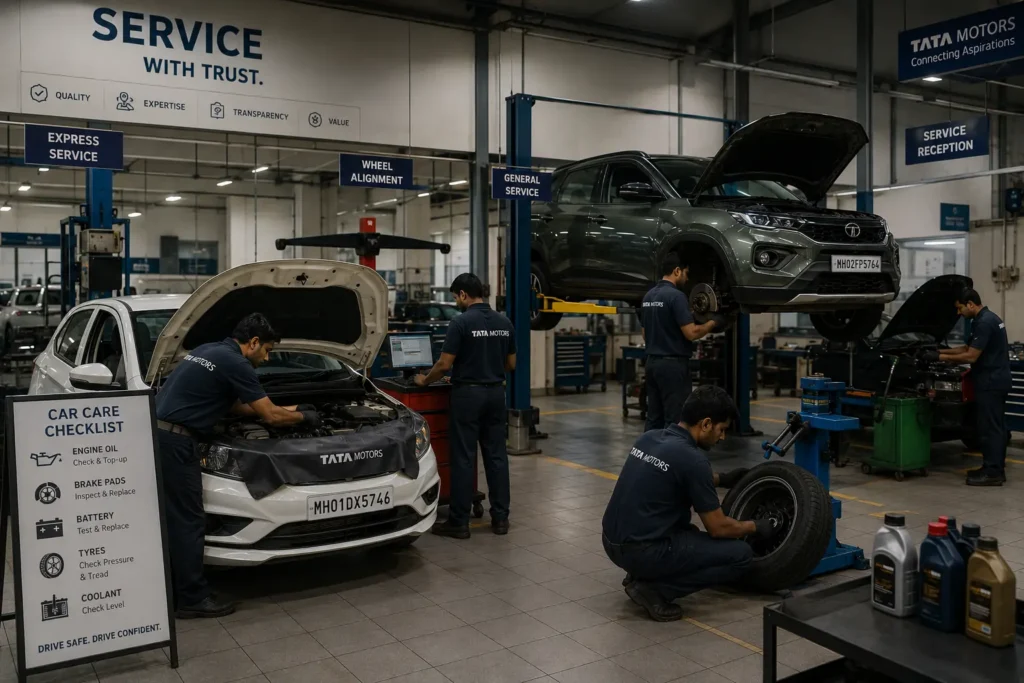
“Free services” aren’t actually free. They only cover labor; you still pay for oil, filters, and consumables.
- Consumables: A standard service for a Tata or Maruti car will cost between ₹6,000 and ₹10,000 annually.
- The 40,000 km Wall: This is when “major” expenses hit. You’ll likely need a new set of tires (₹20,000) and a new battery (₹6,000).
- Brake Pads: In heavy city traffic (Mumbai/Bangalore), brake pads wear out every 15,000 km, costing about ₹3,000–₹5,000.
7. Depreciation: The Biggest Invisible Loss
Depreciation is the money you lose while you sleep. A car is not an investment; it is a depreciating asset.
- Year 1: Your car loses 15–20% of its value the moment you drive it home.
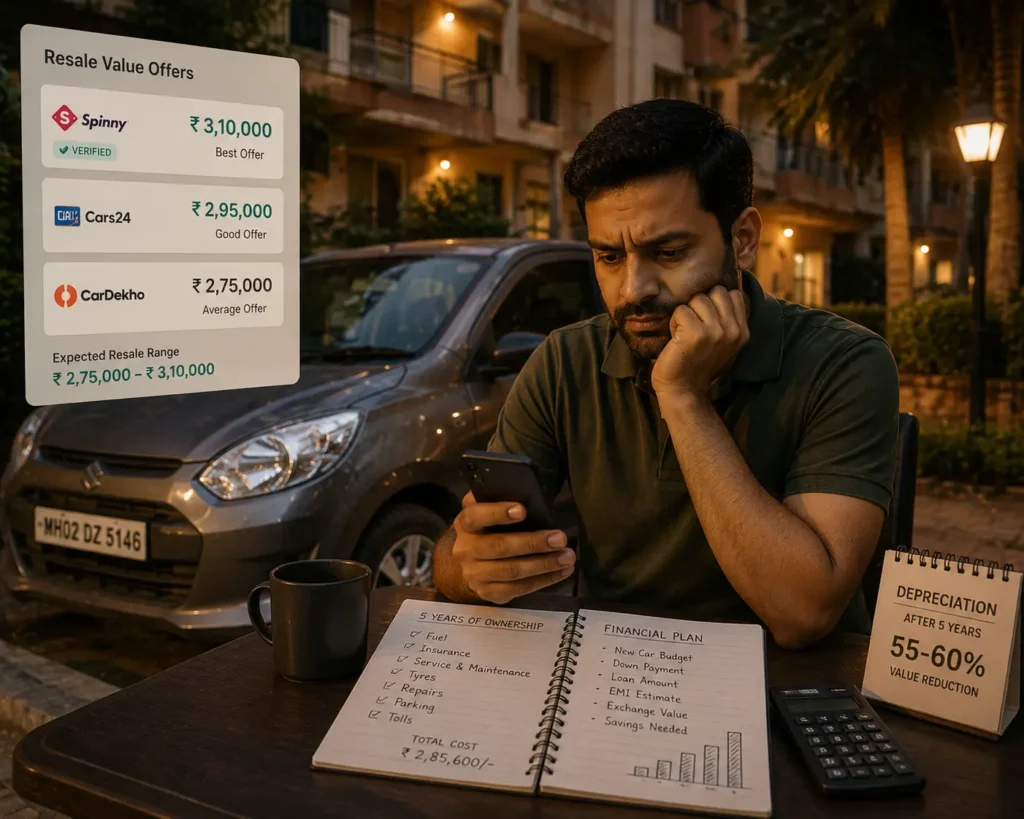
- Year 5: A ₹10 lakh car is typically worth only ₹5.5 lakh to ₹6 lakh.
Most owners ignore this because it’s not a monthly “bill,” but when you go to sell your car, that ₹4 lakh loss is a real hit to your net worth.
8. What Is the Real 5-Year Cost of a ₹10 Lakh Car?
Let’s look at the Total Economic Cost of owning a typical ₹9 lakh (On-Road) petrol car over 5 years:
| Expense Category | 5-Year Total Cost |
| Initial Down Payment | ₹2,00,000 |
| Loan Repayment (EMI + Interest) | ₹9,50,000 |
| Fuel (1,000 km/mo) | ₹4,30,000 |
| Insurance Renewals | ₹1,20,000 |
| Maintenance & Tires | ₹70,000 |
| TOTAL OUTFLOW | ₹17,70,000 |
Even after you subtract the resale value (~₹5.5 lakh), you have “consumed” over ₹12 lakh to own that ₹9 lakh car.
9. How Buyers Can Reduce Ownership Costs
You don’t have to go broke to own a car. Follow these simple rules:
- The 20/4/10 Rule: Pay 20% down, keep the loan to 4 years, and ensure total car costs don’t exceed 10% of your monthly income.
- Say No to “Teflon/Ceramic”: Dealers make huge margins on coatings. Most new cars don’t need them immediately.
- Compare Insurance Online: Never renew through the dealer. Use portals like PolicyBazaar to save up to 30%.
- Maintain Tire Pressure: Low pressure drops mileage by 5–10%. It’s the easiest way to save fuel money.
Common Buyer Questions About Car Ownership Costs
What is the real cost of owning a car in India?
The real cost includes the EMI, fuel, insurance, maintenance, and depreciation. For a ₹10 lakh car, expect a total monthly outflow of ₹25,000 to ₹32,000.
Is EMI the biggest expense in car ownership?
While EMI is the most visible, fuel and depreciation often cost more than the interest paid on a loan over a 5-year period.
Which cars have the lowest maintenance cost in India?
Maruti Suzuki and Hyundai typically have the most affordable and widely available service networks, leading to lower long-term maintenance costs.
How much should I budget monthly for a car?
A safe budget is roughly 1.5 to 1.8 times your EMI. If your EMI is ₹15,000, ensure you have at least ₹25,000 available for fuel and maintenance.
Which car has the best resale value in India?
Maruti Suzuki hatchbacks (like the Baleno/Swift) and Toyota models generally hold their value best in the Indian used car market.
Final Thoughts
A car is a symbol of freedom, but it shouldn’t become a financial cage. By understanding these hidden costs before you sign the papers, you can choose a car that fits your life, not just your dreams.
Calculate your 5-year TCO (Total Cost of Ownership) today, and drive with peace of mind tomorrow!
Helpful Resources for Indian Car Buyers
- Bharat NCAP Official Website — India’s official crash-testing and vehicle safety rating platform. Includes adult and child occupant scores, crash-test protocols, and tested vehicle lists.
- Global NCAP – Safer Cars for India — Global crash-test program that pushed Indian manufacturers toward safer vehicle structures and occupant protection standards.
- Reserve Bank of India (RBI) — Official source for repo rates, lending rules, and banking regulations in India. (rbi.org.in)
- TransUnion CIBIL — Check your credit score and track your loan eligibility before applying for a car loan.
- SBI Car Loans — View latest interest rates, eligibility criteria, and loan offers from State Bank of India.
- HDFC Bank Car Loans — Explore car loan options, EMIs, and financing plans from HDFC Bank.
- ICICI Bank Car Loans — Compare new and used car loan offers along with repayment options.
- Policybazaar Car Insurance — Compare insurance plans, premiums, and add-on coverage options in one place.
- Acko Car Insurance — Get quick online quotes and renewal estimates for car insurance.
- AutomotiveZone Mileage Cost Calculator — Estimate real fuel costs based on your driving mileage.
- AutomotiveZone Monthly Car Expense Calculator — Calculate total monthly car ownership cost including EMI, fuel, and maintenance.
Disclaimer: Prices, mileage, safety ratings, loan rates, and ownership costs are approximate and may vary by location, variant, and market conditions in 2026. Some visuals may be AI-generated for illustration. Please verify final details with authorized dealers before purchase.