

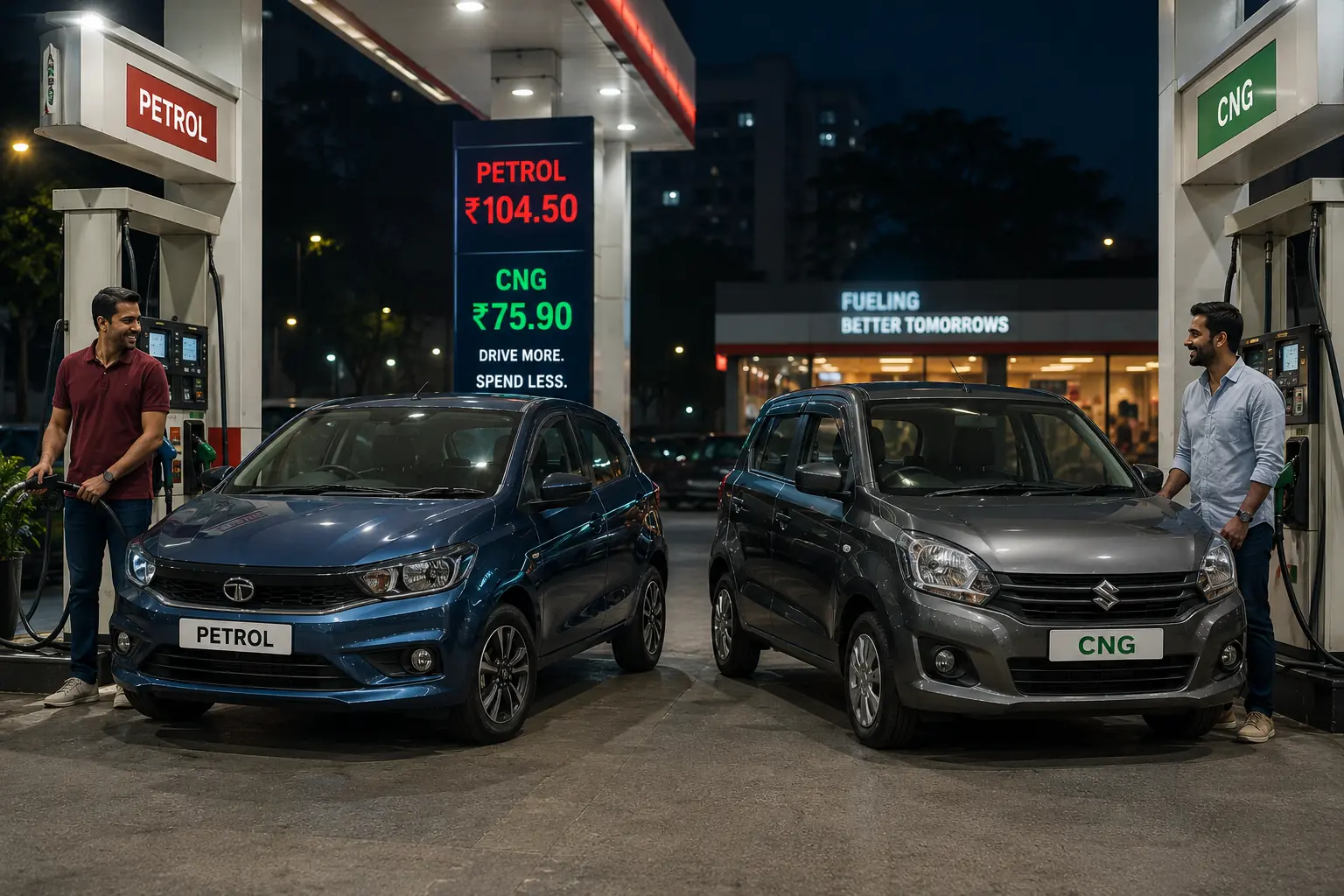
If you are standing in a car showroom in India today, you are likely facing the “Dual Fuel” dilemma. With petrol prices staying stubbornly high and the ₹10 lakh budget being the most competitive segment, the choice between Petrol and CNG has never been harder.
Most buyers look at the sticker price and mileage figures, but the real financial difference appears over 5 years of ownership. Should you pay extra for a factory-fitted CNG variant, or stick with the smoother refinement of petrol?
If you’re also exploring the best cars under ₹10 lakh in India, this guide will help you understand which fuel type actually saves more money long-term.
Quick Verdict: Which Fuel Type Saves More Money?
In 2026, CNG cars remain the cheapest cars to run in India, delivering an average running cost of roughly ₹3.2–₹3.8 per km.
However, petrol cars still make more sense for:
- Low monthly running
- Frequent highway trips
- Buyers prioritizing refinement and convenience
For heavy city commuters, CNG savings can exceed ₹30,000 annually.
Why More Indians Are Choosing CNG Cars in 2026
The biggest reason is simple: fuel prices.
For middle-class Indian families, daily commuting costs have become a serious monthly expense.
What Changed Recently?
- Petrol prices remain close to ₹100/litre in many cities
- CNG infrastructure has expanded rapidly
- Factory-fitted CNG technology is now far more refined
- Twin-cylinder setups improved boot space practicality
CNG cars are no longer seen as “taxi cars.” They’ve become mainstream family vehicles.
If fuel efficiency is your top priority, also read: Most Fuel-Efficient Cars Under ₹10 Lakh in India (2026)
Petrol vs CNG Running Cost: Real India Numbers
Brochure mileage and real-world mileage are completely different things.
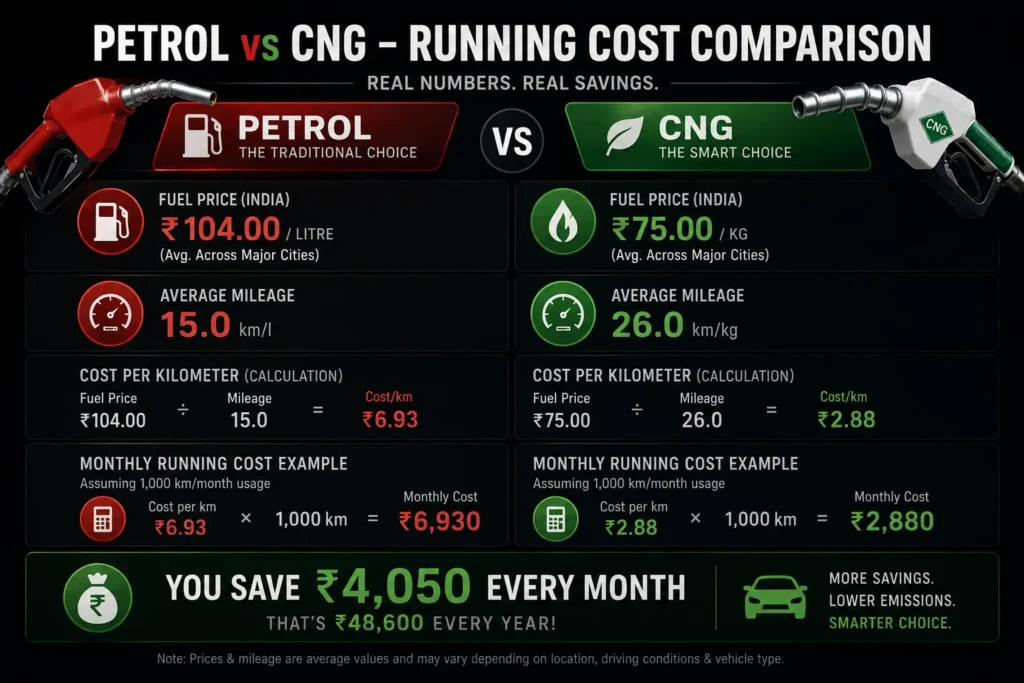
Indian traffic, AC usage, and stop-go driving reduce efficiency significantly.
Here’s what owners are realistically seeing in 2026:
| Fuel Type | Real Mileage | Average Fuel Price | Running Cost |
|---|---|---|---|
| Petrol | 15–17 km/l | ₹98–₹102/l | ₹5.8–₹6.5/km |
| CNG | 22–25 km/kg | ₹82–₹88/kg | ₹3.3–₹3.9/km |
What Does This Mean?
A CNG car can save approximately:
- ₹2.5–₹3 per km
- ₹2,500–₹3,500 every month for heavy users
- More than ₹1.5 lakh over 5 years
That’s a major difference for budget-conscious buyers.
Best Petrol Cars Under ₹10 Lakh for Lower Running Costs
Petrol still makes perfect sense for many Indian buyers.
Maruti Suzuki Swift
- Excellent fuel efficiency
- Smooth lightweight driving feel
- Better highway refinement
Hyundai Grand i10 Nios
- One of the smoothest petrol engines in the segment
- Ideal city hatchback
- Easy maintenance
Tata Punch Petrol
- SUV stance with strong safety
- Better for lower annual running
- Good urban practicality
If safety matters equally to you, check out: Safest Cars Under ₹10 Lakh in India (2026)
Why Petrol Still Works Well
Petrol cars are better for:
- Under 800–1000 km monthly usage
- Highway-focused driving
- Buyers avoiding CNG queues
- Drivers wanting smoother performance
Best CNG Cars Under ₹10 Lakh for Maximum Savings
For pure cost savings, CNG dominates.
Maruti WagonR CNG
- Lowest running cost in India
- Proven reliability
- Excellent resale value
Tata Tiago iCNG
- Twin-cylinder technology improves luggage space
- Better design and cabin feel
- Strong safety reputation
Maruti Dzire CNG
- Excellent family sedan
- Massive fuel savings
- Improved 5-star safety image
Why Factory-Fitted CNG Matters
Modern factory-fitted CNG cars are:
- Safer
- More reliable
- Better calibrated
- Covered under manufacturer warranty
Avoid aftermarket kits whenever possible.
Real Monthly Fuel Cost Comparison (1000 km/Month Example)
Let’s use a realistic middle-class commuting example.
Petrol Car Example
- Mileage: 16 km/l
- Petrol Price: ₹100/l
- Monthly Fuel Needed: ~62 litres
- Monthly Cost: ~₹6,200
CNG Car Example
- Mileage: 25 km/kg
- CNG Price: ₹85/kg
- Monthly Fuel Needed: ~40 kg
- Monthly Cost: ~₹3,400
Total Savings
| Period | Estimated Savings with CNG |
|---|---|
| Monthly | ₹2,800+ |
| Yearly | ₹33,000+ |
| 5 Years | ₹1.6 lakh+ |
For heavy city commuters, the math becomes very difficult to ignore.
Petrol vs CNG Maintenance: The Hidden Truth
A lot of buyers worry that CNG cars are expensive to maintain.
The reality is more balanced.
Petrol Cars
Advantages:
- Simpler servicing
- Better engine refinement
- Lower maintenance complexity
CNG Cars
Challenges:
- Slightly more service checks
- Spark plug wear
- Reduced boot space in some models
- Small power drop
However, modern factory-fitted CNG systems are dramatically better than older setups.
The maintenance difference is usually minor compared to the fuel savings.
City Commuters vs Highway Drivers: Which Fuel Type Makes More Sense?

Your usage pattern matters more than internet opinions.
CNG Makes More Sense For:
- Office commuting
- Daily city traffic
- High monthly running
- Cab/fleet-style usage
Petrol Makes More Sense For:
- Frequent highway trips
- Remote travel
- Performance-focused driving
- Buyers wanting hassle-free refueling
The Reality of CNG Queues
One hidden downside still exists:
- Long waiting lines at some pumps
- Limited highway availability
- Refueling inconvenience during rush hours
If practicality matters more than savings, petrol remains easier to live with.
Still deciding between hatchbacks and SUVs? Read: Hatchback vs Compact SUV Under ₹10 Lakh
What About Resale Value?
Factory-fitted CNG cars now have excellent resale demand.
Especially:
Why?
Because used-car buyers also want lower fuel expenses.
Important Warning
Aftermarket CNG kits can:
- Reduce resale value
- Create reliability concerns
- Raise safety questions
Factory-fitted options remain the safest choice.
Common Questions Buyers Ask
Which is cheaper to run: petrol or CNG?
CNG is significantly cheaper, costing roughly ₹3.5/km compared to petrol’s ₹6/km average.
Is CNG safe in modern cars?
Yes. Factory-fitted CNG systems now include advanced leak detection and safety shutoff mechanisms.
Does CNG reduce engine life?
Not significantly, provided servicing is done properly and on schedule.
Which fuel type gives better resale value?
Factory-fitted Maruti CNG cars currently have some of the strongest resale demand in India.
Is CNG practical for highway travel?
It’s improving, but petrol still offers better convenience and stronger highway performance.

Final Verdict: Petrol or CNG in 2026?
The answer depends entirely on your monthly driving pattern.
Choose Petrol If:
- You drive under 1,000 km/month
- You travel frequently on highways
- You value convenience and refinement
Choose CNG If:
- You drive daily in city traffic
- Fuel savings matter most
- Your running exceeds 1,200–1,500 km/month
For Indian city commuters, CNG has become one of the easiest ways to reduce monthly expenses without switching to an EV.
But for occasional users, petrol still offers the smoother and simpler ownership experience.
Before buying, calculate:
- Your monthly running
- Fuel availability in your area
- Long-term ownership plans
That simple math will usually reveal the right answer faster than any showroom sales pitch.
Helpful Resources for Indian Car Buyers
- Bharat NCAP Official Website — India’s official crash-testing and vehicle safety rating platform. Includes adult and child occupant scores, crash-test protocols, and tested vehicle lists.
- Global NCAP – Safer Cars for India — Global crash-test program that pushed Indian manufacturers toward safer vehicle structures and occupant protection standards.
- Reserve Bank of India (RBI) — Official source for repo rates, lending rules, and banking regulations in India. (rbi.org.in)
- TransUnion CIBIL — Check your credit score and track your loan eligibility before applying for a car loan.
- SBI Car Loans — View latest interest rates, eligibility criteria, and loan offers from State Bank of India.
- HDFC Bank Car Loans — Explore car loan options, EMIs, and financing plans from HDFC Bank.
- ICICI Bank Car Loans — Compare new and used car loan offers along with repayment options.
- Policybazaar Car Insurance — Compare insurance plans, premiums, and add-on coverage options in one place.
- Acko Car Insurance — Get quick online quotes and renewal estimates for car insurance.
- AutomotiveZone Mileage Cost Calculator — Estimate real fuel costs based on your driving mileage.
- AutomotiveZone Monthly Car Expense Calculator — Calculate total monthly car ownership cost including EMI, fuel, and maintenance.
Disclaimer: Prices, mileage, safety ratings, loan rates, and ownership costs are approximate and may vary by location, variant, and market conditions in 2026. Some visuals may be AI-generated for illustration. Please verify final details with authorized dealers before purchase.