
Tata Harrier EV Quick Overview
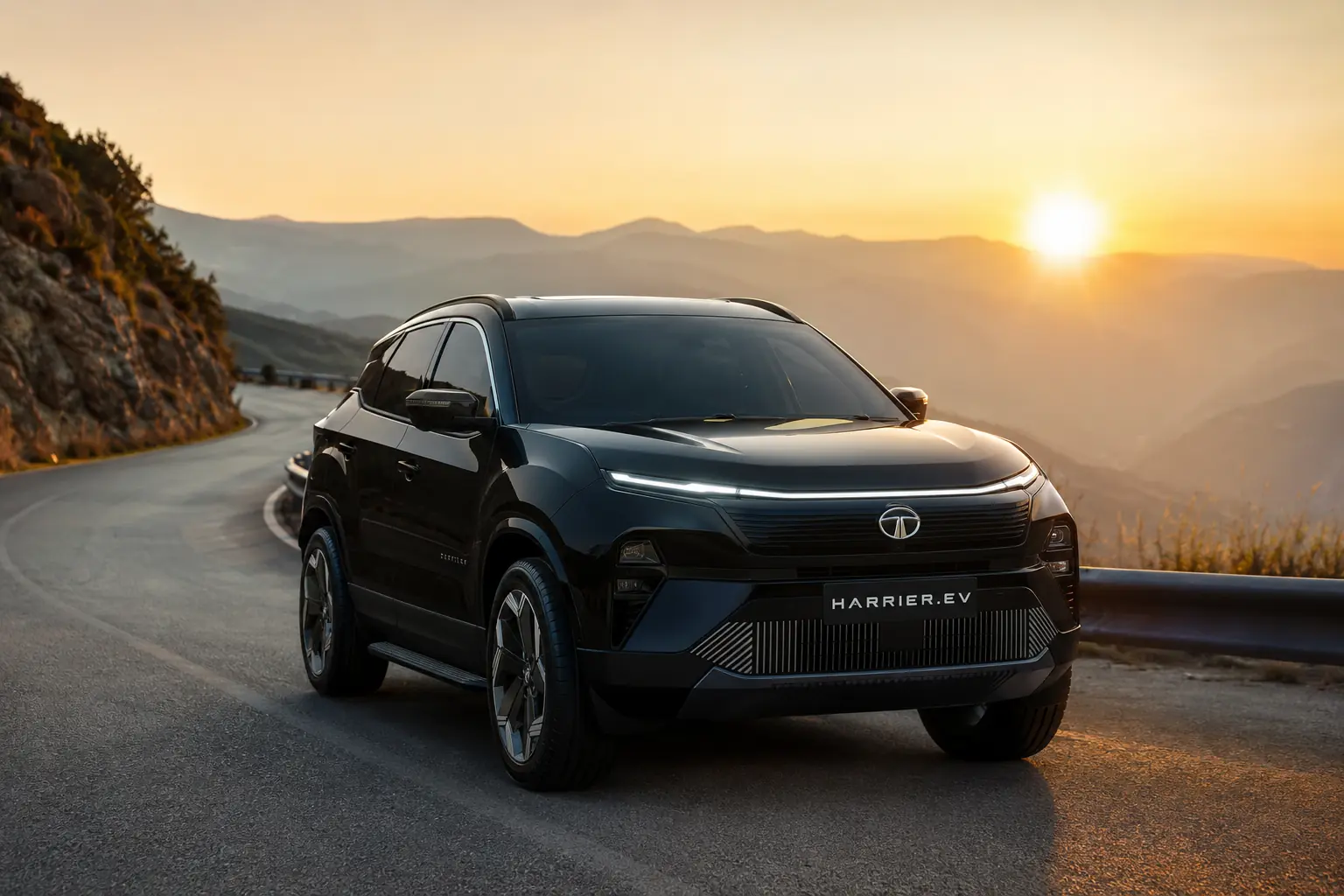
The Tata Harrier EV stands as the absolute flagship of India’s electric vehicle shift, priced between ₹21.49 Lakh and ₹30.23 Lakh (ex-showroom). Built on the dedicated acti.ev skateboard architecture, it offers two high-density liquid-cooled battery choices: a 65 kWh pack producing 235 bhp and a massive 75 kWh pack pushing up to 390 bhp and 504 Nm of torque in its dual-motor Quad Wheel Drive (QWD/AWD) setup. It achieves an ARAI-certified range of 538 km to 627 km, delivering a highly predictable real-world city range of 390 km to 480 km.
Tata Harrier EV Price Guide 2026: Real-World Range, Dual-Motor AWD, Neo QLED Tech & Is It Worth Buying?
For years, the premium mid-size SUV segment in India relied heavily on rumbling, imported diesel engines to provide the heavy low-end torque and high-speed highway tracking that family buyers crave. While these diesel power plants are excellent for long-distance cruising, they increasingly face tightening urban emission laws, high routine maintenance bills, and lacks the instant, silent acceleration layout modern tech buyers expect.
The Tata Harrier EV completely disrupts this premium segment. Rather than simply packing batteries into a conversion framework, Tata re-engineered their flagship SUV using the dedicated acti.ev skateboard platform. By dropping a heavy front-heavy diesel engine, pushing the wheelbase out to a massive 2,741 mm, and introducing a specialized dual-motor All-Wheel Drive configuration, the Harrier EV delivers high supercar-level acceleration alongside a whisper-quiet luxury experience under a ₹30 Lakh budget.
Why the Tata Harrier EV Commands the Premium Electric Space
The Harrier EV marks a massive transition from traditional internal combustion platforms to highly optimized, born-electric packaging:
True Quad Wheel Drive (AWD): By placing an induction motor on the front axle and a permanent magnet synchronous motor behind, it gains intelligent all-wheel-drive capabilities that manage terrain slips instantly.
The Power of the 75 kWh Pack: Houses one of the largest high-density battery cell structures in its class, providing genuine long-distance interstate driving capability.
A Bharat NCAP 5-Star Baseline: Built with an ultra-rigid high-strength steel underbody frame that houses the battery securely, it achieves a full 5-Star structural safety rating.
Tata Harrier EV Price List & Variants (2026)
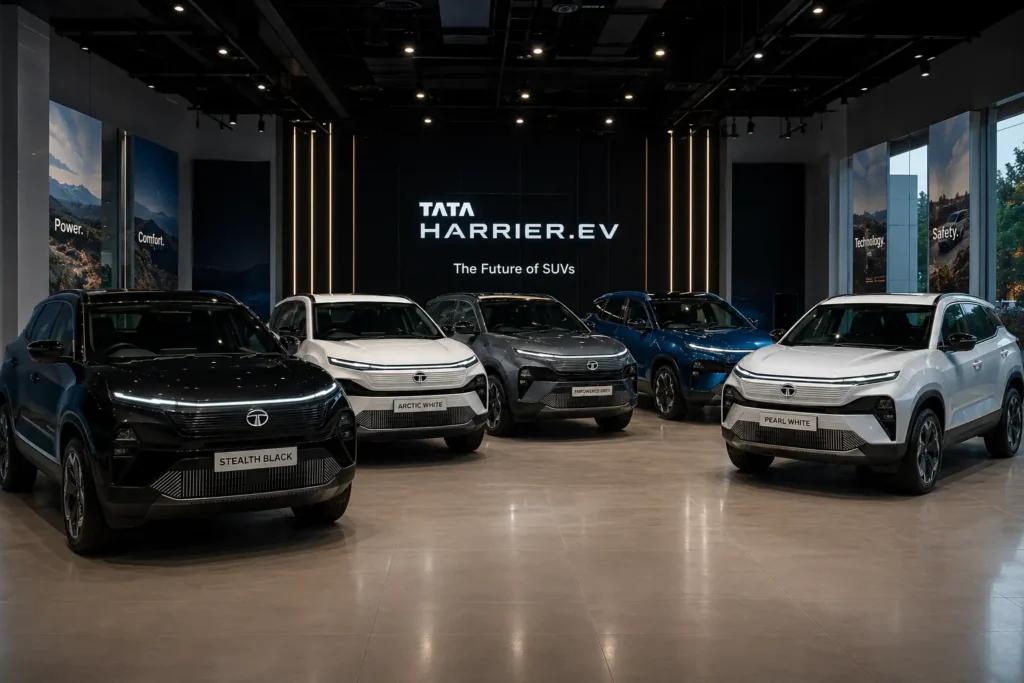
The Harrier EV portfolio organizes its extensive 17-trim structure across three primary style tiers, scaling up based on battery capacity and dual-motor AWD layout.
Ex-Showroom India Price Architecture:
| Variant Grade | Battery Pack & Drivetrain | Key Feature Inclusions | Ex-Showroom Price |
| Adventure 65 (Base) | 65 kWh Pack / RWD | 6 Airbags, LED Bar, Dual Screen, Disc Brakes | ₹21.49 Lakh |
| Adventure S 65 | 65 kWh Pack / RWD | Panoramic Sunroof, Voice Assistant Hooks | ₹21.99 Lakh |
| Fearless Plus 65 | 65 kWh Pack / RWD | Ventilated Seats, 360° Cam, Leatherette | ₹23.99 Lakh |
| Fearless Plus 75 | 75 kWh Pack / RWD | Larger Cell Pack / Extended Real Range | ₹24.99 Lakh |
| Fearless Plus QWD 75 | 75 kWh Pack / AWD | Dual-Motor AWD Architecture / 390 bhp | ₹26.49 Lakh |
| Empowered 75 | 75 kWh Pack / RWD | 14.5″ Screen, Level 2 ADAS, JBL Audio | ₹27.49 Lakh |
| Empowered QWD 75 | 75 kWh Pack / AWD | Complete AWD / Self-Parking Assist Tech | ₹28.99 Lakh |
| Empowered QWD 75 Stealth | 75 kWh Pack / AWD | Dark Trim Matrix / Flagship Luxury Tech | ₹30.23 Lakh |
*Note: Variants suffixing “ACFC” come bundled with an upgraded high-capacity 7.2 kW AC home fast charger unit for an additional ~₹49,000 upfront premium.
Interior Architecture: The Digital Command Lounge
Step inside the Harrier EV, and its interior layout steps completely away from conservative templates, mimicking a multi-screen luxury theater lounge.
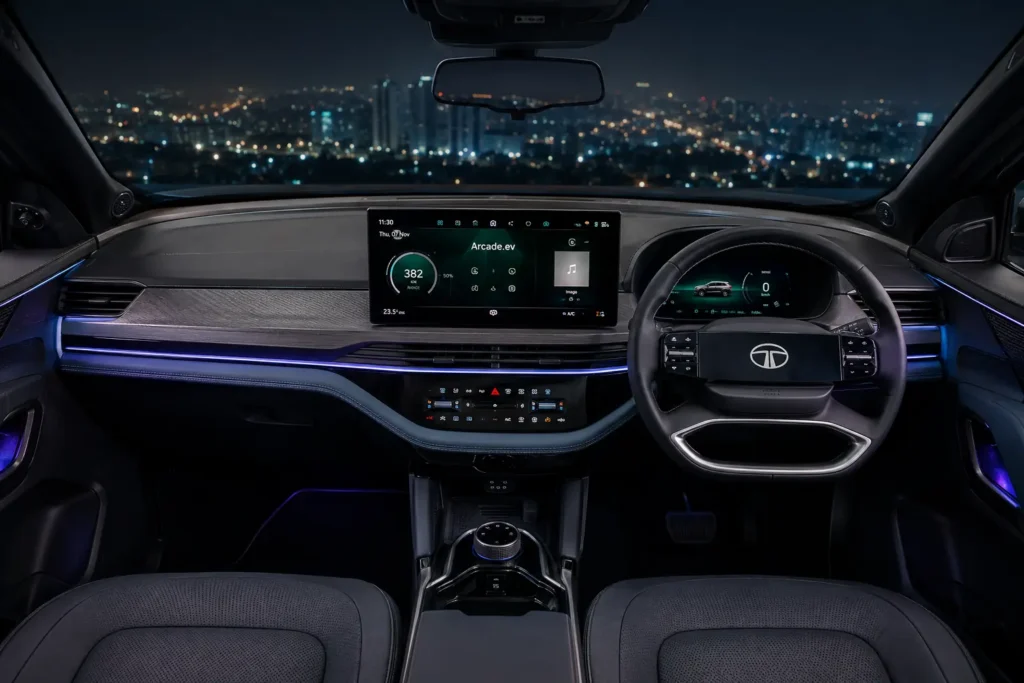
1. The 14.5-Inch Samsung Neo QLED Display
The center of the soft-touch dashboard is anchored by a massive 14.5-inch cinematic touchscreen infotainment system using Samsung Neo QLED technology—delivering the crispest contrast ratios and brightest visibility maps in its class. It runs wireless Apple CarPlay and Android Auto seamlessly and introduces DrivePay telematics, letting you pay for public EV charging network juice or FASTag bills directly from the dashboard interface.
2. Cabin Materials, Comfort, and Dolby Atmos
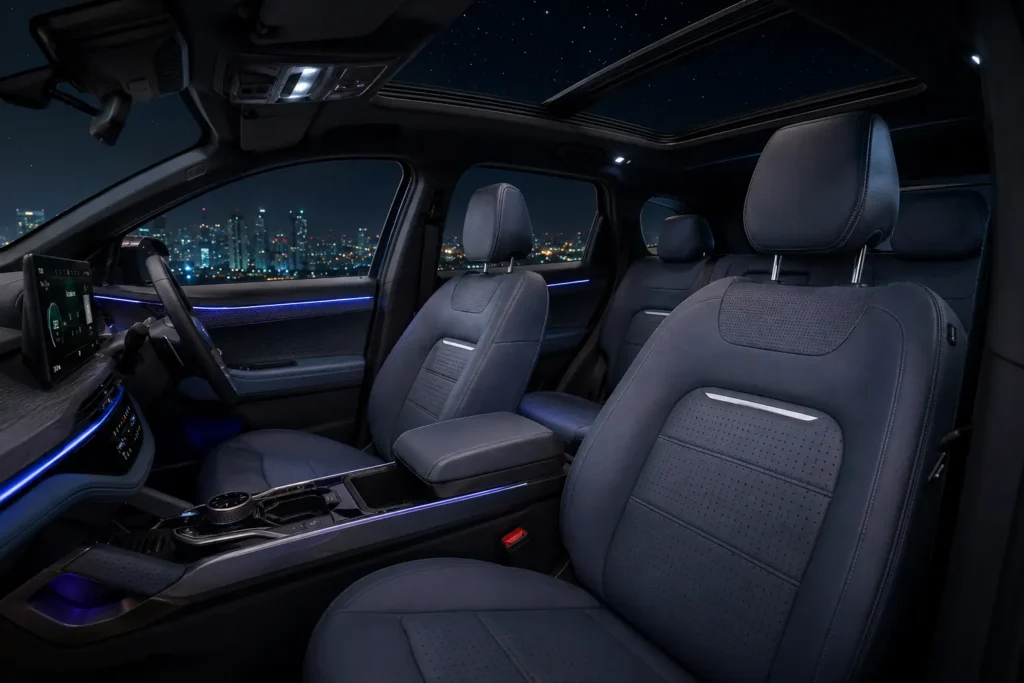
The cabin uses a modern dual-zone automatic climate control deck contrasted by premium quilted leatherette upholstery. The front row prioritizes passenger relaxation, offering 3-stage cooling ventilation alongside memory adjustments for the driver. Music is handled by an elite 10-speaker JBL audio array tuned with Dolby Atmos 5.1 surround sound, providing phenomenal acoustic separation.
3. Grand Family Passenger Space and Luggage Flexibility
Thanks to its sprawling 2,741 mm wheelbase and completely flat floor workspace, rear-row legroom and shoulder track space are vast. Three adults can lounge comfortably over multi-hour journeys, assisted by individual rear AC vents and personal USB fast-charging portals.
The gesture-activated electronic tailgate opens up to reveal a clean 502-liter boot capacity, which easily accommodates massive vacation travel cases.
Real-World Engine Mileage & Performance
The Harrier EV delivers sports-car-rivaling acceleration, launching its substantial body mass forward with massive authority.
Powertrain Character Matrix:
The 65 kWh Specification: Delivers a highly refined 235 bhp and 315 Nm of torque directly to the driving wheels, moving with sharp, immediate throttle agility.
The Flagship 75 kWh QWD Setup: Rockets from 0 to 100 km/h in a blistering 6.3 seconds by deploying its full 390 bhp and 504 Nm of instant torque, pulling hard up to an electronically capped top speed of 180 kmph.
True Real-World Range Tracking
| Selected Battery Variant | MIDC Claimed Range | True City Traffic Range | Open Expressway Cruising |
| Standard 65 kWh Pack | 538 km | 390 km to 415 km | 350 km to 365 km |
| Flagship 75 kWh Pack | 627 km | 455 km to 480 km | 400 km to 420 km |
Ultra-Fast Intelligent Charging Speeds
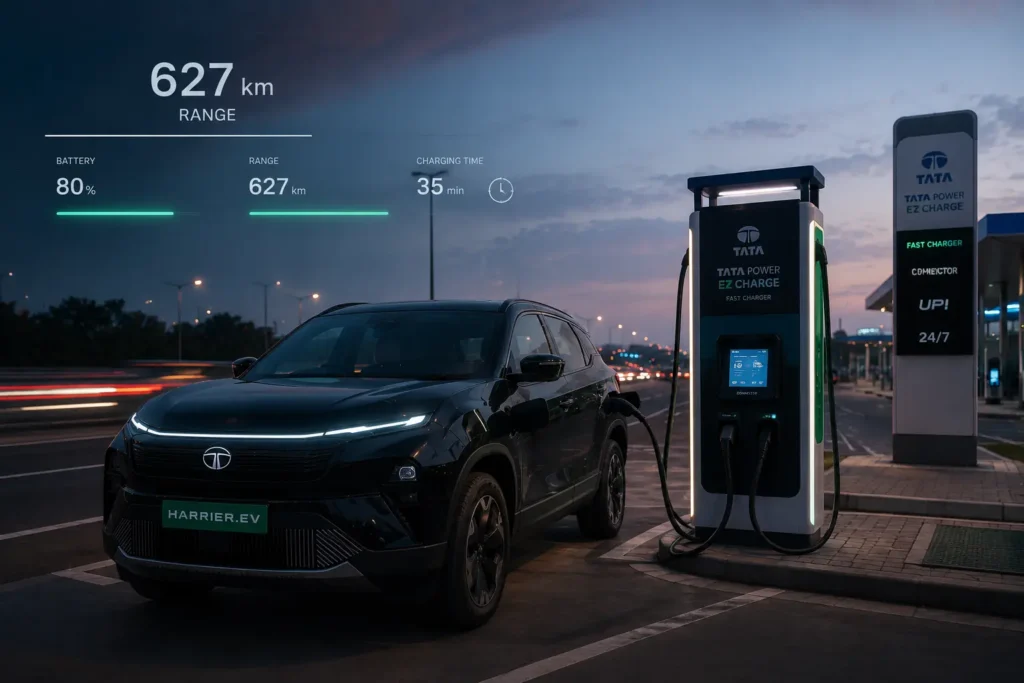
- High-Capacity Public Fast Chargers: Built on advanced high-voltage architectures, plugging into a commercial 120 kW DC highway fast-charging terminal juices the battery pack from 20% to 80% in just 25 minutes.
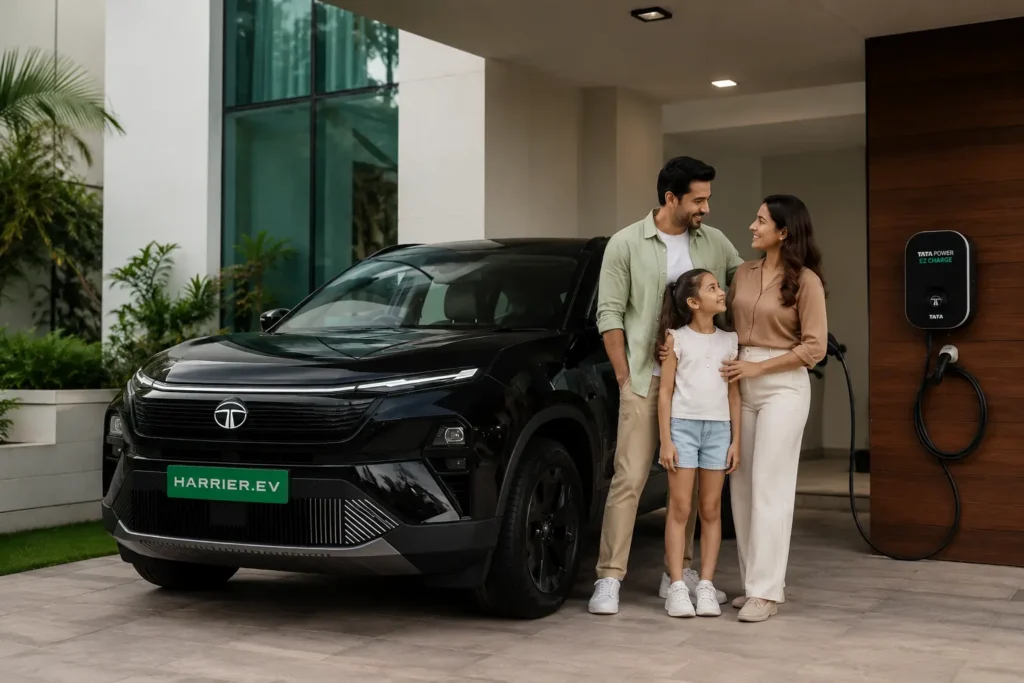
- Standard AC Home Wall Box: The bundled 7.2 kW AC charger safely completes a standard home top-up from empty to full overnight in approximately 10.7 hours.
Tata Harrier EV Full Technical Specifications
| Technical Parameter | Standard 65 kWh Specification | Flagship 75 kWh QWD Specification |
| Motor Configuration | Single Electric Motor (Rear-Wheel Drive) | Dual Electric Motors (Quad Wheel Drive AWD) |
| Peak Power Output | 235 bhp (238 PS) | 390 bhp (395 PS) |
| Peak Torque Output | 315 Nm (Instantaneous) | 504 Nm (Instantaneous) |
| Battery Chemistry | Liquid-Cooled Lithium-Ion Pack | Liquid-Cooled Lithium-Ion Pack |
| Braking Systems | Ventilated Front & Rear Disc Brakes | Ventilated Front & Rear Disc Brakes |
| Suspension Tracking | Independent McPherson Strut | Independent Multi-Link Rear Suspension |
| Tyre & Wheel Setup | 245/60 R18 Alloy Wheels | 245/55 R19 Aero-Optimized Alloys |
| Dimensions (L x W x H) | 4,607 mm x 1,922 mm x 1,740 mm | 4,607 mm x 1,922 mm x 1,740 mm |
Tata Harrier EV Running Cost vs Premium Petrol/Diesel SUVs
Let’s calculate the real monthly budget math for a high-utilization owner covering a standard distance of 1,500 km per month over a 5-year tenure.
Scenario A: Tata Harrier EV (75 kWh Home Charging Setup)
Average domestic power tariff: ₹8 per unit (kWh).
To fully charge the large 75 kWh battery pack takes roughly 82 units of electricity (accounting for charging losses), costing ₹656.
A real-world mixed city range of ~460 km means covering 1,500 km requires roughly 3.2 full charging cycles.
Monthly Power Bill: ~₹2,100 (Approx. ₹1.40 per km).
Scenario B: Traditional Premium Mid-Size Diesel SUV (Automatic)
Average cost of standard diesel fuel: ₹90 per liter.
Real-world urban city fuel economy in heavy traffic: 11 km/l.
Diesel fuel required for 1,500 km: 136.3 Liters.
Monthly Fuel Bill: ~₹12,267 (Approx. ₹8.17 per km).
5-Year Cumulative Operational Energy Cost Savings
[Traditional Diesel Mid-SUV:  ₹12,267/mo]
=======> 5-Year Total: ₹7.36 Lakh
[Harrier EV Power Charging:    ₹2,100/mo]
==> 5-Year Total: ₹1.26 Lakh
--------------------------------------
Net Operational Household Savings over 5 Years: ₹6.10 Lakh
Maintenance Cost & Long-Term Ownership
By dropping volatile moving items like mechanical fuel injectors, turbochargers, multi-speed automated clutch assemblies, and diesel particulate filters (DPF), long-term service liabilities drop significantly.
Routine Workshop Outgo: Scheduled periodic checkups focus primarily on basic cabin air filter replacements, brake pad fluid line checks, tire rotations, suspension greasing, and high-voltage diagnostic software health scans. Standard routine service bills stay very low, ranging between ₹5,000 and ₹7,000 annually.
Battery Safety & Protection Warranty: Tata Motors protects your high-voltage investment by backing the battery pack with a standard 8-year or 1,60,000 km warranty program, alongside a lifetime warranty option in select tiers to maximize your long-term resale profile.
Tata Harrier EV Pros & Cons
Advantages
Mind-Blowing AWD Punch: 390 bhp and 504 Nm of torque launch the large SUV from 0-100 km/h in 6.3 seconds.
Stunning Neo QLED Display: The massive 14.5-inch Samsung display delivers exceptional clarity and color.
Exceptional Interior Space: The flat floor and stretched wheelbase offer expansive legroom for five adults.
Elite Safety Architecture: Standardized 6 airbags safety framework combined with a full Level 2 ADAS suite.
Incredibly Low Running Costs: Shifts premium driving bills below a mere ₹1.50 per km when charged at home.
Disadvantages
High Upfront Capital Premium: Top-spec flagship AWD variants cross the ₹30 Lakh ex-showroom boundary.
Firm Ride over Sharp Bumps: The independent multi-link suspension can feel slightly firm at slow city speeds over sharp potholes when driving unladen.
Substantial Kerb Weight: The large battery packs add significant weight, which requires a bit more effort when maneuvering in tight spots.
Touchscreen-Heavy Climate Adjustments: Adjusting basic fan speeds requires using the central display panel or capacitive touch sliders on the go.
Who Should Buy the Tata Harrier EV?
Recommended For:
High-Mileage Tech Buyers: Ideal for owners covering over 1,500 km monthly who want a premium flagship machine with exceptionally low operating costs.
Performance & Adventure Lovers: Perfect for drivers needing authentic dual-motor AWD traction to comfortably tackle unpaved mountain trails and wet monsoon paths.
Space-Prioritizing Large Families: Excellent for households looking for maximum rear passenger comfort, exceptional boot space, and a 5-star crash-test rating.
Not Recommended For:
Apartment Residents Lacking Private Charging Access: If you do not have a dedicated parking space to install an AC home wall box charger overnight, relying purely on commercial charging setups can add friction.
Budget-First Minimalist Commuters: If you simply want a basic, low-cost commuter tool without complex high-end electronic displays and advanced self-parking assist tools.
Questions Buyers Commonly Ask about Harrier EV
What is the real on-road starting price of the Harrier EV base model?
While the base Adventure 65 ex-showroom price starts at ₹21.49 Lakh, adding standard comprehensive insurance, local RTO registration fees, and essential documentation brings the final base on-road metro price to between ₹22.80 Lakh and ₹24.10 Lakh depending on your specific state taxes.
What is the core difference between RWD and QWD models?
The standard RWD models utilize a single electric motor powering the driving wheels to deliver 235 bhp. The flagship QWD versions introduce an advanced dual-motor All-Wheel Drive setup that bumps total power to a massive 390 bhp, unlocking a dedicated terrain control response system with 6 specialized modes.
How long does it take to charge from empty on a regular highway trip?
The Harrier EV supports high-capacity DC fast-charging input. If you plug into a commercial 120 kW DC highway fast charger, it can juice the battery pack from 20% to 80% in a swift 25 minutes, providing roughly 250 km of range with just 15 minutes of charging.
Is the battery safe against heavy monsoon street flooding?
Yes. Both the high-performance dual electric motors and the low-mounted lithium-ion battery core are fully sealed, carrying a certified IP67 waterproof and dustproof protection rating to withstand heavy street flooding safely.
How does it compare to the Mahindra XEV 9e?
While the Mahindra XEV 9e offers a futuristic coupe-like design and a distinct cabin layout, the Tata Harrier EV stands out by offering a legitimate dual-motor AWD setup with 390 bhp, an ultra-premium Samsung Neo QLED 14.5-inch display panel, a more upright traditional SUV stance, and Tata’s expansive public charging telematics ecosystem.
Final Verdict: Is the Tata Harrier EV Worth Buying in 2026?
The Tata Harrier EV represents an exceptionally premium, logical, and forward-thinking financial investment. It skips uninspiring, generic commuter styling sheets and low-power conversion platforms; instead, it focuses on delivering a commanding global SUV road presence, a jaw-dropping dual-motor AWD performance envelope, an advanced interactive Samsung Neo QLED cockpit suite, and an exceptional battery warranty backup.
If you have a secure parking space at home to plug in an AC wall box charger, value sports-car-rivaling launch acceleration on open roads, and want an advanced connected machine that slashes your monthly operating bills to a mere fraction of a diesel SUV, the Harrier EV represents an exceptional milestone choice under a ₹30 Lakh budget. However, if your family routinely takes unplanned long-distance highway trips beyond 500 km without checking public charging maps, alternative hybrid platforms might fit your garage better. Ultimately, let your real-world daily commute distances, love for premium digital technology, and terrain traction requirements guide your final choice.
“Running cost matters more than fuel type when daily commuting is involved.”
Helpful Resources for Indian EV Car Buyers
Check Your Car’s Resale Value Before Buying the Tata Harrier EV
Planning to upgrade to the Tata Harrier EV? Find out the estimated resale value of your current car and understand how much you can offset from the purchase price of your new electric SUV.
Check Car Resale Value →- Bharat NCAP Official Website — India’s official crash-testing and vehicle safety rating platform. Includes adult and child occupant scores, crash-test protocols, and tested vehicle lists.
- Global NCAP – Safer Cars for India — Global crash-test program that pushed Indian manufacturers toward safer vehicle structures and occupant protection standards.
- Reserve Bank of India (RBI) — Official source for repo rates, lending rules, and banking regulations in India. (rbi.org.in)
- TransUnion CIBIL — Check your credit score and track your loan eligibility before applying for a car loan.
- AutomotiveZone Mileage Cost Calculator — Estimate real fuel costs based on your driving mileage.
- AutomotiveZone Monthly Car Expense Calculator — Calculate total monthly car ownership cost including EMI, fuel, and maintenance.
- AutomotiveZone Fuel Cost Calculator — Instantly estimate petrol, diesel, or CNG expenses based on mileage, fuel price, and trip distance.
- AutomotiveZone EV vs Petrol Cost Calculator — Compare electric vehicle charging costs with petrol fuel expenses to see long-term savings.
- AutomotiveZone EV Charging Cost Calculator — Calculate home and fast-charging electricity costs for your EV using battery size and electricity tariff.
- AutomotiveZone Car Resale Value Estimator — Estimate your car’s current market resale value based on age, mileage, ownership, and condition.
Disclaimer: Prices, mileage, safety ratings, loan rates, and ownership costs are approximate and may vary by location, variant, and market conditions in 2026. Some visuals may be AI-generated for illustration. Please verify final details with authorized dealers before purchase.