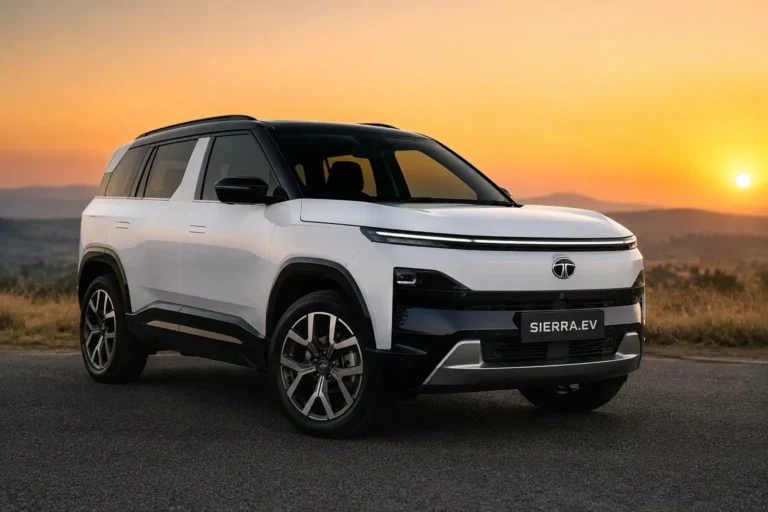

E20, E30 & E85 Flex-Fuel Cars in India Quick Overview
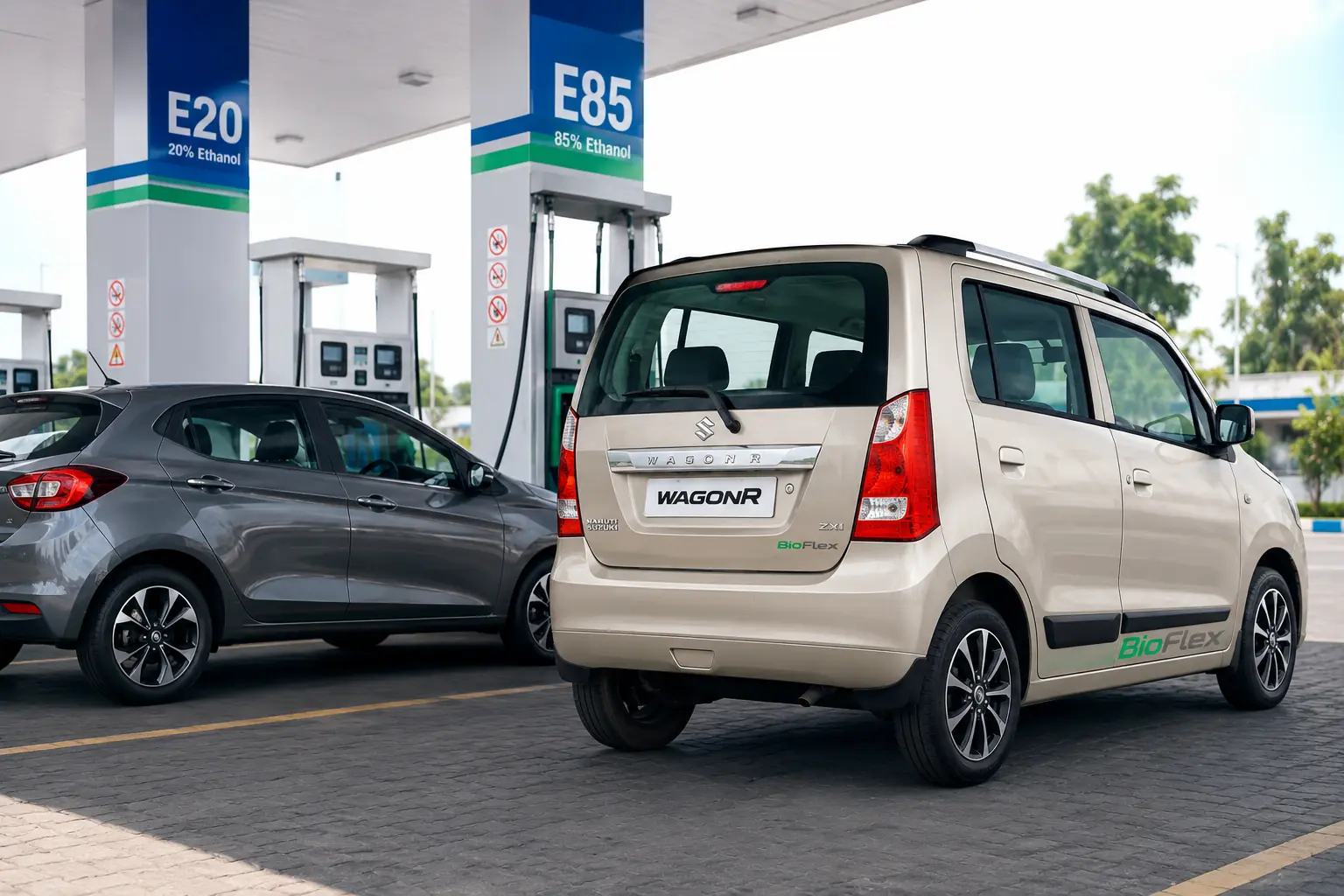
India’s automotive landscape has officially transitioned into the ethanol era. As of 2026, 100% of new petrol cars sold in India are E20 compliant (certified to run on a 20% ethanol-petrol blend) under BS6 Phase 2 mandates. Taking the strategy further, the Bureau of Indian Standards (BIS) has officially notified higher E30 blends, while ARAI has commenced rigorous 1,50,000 km pilot tests for E25 blends set to conclude by late 2027. Most crucially, India has crossed into the era of true Flex-Fuel Vehicles (FFVs) with the launch of the country’s first mass-market E85-homologated passenger car, the Maruti Suzuki WagonR BioFlex (₹7.24 Lakh), capable of running on any blend from E20 up to E100 (pure ethanol).
The Green Fuel Transition: Navigating E20 Compliant Fleets, Rising E30 Testing & The Reality of E85 Flex-Fuel
For the average Indian car buyer, filling up at a fuel station has quietly changed over the last few years. As India accelerates its biofuel roadmap to secure energy independence and reduce expensive crude oil imports, traditional pure petrol (E0) has vanished from commercial pumps.
However, this rapid transition has left buyers facing a highly technical puzzle. While every new showroom car handles standard E20 fuel perfectly, rumors of upcoming E25/E30 mandates have raised anxieties about long-term engine component corrosion. Furthermore, the arrival of true E85 Flex-Fuel cars promises cheaper pump prices but introduces a massive catch: a noticeable drop in overall fuel efficiency. Let’s look at the mechanical realities, the current vehicle lists, and the real financial math of ethanol driving in India.
1. The E20 Standard: 100% Showroom Readiness
If you are buying a brand-new petrol car today, it is fully E20 compatible from the factory floor. Automotive manufacturers successfully re-engineered their entire powertrain lineups to clear the BS6 Phase 2 transition deadline.
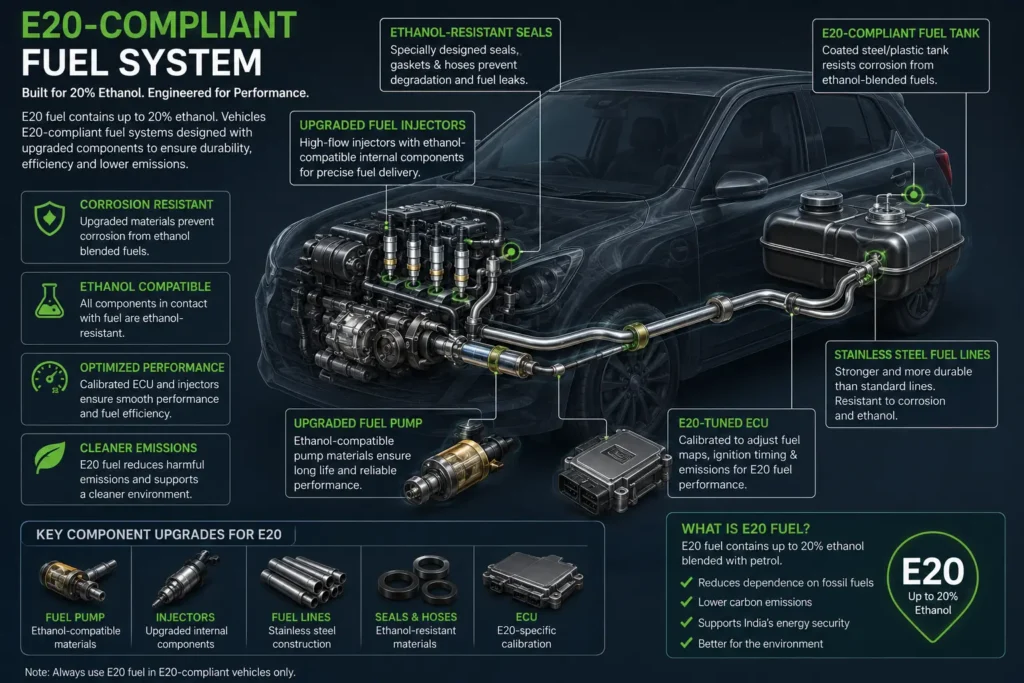
The E20 Component Overhaul:
Standard petrol causes zero issues in older cars, but ethanol is highly hygroscopic (it absorbs water) and corrosive to standard rubber and metals. To make their lineups E20-safe, manufacturers completely swapped out vulnerable components:
Material Upgrades: Fuel pumps, rubber fuel lines, seals, and gaskets were replaced with high-durability fluorocarbon elastomers and stainless steel.
Engine Hardening: Fuel injectors were redesigned with anti-clogging nozzles, and valve seats were hardened to handle the different combustion traits of ethanol.
ECU Remapping: Engine control units were recalibrated to dynamically alter ignition timing and fuel delivery loops.
Leading E20-Ready Fleets Across India:
| Manufacturer | Core E20-Compliant Model Lineups | Warranty Status |
| Maruti Suzuki | Swift, Baleno, Fronx, Brezza, Grand Vitara, Ertiga, Dzire, Elevate | Covered (All models post-April 2023) |
| Hyundai & Kia | i20 N Line, Exter, Venue, Creta, Verna, Seltos, Sonet, Carens | Covered (All current 1.2L & 1.5L engines) |
| Tata Motors | Tiago, Tigor, Punch, Altroz, Nexon, Curvv Petrol | Covered (Revotron & Hyperion engines) |
| VW & Skoda | Virtus, Taigun, Slavia, Kushaq (1.0 TSI & 1.5 TSI Layouts) | Covered (All BS6 Phase 2 deliveries) |
2. The Next Wave: E25 Pilots and E30 Notifications
The government isn’t stopping at E20. To further curb emissions, India is actively pushing toward higher ethanol percentages, creating a bridging roadmap:
The E30 BIS Notification: The Bureau of Indian Standards has officially notified and finalized the fuel quality specifications for blends up to E30. This serves as an industrial preparatory framework, signaling to carmakers the exact chemical baseline they must engineer engines for in the future.
The E25 ARAI Pilot Test: Led by the Automotive Research Association of India (ARAI), extensive 1,50,000-kilometer endurance pilot testing for E25 fuel is underway. Running through late 2027, this study explicitly monitors how higher ethanol percentages interact over long durations with existing E10 and E20 certified engines, ensuring safety before any nationwide mandates are passed.
3. The E85 Flex-Fuel Pioneers: Mass Market Launch
A true Flex-Fuel Vehicle (FFV) is completely separate from an E20 car. While an E20 car can handle up to 20% ethanol, an FFV packages a specialized Ethanol Sensor that reads the exact alcohol percentage in the tank in real time, adjusting the engine automatically to run on anything from E20 up to E85 or E100 (pure ethanol).
The Maruti Suzuki WagonR BioFlex
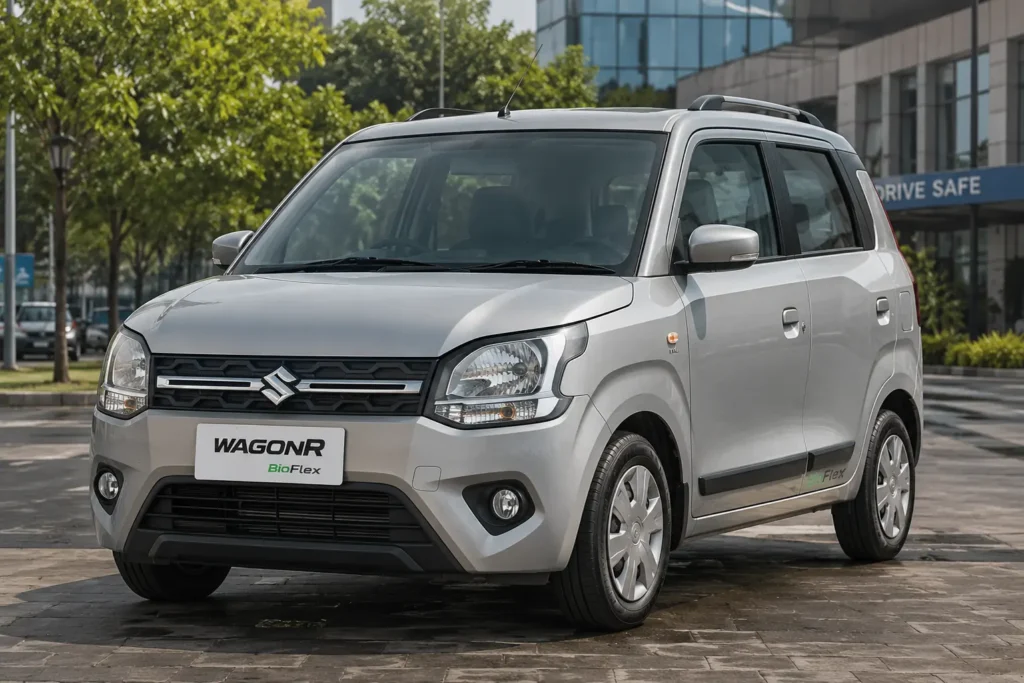
Making automotive history, Maruti Suzuki officially launched the WagonR BioFlex at ₹7.24 Lakh (ex-showroom), representing India’s very first commercially available mass-market flex-fuel car. Homologated specifically for E85 fuel, it commands a premium of roughly ₹74,000 over its standard petrol sibling due to heavily upgraded fuel injectors, a heated fuel rail (for cold starts), and an advanced corrosion-resistant fuel tank deck.
Showcased & Prototype Readiness:
Toyota Innova Hycross Flex-Fuel: Toyota is running highly publicised technology pilots with a prototype Hycross that marries an E85-compatible 2.0-litre engine with their efficient Strong Hybrid system to offset ethanol’s mileage penalty.
Tata Punch Flex-Fuel: Showcased as a production-ready prototype utilizing their reliable 1.2-litre engine platform modified with hardened fuel lines.
Two-Wheeler Space: Hero MotoCorp has commercialized the Splendor+ Flex Fuel and HF Deluxe Flex Fuel, joining Honda’s CB300F Flex Fuel motorcycle in supporting E85 infrastructure.
Honest Real-World Running Costs: The Ethanol Mileage Penalty
While ethanol sounds highly attractive because it is renewable and carries a cheaper pump price per liter, it has one major mechanical drawback: ethanol possesses roughly 30% lower energy density than pure petrol.
Let’s look at the actual financial math of driving a mass-market E85 car versus a standard E20 petrol car over a 1,200 km monthly city commute.
Scenario A: Standard E20 Petrol Commute
Average cost of standard E20 petrol: ₹102 per liter.
Real-world average city fuel mileage: 17.5 km/l.
Fuel required to clear 1,200 km: 68.5 Liters.
Monthly Fuel Bill: ~₹6,987 (Approx. ₹5.82 per km).
Scenario B: E85 Flex-Fuel Commute (The 25% Mileage Drop)
Average cost of commercial E85 pump fuel: ₹82 per liter (Subsidized rate).
Real-world city mileage on E85: Drops by 25% down to 13.1 km/l.
Fuel required to clear 1,200 km: 91.6 Liters.
Monthly Fuel Bill: ~₹7,511 (Approx. ₹6.25 per km).
The Reality Check: Because the engine must burn significantly more ethanol to produce the same power as petrol, the 25-30% drop in fuel efficiency completely wipes out the cheaper pump price. Without a massive price drop for E85, a flex-fuel car actually costs slightly more to run per kilometer.
Pros & Cons of the Ethanol Transition
Advantages
Substantial Macro Emission Reductions: Higher ethanol blending significantly cuts down tailpipe carbon monoxide and particulate matter emissions in dense cities.
National Energy Independence: Displacing crude oil with domestic, sugarcane-derived bio-ethanol saves billions in national foreign exchange reserves.
Decreased Engine Carbon Deposits: Ethanol burns exceptionally cleanly, leaving minimal carbon buildup on spark plugs and piston crowns over time.
Disadvantages
The Inescapable Mileage Drop: Higher blending percentages result in lower energy density, leading to reduced fuel economy for the end consumer.
Severely Limited E85 Infrastructure: While E20 petrol is universal, India currently has fewer than 60 commercial retail outlets dispensing E85 fuel, mostly clustered around Delhi-NCR and Maharashtra.
Initial Purchase Premium: True flex-fuel vehicles require specialized sensors and hardened components that drive up the vehicle’s initial showroom price tag.
Questions Buyers Commonly Ask about E20, E30 & E85 Flex-Fuel Cars in India
Will using E20 fuel void the warranty on an older car built before 2023?
No, it will not automatically void an existing extended warranty, but it comes with a major caveat. Vehicles manufactured prior to the April 2023 BS6 Phase 2 mandate were engineered around an E10 baseline. While using E20 occasionally won’t cause instant engine failure, long-term continuous use in non-compliant older cars can lead to accelerated degradation of fuel pump diaphragms and rubber hoses. If a failure is proven to be caused by material corrosion from unauthorized high-ethanol exposure, the specific part replacement will not be covered under warranty.
Can I mix E20 petrol and E85 fuel together in a Flex-Fuel car?
Yes, absolutely. That is the entire purpose of a authentic Flex-Fuel Vehicle like the WagonR BioFlex. The on-board ethanol sensor constantly measures the exact chemical ratio in the fuel line. If you fill half your tank with E20 and the other half with E85, the ECU instantly recalibrates the fuel injection timing on the fly to match the blended octane rating safely.
Why hasn’t the government launched retrofitting kits for older cars?
Converting an older car to be fully ethanol-safe is an incredibly complex engineering task. It isn’t just a software patch; it requires physically dropping the fuel tank to swap out all lines, replacing the fuel pump, updating the injectors, and installing a highly calibrated new ECU map. Because the physical labor and material costs would easily cross ₹40,000 per car, manufacturers and government bodies are focusing resources on natural fleet renewal rather than retrofitting older vehicles.
Final Verdict: Where Should You Put Your Money?
The transition to ethanol in India is an absolute reality, not a temporary experiment. If you are shopping for a standard petrol car, you can buy with complete confidence—every major carmaker has fully hardened their components to handle current E20 pump fuel seamlessly.
However, if you are looking at the newly arriving E85 Flex-Fuel vehicles, the current ecosystem demands caution. While the technology works flawlessly, the combination of a limited E85 refueling network outside of major metros and the lower fuel economy means these vehicles are currently suited for early adopters or corporate fleets within Delhi-NCR and Mumbai. Until the government establishes a wider network of E85 stations and drops ethanol prices further to offset the efficiency loss, traditional E20-ready petrol options or factory-fitted CNG lines represent a much safer, more predictable value proposition for your garage.
Helpful Resources for Indian Car Buyers
- Bharat NCAP Official Website — India’s official crash-testing and vehicle safety rating platform. Includes adult and child occupant scores, crash-test protocols, and tested vehicle lists.
- Global NCAP – Safer Cars for India — Global crash-test program that pushed Indian manufacturers toward safer vehicle structures and occupant protection standards.
- Reserve Bank of India (RBI) — Official source for repo rates, lending rules, and banking regulations in India. (rbi.org.in)
- TransUnion CIBIL — Check your credit score and track your loan eligibility before applying for a car loan.
- AutomotiveZone Mileage Cost Calculator — Estimate real fuel costs based on your driving mileage.
- AutomotiveZone Monthly Car Expense Calculator — Calculate total monthly car ownership cost including EMI, fuel, and maintenance.
- AutomotiveZone Fuel Cost Calculator — Instantly estimate petrol, diesel, or CNG expenses based on mileage, fuel price, and trip distance.
- AutomotiveZone EV vs Petrol Cost Calculator — Compare electric vehicle charging costs with petrol fuel expenses to see long-term savings.
- AutomotiveZone EV Charging Cost Calculator — Calculate home and fast-charging electricity costs for your EV using battery size and electricity tariff.
- AutomotiveZone Car Resale Value Estimator — Estimate your car’s current market resale value based on age, mileage, ownership, and condition.
Disclaimer: Prices, mileage, safety ratings, loan rates, and ownership costs are approximate and may vary by location, variant, and market conditions in 2026. Some visuals may be AI-generated for illustration. Please verify final details with authorized dealers before purchase.