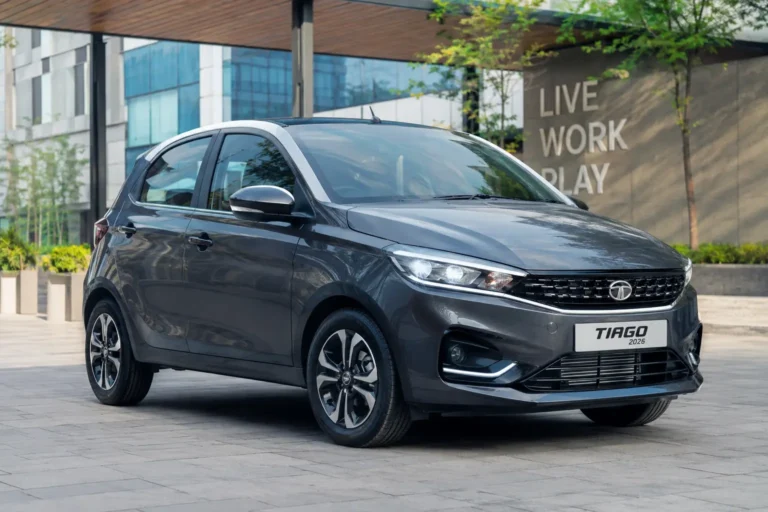

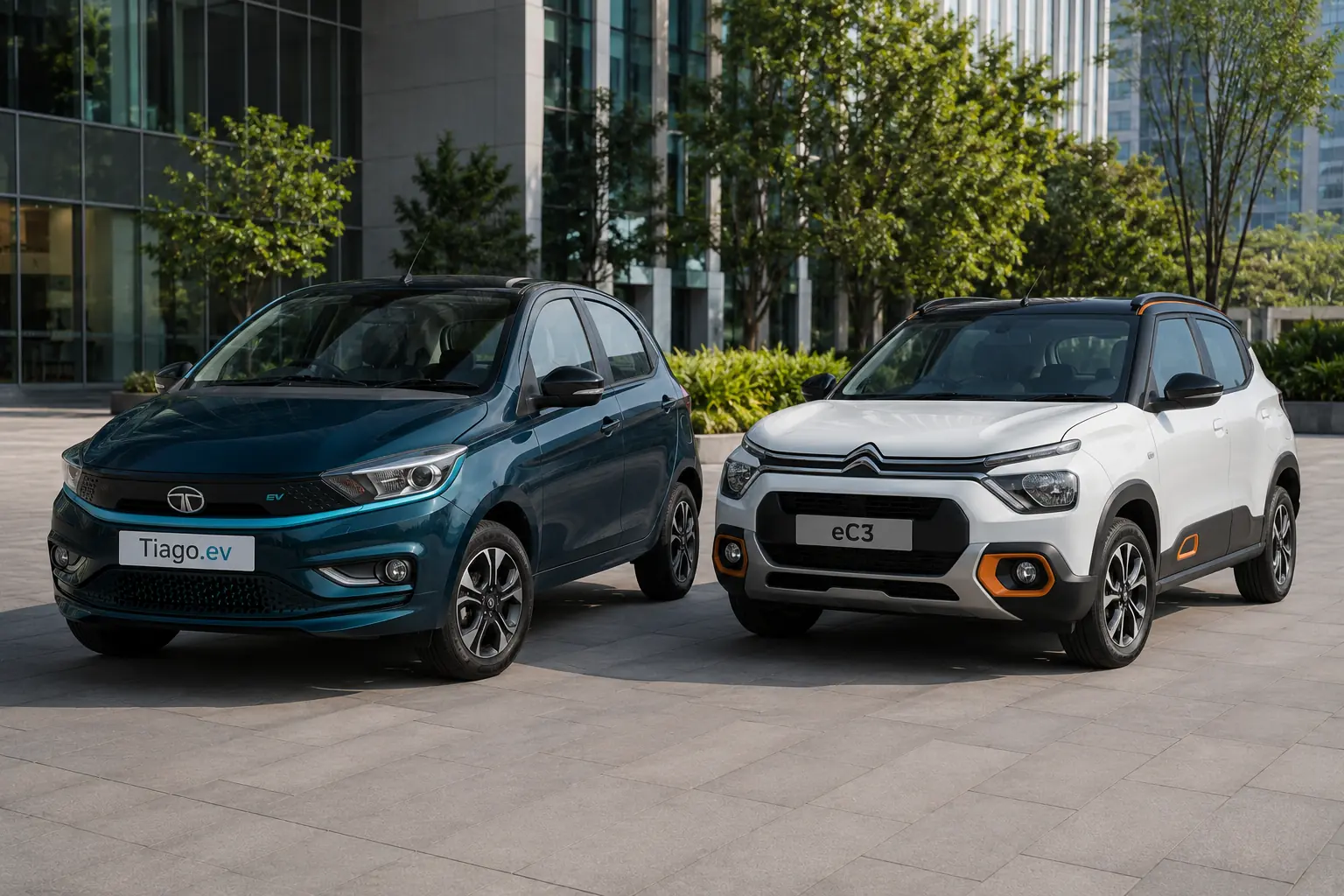

Tata Tiago EV Vs Citroen eC3 Quick Overview
Choosing between the 2026 Tata Tiago EV and the Citroen eC3 depends on whether you prioritize cutting-edge tech and safety over pure cabin space. The newly launched generation-update Tiago EV is aggressively priced from ₹6.99 Lakh to ₹9.99 Lakh, packing standard 6 airbags, a 360-degree camera, and a 24 kWh battery (285 km claimed range). Meanwhile, the Citroen eC3 sits a segment higher in price, stretching from ₹11.50 Lakh to ₹13.53 Lakh, offering a larger 29.2 kWh battery (320 km claimed range) and vastly superior rear-seat space, but severely lags in feel-good features, safety ratings, and highway performance.
Battle of the Budget EVs: Unpacking Tech, Real-World Range, Safety, and Everyday Value in the Ultimate Electric Hatchback Face-Off
In India’s rapidly expanding entry-level electric vehicle ecosystem, buyers are no longer forced to accept stripped-down experimental conversion cars. The sub-₹15 Lakh EV space has matured into a legitimate arena where distinct automotive philosophies collide. For daily city commuters and first-time EV households, the decision often narrows down to two popular, highly practical approaches to clean urban mobility.
On one side sits the freshly launched generation-update 2026 Tata Tiago EV. It treats the budget EV segment like a tech playground, wrapping a high-end digital dashboard, 360-degree camera logic, and robust safety tech inside a nimble, city-friendly footprint. On the opposite side stands the French contender, the Citroen eC3. It takes a distinct utility-first angle, opting for an oversized, crossover-like cabin, a larger battery pack, and a supple ride quality that iron out broken Indian infrastructure effortlessly.
If you are looking to plug a new electric hatchback into your garage, this comprehensive comparison breaks down the raw facts, hidden compromises, and real-world costs.
1. Product Context & Price Architecture
Tata Motors has strategically leveraged localized manufacturing efficiencies to offer an incredibly low entry barrier. Alternatively, the Citroen eC3 steps up into a higher financial tier, positioning itself as a larger sub-compact crossover hatchback.
Ex-Showroom Pan-India Pricing Framework:
| Variant Tier Baseline | Tata Tiago EV (2026 Generation Update) | Citroen eC3 (Crossover Hatch) |
| Base Model | ₹6.99 Lakh (Smart 19.2 kWh) | ₹11.50 Lakh (Live 29.2 kWh) |
| Mid-Tier Pack | ₹8.49 Lakh (Pure Plus 19.2 kWh) | ₹12.90 Lakh (Feel 29.2 kWh) |
| Long-Range Sweet Spot | ₹9.49 Lakh (Pure Plus 24.0 kWh) | — |
| Flagship Trim | ₹9.99 Lakh (Creative Plus 24.0 kWh) | ₹13.53 Lakh (Shine DT 29.2 kWh) |
The Battery Rental Alternative (Tata BaaS): To disrupt upfront pricing metrics even further, Tata offers the 2026 Tiago EV under a Battery-as-a-Service (BaaS) program. This slashes the initial acquisition sticker price down to ₹4.69 Lakh for the base variant, paired with a clean, low-cost battery rental metric of ₹2.60 per kilometer driven.
2. Battery Capacities, Real Range & Charging Reality
While laboratory test cycles promise high triple-digit perimeters, heavy real-world urban gridlock and constant climate control usage paint a more accurate picture.
Powertrain Engineering Metrics:
| Technical Parameter | Tata Tiago EV (Creative Plus) | Citroen eC3 (Shine Trim) |
| Battery Pack Chemistry | High-Density Liquid-Cooled LFP | Air-Cooled Lithium-Ion Pack |
| Battery Cell Capacity | 24.0 kWh (19.2 kWh Base) | 29.2 kWh Standard |
| Peak Electric Motor Power | 74 bhp (55 kW) | 56 bhp (42 kW) |
| Peak Instantaneous Torque | 114 Nm | 143 Nm |
| MIDC / ARAI Claimed Range | 285 km (223 km Base) | 320 km |
| True City Commuter Range | 195 km to 215 km | 210 km to 230 km |
| DC Fast Charging Target | 10% to 80% in 58 Mins (via 25 kW) | 10% to 80% in 57 Mins (via 30 kW) |
| Top Speed Ceiling | 120 kmph (Confidently tracks highway) | 107 kmph (Feels noticeably out of breath) |
While the Citroen eC3 packs a larger 29.2 kWh battery pack that stretches its real-world city perimeter slightly farther, its performance drops noticeably as speeds rise. The Tiago EV pulls cleanly up to 120 kmph, whereas the eC3 runs completely out of breath past 90 kmph, restricting its role strictly to low-speed inner-city lanes.
3. Technology Integration & Feature Architecture
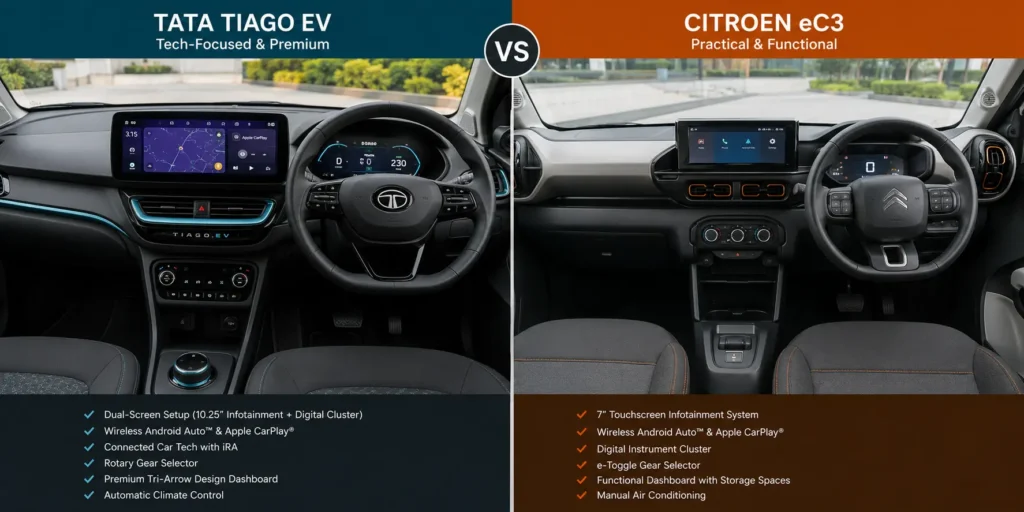
The starkest contrast between these two vehicles unfolds the moment you step inside the driver’s environment. The Tiago EV feels like an interactive smartphone workspace, whereas the eC3 leans on an old-school minimalist arrangement.
The Infotainment Cluster: The updated 2026 Tiago EV introduces a clean, split dashboard layout housing two distinct floating displays (a dedicated digital driver console alongside an interactive central media touchscreen). The Citroen eC3 counters with a wide, vibrant 10.2-inch touchscreen with wireless phone mirroring, but leaves the driver looking at a basic, low-cost black-and-white digital MID.
Parking & Sight Assist: The Tiago EV upgrades tight city parking safety by incorporating a 360-degree high-definition surround camera system complete with active blind-spot monitoring feed. The Citroen eC3 relies entirely on a standard rear parking sensor loop and basic camera lines.
Creature Comfort Elements: Opting for the top-spec Tata unlocks automated conveniences like automatic climate control, cruise control, push-button start, automatic LED projector headlamps, and rain-sensing wipers. The Citroen eC3 lacks these elements entirely—forcing you to adjust temperature settings manually via basic physical cables and mechanical keys.
4. Space, Comfort & Suspension Layout
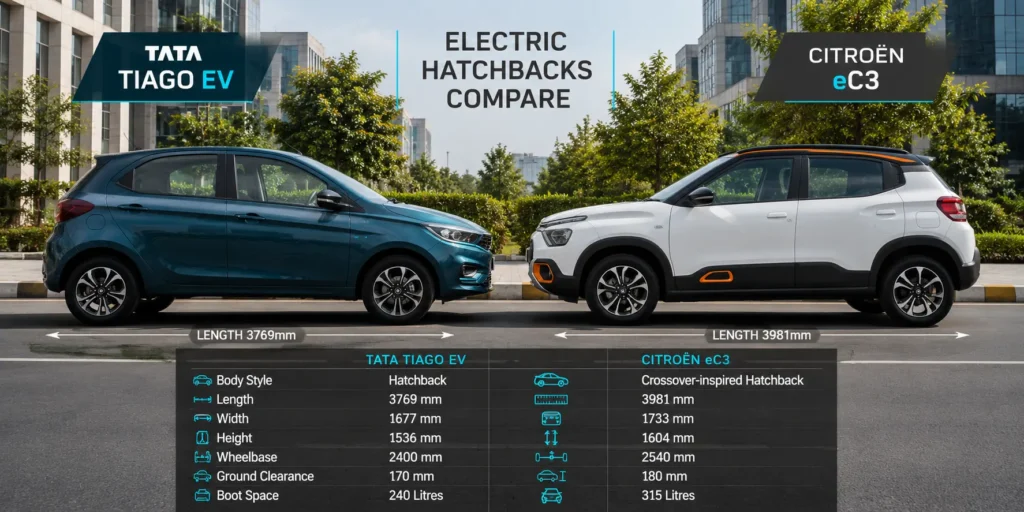
The Citroen eC3 hits back aggressively by leveraging its larger physical footprint to deliver superior cabin packaging and structural ride refinement.
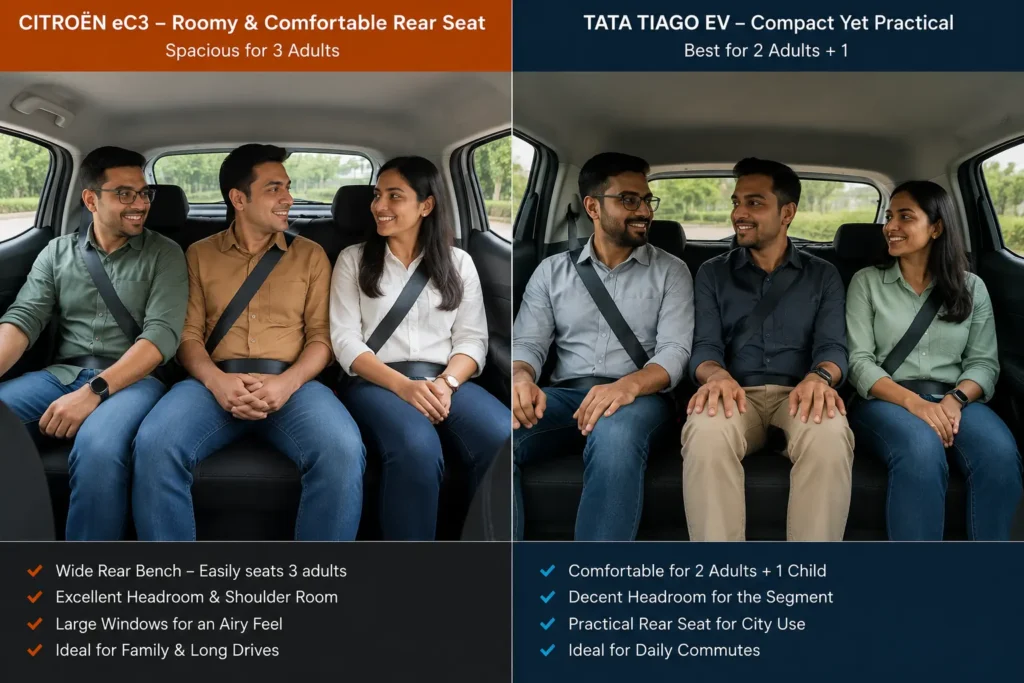
Rear-Seat Living Space: With a longer footprint and taller stance, the Citroen eC3 offers vastly superior rear legroom, generous knee clearance, and vertical headroom. It comfortably accommodates three adult passengers across its rear bench. The Tiago EV, while cozy for small families, feels noticeably tighter across the rear row shoulder track.
Cavernous Boot Capacity: The eC3 provides a spacious 315-liter boot floor volume that easily swallows large family travel cases. The Tiago EV packs a smaller trunk footprint, limiting cargo carrying potential.
The French Ride Identity: Citroen’s absolute masterstroke is its progressive suspension tune. It glides over sharp speed breakers, jagged concrete edges, and deep rural ruts with a smooth, cushiony composure that completely shields occupants, out-comforting the stiffer, firmly-sprung Tiago EV setup.
5. Structural Crash Safety Framework
Safety has evolved into a non-negotiable metric for modern Indian car buyers, and the variance between these two platforms represents a major deciding factor.
The Tata Safety Code: The 2026 Tiago EV comes comprehensively equipped with 6 standard airbags across all variants (including dual front, side, and curtain protection layouts), Electronic Stability Program (ESP), Tyre Pressure Monitoring (TPMS), and a proven high-strength steel crash shell aiming for a top-tier safety rating.
The Citroen Vulnerability: The Citroen eC3 scored a highly disappointing 0-Star rating in official Global NCAP crash testing cycles. It lacks side and curtain airbags entirely, offering only 2 basic front airbags and minimal electronic stability control intervention.
6. Real-World Running Costs vs Petrol Equivalents
Let’s calculate the monthly operational fuel bills for an urban commuter covering a standard cross-town distance of 1,200 km per month using home AC power charging.
Scenario A: 2026 Tata Tiago EV / Citroen eC3 (Home AC Charging Loop)
Average domestic power tariff: ₹8 per unit (住宅/kWh).
To fully charge a standard 24-29 kWh battery pack at home requires roughly ₹200 to ₹240 in electricity consumption.
With highly efficient electric regeneration systems active, covering 1,200 km per month demands roughly 5 to 6 full home charging cycles.
Monthly Power Bill: ~₹1,100 to ₹1,300 (Approx. ₹0.90 to ₹1.05 per km).
Scenario B: Traditional Petrol Automatic City Hatchback (Real-World 14 km/l)
Average cost of standard petrol fuel: ₹102 per liter.
Fuel required to clear 1,200 km in dense traffic: 85.7 Liters.
Monthly Fuel Bill: ~₹8,741 (Approx. ₹7.28 per km).
7. Final Verdict: Which EV Should You Buy?
Both electric hatchbacks are highly efficient city runabouts, but they target completely separate buyer priorities.
Choose the Citroen eC3 if:
Your absolute highest priority is maximizing rear-seat passenger space, luggage carrying capacity, and plush, sofa-like ride comfort over rough roads. If you plan to use the vehicle primarily as a spacious, low-speed, chauffeur-driven city text-shuttle where digital screen tech and high safety gear are secondary thoughts, the eC3’s large platform handles the physical duty well.
Choose the 2026 Tata Tiago EV if:
You want the smartest, safest, and highest value-for-money electric car available under a ₹10 Lakh budget. The updated Tiago EV completely outclasses its French rival by standardizing 6 airbags safety protection, a high-tech dual-screen dashboard, a 360-degree camera loop, and a crisp, highway-capable top speed ceiling. Combined with Tata’s vast public fast-charging telematics network and an unbeatable price structure that scales down even lower via the BaaS battery rental model, the Indian hatchback stands out as the definitive, clear winner for the modern tech-conscious family.
Helpful Resources for Indian EV Car Buyers
- Bharat NCAP Official Website — India’s official crash-testing and vehicle safety rating platform. Includes adult and child occupant scores, crash-test protocols, and tested vehicle lists.
- Global NCAP – Safer Cars for India — Global crash-test program that pushed Indian manufacturers toward safer vehicle structures and occupant protection standards.
- Reserve Bank of India (RBI) — Official source for repo rates, lending rules, and banking regulations in India. (rbi.org.in)
- TransUnion CIBIL — Check your credit score and track your loan eligibility before applying for a car loan.
- AutomotiveZone Mileage Cost Calculator — Estimate real fuel costs based on your driving mileage.
- AutomotiveZone Monthly Car Expense Calculator — Calculate total monthly car ownership cost including EMI, fuel, and maintenance.
- AutomotiveZone Fuel Cost Calculator — Instantly estimate petrol, diesel, or CNG expenses based on mileage, fuel price, and trip distance.
- AutomotiveZone EV vs Petrol Cost Calculator — Compare electric vehicle charging costs with petrol fuel expenses to see long-term savings.
- AutomotiveZone EV Charging Cost Calculator — Calculate home and fast-charging electricity costs for your EV using battery size and electricity tariff.
- AutomotiveZone Car Resale Value Estimator — Estimate your car’s current market resale value based on age, mileage, ownership, and condition.
Disclaimer: Prices, mileage, safety ratings, loan rates, and ownership costs are approximate and may vary by location, variant, and market conditions in 2026. Some visuals may be AI-generated for illustration. Please verify final details with authorized dealers before purchase.