
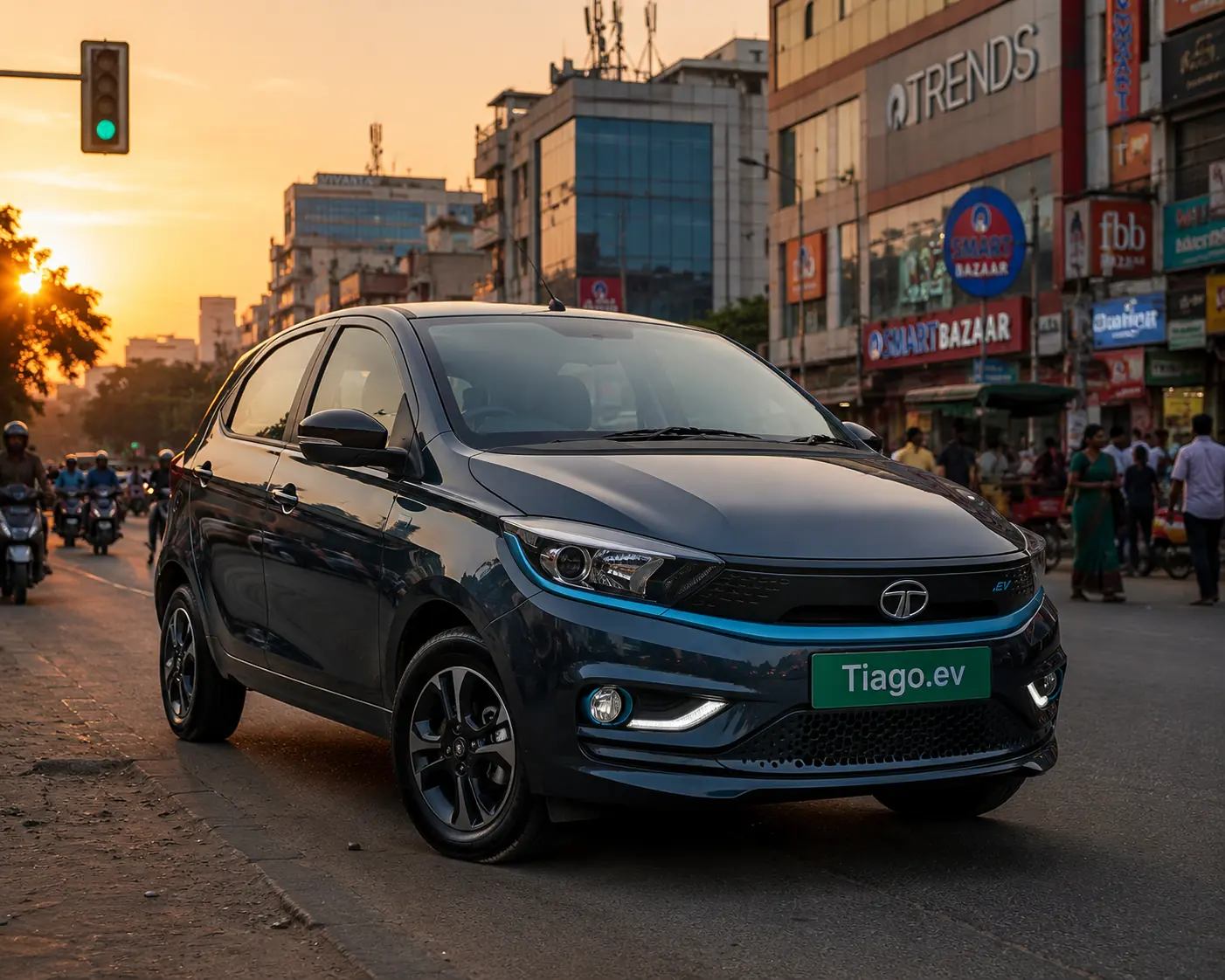

Tata Tiago EV Quick Overview
The 2026 Tata Tiago EV is India’s benchmark entry-level electric hatchback, priced between ₹7.99 Lakh and ₹11.14 Lakh (ex-showroom). Available in 19.2 kWh (Medium Range) and 24 kWh (Long Range) variants, it delivers a realistic real-world city range of 160 km to 215 km. Featuring a familiar interior layout with premium digital updates, it functions as an efficient, low-maintenance urban commuter.
Tata Tiago EV Price Guide 2026: Real-World Range, Interior, Running Cost & Verdict
While high-end electric coupe-SUVs grab headlines, the actual electric transition for most Indian households happens at a much more practical level. For the middle-class commuter trying to escape high petrol costs and heavy city traffic, the primary need is simple: a compact, automatic, and highly affordable urban runabout.
The Tata Tiago EV fills this gap perfectly. As the country’s most established electric hatchback, it does not attempt to mimic a futuristic spacecraft. Instead, it takes a trusted, highly safe family platform and infuses it with battery efficiency. In 2026, it remains the most sensible choice for buyers stepping away from traditional ICE vehicles into an electric lifestyle under ₹10 Lakh.
Why the Tata Tiago EV Dominates the Entry-Level Segment
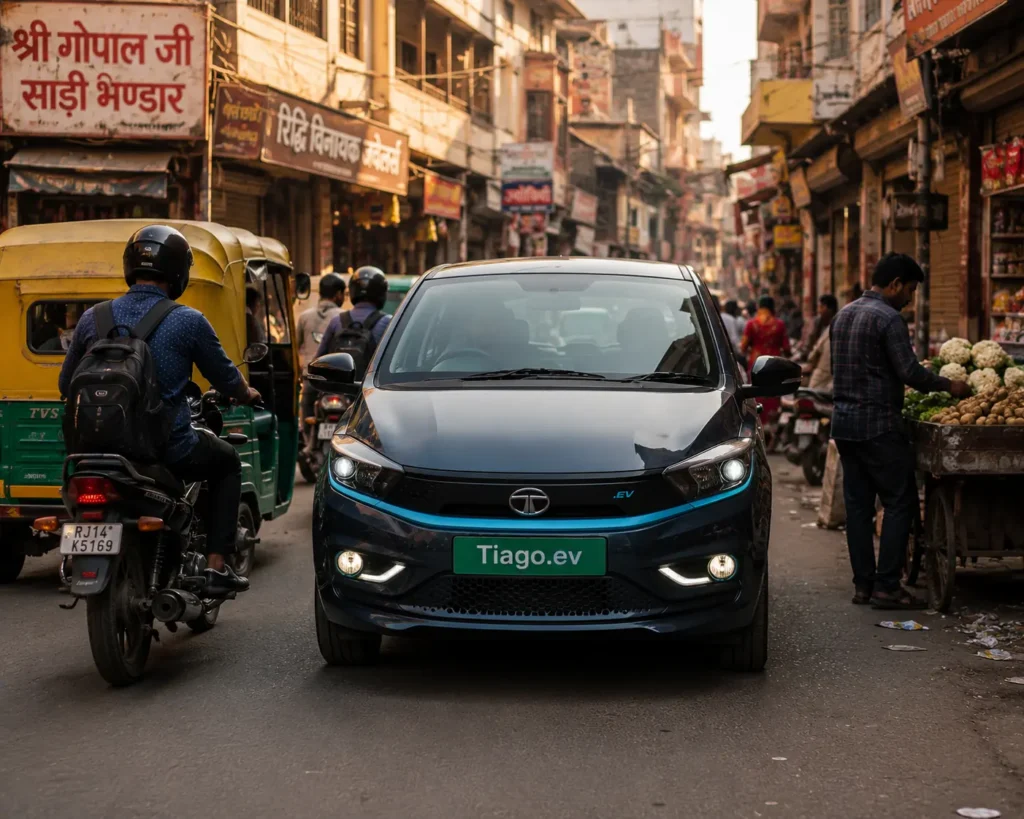
The core appeal of the Tiago EV is its lack of intimidation. For an individual transitioning from a scooter or an older manual petrol car, it offers an incredibly easy learning curve.
- Financial Shielding: With daily workplace commutes getting longer and petrol prices hovering around the ₹100–₹110 mark, the Tiago EV dramatically lowers daily operating expenses.
- The Urban Footprint: Measuring just 3,769 mm in length, it can easily slide into tight city parking bays and slip through narrow market lanes where larger SUVs get stuck.
- Proven Platform Safety: Built on a structurally sound architecture that holds a legacy 4-star Global NCAP pedigree, it provides peace of mind that lightweight, non-traditional micro-EVs cannot match.
Tata Tiago EV Price List & Variants (2026)
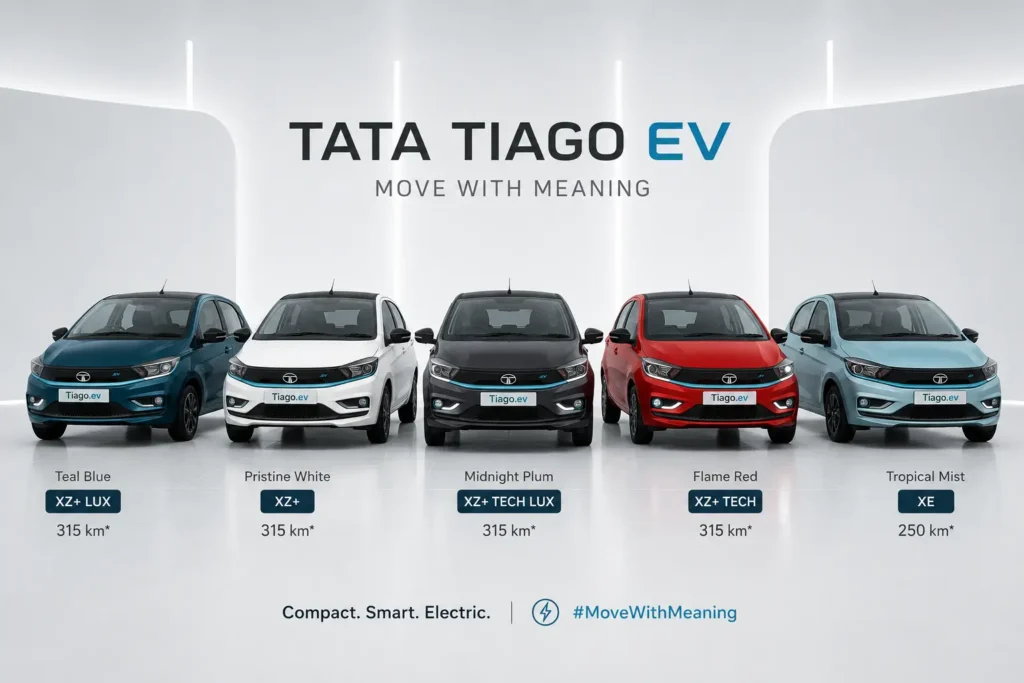
The portfolio is classified into two distinct operational setups: the Medium Range (MR) using a 19.2 kWh pack, and the highly recommended Long Range (LR) which bumps capacity to a 24 kWh pack.
| Variant Name | Battery Pack | Claimed MIDC Range | Ex-Showroom Price | Best Suited For |
| XE MR | 19.2 kWh | 250 km | ₹7.99 Lakh | Purely Fleet / Extreme Budget Buyers |
| XT MR | 19.2 kWh | 250 km | ₹8.99 Lakh | Strict City Commuters / Second Car |
| XT LR | 24.0 kWh | 315 km | ₹10.14 Lakh | The Value Sweet Spot for Most Families |
| XZ Plus Tech LUX LR | 24.0 kWh | 315 km | ₹11.14 Lakh | Feature-First Buyers wanting Top Comfort |
To give you a highly factual, granular breakdown of India’s most popular electric hatchback, here are the official technical specifications for both the Medium Range (MR) and Long Range (LR) variants of the 2026 Tata Tiago EV.
Tiago EV Electric Drivetrain & Performance
The Tiago EV utilizes Tata’s high-voltage Ziptron architecture. It features a Permanent Magnet Synchronous Motor (PMSM) that sends power directly to the front wheels.
| Parameter | Medium Range (MR) | Long Range (LR) |
| Motor Type | Permanent Magnet Synchronous Motor | Permanent Magnet Synchronous Motor |
| Battery Capacity | 19.2 kWh (High energy density) | 24.0 kWh (High energy density) |
| Battery Cell Chemistry | Lithium Iron Phosphate (LFP) | Lithium Iron Phosphate (LFP) |
| Maximum Power | 45 kW (60.3 bhp) | 55 kW (73.8 bhp) |
| Maximum Torque | 110 Nm (Instant) | 114 Nm (Instant) |
| Drive Modes | City & Sport | City & Sport |
| Regenerative Braking | 4 Levels (Level 0 – 1 – 2 – 3) | 4 Levels (Level 0 – 1 – 2 – 3) |
| Acceleration (0-60 km/h) | 6.2 Seconds | 5.7 Seconds |
| Ingress Protection (IP) | IP67 Certified (Battery & Motor) | IP67 Certified (Battery & Motor) |
| Thermal Management | Liquid Cooled | Liquid Cooled |
Tiago EV Dimensions & Capacities
The Tiago EV retains the exact structure of its petrol sibling, meaning it fits perfectly into narrow streets and tight parking spaces.
| Parameter | Measurement |
| Overall Length | 3,769 mm |
| Overall Width | 1,677 mm |
| Overall Height | 1,536 mm |
| Wheelbase | 2,400 mm |
| Unladen Ground Clearance | 165 mm |
| Boot Space Capacity | 240 Liters (Without Parcel Shelf) |
| Turning Circle Radius | 5.1 Meters |
| Seating Capacity | 5 Seater |
| Kerb Weight | 1,235 kg (Long Range) |
Tiago EV Driving Range & Charging Timelines
The real-world range is derived from typical Indian urban environments using the standard C75 test protocol.
| Parameter | Medium Range (MR) | Long Range (LR) |
| MIDC Certified Range | 250 km / charge | 315 km / charge |
| C75 Real-World Range | ~160 – 165 km | ~210 – 215 km |
| 15A Home Socket (10-100%) | ~6.9 Hours | ~8.7 Hours |
| 3.3 kW AC Wall Box (10-100%) | ~6.9 Hours | ~8.7 Hours |
| 7.2 kW AC Fast Charger (10-100%) | N/A | ~3.6 Hours |
| 25 kW DC Fast Charger (10-80%) | ~58 Minutes | ~58 Minutes |
| Charging Port Standard | CCS2 (Combined Charging System) | CCS2 (Combined Charging System) |
Tiago EV Chassis, Suspension & Braking
The suspension setup is slightly stiffened compared to the petrol model to offset the added weight of the under-floor battery cells.
- Front Suspension: Independent MacPherson Strut with Coil Spring and dual-path struts.
- Rear Suspension: Semi-independent Twist Beam with dual-path hydraulic shock absorbers.
- Front Brakes: Disc brakes with brake disc wiping feature.
- Rear Brakes: Drum brakes.
- Tyre Profile: 175/65 R14 (Low rolling resistance radial tubeless).
- Wheel Type: 14-inch Steel rims (Hyperstyle wheel covers on top trims).
- Steering Type: Electric Power Assisted Steering (EPAS) with manual tilt adjustment.
Tiago EV Structural Safety & Electronics
The car is built on a high-strength steel platform designed to absorb crash loads efficiently.
- Safety Rating: 4-Star Global NCAP (Legacy Platform Validation).
- Braking Safety: ABS with Electronic Brakeforce Distribution (EBD) and Corner Stability Control (CSC).
- Airbags: 2 Standard Front Airbags (Driver and Co-driver).
- Aids: Hill Hold Assist, Reverse Parking Sensors, and a HD Rear View Camera with dynamic guidelines.
- Tyre Tech: Tyre Pressure Monitoring System (TPMS) and standard puncture repair kit.
Tiago EV Factory Warranty Coverage
- Battery Pack & Motor Warranty: 8 Years or 1,60,000 km (Whichever comes first).
- Standard Vehicle Warranty: 3 Years or 1,25,000 km (Whichever comes first).
Cabin Architecture & Interior Quality
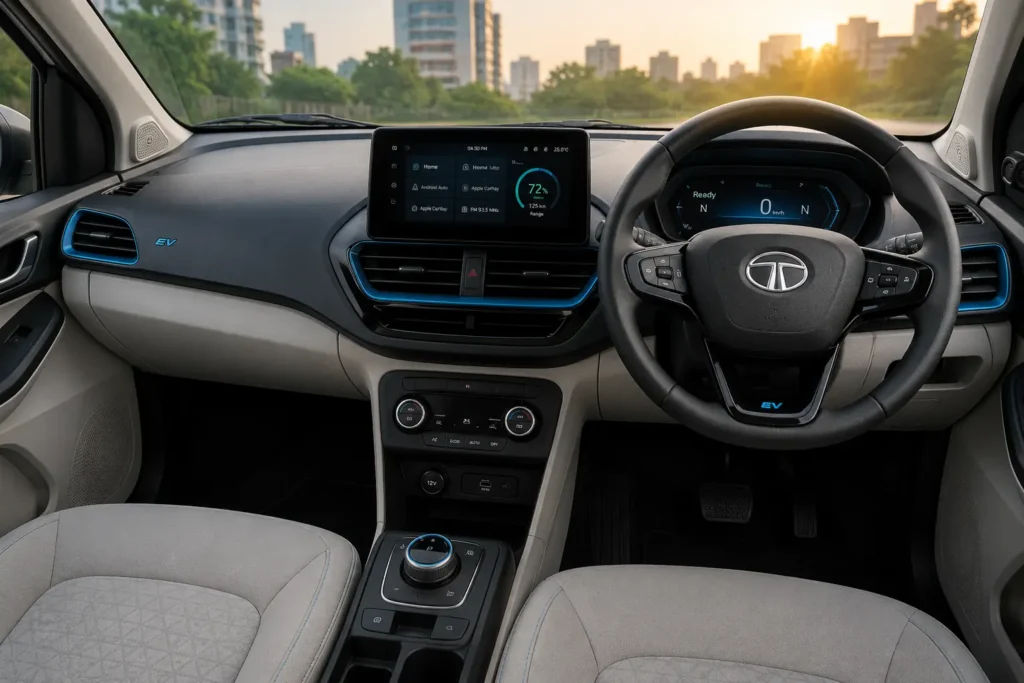
Step inside the Tiago EV, and you are greeted by an interior that feels highly familiar yet modern. Tata has retained the sensible, user-friendly layout of the standard Tiago but added subtle EV elements.
1. Aesthetic Highlights & Material Choice
The cabin drops boring monochromatic shades for a premium dual-tone black and off-white theme. Striking electric blue accents outline the side air vents and digital gauge clusters, serving as a constant visual reminder of its clean energy underpinnings. On the top-spec Tech LUX trims, you get plush perforated leatherette upholstery with intricate blue stitching, giving the interior a premium lift.
2. Infotainment & Sound Setup
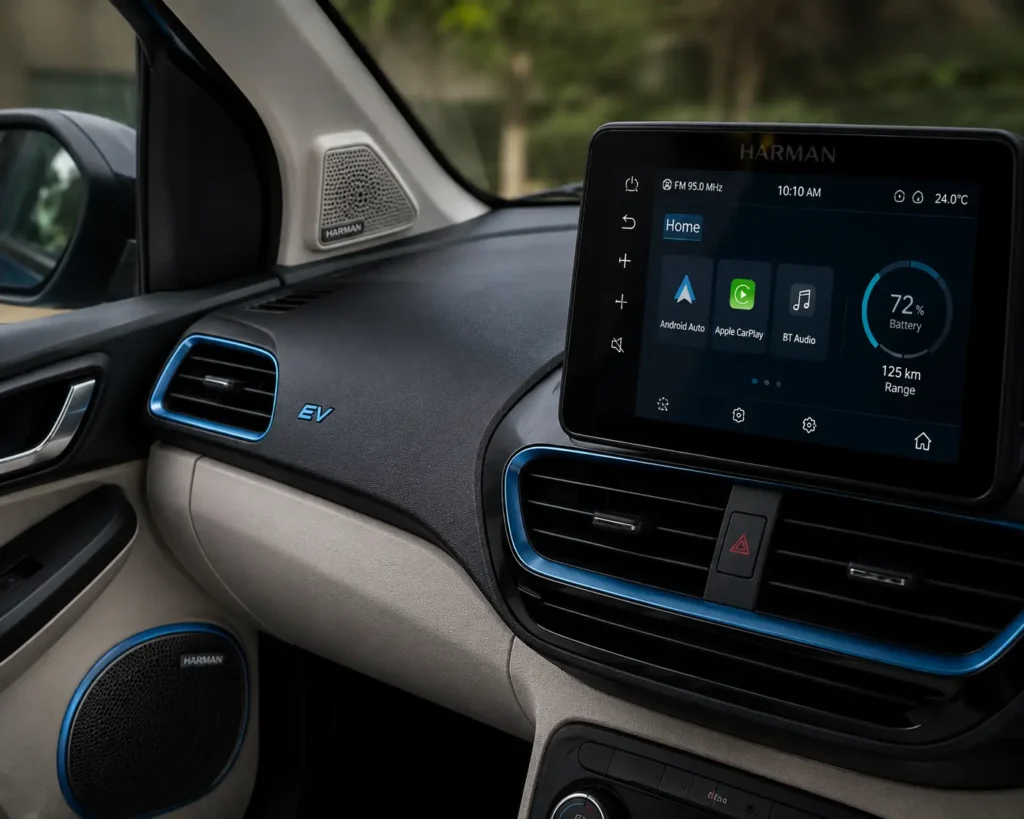
The center console houses a 7-inch floating touchscreen infotainment system running Apple CarPlay and Android Auto. While the screen user interface feels a bit dated compared to newer smartphones, it handles navigation and media calls seamlessly. The true star of the interior is the 4-speaker, 4-tweeter Harman audio system, which delivers deep, rich sound quality that easily beats everything else in the budget segment.
3. Space & Packaging Reality
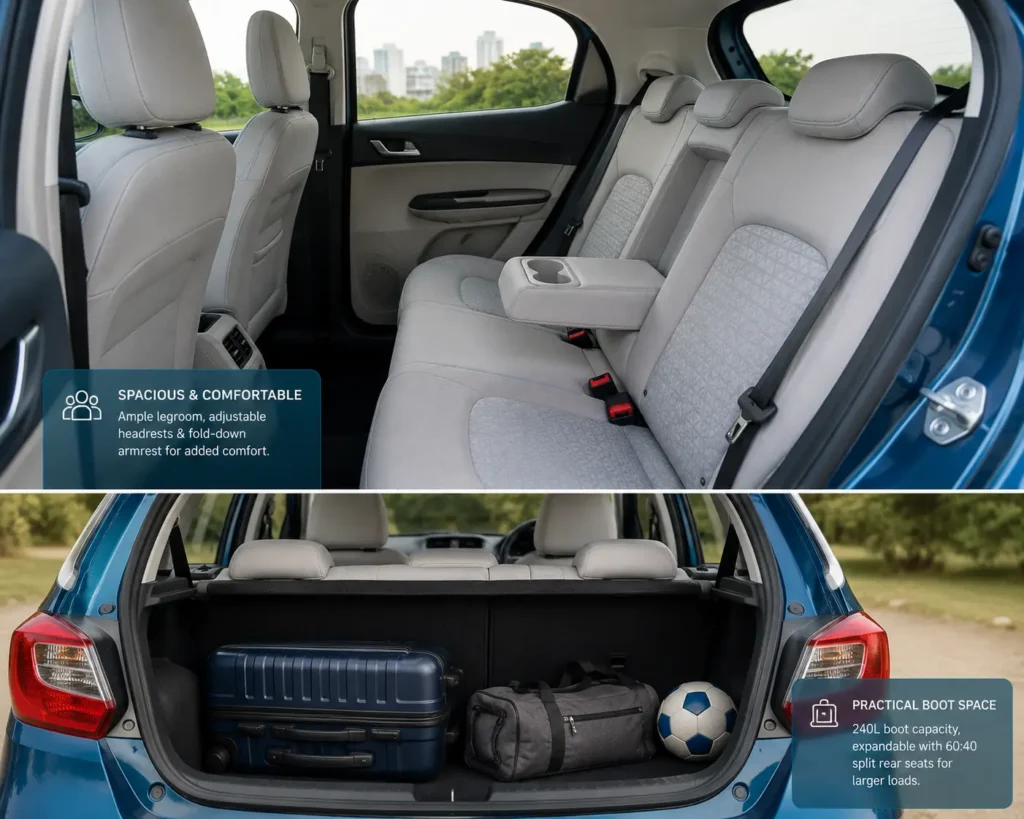
Up front, the seats are snug and offer good under-thigh support. In the rear, knee room is quite decent for two average-sized adults, though seating three abreast is a tight squeeze.
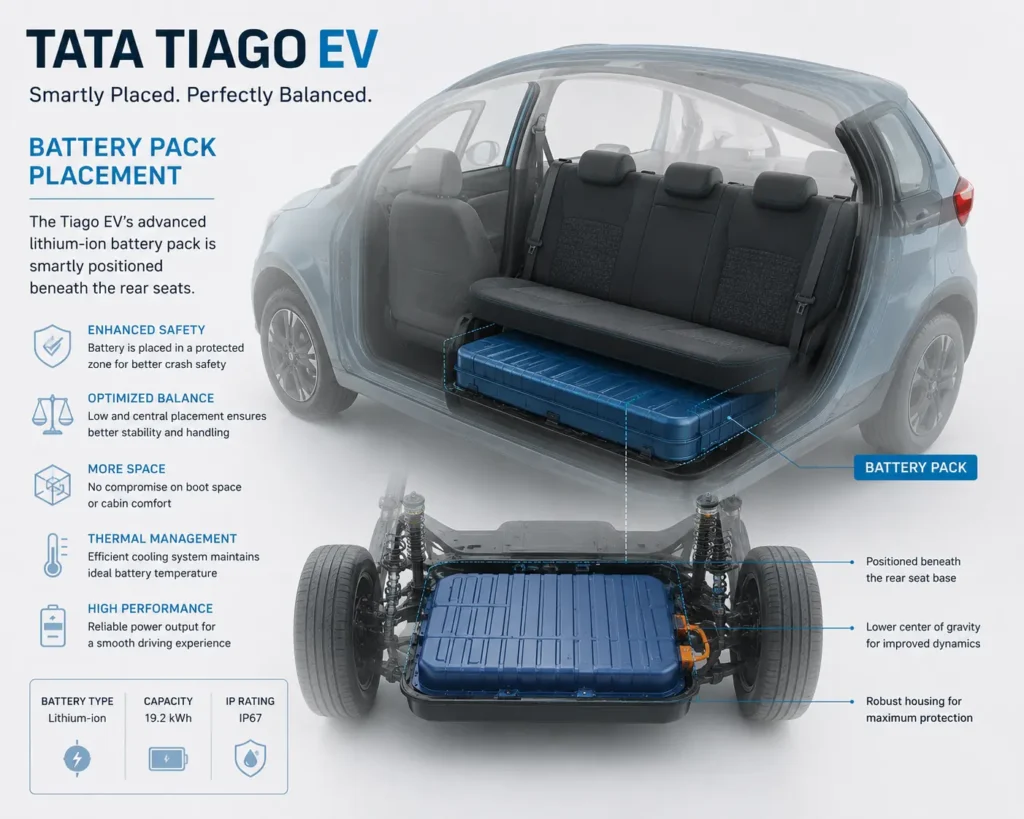
Importantly, Tata has cleverly packaged the liquid-cooled battery pack beneath the rear seats, meaning floor height remains completely unchanged from the petrol model—no awkward “knees-up” seating position here. The boot retains a functional 240-liter cargo capacity, though the traditional spare wheel is replaced by an on-board temporary puncture repair kit to maximize battery space.
Real-World Range & Charging Experience
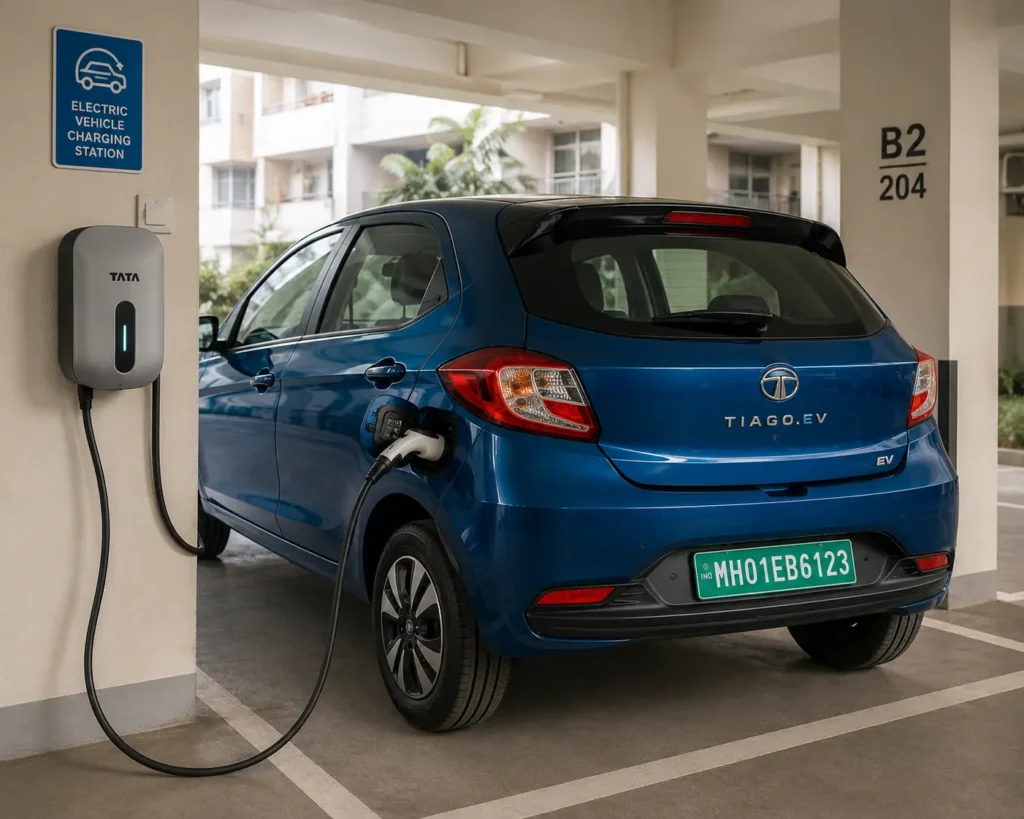
The difference between laboratory range testing and the reality of Indian driving conditions requires an honest look.
Real Urban Range Expectations
- The 19.2 kWh (Medium Range): Delivers a realistic city range of 160 km to 170 km on a full charge.
- The 24.0 kWh (Long Range): Delivers a highly dependable real-world range of 210 km to 215 km in mixed urban conditions.
The car uses a clever 4-level regenerative braking setup (Level 0 to Level 3) controlled via dashboard keys. In heavy, stop-and-go city traffic, setting it to Level 3 allows you to recapture massive kinetic energy during deceleration, maximizing your efficiency. However, highway cruising at speeds past 90 km/h pushes aerodynamic drag high and quickly drops your range. In peak summer months, running the automatic climate control continuously lowers overall system efficiency by roughly 12%.
The Charging Habit
- 15A Home Socket: Standard emergency replenishment takes about 6.9 hours (MR) to 8.7 hours (LR) via a regular wall plug.
- 7.2 kW AC Wall Fast Charger: Fully tops up the Long Range battery pack at home in a swift 3.5 hours.
- Public DC Fast Charging: Utilizing a standard 25 kW public terminal juices the cells from 10% to 80% in 58 minutes, making brief inter-city hops possible with pre-planned stops.
Tata Tiago EV Running Cost vs Petrol Hatchbacks
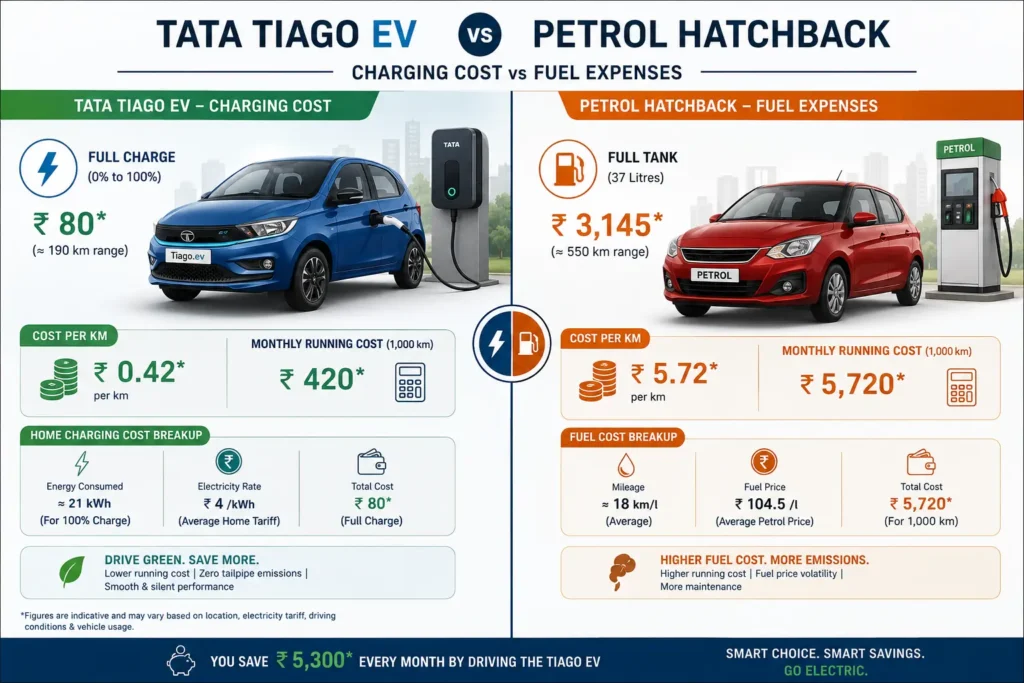
Let’s calculate the real operational math for a typical urban family covering 1,200 km per month.
Scenario A: The Tiago EV Operation (24 kWh Long Range)
- Average urban domestic power tariff: ₹8 per unit (kWh).
- Fully replenishing the 24 kWh pack requires roughly 26 units of electricity (accounting for minor transmission line drop-off), costing ₹208.
- Covering 1,200 km requires roughly 6 home charging cycles.
- Monthly Power Bill: ~₹1,248 (Approx. ₹1.04 per km).
Scenario B: Standard Petrol Automatic Hatchback
- Average cost of standard fuel: ₹102 per liter.
- Real-world urban fuel economy for a petrol AMT: 14 km/l.
- Fuel needed for 1,200 km: 85.7 Liters.
- Monthly Fuel Bill: ₹8,741 (Approx. ₹7.28 per km).
5-Year Cumulative Fuel Cost Savings
[Petrol Hatchback Fuel Outgo: ₹8,741/mo]
====> 5-Year Total: ₹5.24 Lakh
[Tiago EV Electricity Outgo: ₹1,248/mo]
==> 5-Year Total: ₹0.75 Lakh
-------------------------------------------------------------------------
Net Operational Household Savings: ₹4.49 Lakh
Maintenance & Long-Term Ownership Cost

Because the electric motor features only a fraction of the moving parts found in a combustion engine, there are no timing belts, engine oil cycles, spark plugs, or complex gearboxes to service.
- Routine Servicing: Annual scheduled periodic service focuses purely on cabin air filter replacement, wheel alignments, diagnostic software scans, and fluid top-ups. Average bills range comfortably between ₹2,000 and ₹3,500.
- Battery Durability: Tata covers the high-energy density battery pack and the motor with a robust 8-year or 1,60,000 km warranty. The entire assembly carries an IP67 weatherproof rating, isolating it entirely from rain, waterlogging, dust, and environmental thermal cycles.
Tata Tiago EV Pros & Cons
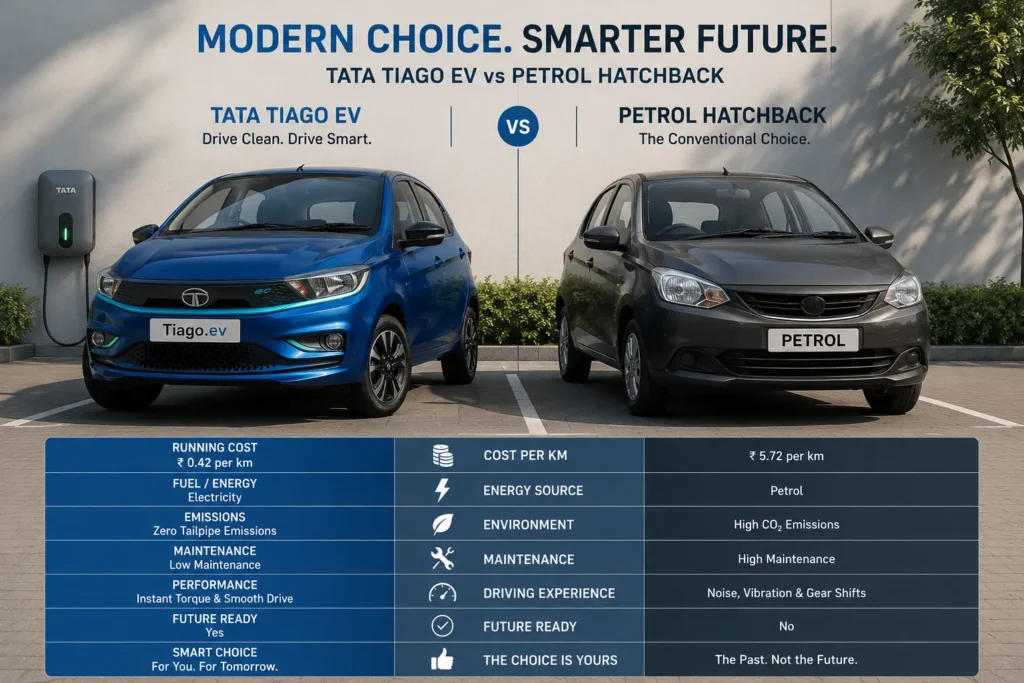
Advantages
- Highly Economical: Drops per-kilometer driving costs to an unbeatable ₹1.04 when using home electricity.
- Premium Cabin Audio: The 8-speaker Harman sound system delivers best-in-class audio performance.
- Effortless City Agility: Light electric power steering and a compact turning radius make parking simple.
- Comfortable Floor Layout: Clever battery packaging protects rear legroom and passenger comfort.
- Regen Adjustability: Simple steering-mounted paddle inputs allow customization of energy harvesting on the fly.
Disadvantages
- Highway Range Limitations: Sustained fast driving drains battery reserves quickly, making it a strict city car.
- Firm Suspension Feel: Tuned slightly firm to handle the 1,200 kg kerb weight over sharp potholes.
- Infotainment Interface: The 7-inch screen looks slightly dated compared to slick modern options.
- Rear Bench Width: The cabin layout is tight if you plan to carry three adults in the rear seat regularly.
Who Should Buy the Tata Tiago EV?

Recommended For:
- Daily Office Commuters: Ideal for professionals facing a predictable 40–60 km daily cross-city trip through dense bumper-to-bumper traffic.
- Nuclear Urban Households: Functions beautifully as a hassle-free secondary family car for local school drops and grocery runs.
- Budget-Conscious EV Adopters: Perfect for those wanting to try electric mobility under a strict ₹10 Lakh budget.
Not Recommended For:
- Frequent Intercity Highway Travelers: Long highway charging stops add significant time to tight travel schedules.
- Apartment Residents Lacking Private Power Points: Relying purely on public DC commercial stations lowers convenience and increases operational costs.
Compare the Tata Tiago EV Before You Buy
Confused between the Tata Tiago EV, Tata Punch EV, MG Windsor EV, or Tata Nexon EV? Compare real-world range, charging time, running cost, boot space, features, and pricing side-by-side before making your decision.
Compare EV Hatchbacks & SUVs →Questions Buyers Commonly Ask about Tata Tiago EV
What is the real starting price of the Tata Tiago EV?
The entry-level XE Medium Range variant starts at ₹7.99 Lakh ex-showroom. On-road prices across major metros range between ₹8.4 Lakh and ₹11.8 Lakh depending on state registration policies.
What is the true real-world range of the Tiago EV Long Range?
While the official laboratory claim stands at 315 km, actual real-world city usage with the air conditioning running consistently delivers a highly dependable 210 km to 215 km.
How long does it take to charge the Tiago EV battery at home?
Using a regular 15A three-pin household plug takes roughly 8.7 hours to charge the 24 kWh version from 10% to 100%. A 7.2 kW AC fast home box cuts that time down to just 3.5 hours.
Is the interior comfortable for senior citizens?
Yes. Since the battery pack is tucked away underneath the rear bench, the seat height and floor layout remain at a natural angle, ensuring easy entry and exit for elderly family members.
Is the Tiago EV cheaper to run than a CNG car?
Yes. While factory CNG cars cost around ₹3.50–₹4.00 per kilometer to run, the Tiago EV drops that running cost to roughly ₹1.04 per kilometer when charged at home.
Final Verdict: Is the Tata Tiago EV Worth Buying in 2026?
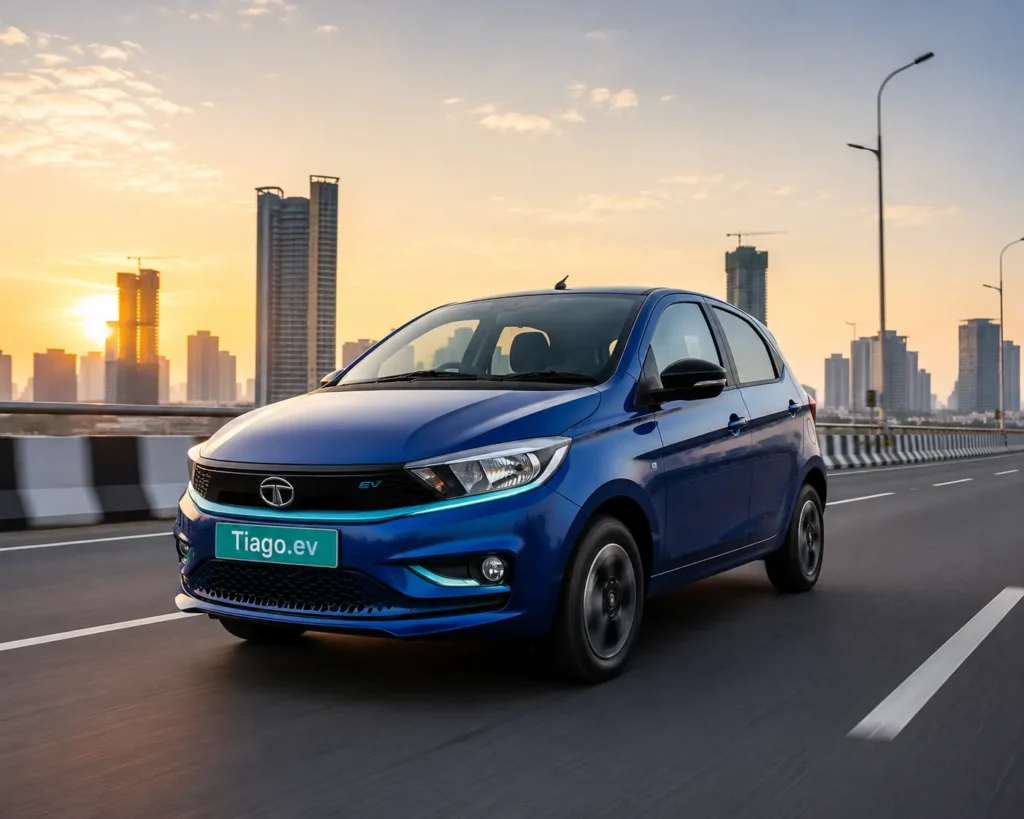
The Tata Tiago EV makes complete financial and practical sense if you use it as intended: a dedicated, high-utilization urban tool. It doesn’t rely on flashy screens or concepts to close a sale; instead, it offers real cabin comfort, a fantastic sound system, a proven safety structure, and exceptionally predictable running costs.
If you have a dedicated, secure parking spot to plug your car in overnight and a daily commute that regularly crosses city limits, it is one of the smartest investments you can make to lower your household transportation bills. However, if your budget requires a single vehicle to handle unexpected 500 km interstate highway journeys with a full load of luggage, sticking to a conventional petrol model or stretching for a larger battery remains the more practical route. Ultimately, let your real-world daily mileage guide your final choice.
Helpful Resources for Indian EV Car Buyers
- Bharat NCAP Official Website — India’s official crash-testing and vehicle safety rating platform. Includes adult and child occupant scores, crash-test protocols, and tested vehicle lists.
- Global NCAP – Safer Cars for India — Global crash-test program that pushed Indian manufacturers toward safer vehicle structures and occupant protection standards.
- Reserve Bank of India (RBI) — Official source for repo rates, lending rules, and banking regulations in India. (rbi.org.in)
- TransUnion CIBIL — Check your credit score and track your loan eligibility before applying for a car loan.
- SBI Car Loans — View latest interest rates, eligibility criteria, and loan offers from State Bank of India.
- HDFC Bank Car Loans — Explore car loan options, EMIs, and financing plans from HDFC Bank.
- ICICI Bank Car Loans — Compare new and used car loan offers along with repayment options.
- Policybazaar Car Insurance — Compare insurance plans, premiums, and add-on coverage options in one place.
- Acko Car Insurance — Get quick online quotes and renewal estimates for car insurance.
- AutomotiveZone Mileage Cost Calculator — Estimate real fuel costs based on your driving mileage.
- AutomotiveZone Monthly Car Expense Calculator — Calculate total monthly car ownership cost including EMI, fuel, and maintenance.
- AutomotiveZone Fuel Cost Calculator — Instantly estimate petrol, diesel, or CNG expenses based on mileage, fuel price, and trip distance.
- AutomotiveZone EV vs Petrol Cost Calculator — Compare electric vehicle charging costs with petrol fuel expenses to see long-term savings.
- AutomotiveZone EV Charging Cost Calculator — Calculate home and fast-charging electricity costs for your EV using battery size and electricity tariff.
- AutomotiveZone Car Resale Value Estimator — Estimate your car’s current market resale value based on age, mileage, ownership, and condition.
Disclaimer: Prices, mileage, safety ratings, loan rates, and ownership costs are approximate and may vary by location, variant, and market conditions in 2026. Some visuals may be AI-generated for illustration. Please verify final details with authorized dealers before purchase.
Calculate Tata Tiago EV Charging Cost
Want to know how much the Tata Tiago EV really costs to charge every month? Estimate home charging expenses, electricity cost per kilometer, and real-world EV savings based on your driving usage and local electricity tariff.
Compare the Tiago EV’s charging cost against petrol hatchbacks and see how much you can save annually on daily city commutes.
Calculate Tiago EV Charging Cost →