
Yamaha RX 100 Quick Overview
The legendary Yamaha RX 100 remains one of the most anticipated nameplate revivals in Indian motorcycling history, with an estimated launch window pointing toward late 2026 or early 2027 at an expected price of ₹1.25 Lakh to ₹1.50 Lakh (ex-showroom). Because modern emission norms strictly ban the original raw, smoke-spewing two-stroke engines, Yamaha is exploring a clean, high-performance 4-stroke fuel-injected layout (speculated to sit between 125cc and 155cc) engineered to mimic the featherweight agility and punchy character of the original icon.
Yamaha RX 100 Relaunch Guide: Expected Engine Strategy, Retro Tech, Estimated Running Costs & Reality Check
In the modern commuter motorcycle landscape, today’s 100cc to 125cc options approach daily transport as a highly practical, low-vibration calculation. While they deliver exceptional double-digit mileage figures and bulletproof reliability, they often lack the raw mechanical soul, dramatic initial acceleration burst, and lightweight handling thrill that defined the golden era of Indian performance biking.
The mere mention of the Yamaha RX 100 instantly evokes pure automotive nostalgia. From 1985 to 1996, this sub-100cc two-stroke rocket single-handedly ruled Indian streets, establishing itself as an absolute legend due to its lightning-fast acceleration and distinctive, high-pitched exhaust notes.
However, resurrecting a legend in 2026 introduces massive engineering hurdles. To satisfy stringent BS6 Phase 2 emission standards and mandatory safety codes, Yamaha cannot simply reproduce the old machine. Instead, the upcoming project aims to carefully balance classic vintage lines with modern, high-voltage four-stroke efficiency.
The Ultimate Dilemma: Recreating a Two-Stroke Soul in a Four-Stroke Era
Resurrecting the RX 100 is an incredibly complex engineering task because its original formula goes completely against modern environmental laws:
The Two-Stroke Restriction: The original 98cc engine delivered an explosive power burst because it fired on every single crankshaft rotation. Modern environmental laws require cleaner four-stroke engines, which fire on every second rotation, making it highly difficult to mimic that instant throttle snap.
The Power-to-Weight Challenge: The classic bike weighed a featherweight 95 kg, allowing its modest 11 hp to feel incredibly fast. Adding heavy modern body components, catalytic converters, and thick structural steel blocks threatens to compromise that signature agility.
Preserving the Brand Aura: Yamaha Motor India’s leadership has explicitly stated they will not slap the legendary “RX 100” badge onto a slow, generic budget commuter; the new machine must deliver genuine performance excitement.
Yamaha RX 100 Return Anticipated Price & Trims
While official booking channels remain closed, industry data maps the upcoming model to sit as a premium lifestyle alternative to standard commuter motorcycles.
Estimated India Price Architecture:
| Anticipated Trim Level | Engine Mapping Strategy | Primary Features Bundled | Expected Ex-Showroom Price |
| RX 100 Reborn (STD) | ~125cc to 155cc 4-Stroke FI | Classic Round LED, Alloys, Dual-ABS, Retro Tank | ₹1.25 Lakh – ₹1.50 Lakh |
The Lifestyle Pricing Bracket: By avoiding the mass-market commuter space, Yamaha targets a premium price point. This allows them to bundle higher-quality chassis components, sportier suspension tracking, and distinctive chrome treatments without exceeding a logical ₹1.5 Lakh budget.
Anticipated Retro Design & Modern Cockpit Tech
Yamaha’s design philosophy aims to maintain a strictly retro visual aesthetic while integrating modern, digital conveniences.
1. Vintage Aesthetics with Modern LED Lighting
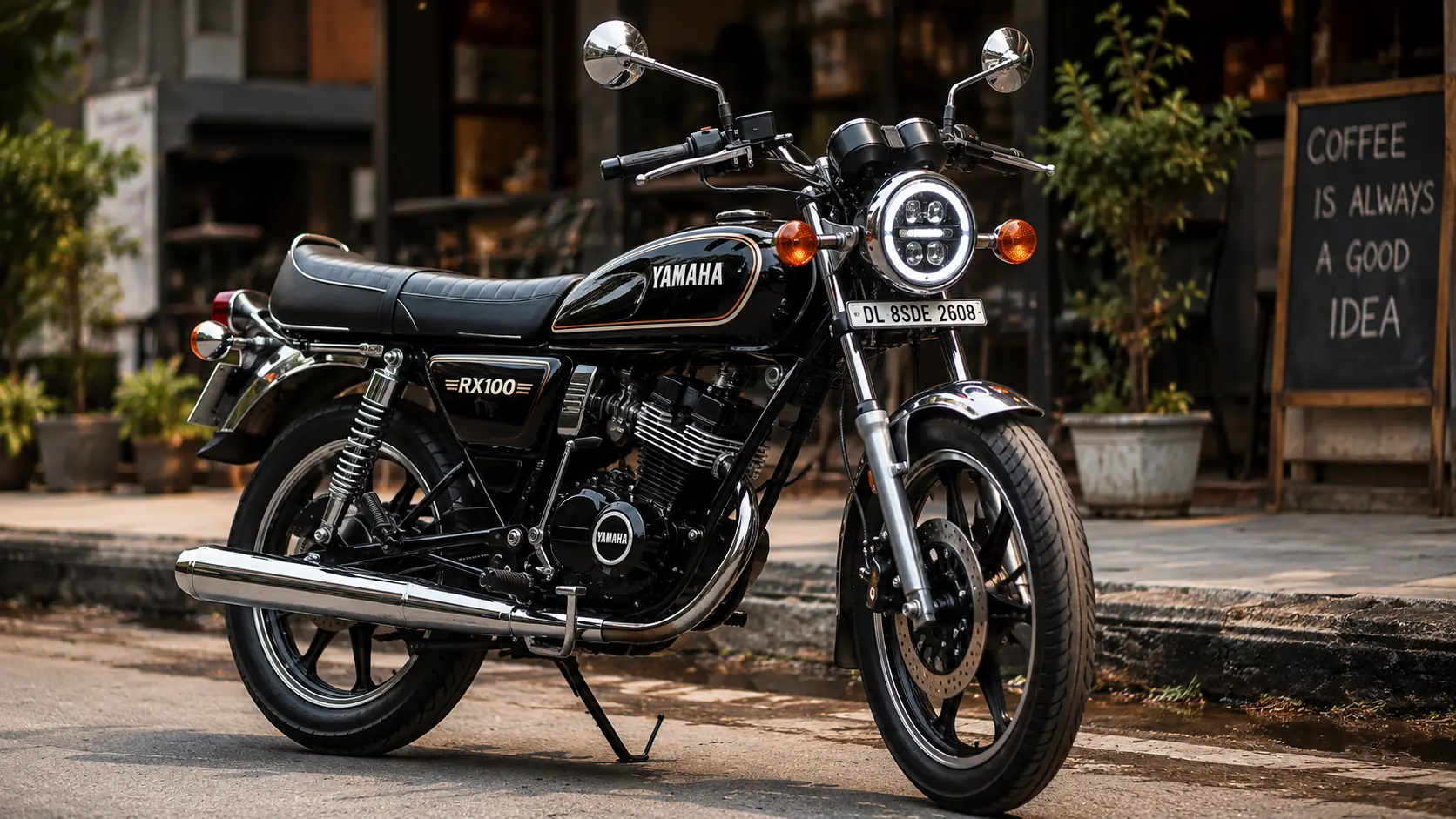
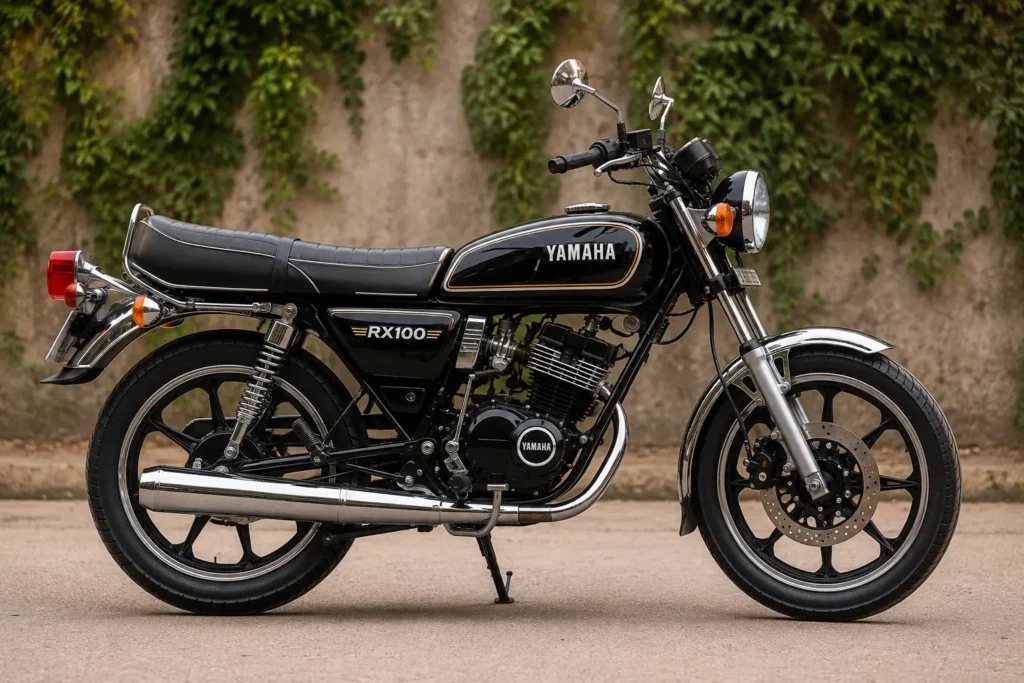
The silhouette will heavily honor its classic 1980s ancestor. It is expected to feature a slim, metallic, teardrop-shaped fuel tank complete with vintage pinstripes, an abundance of premium chrome-finished components (including the fenders and exhaust heat shields), and a flat, ribbed bench seat. However, the old halogen setup will be replaced by a signature circular multi-reflector LED headlamp to maximize low-visibility tracking safety.
2. Connected Electronics and Instrumentation
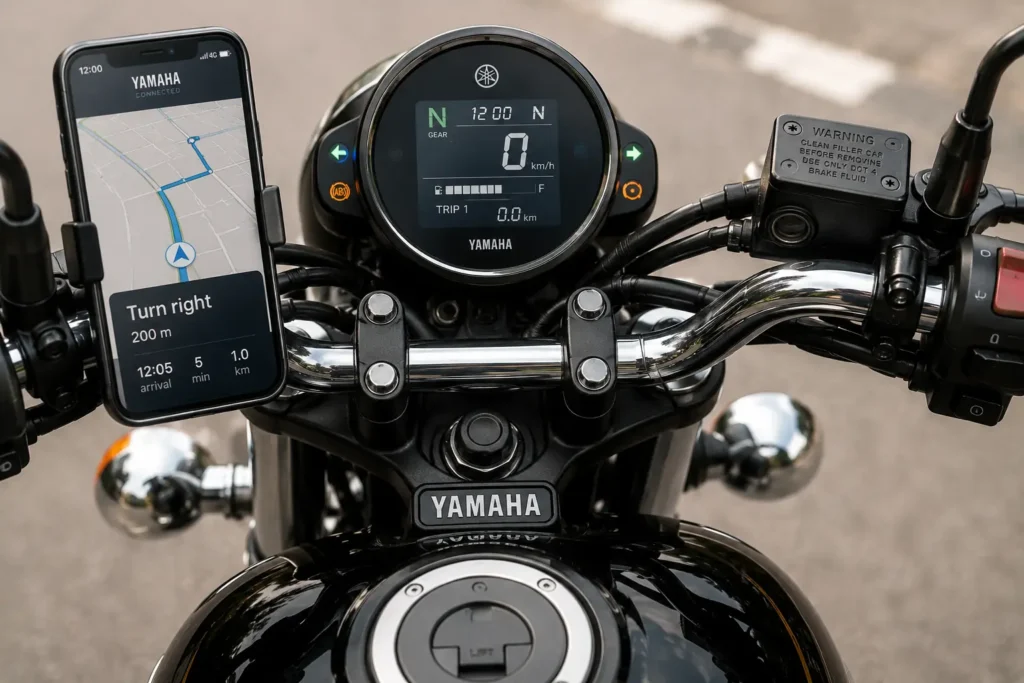
Digital Instrument Cluster with Bluetooth: The dashboard drops ancient analog cable needles for a clean, round retro LCD or TFT display interface. Once synced to a smartphone via Bluetooth, it will handle turn-by-turn map directions, live call tracking alerts, and vehicle diagnostic logs.
Mandatory Anti-Lock Safety (ABS): To satisfy domestic safety laws for motorcycles, the bike will feature a high-performance Single-Channel or Dual-Channel ABS system clamped onto front and rear disc brakes, completely upgrading the old drum brake stopping performance.
Speculated Engine Architecture & Real-World Performance
Because a modern 100cc four-stroke engine produces a very relaxed 8 bhp, engineers are highly speculated to scale up the engine displacement to recapture the bike’s original spirit.
Potential Powertrain Engineering Paths
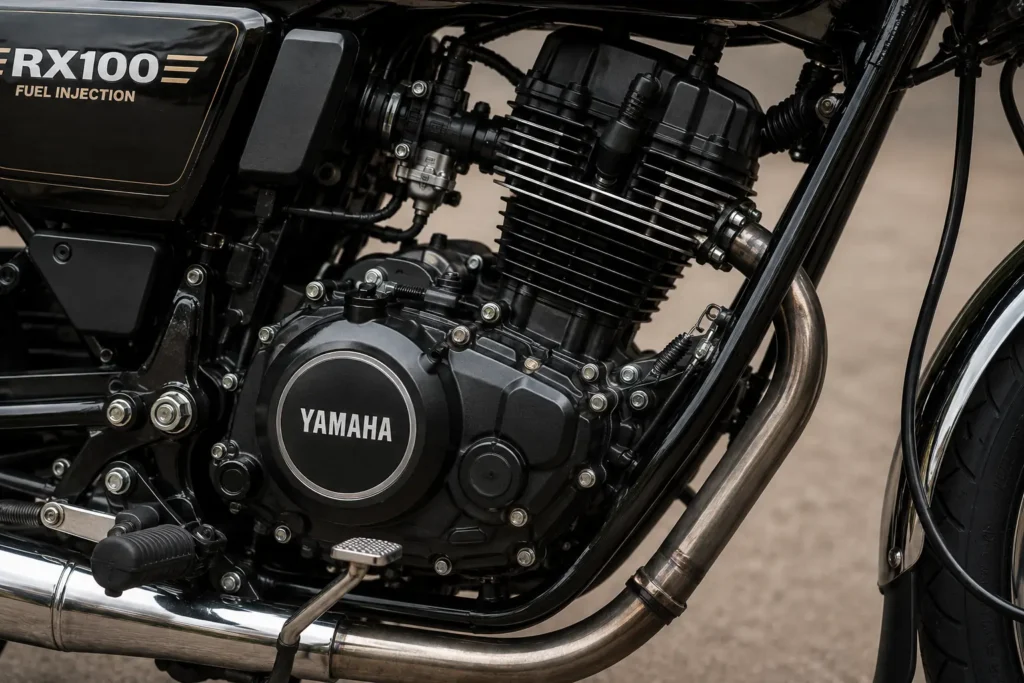
The 125cc Fuel-Injected Route: Utilizing a high-compression 125cc fuel-injected motor could safely deliver 11 to 12 bhp and roughly 11 Nm of torque, easily moving a lightweight modern frame.
The 155cc Premium Blue Core Variant: A highly exciting alternative involves using a version of Yamaha’s legendary 155cc liquid-cooled engine (from the MT-15/R15). This would unlock a serious 18+ bhp performance tier, easily securing the “King of the Streets” title for a new generation.
Expected Real-World Fuel Range Tracking
| Speculated Engine Tier | Anticipated City Economy | Anticipated Highway Cruise | Estimated Single-Tank Range |
| Premium 4-Stroke Tune | 40 to 45 kmpl | 48 to 52 kmpl | ~450 km (Using a standard 10L Tank) |
Yamaha RX 100 Return Anticipated Specifications
| Technical Parameter | Expected Modern Engineering Baseline Capabilities |
| Engine Architecture | 125cc – 155cc Single-Cylinder, 4-Stroke, SOHC, BS6-2 Compliant |
| Fuel System Matrix | Electronic Fuel Injection (FI) with Transistorized Ignition |
| Gearbox Layout | 5-Speed or 6-Speed Constant Mesh Manual Transmission |
| Front Braking Option | 282mm Hydraulic Disc Brake Assembly with ABS Control |
| Rear Braking Option | 220mm Disc Brake / High-Spec Mechanical Drum Assembly |
| Front Suspension Set | Conventional Telescopic Hydraulic Forks with Retro Rubber Sleeves |
| Rear Suspension Set | Classic Dual Chrome Spring Shock Absorbers |
| Tyre Configuration | 17-Inch or 18-Inch Tubeless Radials (Replacing old tube styles) |
| Target Kerb Weight | Targeting under 115 kg to 125 kg (To protect power-to-weight sprint) |
Estimated Operational Running Costs
Let’s calculate the projected monthly budget math for a lifestyle commuter covering a standard distance of 1,000 km per month using modern 4-stroke efficiency.
Scenario A: Upcoming Yamaha RX 100 Reborn (43 kmpl Projected Average)
- Average cost of standard petrol fuel: ₹102 per liter.
- Real-world urban city mileage: 43 kmpl.
- Fuel needed for 1,000 km: 23.2 Liters.
- Monthly Fuel Bill: ~₹2,366 (Approx. ₹2.36 per km).
Scenario B: Traditional Restored 1990s Two-Stroke RX 100
- Real-world actual mileage when ridden hard: ~30 kmpl.
- Requirement: Adding expensive 2T engine oil to the petrol tank at every refill (~₹50 extra per liter).
- Effective operating cost: Easily crosses ₹3.90 per km.
- Monthly Fuel + 2T Outgo: ~₹3,900 (Plus constant spark plug cleaning).
Expected Pros & Cons of the Revival
Potential Advantages
- Unmatched Nostalgia Appeal: Captures iconic retro styling cues that generate massive emotional connection and road presence.
- Clean, Fuel-Injected Efficiency: Transitioning to a 4-stroke FI layout eliminates exhaust smoke while lowering monthly fuel bills.
- Massive Safety Upgrades: Modern disc brakes combined with ABS ensure highly reliable, confident stopping power.
- Vibration-Free Cruising: Upgraded internal balancing delivers smooth performance at city speeds.
- Worry-Free RTO Legality: Green emission compliance guarantees full 15-year registration validity across all major metros.
Potential Disadvantages
- Loss of the Original 2-Stroke Exhaust Sound: A clean 4-stroke engine simply cannot reproduce the iconic crackling exhaust note that purists love.
- Inevitable Weight Increase: Adding catalytic converters and modern safety hardware makes the bike noticeably heavier than the original 95 kg baseline.
- Premium Initial Purchase Cost: Shifting away from basic commuter platforms results in an upfront entry price crossing the ₹1.2 Lakh mark.
- High Performance Expectations: The bike faces intense pressure to match the legendary acceleration metrics of its famous ancestor.
Questions Buyers Commonly Ask about Yamaha RX 100
Is the Yamaha RX 100 officially available for booking in India right now?
No. Yamaha Motor India has not officially opened order charts or established formal booking banks. Any local dealerships or online portals claiming to take advance financial deposits for the model are unofficial.
Will it come with the original two-stroke engine and exhaust note?
No, that is structurally impossible. Due to strict current BS6 emission standards and global environment mandates, new two-stroke gasoline engines are completely banned for road use in India. The bike must return with a clean, regulated 4-stroke fuel-injected engine.
Why is the launch taking so much time to materialize?
Yamaha’s leadership has repeatedly explained that they refuse to rush the project simply to capitalize on a nameplate. Because recreating the signature styling, featherweight agility, and punchy acceleration profile using heavy, modern 4-stroke equipment requires extensive testing, development timelines remain long.
What is the expected real-world top speed?
Depending on whether Yamaha finalizes a 125cc or a sportier 155cc engine layout, the bike is projected to cruise comfortably up to an official top speed of roughly 110 to 115 kmph.
Final Verdict: Is the Yamaha RX 100 Return Worth the Wait?
The Yamaha RX 100 Return shapes up to be an exceptionally emotional, lifestyle-driven, and unique step for Indian motorcycling. It aims to skip boring, cookie-cutter commuter styling sheets and complex, high-maintenance fairings; instead, it focuses on delivering a timeless vintage silhouette, an agile and lightweight chassis, clean modern fuel injection, and essential ABS safety.
If you are a retro design enthusiast who values the historic prestige of the RX badge, want a simple, clean, and highly maneuverable machine for your daily urban city commutes, and are willing to pay a premium price for nostalgia and character, this project is absolutely worth tracking. However, if your immediate lifestyle requires maximum double-digit utility mileage under a strict budget, or you expect the literal return of an smoky two-stroke racing engine, alternative current commuter or sports lines might fit your garage better. Ultimately, let your love for pure retro heritage and real-world daily route needs guide your final choice.
“Running cost matters more than fuel type when daily commuting is involved.”
Helpful Resources for Indian Bike Buyers
Calculate Yamaha RX 100 Fuel Cost
Estimate your monthly petrol expenses, fuel cost per kilometre, and yearly running costs based on your riding distance and fuel efficiency.
Calculate Fuel Cost →- Ministry of Road Transport and Highways (MoRTH): Governs India’s road transport policies, rules, and regulations.
- VAHAN Vehicle Services Portal: Centralized platform for vehicle registration and ownership records in India.
- Automotive Research Association of India (ARAI): Certifies vehicle performance, safety standards, and fuel efficiency data.
- International Centre for Automotive Technology (ICAT): Testing agency for automotive safety, emissions, and homologation approvals.
- ARAI Mileage & Certification Authority: Issues official fuel efficiency and vehicle performance certification reports.
- TransUnion CIBIL — Check your credit score and track your loan eligibility before applying for a car loan.
- AutomotiveZone Mileage Cost Calculator — Estimate real fuel costs based on your driving mileage.
- AutomotiveZone Monthly Car Expense Calculator — Calculate total monthly car ownership cost including EMI, fuel, and maintenance.
- AutomotiveZone Fuel Cost Calculator — Instantly estimate petrol, diesel, or CNG expenses based on mileage, fuel price, and trip distance.
- AutomotiveZone EV vs Petrol Cost Calculator — Compare electric vehicle charging costs with petrol fuel expenses to see long-term savings.
- AutomotiveZone EV Charging Cost Calculator — Calculate home and fast-charging electricity costs for your EV using battery size and electricity tariff.
- AutomotiveZone Car Resale Value Estimator — Estimate your car’s current market resale value based on age, mileage, ownership, and condition.
Disclaimer: Prices, mileage, safety ratings, loan rates, and ownership costs are approximate and may vary by location, variant, and market conditions in 2026. Some visuals may be AI-generated for illustration. Please verify final details with authorized dealers before purchase.