
Maruti e Vitara Quick Overview
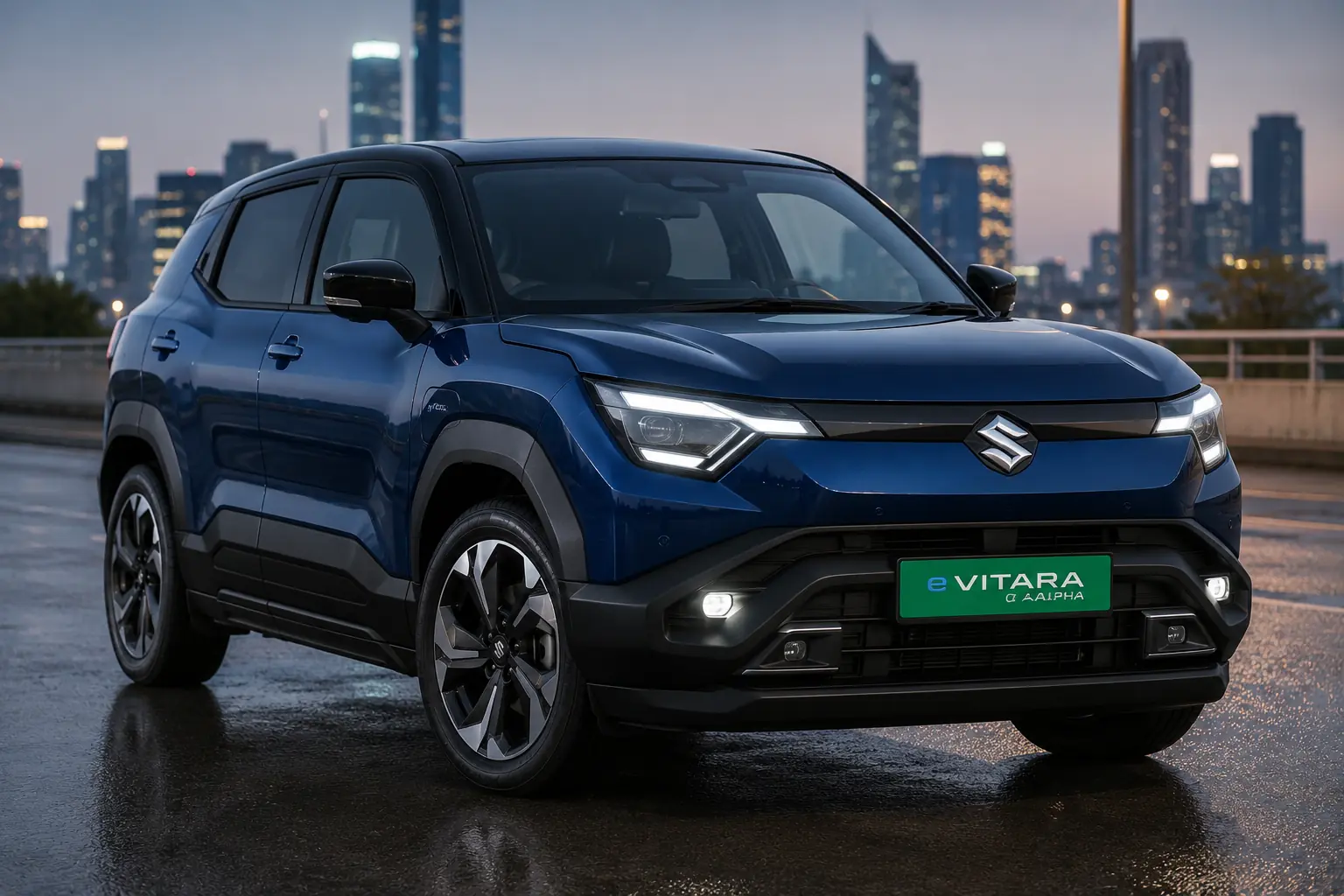
The Maruti Suzuki e Vitara marks a bold step into the electric future, priced from ₹15.99 Lakh to ₹20.01 Lakh (ex-showroom). To maximize affordability, Maruti introduces an innovative Battery-as-a-Service (BaaS) plan, dropping the upfront vehicle cost to between ₹10.99 Lakh and ₹14.29 Lakh combined with a battery rental fee of ₹3.99 to ₹4.39 per km. Built on the dedicated HEARTECT-e platform, it offers 49 kWh and 61 kWh LFP battery packs generating up to 174 PS. It achieves an ARAI-certified range of 440 km to 543 km, delivering a highly reliable real-world mixed range of 330 km to 430 km.
Maruti Suzuki e Vitara 2026: Real-World Range, BaaS Battery Rentals, HEARTECT-e Platform & Is It Worth Buying?
For decades, navigating the mid-size SUV market in India meant balancing high daily fuel costs with the desire for a commanding, spacious vehicle. While conventional petrol and diesel crossovers offer great long-distance capability, their engines transmit noticeable noise and vibrations during stop-and-go metropolitan gridlock, accumulate steep routine servicing bills, and face tightening city emission laws. Conversely, first-generation electric cars often relied on adapted combustion platforms that compromised battery packaging and rear-seat comfort.
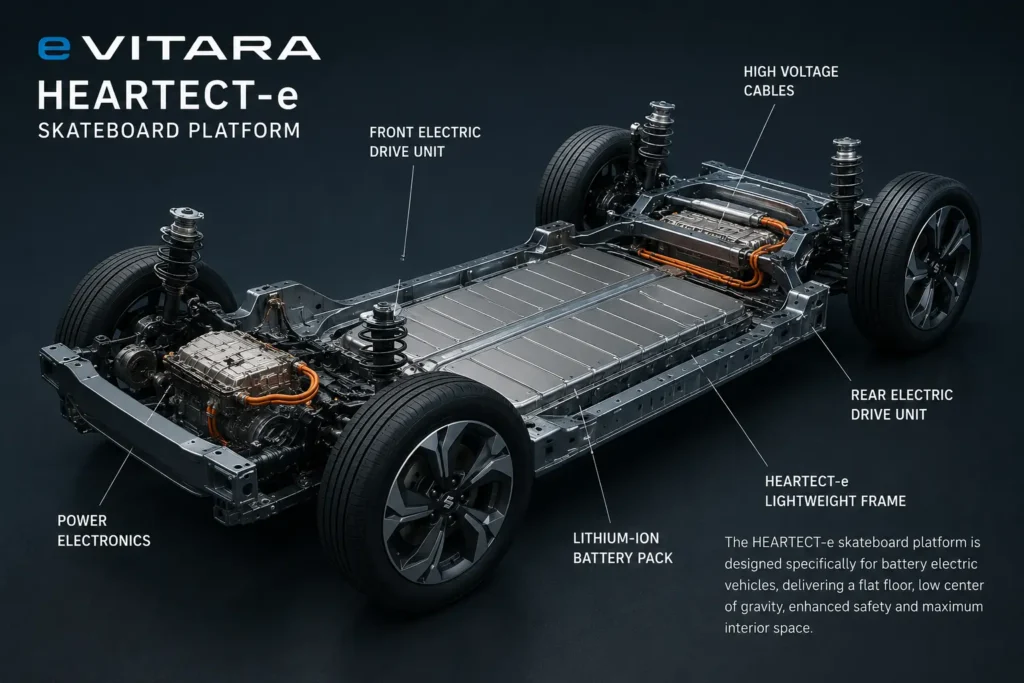
The Maruti Suzuki e Vitara completely rewrites this script. Rather than modifying an existing fossil-fuel shell, Maruti has engineered its first-ever global electric vehicle using the born-electric HEARTECT-e skateboard architecture. Pushing the wheels out to a generous 2,700 mm wheelbase and mounting ultra-safe LFP blade cells flat beneath the cabin floor, the e Vitara delivers a whisper-quiet, tech-forward driving experience. Backed by India’s most expansive service network, it bridges the gap between premium modern luxuries and absolute financial predictability under a ₹20 Lakh budget.
Why the e Vitara Represents a True Electric Evolution
The e Vitara leaves behind old combustion constraints to center entirely on structural weight optimization, battery safety, and unique purchase flexibility:
The Disruption of BaaS Financing: By separating the battery cost via a dual-loan framework, buyers can skip steep initial acquisition premiums and pay for battery usage incrementally like fuel.
Born-Electric HEARTECT-e Framing: Built with over 60% high-tensile and ultra-high-tensile steel, the dedicated EV chassis completely isolates road shocks while heavily reinforcing the side-impact battery crash vault.
BYD-Sourced LFP Blade Cells: Utilizes a highly stable, liquid-cooled Lithium Iron Phosphate cell chemistry engineered to withstand intense Indian summer temperatures without thermal degradation.
Maruti e Vitara Price List & Variant Architecture (2026)
The e Vitara structures its premium NEXA portfolio across three core trim levels—Delta, Zeta, and Alpha—scaling up according to battery capacity and electronic comfort packs.
Ex-Showroom India Price Architecture:
| Variant Grade | Battery Capacity & Drivetrain | Upfront Sticker Price (Without BaaS) | Introductory Price (With BaaS Setup) | Battery Rental Subscription rate |
| Delta 49kWh (Base) | 49 kWh Pack / RWD | ₹15.99 Lakh | ₹10.99 Lakh | + ₹3.99 per km |
| Zeta 61kWh | 61 kWh Pack / RWD | ₹17.49 Lakh | ₹11.99 Lakh | + ₹4.39 per km |
| Alpha 61kWh | 61 kWh Pack / RWD | ₹19.79 Lakh | ₹14.29 Lakh | + ₹4.39 per km |
| Alpha 61kWh DT (Top) | 61 kWh Pack / RWD | ₹20.01 Lakh | ₹14.51 Lakh | + ₹4.39 per km |
*Note: Every variant comes bundled with a complementary 7.4 kW AC home wall-box fast charger unit complete with standard installation. Early adopters also receive 1 year of complementary charging through the ‘e for me’ application at authorized Maruti Suzuki dealer hubs.
Interior Architecture: The High-Tech Twin-Deck Cabin
Step inside, and the e Vitara breaks away from old utilitarian themes, introducing a premium dual-tone interior layout centered around clean, geometric lines.
1. The Integrated Floating Screen Wall
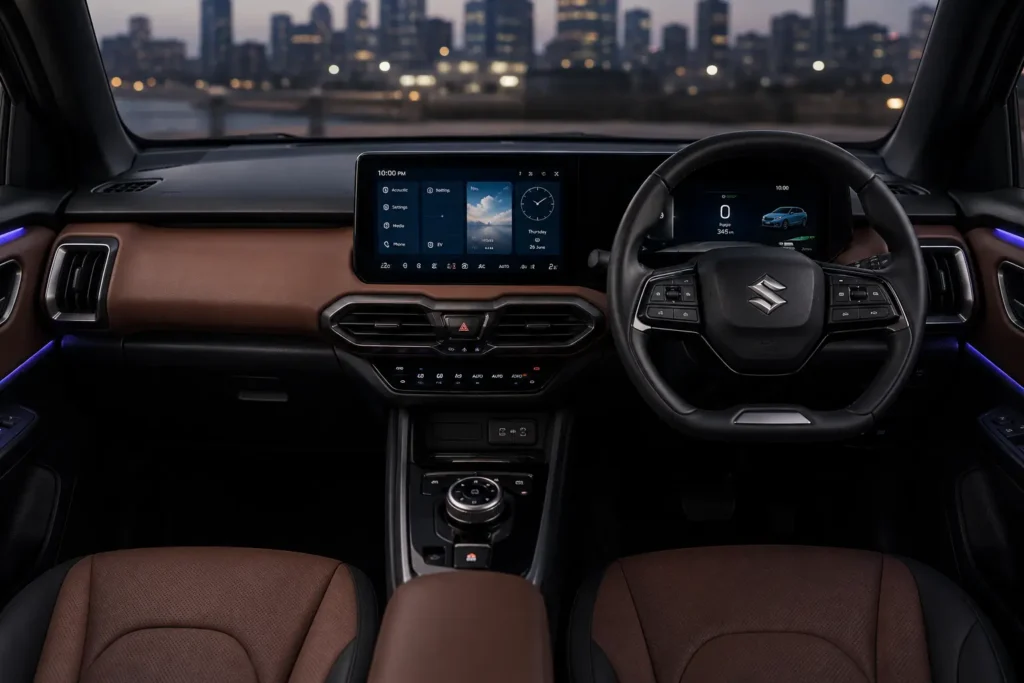
The soft-touch dashboard is anchored by a seamless Integrated Display System combining a 10.25-inch multi-information digital driver console with a sharp 10.1-inch HD center infotainment touchscreen. The software runs wireless Apple CarPlay and Android Auto effortlessly, while the Next-Gen Suzuki Connect suite links over 60 active telematics safety features straight to your phone.
2. High-End Comfort Packaging and Ambient Accents
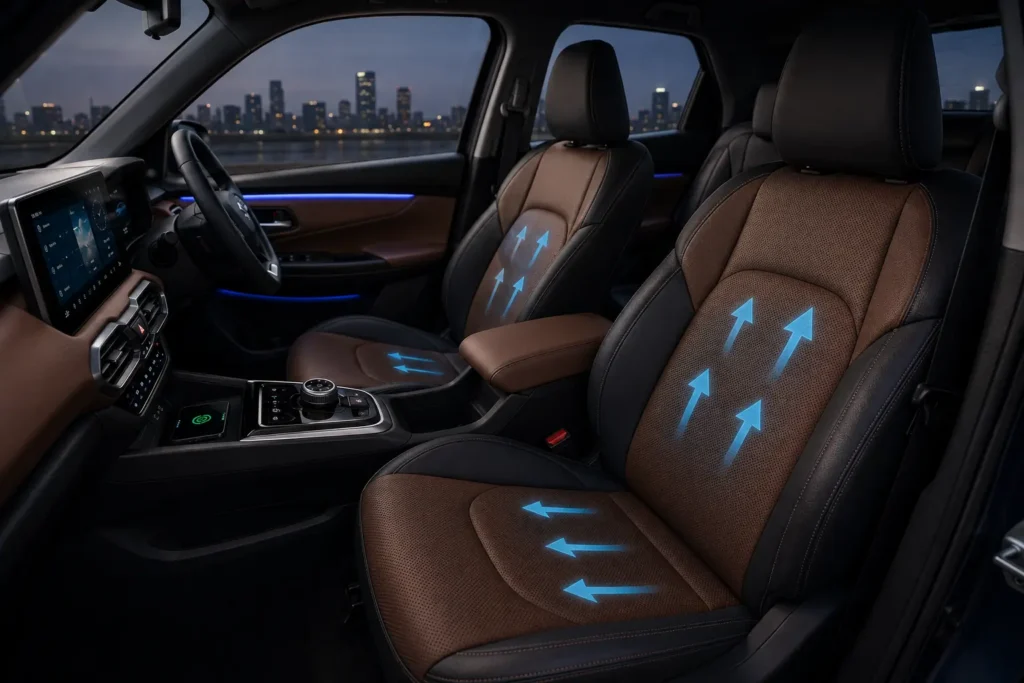
The front row accommodates passengers beautifully, pairing a 10-way power-adjustable driver’s seat with a high-speed Wireless Smartphone Charger and built-in 3-stage ventilated cooling front seats to manage severe summers. The center space features a unique Twin-Deck floating console with an open lower storage tray, highlighted by customizable multi-color ambient lighting tracks and quadruple vertical air vents.
3. Modular 40:20:40 Rear Lounge Flexibility
Thanks to its completely flat floor floorboard layout and long 2,700 mm wheelbase, rear knee clearance is exceptionally generous. Uniquely in its class, the rear row features a premium 40:20:40 split-sliding and reclining seat structure, letting you drop the center armrest section independently to load long objects while carrying passengers comfortably.
The rear hatch opens to reveal a clean 310-liter boot floor volume, complete with a specialized under-floor luggage box to store your portable charging cables neatly away.
Real-World Engine Performance & Range Metrics
The single-motor, rear-wheel-drive (RWD) powertrain trades noisy engine growls for immediate, linear electric acceleration.
Powertrain Performance Character:
The Standard 49 kWh Setup: Puts out a capable 144 PS of power and 193 Nm of instant torque, providing a highly refined, nimble throttle dynamic tailored for daily cross-town city runs.
The Flagship 61 kWh Setup: Ups system output to a punchy 174 PS and 193 Nm of torque, delivering a highly confident step-off in fast-moving highway lanes and sprinting from 0 to 100 km/h in a swift 8.9 seconds.
True Real-World Range Realities
| Selected Vehicle Variant | ARAI Certified Claims | True City Traffic Range | Open Expressway Cruising |
| Standard 49 kWh Pack | 440 km | 330 km to 350 km | 280 km to 300 km |
| Flagship 61 kWh Pack | 543 km | 410 km to 435 km | 350 km to 375 km |
Ultra-Fast DC Charging Speeds
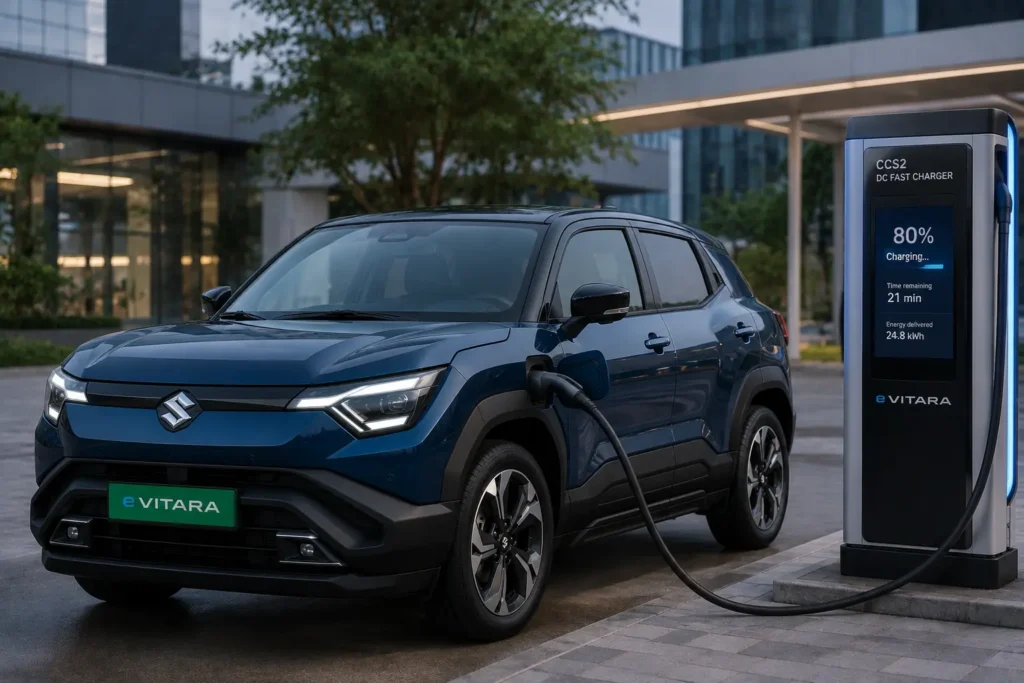
Highway DC Fast Charging Infrastructure: Built on a high-voltage architecture with a standardized CCS2 port, plugging into a public 70 kW DC fast-charging terminal juices the battery pack from 10% to 80% in a swift 45 minutes.
Standard AC Home Wall Box: The included 7.4 kW home charger safely completes a full top-up from 10% to 100% in approximately 9.0 hours overnight.
Fuel Running Cost Comparison: e Vitara vs Petrol SUVs
Let’s evaluate the monthly operational math for a daily urban commuter covering a standard distance of 1,500 km per month using home AC power lines.
Scenario A: Maruti e Vitara 61kWh (Standard Upfront Purchase Layout)
- Average domestic power tariff: ₹8 per unit (kWh).
- To fully replenish the 61 kWh pack takes roughly 66 units of electricity (including minor charging transfer losses), costing ₹528.
- A true mixed driving range of ~415 km means covering 1,500 km requires roughly 3.6 full charging cycles.
- Monthly Power Bill: ~₹1,900 (Approx. ₹1.27 per km).
Scenario B: Traditional Premium Mid-Size Petrol SUV (Real city mixed 12.5 km/l)
- Average cost of standard petrol fuel: ₹102 per liter.
- Petrol fuel required to clear 1,200 km in dense traffic: 120 Liters.
- Monthly Fuel Bill: ~₹12,240 (Approx. ₹8.16 per km).
Maintenance Cost & Long-Term Ownership Confidence
By dropping vulnerable internal combustion elements like oil filters, catalytic converters, spark plugs, and complex automatic multi-speed transmissions, routing mechanical workshop service costs drop dramatically.
Scheduled Periodic Servicing Outgo: Routine service visits track at standard annual intervals. Maintenance focuses primarily on cabin air filter changes, tire rotation checks, brake fluid line inspections, and full diagnostic software scans. Expect average annual workshop bills to stay exceptionally affordable, ranging between ₹4,000 and ₹5,500.
Assured Long-Term Buyback Plan: To address battery resale anxiety, Maruti offers an official Assured Buyback Plan, guaranteeing up to 60% residual value after a 3-year ownership cycle, backed standard by an 8-year or 1,60,000 km battery warranty.
Calculate Maruti Suzuki e Vitara Monthly Running Cost
Estimate your monthly charging cost, electricity usage, maintenance savings, and overall EV ownership budget for the Maruti Suzuki e Vitara based on your driving habits and charging pattern.
Calculate Monthly Expense →Maruti Suzuki e Vitara Pros & Cons
Advantages
Disruptive Entry Price (BaaS): Battery rental sub-options drop the initial vehicle purchase wall down to a highly accessible ₹10.99 Lakh.
Durable BYD Blade Cells: Exceptional thermal stability ensures long-term battery cell longevity in intense summer climates.
Superb 40:20:40 Rear Flexibility: Sliding and multi-split rear configurations offer class-leading interior cabin utility.
Top-Tier 5-Star Safety Profile: Confidently backed by a validated 5-star safety rating from Bharat NCAP testing with standard Level 2 ADAS.
Maruti’s Peace-of-Mind Network: Backed by India’s largest and most trusted secondary automotive service ecosystem.
Disadvantages
India Model Misses AWD Tech: While global variants include dual-motor formats, the Indian lineup is strictly limited to a Front/Rear Single-Motor 2WD drivetrain.
Slightly Firm Low-Speed Ride: To balance the heavy underslung battery weight, the suspension is tuned slightly firm, which can transfer sharp thuds over deep potholes when driving solo.
Touchscreen-Heavy Climate Sliders: Accessing deep customized sub-menus for minor blower distributions requires navigating display interfaces on the move.
Compact 310L Boot Floor: While perfectly adequate for urban grocery runs, the trunk floor space is smaller than some petrol SUV alternatives.
Who Should Buy the Maruti Suzuki e Vitara?
Recommended For:
Affordability-Prioritizing Family Buyers: Ideal for households looking to step into premium electric mobility without paying massive upfront premiums, leveraging the clever BaaS financing scheme.
High-Mileage Workplace Commuters: Perfect for professionals covering over 50 km daily who want to slash high monthly fuel bills while enjoying zero-vibration city creeping.
Safety-First Connected Tech Lovers: Excellent for anyone wanting a solid 5-star crash structure standard with active camera-radar Level 2 ADAS assistance and ventilated cooling seats.
Not Recommended For:
Remote Remote-Area Explorers: If your primary driving style involves crossing long-distance remote hinterlands where third-party public DC fast chargers are entirely unavailable.
Minimalist Old-School Drivers: If you prefer simple analog instrumentation dials directly behind the wheel and mechanical climate knobs instead of large floating screen walls.
Questions Buyers Commonly Ask about Maruti e Vitara
What is the real on-road starting price of the e Vitara base trim with BaaS?
While the base Delta 49kWh with BaaS carries an attractive ex-showroom price of ₹10.99 Lakh, adding comprehensive electric vehicle insurance, standard RTO registration clearances, and local road taxes brings the final on-road baseline price to between ₹12.10 Lakh and ₹12.65 Lakh depending on your specific state tax structures.
How does the BaaS battery billing operate if my car sits idle for a month?
Under Maruti’s structured BaaS financing layout, the battery rental fee tracks your actual physical usage. You pay a small baseline processing cost combined with the exact per-kilometer rate (e.g., ₹3.99/km for the 49 kWh pack) calculated from your odometer reading, meaning your monthly billing drops to zero if the vehicle is not driven.
How does the vehicle handle flooded streets during heavy monsoons?
The e Vitara’s battery core and high-voltage electrical architecture are completely sealed from dust and liquid intrusion, carrying a certified IP67 waterproof protection rating to comfortably withstand deep urban waterlogged streets and flash monsoon floods safely.
Final Verdict: Is the Maruti e Vitara Worth Buying in 2026?
The Maruti Suzuki e Vitara represents an exceptionally premium, logical, and structurally protective automotive investment. It avoids uninspiring, high-maintenance combustion platforms and fragile crossover templates; instead, it focuses on delivering a commanding global SUV road presence, an advanced twin-display electronic command lounge, top-tier 5-star Bharat NCAP crash safety ratings, and an unbeatable long-term battery backup assurance.
If you have a secure parking space at home to plug in an AC wall box charger, value a highly smooth and quiet automatic drive that transforms dense city traffic crawls, and want an advanced machine that slashes your monthly operating footprint down to a fraction of a petrol SUV, the e Vitara Alpha or Zeta trims represent an extraordinary milestone choice. However, if your lifestyle demands a dedicated all-wheel-drive off-roader to tackle deep wilderness trails, or you routinely take unplanned interstate trips crossing remote regions without checking charging maps, alternative platforms might fit your garage better. Ultimately, let your real-world daily commute distances, preferred purchase structure, and appreciation for zero-emission tech guide your final choice.
Helpful Resources for Indian Car Buyers
- Bharat NCAP Official Website — India’s official crash-testing and vehicle safety rating platform. Includes adult and child occupant scores, crash-test protocols, and tested vehicle lists.
- Global NCAP – Safer Cars for India — Global crash-test program that pushed Indian manufacturers toward safer vehicle structures and occupant protection standards.
- Reserve Bank of India (RBI) — Official source for repo rates, lending rules, and banking regulations in India. (rbi.org.in)
- TransUnion CIBIL — Check your credit score and track your loan eligibility before applying for a car loan.
- AutomotiveZone Mileage Cost Calculator — Estimate real fuel costs based on your driving mileage.
- AutomotiveZone Monthly Car Expense Calculator — Calculate total monthly car ownership cost including EMI, fuel, and maintenance.
- AutomotiveZone Fuel Cost Calculator — Instantly estimate petrol, diesel, or CNG expenses based on mileage, fuel price, and trip distance.
- AutomotiveZone EV vs Petrol Cost Calculator — Compare electric vehicle charging costs with petrol fuel expenses to see long-term savings.
- AutomotiveZone EV Charging Cost Calculator — Calculate home and fast-charging electricity costs for your EV using battery size and electricity tariff.
- AutomotiveZone Car Resale Value Estimator — Estimate your car’s current market resale value based on age, mileage, ownership, and condition.
Disclaimer: Prices, mileage, safety ratings, loan rates, and ownership costs are approximate and may vary by location, variant, and market conditions in 2026. Some visuals may be AI-generated for illustration. Please verify final details with authorized dealers before purchase.