
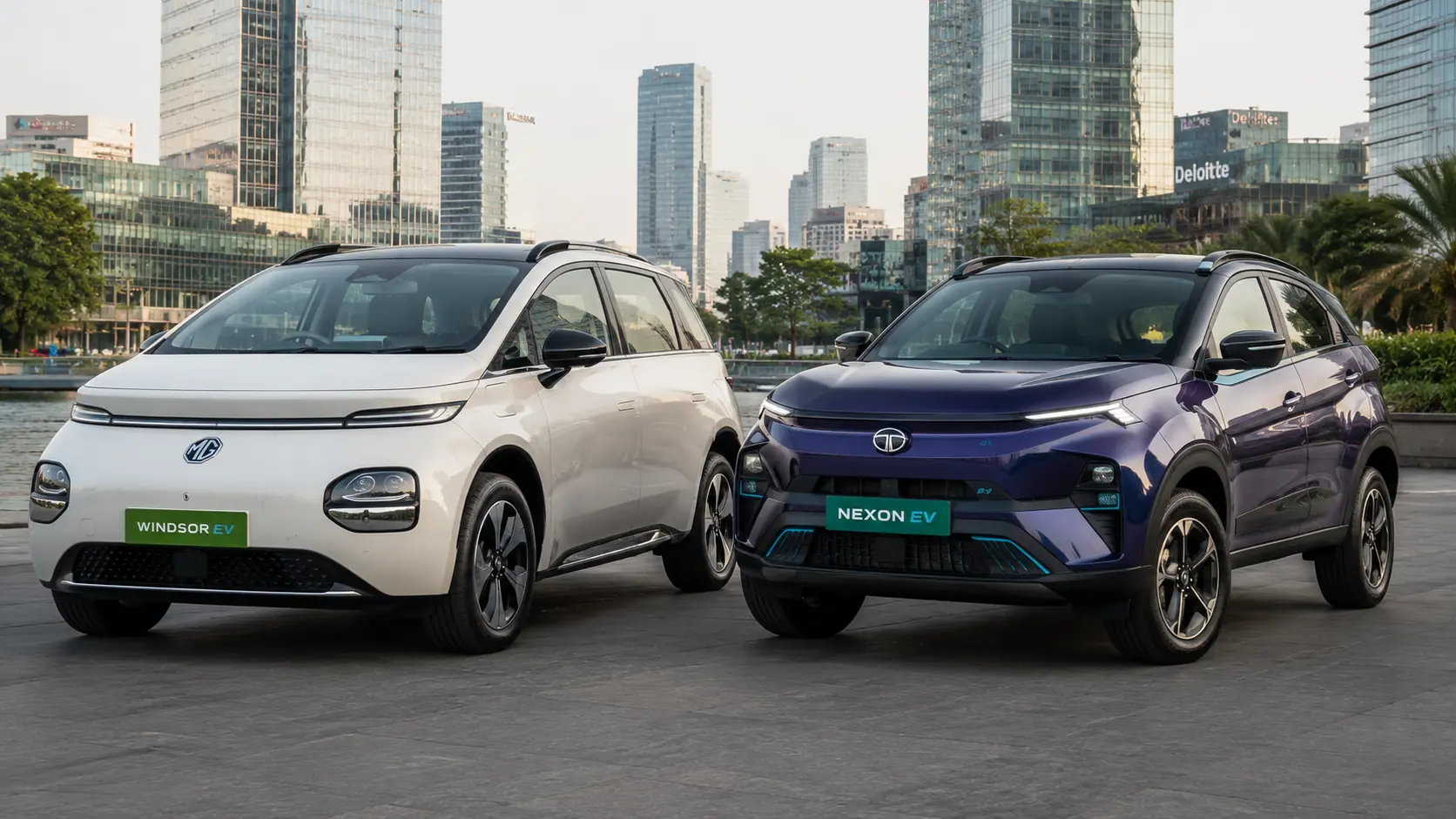

MG Windsor EV vs Tata Nexon EV Quick Overview
In 2026, the Tata Nexon EV (priced from ₹12.49 Lakh to ₹17.49 Lakh ex-showroom) serves as a traditional, high-riding compact SUV available in 30 kWh and 45 kWh battery formats, delivering a real-world range of 210 km to 325 km along with a rugged 5-star safety build. Meanwhile, the MG Windsor EV (priced from ₹14.00 Lakh to ₹18.50 Lakh) uses a crossover-MPV design philosophy with 38 kWh and 52.9 kWh battery options to provide a real-world city range of 220 km to 310 km, prioritizing lounge-like legroom and massive cargo utility.
MG Windsor EV vs Tata Nexon EV: The Ultimate 2026 Mid-Size Electric Car Guide
The sub-₹20 Lakh electric vehicle space in India has evolved past basic commuter options into a highly competitive segment. For the longest time, the Tata Nexon EV sat comfortably as the default choice—a sharp, high-riding compact SUV built on a rugged framework that feels deeply familiar to traditional car buyers.
However, MG Motor has challenged this conventional SUV path with the MG Windsor EV. The Windsor completely redefines vehicle space packaging, trading a high SUV bonnet line for an aerodynamic, aerodynamic crossover-MPV shape. It is built from the inside out, placing rear passenger comfort and digital screens above traditional off-road design layout cues.
This comprehensive guide compares the technical specifications, real-world range, and daily usability features of these two highly popular electric cars.
1. Basic Information
The underlying body styles split these cars into two distinct packaging concepts:
MG Windsor EV (Crossover MPV): Built on a dedicated electric platform layout that stretches the wheelbase out to the absolute edges. It targets buyers who prioritize back-seat business comfort, exceptional cabin width, and massive trunk volumes.
Tata Nexon EV (Traditional Compact SUV): Built on a heavily modified platform that carries over the tall, imposing stance, high bonnet, and traditional driving dynamics of India’s favorite family crossover.
Both vehicles enjoy a flat 5% EV GST rate in India and qualify for substantial state-level road tax waivers across major metropolitan areas.
2. Engine & Powertrain Architecture
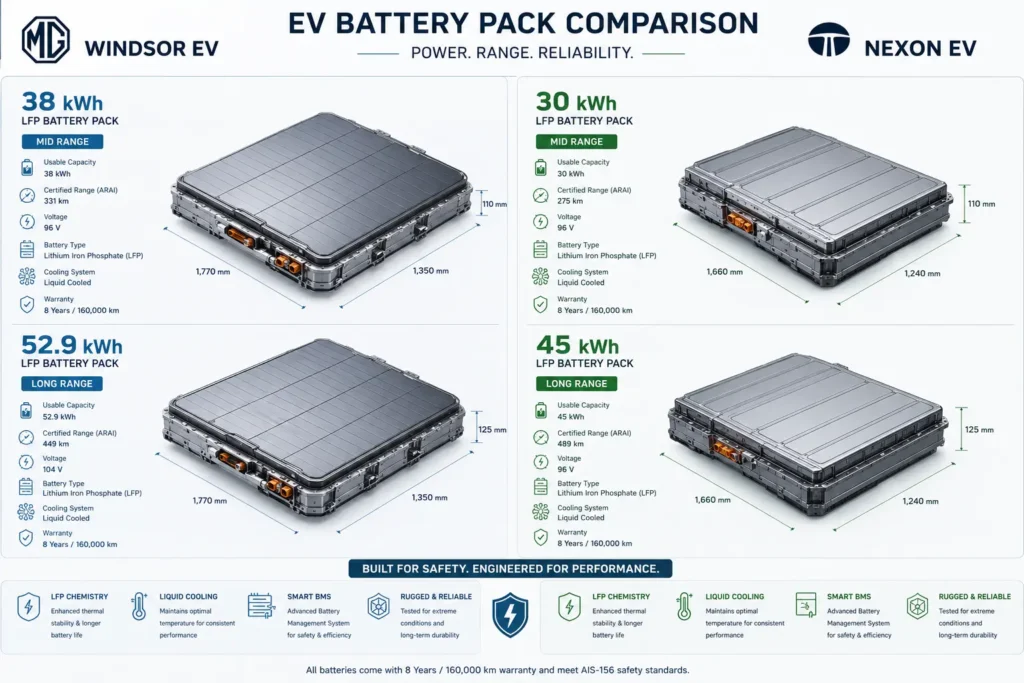
Both vehicles drive their front wheels via Permanent Magnet Synchronous Motors (PMSM), but they divide their range strategies across different battery cell volumes:
MG Windsor EV: Available across a base 38 kWh battery layout (Excite, Exclusive, Essence) and a premium, long-distance 52.9 kWh battery pack (Exclusive Pro, Essence Pro).
Tata Nexon EV: Divides its lineup into a Medium Range (30 kWh) setup and a highly versatile Long Range / Upgraded 45 kWh structural battery block using safe Lithium-Iron-Phosphate (LFP) cell layouts.
3. Performance & Real-World Efficiency
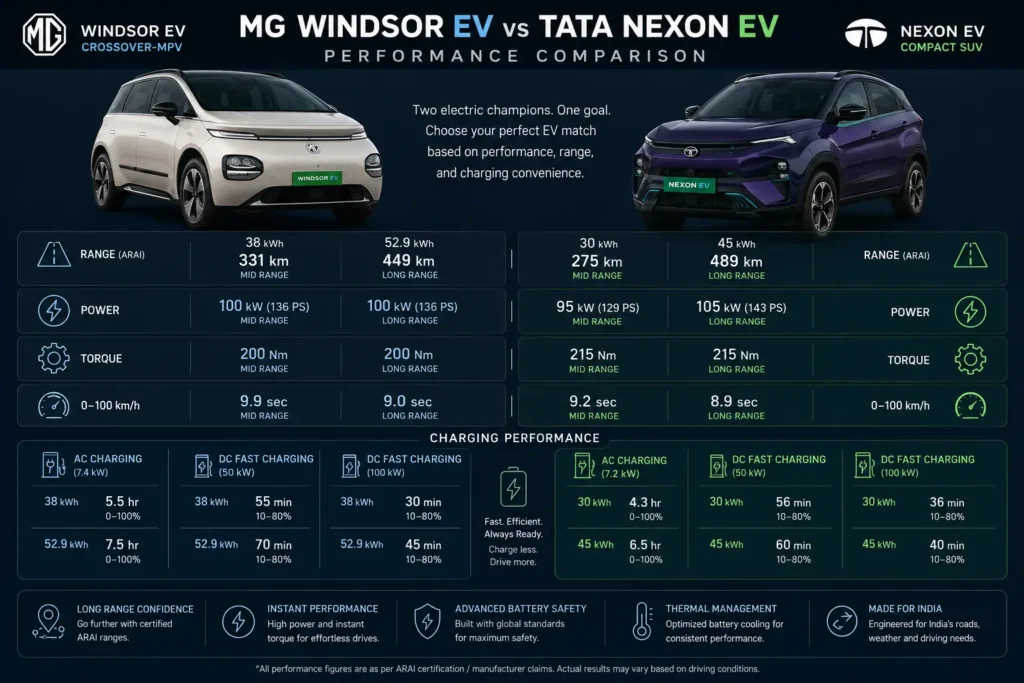
The motor tunings show slightly different behaviors on the road, with the Nexon favoring raw low-end torque and the Windsor delivering smooth, linear progressive power.
| Performance Parameter | MG Windsor EV (52.9 kWh) | Tata Nexon EV (45 kWh Long Range) |
| Peak Power Output | 134 bhp (136 PS) | 142 bhp (145 PS) |
| Peak Torque Output | 200 Nm | 215 Nm (Instantaneous) |
| 0 to 100 km/h Sprint | ~9.5 Seconds | 8.9 Seconds (Sporty punch) |
| ARAI Claimed Range | 449 km | 489 km |
| Real-World City Range | ~295 km – 310 km | ~310 km – 325 km |
| Max DC Fast Charging | 60 kW (0-80% in 50 minutes) | 60 kW (10-80% in 40 minutes) |
Real-World Energy Observations
MG Windsor EV (38 kWh Base): Delivers a highly consistent city commute range of 210 km to 220 km. Upgrading to the 52.9 kWh Pro pack pushes actual metropolitan city ranges up to 310 km, which drops closer to 250 km during constant highway cruising.
Tata Nexon EV (45 kWh LR): Delivers an impressive city range of 315 km to 325 km. Its aerodynamic profiling keeps it more efficient at highway speeds, returning roughly 265 km of steady highway driving. Continuous air conditioning usage in peak 42°C summer heat reduces overall efficiency by roughly 12% on both models.
4. Ride, Control & Dynamics
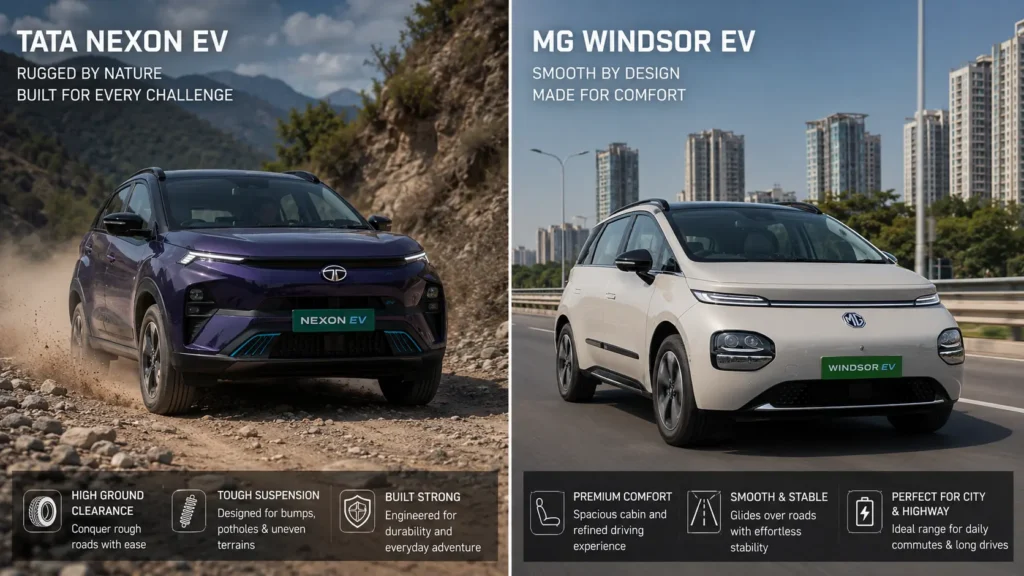
MG Windsor EV: Features a stretched wheelbase that makes it exceptionally stable during straight-line highway cruising. The suspension tracking feels slightly firm at low city speeds, sending a noticeable thud into the cabin over sharp potholes. However, it flattens out smoothly as speeds increase, supported by all-wheel disc brakes standard across the range.
Tata Nexon EV: Delivers a classic, rugged SUV ride quality. It absorbs broken tarmac, rural ruts, and jagged speed breakers smoothly. It offers a tight 5.2-meter turning radius and a high ground clearance that feels reassuringly sturdy when navigating waterlogged monsoon streets.
5. Dimensions & Packaging
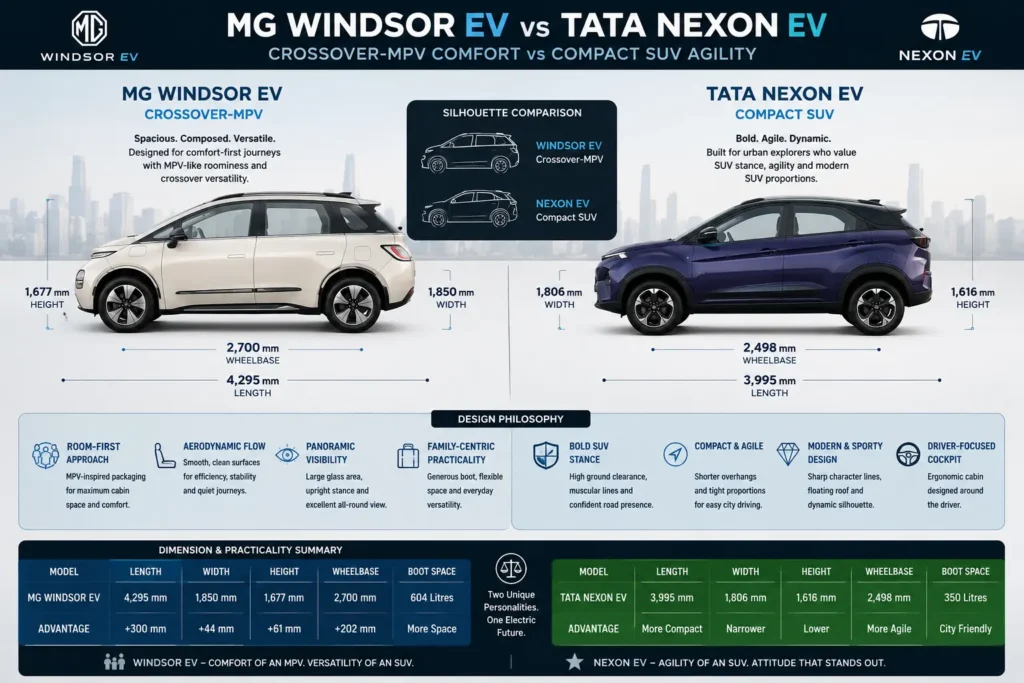
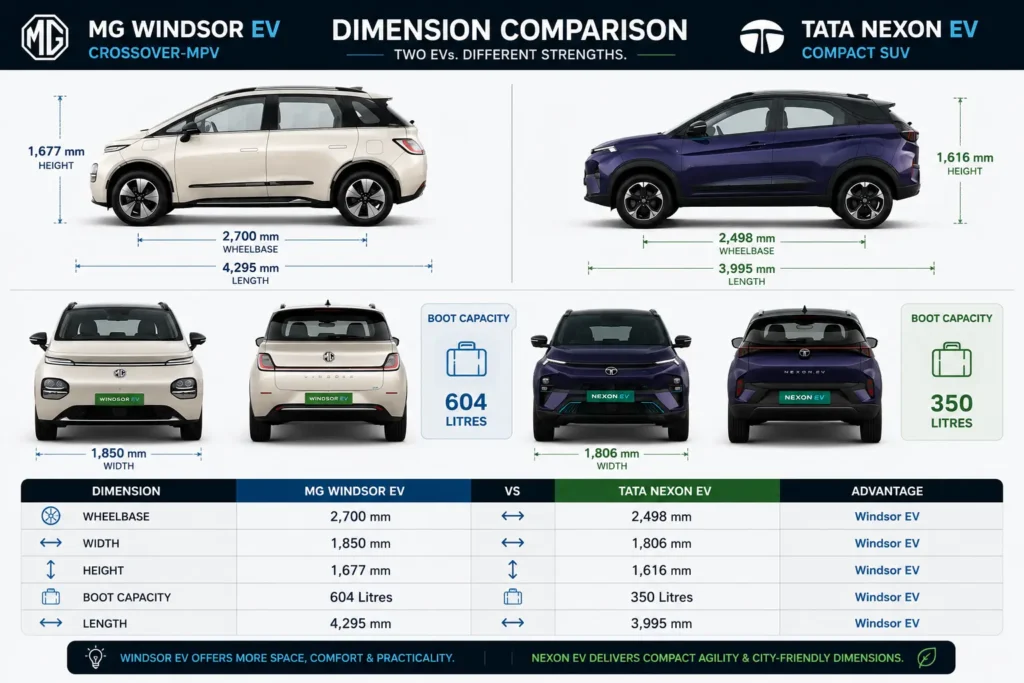
The Windsor’s crossover template maximizes internal space efficiency over the Nexon’s traditional SUV lines:
| Dimensional Parameter | MG Windsor EV | Tata Nexon EV |
| Length | 4,295 mm (Longer stance) | 3,995 mm (Sub-4-meter agility) |
| Width | 1,850 mm (Superior width track) | 1,802 mm |
| Height | 1,677 mm | 1,620 mm |
| Wheelbase Length | 2,700 mm (D-Segment space) | 2,498 mm |
| Unladen Ground Clearance | 186 mm | 190 mm (High trail clearance) |
| Trunk Cargo Volume | 604 Liters (Deep, cavernous boot) | 350 Liters |
6. Comfort & Convenience
The comfort focus highlights the core split between these two vehicles: the Windsor targets a lounge experience, while the Nexon packs multi-zone features.
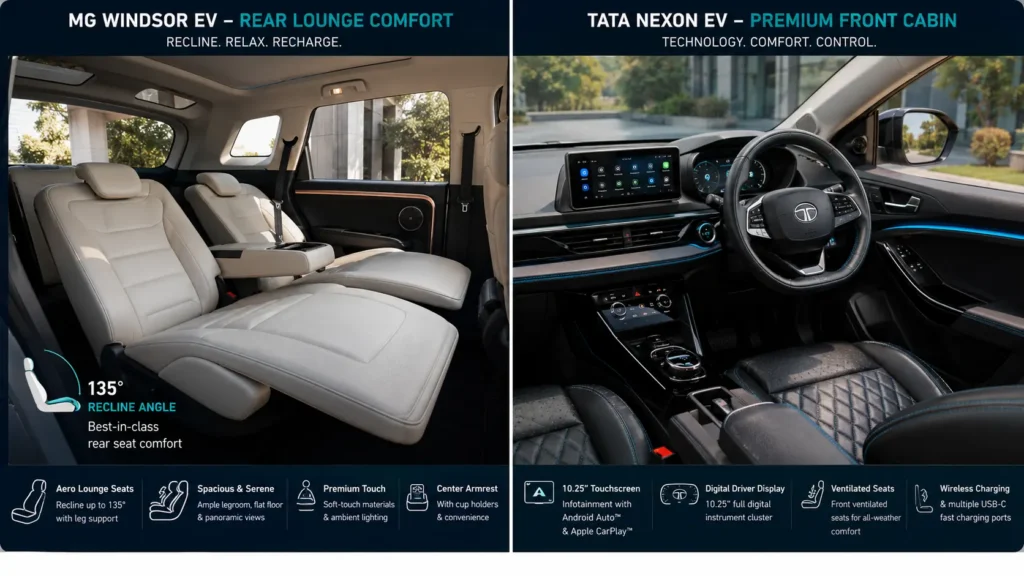
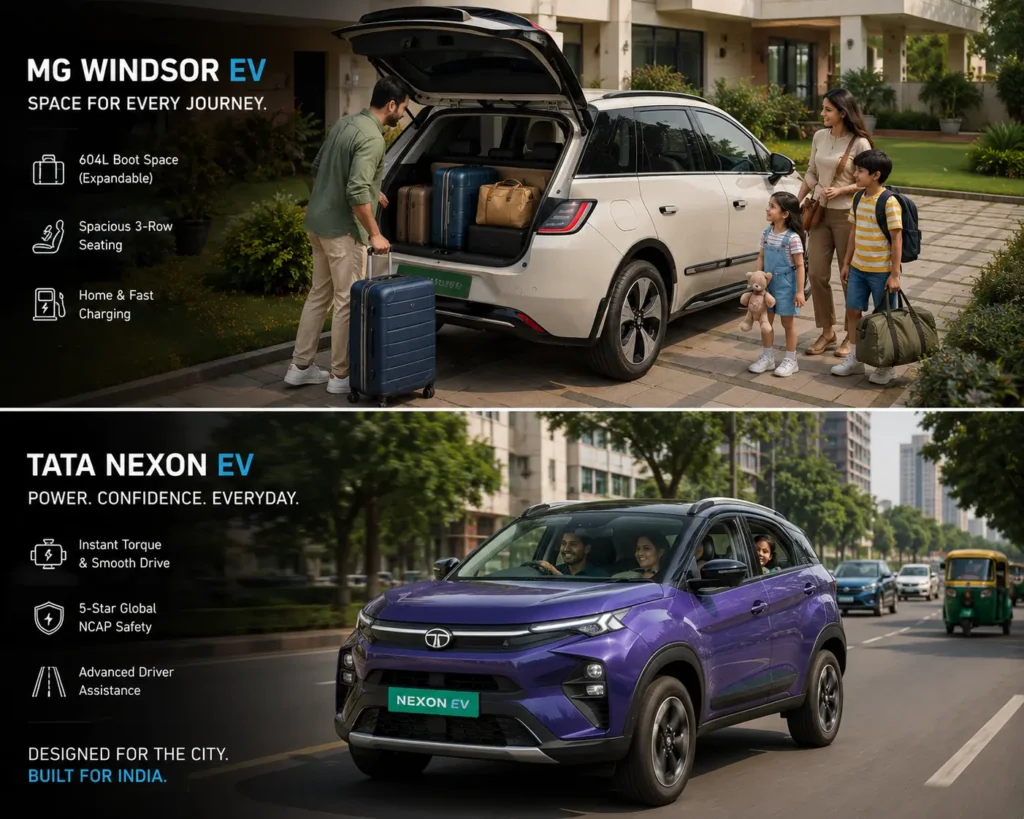
MG Windsor EV: Emphasizes rear passenger luxury. The rear row features Aero Lounge seats that recline up to a massive 135-degree angle, allowing rear occupants to stretch out comfortably. It includes a massive panoramic glass roof that bathes the cabin in light, ventilated front seats, and a 6-way power-adjustable driver’s seat.
Tata Nexon EV: Focuses on comprehensive feel-good features. It includes front row cooling ventilation, a voice-assisted power sunroof, automatic dual-zone climate control with a built-in air purifier, rear sunshades to block direct glare, and standard cruise control.
7. Interior Design & Materials
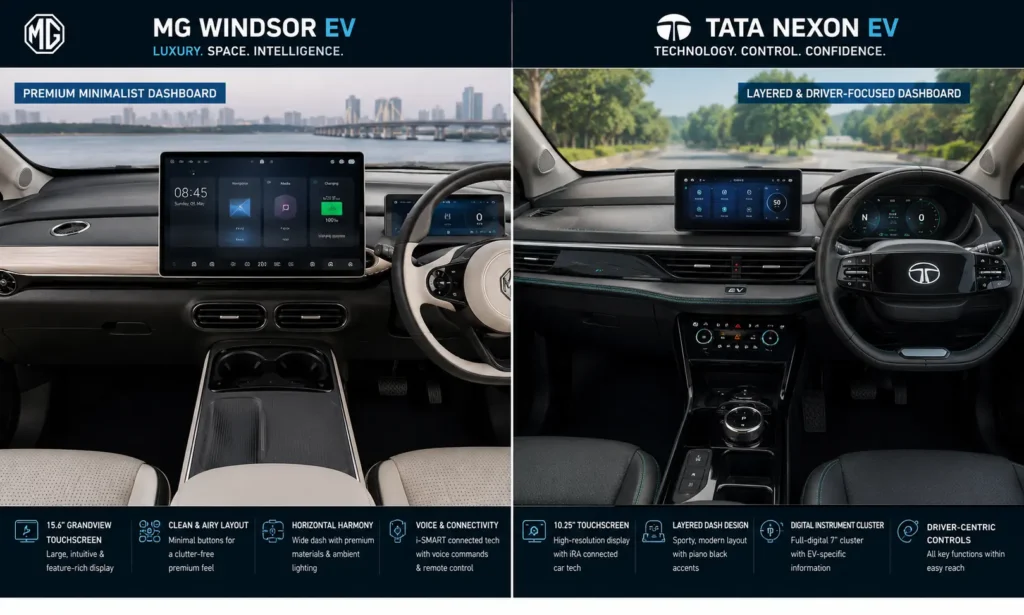
MG Windsor EV: Designed with clean, minimalist lines. Soft-touch leatherette upholstery with premium quilted stitching dominates the dashboard and center console line. The cabin drops almost all physical buttons, routing all functions through the massive central digital screen.
Tata Nexon EV: Features a modern, multi-layered dashboard layout that feels premium. It incorporates a unique touch-sensitive capacitive climate control deck, a leather-wrapped two-spoke steering console, a high center tunnel with storage, and premium tri-arrow design highlights across the door cards.
8. Exterior Styling Elements
MG Windsor EV: Features an avant-garde, aerodynamic crossover profile. It stands out with a sweeping front fascia showing an illuminated MG logo badge, sleek connected front and rear LED light bars, flush smart door handles, and large 18-inch aerodynamic alloy wheels that provide a substantial road presence.
Tata Nexon EV: Retains a muscular, aggressive SUV silhouette. It highlights sharp, futuristic split LED headlights with dynamic sequential indicators, robust wheel arch cladding, an athletic rear roof spoiler layout, and standard 16-inch alloy wheels.
9. Safety Profile & Crash Protection
Both manufacturers place a high priority on safety, packing their vehicles with advanced passive structural reinforcement:
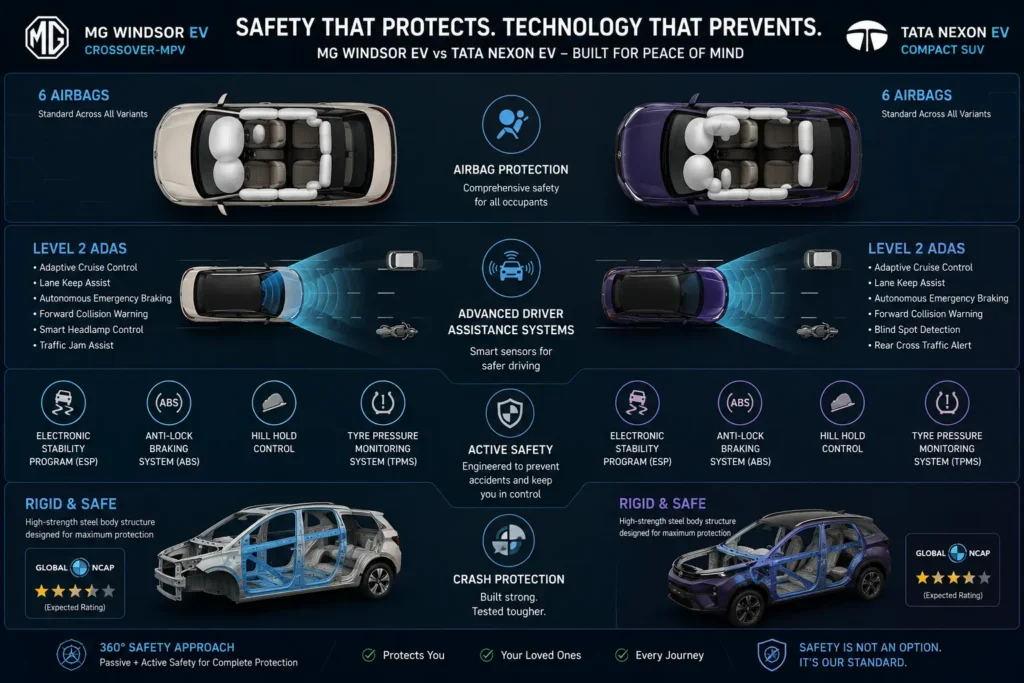
MG Windsor EV: Comes standard with 6 airbags across all variants, disc brakes on all four wheels, electronic stability program (ESP), hill hold control, hill descent control, and a 360-degree high-definition camera network on upper trims.
Tata Nexon EV: Built on an ultra-robust frame that achieved a full 5-Star Bharat / Global NCAP safety certification. It standardizes 6 airbags, ESP, and traction control across all trims. Top-tier trims feature an advanced Level 2 ADAS suite that adds autonomous emergency braking, lane keep assist, and forward collision warnings.
10. Advanced Connected Internet & Telematics
MG Windsor EV: Uses the i-Smart next-generation app suite, supporting over 60+ connected car functions. It lets owners monitor battery charge levels, check remote location parameters, pre-cool the cabin via a smartphone, and map out available charging infrastructure.
Tata Nexon EV: Runs the zConnect app architecture, offering roughly 45 telematics features. A standout highlight on mid-to-high trims is the Arcade.ev software ecosystem, which allows occupants to play games or watch streaming apps (YouTube, Hotstar) on the infotainment screen while the car is safely parked at a public charging station.
11. Entertainment & Media Technology
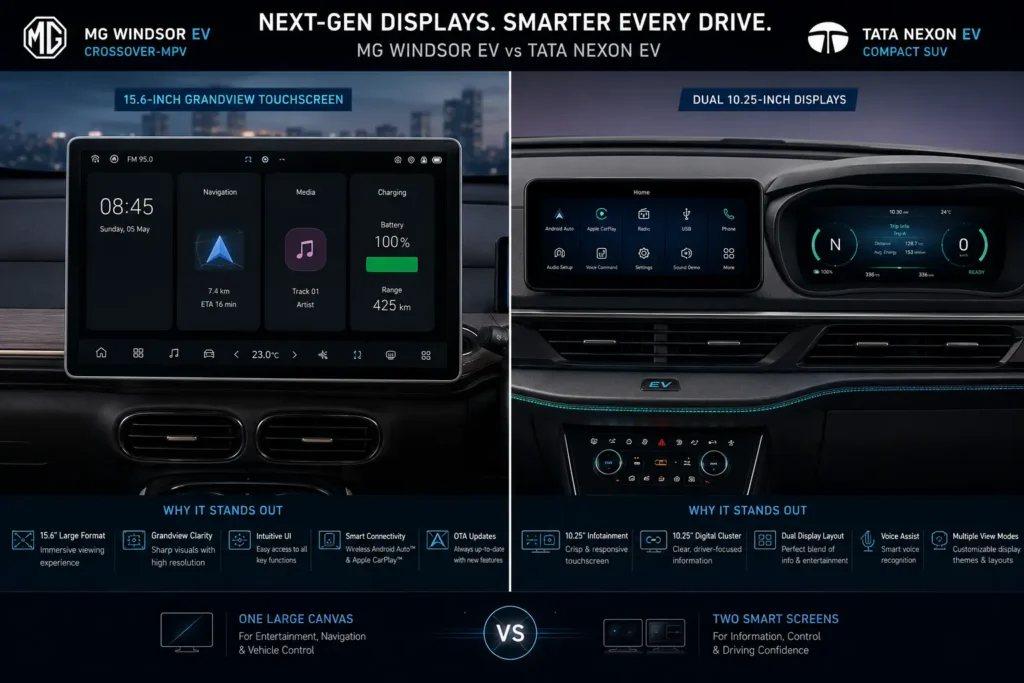
MG Windsor EV: Features a massive 15.6-inch Grand Touchscreen infotainment system—the largest screen in its class—which handles all primary media operations alongside wireless Apple CarPlay and Android Auto. This is paired with an 8.8-inch digital driver screen and an exceptional 9-speaker premium sound system tuned by Infinity.
Tata Nexon EV: Incorporates a beautiful 10.25-inch high-definition cinematic screen flowing neatly into a matching 10.25-inch fully digital instrument cockpit capable of displaying full-screen navigation maps. It features wireless Apple CarPlay/Android Auto connectivity, outputting audio through a premium 9-speaker JBL cinematic sound stage.
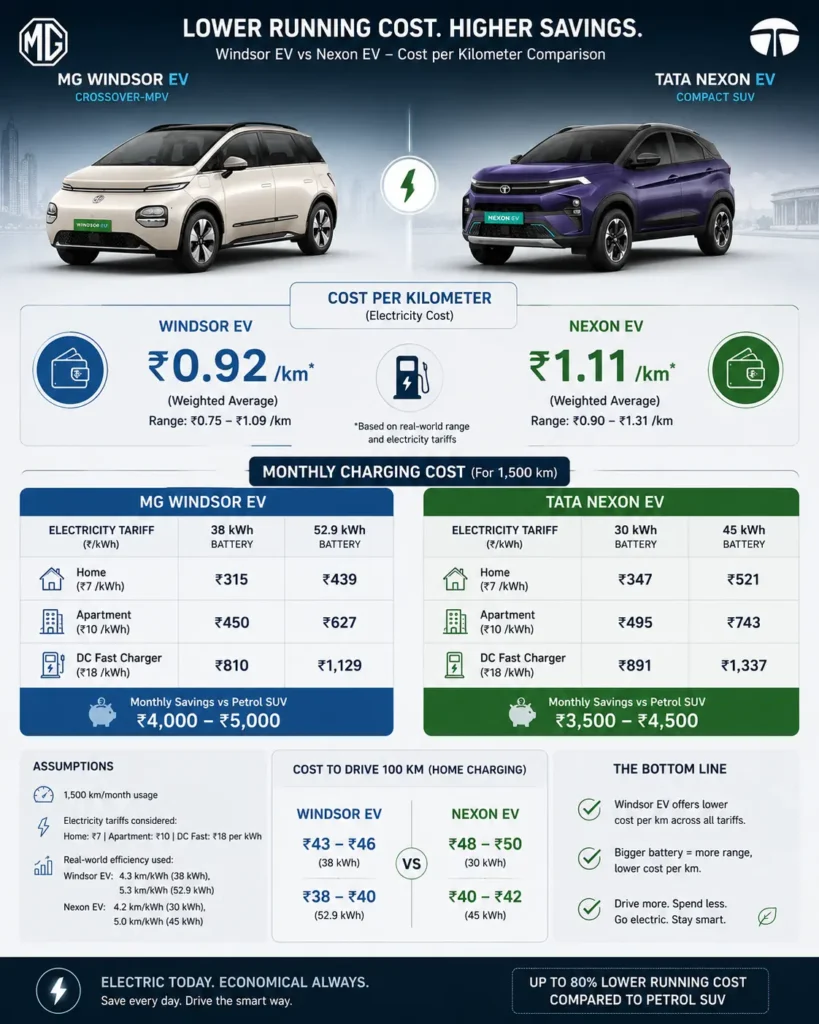
12. Energy Running Cost Comparison
Let’s calculate the operational math for an urban commuter covering 1,200 km per month using home AC power charging.
Scenario A: MG Windsor EV (52.9 kWh Pack)
Average domestic power tariff: ₹8 per unit (kWh).
Fully topping up the 52.9 kWh battery takes roughly 58 units of electricity (accounting for minor charging inefficiencies), costing ₹464.
A real-world city range of ~300 km means covering 1,200 km requires exactly 4 charging cycles.
Monthly Power Bill: ~₹1,856 (Approx. ₹1.54 per km).
(Note: Choosing MG’s innovative BaaS model drops the ex-showroom entry price to ₹9.99 Lakh, introducing a fixed battery rental fee of ₹3.50 per km).
Scenario B: Tata Nexon EV (45 kWh Long Range Pack)
Fully topping up the 45 kWh battery uses roughly 50 units of electricity, costing ₹400.
A real-world mixed family range of ~320 km means covering 1,200 km requires roughly 3.75 charging cycles.
Monthly Power Bill: ~₹1,500 (Approx. ₹1.25 per km).
Final Verdict: Which Electric Car Belongs in Your Garage?
Choose the MG Windsor EV if:
You frequently travel with rear-seat passengers who require extensive legroom and appreciate 135-degree reclining Aero Lounge seats.
You need a massive boot (604 liters) to carry large volumes of luggage or equipment for business trips.
You love a clean, minimalist interior dominated by a large 15.6-inch touchscreen and premium Infinity audio.
Choose the Tata Nexon EV if:
You prefer a traditional, commanding SUV driving stance with a high bonnet view and a rugged suspension setup that handles deep potholes smoothly.
You want the reassurance of a proven, 5-star crash-test rated platform backed by an active Level 2 ADAS safety suite.
You want tactile, physical controls for basic functions like climate adjustment rather than relying entirely on a touchscreen menu.
Helpful Resources for Indian EV Car Buyers
- Bharat NCAP Official Website — India’s official crash-testing and vehicle safety rating platform. Includes adult and child occupant scores, crash-test protocols, and tested vehicle lists.
- Global NCAP – Safer Cars for India — Global crash-test program that pushed Indian manufacturers toward safer vehicle structures and occupant protection standards.
- Reserve Bank of India (RBI) — Official source for repo rates, lending rules, and banking regulations in India. (rbi.org.in)
- TransUnion CIBIL — Check your credit score and track your loan eligibility before applying for a car loan.
- AutomotiveZone Mileage Cost Calculator — Estimate real fuel costs based on your driving mileage.
- AutomotiveZone Monthly Car Expense Calculator — Calculate total monthly car ownership cost including EMI, fuel, and maintenance.
- AutomotiveZone Fuel Cost Calculator — Instantly estimate petrol, diesel, or CNG expenses based on mileage, fuel price, and trip distance.
- AutomotiveZone EV vs Petrol Cost Calculator — Compare electric vehicle charging costs with petrol fuel expenses to see long-term savings.
- AutomotiveZone EV Charging Cost Calculator — Calculate home and fast-charging electricity costs for your EV using battery size and electricity tariff.
- AutomotiveZone Car Resale Value Estimator — Estimate your car’s current market resale value based on age, mileage, ownership, and condition.
Disclaimer: Prices, mileage, safety ratings, loan rates, and ownership costs are approximate and may vary by location, variant, and market conditions in 2026. Some visuals may be AI-generated for illustration. Please verify final details with authorized dealers before purchase.
Compare MG Windsor EV & Tata Nexon EV Charging Costs
Find out which EV is cheaper to charge. Calculate monthly electricity expenses, cost per kilometer, and long-term ownership savings for the MG Windsor EV and Tata Nexon EV.
Compare EV Charging Costs →