

Tata Punch EV vs Tata Tiago EV Quick Overview
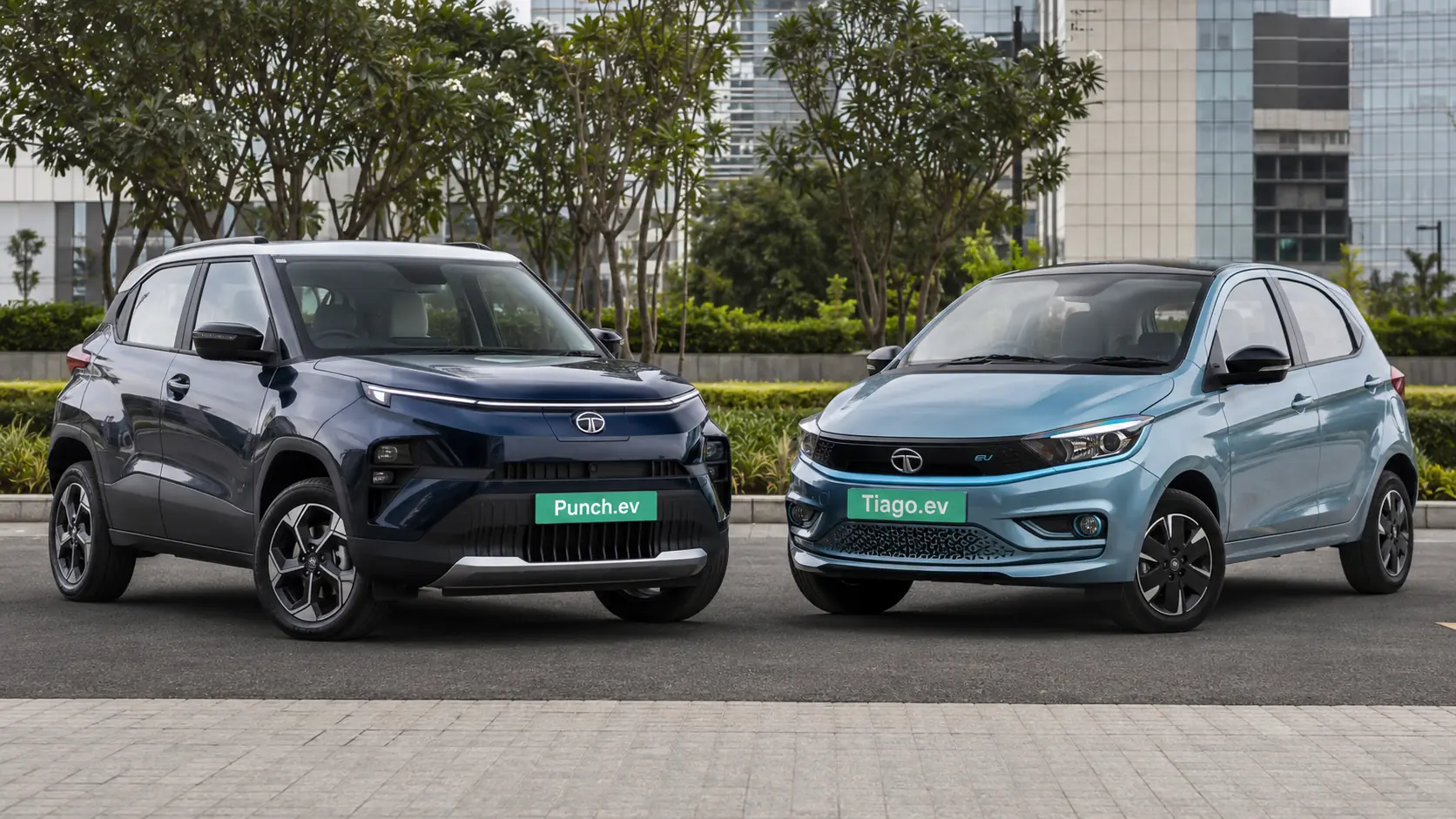
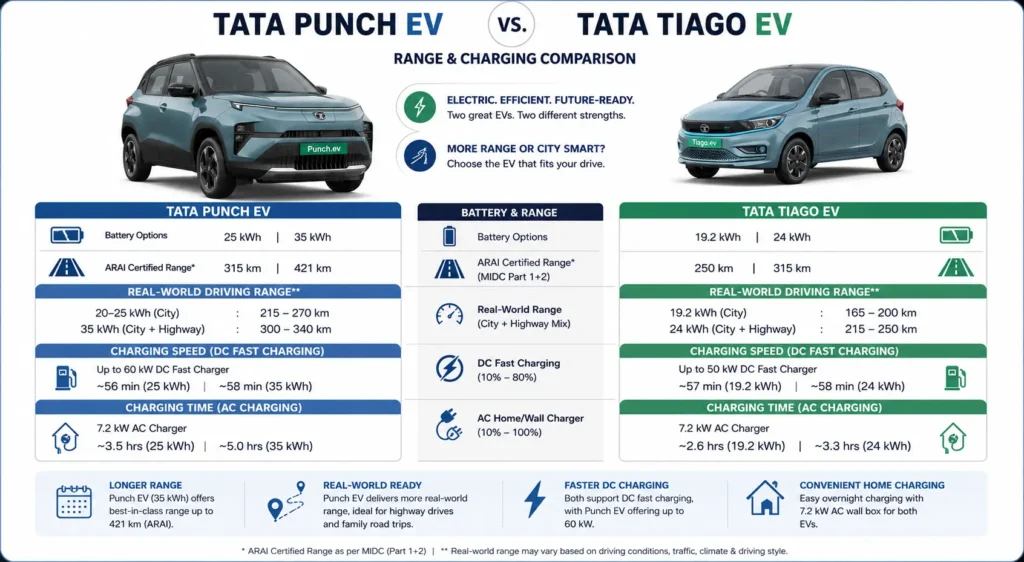
In 2026, the Tata Tiago EV (priced from ₹6.99 Lakh to ₹9.99 Lakh) stands as a highly maneuverable, budget-first city hatchback delivering a real-world range of 210 km to 230 km. In contrast, the Tata Punch EV (priced from ₹9.69 Lakh to ₹13.38 Lakh) is a ground-up electric micro-SUV built on the advanced acti.ev skateboard platform, offering a real-world range of up to 355 km, a 5-star safety profile, and a premium feature suite.
Tata Punch EV vs Tata Tiago EV: The Ultimate 2026 Entry-Level Electric Car Guide
Choosing an entry-level urban electric vehicle used to be simple because choices were limited. However, as battery technologies mature, Tata Motors has split its entry-level EV portfolio into two distinct body styles and price brackets, forcing buyers to weigh absolute upfront savings against long-range platform features.
The Tata Tiago EV represents the mass-market entry point—a nimble, uncomplicated city hatchback that converts a traditional petrol framework into a highly efficient commuter car. The Tata Punch EV, conversely, marks the debut of Tata’s dedicated acti.ev architecture. It is an uncompromising electric micro-SUV packed with premium technology and high safety credentials.
This comprehensive guide breaks down the core structural differences between these two urban EVs to help you identify which option belongs in your garage.
1. The Core Architectural Philosophy
The underlying structural layout establishes the fundamental behavioral differences between these two vehicles:
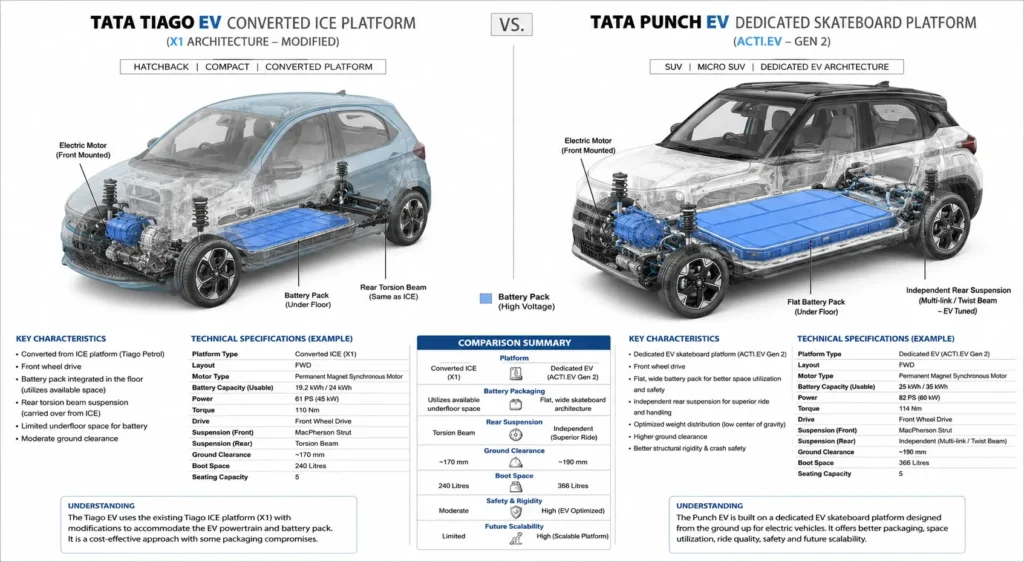
Tata Tiago EV (Converted ICE Platform): The Tiago EV is a converted platform. Tata took a standard petrol hatchback chassis and modified it to house battery cells split between the transmission tunnel and under the rear floor. It is designed to look, feel, and drive like a familiar city hatchback.
Tata Punch EV (Dedicated Skateboard Architecture): The Punch EV sits on the acti.ev platform—a dedicated, ground-up electric skateboard frame. This layout places the battery pack completely flat across the floor between the wheels, maximizing interior legroom, structural rigidity, and battery safety.
2. Price List & Variants (2026)
The price matrix shows zero overlap, placing these two electric vehicles into separate budget categories.
Tata Tiago EV Variant Spread
The Tiago EV splits its trim packages across a Medium Range (19.2 kWh) and a Long Range (24 kWh) battery pack.
| Variant Name | Battery Capacity | Ex-Showroom Price | Primary Variant Focus |
| XE MR | 19.2 kWh | ₹6.99 Lakh | Pure Budget Entry / Fleet use |
| XT MR | 19.2 kWh | ₹7.99 Lakh | Essential City Commuter Base |
| XT LR | 24.0 kWh | ₹8.99 Lakh | Extended Range Sweet Spot |
| XZ Plus LR | 24.0 kWh | ₹9.49 Lakh | Premium Features Baseline |
| XZ Plus Tech LUX LR | 24.0 kWh | ₹9.99 Lakh | Fully-Loaded Hatchback Flagship |
Tata Punch EV Variant Spread
The Punch EV scales its pricing based on advanced features, dividing packages into Standard Range (30 kWh) and Long Range (40 kWh) cell capacities.
| Variant Name | Battery Capacity | Ex-Showroom Price | Primary Variant Focus |
| Smart | 30.0 kWh | ₹9.69 Lakh | Entry SUV Layout / Safety First |
| Adventure | 30.0 kWh | ₹10.49 Lakh | Mid-Tier Features Baseline |
| Empowered | 30.0 kWh | ₹11.49 Lakh | High-Tech Screen Upgrade |
| Empowered Plus | 30.0 kWh | ₹11.99 Lakh | Top Feature Package (Standard Battery) |
| Adventure LR | 40.0 kWh | ₹12.29 Lakh | Long Range Value Entry |
| Empowered Plus LR | 40.0 kWh | ₹13.38 Lakh | Flagship Micro-SUV Experience |
3. Technical Specifications & Performance
| Technical Parameter | Tata Tiago EV (Long Range) | Tata Punch EV (Long Range) |
| Drivetrain Layout | Front-Wheel Drive (Single PMSM) | Front-Wheel Drive (Single PMSM) |
| Peak Power Output | 74 bhp (55 kW) | 127 bhp (95 kW) |
| Peak Torque Output | 114 Nm | 154 Nm (Instantaneous) |
| ARAI Claimed Range | 315 km | 468 km |
| Real-World City Range | ~210 km – 230 km | ~335 km – 355 km |
| Acceleration (0-100 km/h) | ~13.5 Seconds | 9.0 Seconds (Punchy Mid-Range) |
| Max DC Fast Charging | 25 kW (10-80% in 57 minutes) | 50 kW (10-80% in 30 minutes) |
4. Ride, Control & Dynamics
The chassis tuning and weight distribution influence how these cars handle everyday city road conditions:
Tata Tiago EV: Its low hatchback ride height creates a low center of gravity. It delivers agile handling that slices through tight, congested lanes effortlessly. The suspension is tuned softly to prioritize slow city comfort, smoothing out minor pavement ripples nicely. A tight 5.1-meter turning radius makes parking simple.
Tata Punch EV: Thanks to the flat under-floor battery weight of the skateboard platform, body roll is kept to a minimum despite its tall SUV stance. The car feels firmly planted at highway speeds. It features Multi-Mode Regenerative braking paddle shifters behind the steering wheel, allowing you to cycle smoothly through 4 levels of braking energy capture.
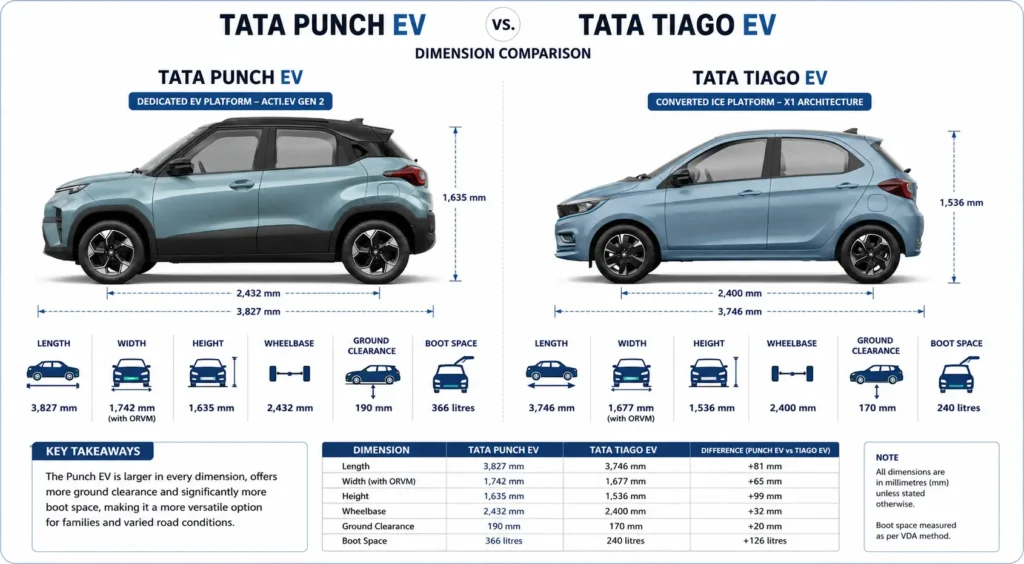
5. External Dimensions & Capacities
| Dimensional Parameter | Tata Tiago EV Hatchback | Tata Punch EV SUV |
| Length | 3,769 mm | 3,880 mm |
| Width | 1,677 mm | 1,742 mm (Wider track width) |
| Height | 1,532 mm | 1,622 mm (Commanding view) |
| Wheelbase Capacity | 2,400 mm | 2,445 mm |
| Unladen Ground Clearance | 166 mm | 195 mm (Clears severe ruts easily) |
| Boot Space Volume | 240 Liters | 366 Liters + Front Frunk box |
6. Comfort & Everyday Convenience
Tata Tiago EV: Focuses on essential daily urban comfort. It provides automatic climate control, a height-adjustable driver’s seat, well-padded fabric seats, and a cooled glove box. However, it cuts back on premium upgrades, lacking a sunroof, a rear armrest, or front seat ventilation.
Tata Punch EV: Steps firmly into the luxury segment, bringing features rarely seen under ₹15 Lakh. It offers ventilated (cooled) leatherette front seats to beat harsh summers, an electronic parking brake with Auto Hold, a voice-assisted electric sunroof, cruise control, and an active air purifier built into the climate system.
7. Interior Architecture & Cockpit Design
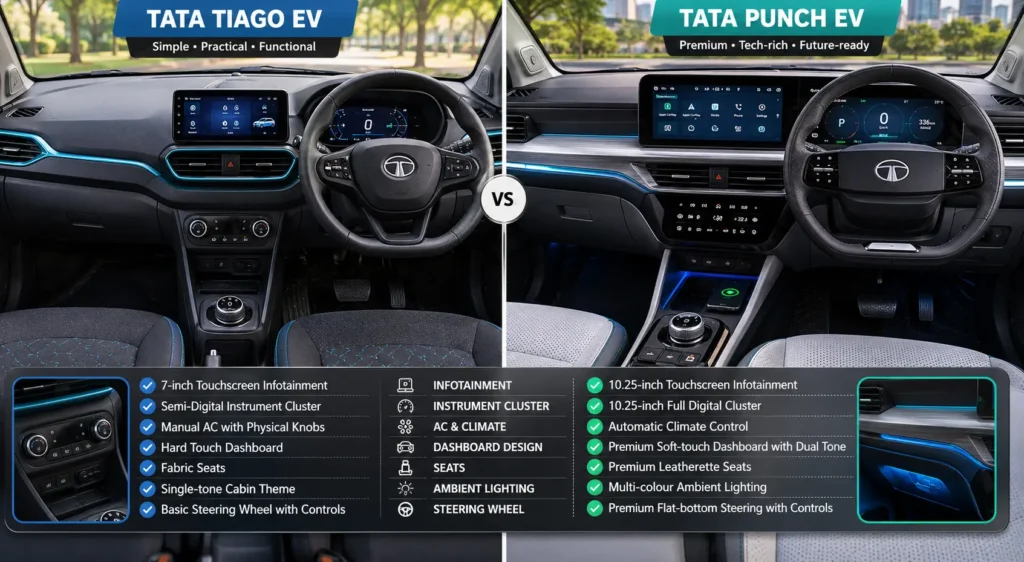
Tata Tiago EV: Uses a highly traditional dashboard layout with a standard three-spoke steering wheel and clear physical climate toggles. The interior features signature EV blue highlight accents surrounding the air conditioning side louvers, keeping things practical, intuitive, and easy to clean.
Tata Punch EV: Features a modern dashboard layout with clean jewel accents. It replaces traditional physical switches with a glossy touch panel for climate functions. It integrates a rotary drive selector and a signature two-spoke steering wheel with an illuminated Tata logo.
8. Entertainment & Media Technology
Tata Tiago EV: Features an upgraded 10.24-inch floating touchscreen display and a 5-inch digital driver console. It supports wireless Apple CarPlay and Android Auto for smooth navigation mapping and outputs audio through an excellent 4-speaker and 4-tweeter sound system tuned by Harman.
Tata Punch EV: Doubles its screen real estate with dual displays on top trims. A massive 10.25-inch HD touchscreen infotainment system by Harman sits next to a matching 10.25-inch virtual cockpit driver screen that can mirror full navigation maps. It includes a wireless charging dock and the Arcade.ev App Suite to stream video apps over Wi-Fi while parked at charging stations.
9. Advanced Connected Internet (Telematics)
Tata Tiago EV: Uses the standard ZConnect platform app framework, offering roughly 40 connected car features. It allows owners to track the live position of the car, lock or unlock the doors remotely, check driving trip analytics, and monitor battery range levels directly from a smartphone.
Tata Punch EV: Runs the latest iRA.ev smart car suite supporting over 60+ connected features. It offers smartwatch connectivity, remote cabin pre-cooling, geofencing, real-world battery state tracking, and unique multiple voice assistant mappings (“Hey Tata”, Alexa, Siri, and Google Assistant).
10. Safety Profile & Crash Validation
The structural platforms create a clear safety distinction between the two models:
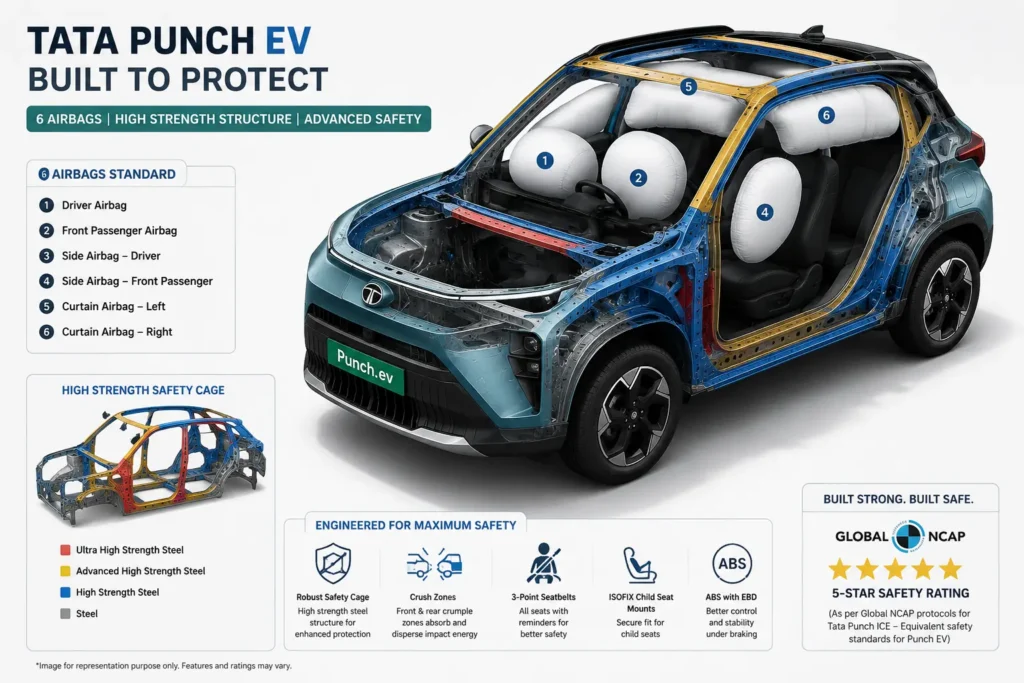
Tata Tiago EV: Built on a reinforced vehicle frame, coming equipped with dual front airbags, ABS with EBD, cornering stability control, and rear parking guidelines. Higher trims add electronic stability control (ESC) and a tyre pressure monitoring system (TPMS).
Tata Punch EV: Built on the high-tensile steel structural acti.ev platform, achieving a full 5-Star Bharat / Global NCAP safety rating. It standardizes 6 airbags across all variants, electronic stability control (ESC), hill hold, hill descent control, and disc brakes on all four wheels for confident stopping power.
11. Energy Running Cost Comparison
Let’s calculate the operational math for an urban commuter covering 1,200 km per month using domestic home charging.
Scenario A: Tata Tiago EV (24 kWh Pack)
Average domestic power tariff: ₹8 per unit (kWh).
Fully topping up the 24 kWh pack takes roughly 26 units of power (allowing for standard minor charging losses), costing ₹208.
Real-world city range of ~220 km means covering 1,200 km requires roughly 5.4 charging cycles.
Monthly Electricity Bill: ~₹1,123 (Approx. ₹0.93 per km).
Scenario B: Tata Punch EV (40 kWh Long Range Pack)
Fully topping up the 40 kWh battery takes roughly 44 units of power, costing ₹352.
Real-world city range of ~345 km means covering 1,200 km requires roughly 3.4 charging cycles.
Monthly Electricity Bill: ~₹1,196 (Approx. ₹0.99 per km).
Summary of Running Costs
Because both cars weigh substantially less than large mid-size SUVs, their energy efficiency remains high. Driving either model keeps your per-kilometer operational cost under ₹1.00, delivering massive savings compared to equivalent petrol vehicles that average ₹6.50 to ₹8.00 per kilometer.
Final Verdict: Which One Belongs in Your Garage?
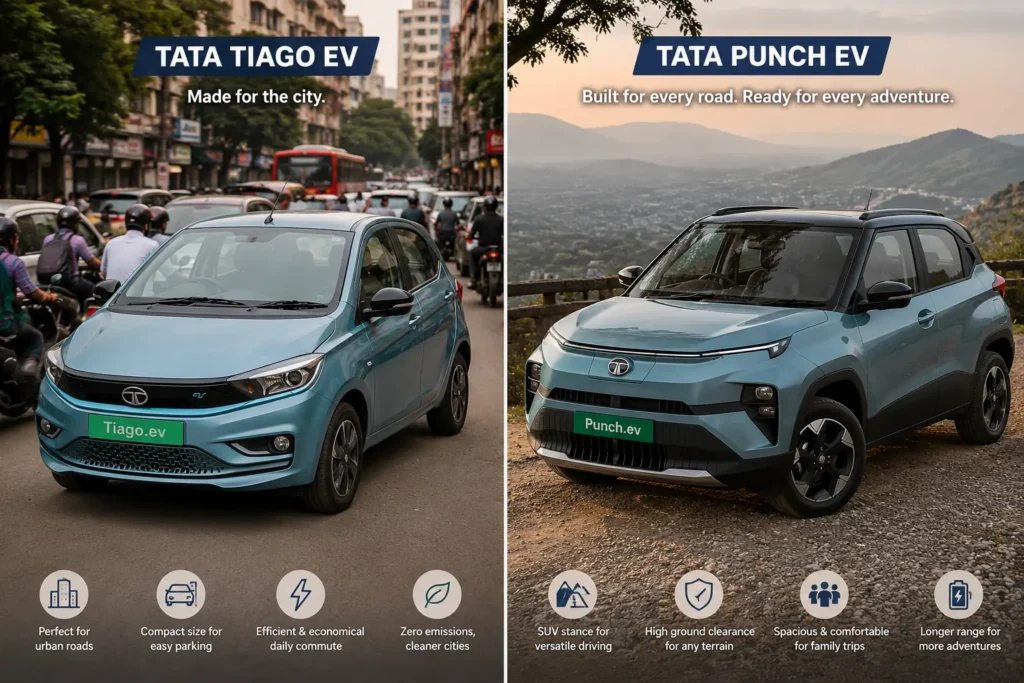
Choose the Tata Tiago EV if:
Your maximum budget is strictly capped under ₹10 Lakh on-road.
Your driving is restricted strictly to local city errands, school runs, and office commutes under 60 km daily.
You want an agile, uncomplicated hatchback that is exceptionally simple to maneuver, squeeze through narrow market lanes, and park in tight spots.
Choose the Tata Punch EV if:
You want a more versatile primary car capable of handling out-of-town weekend highway trips past 250 km without charging pauses.
You require a high 195mm ground clearance to clear broken, waterlogged suburban roads and tall speed breakers safely.
You prioritize an absolute top-tier safety package (5-star rating with 6 standard airbags) and want a contemporary, premium cabin with front seat cooling and dual 10.25-inch digital screens.
Helpful Resources for Indian EV Car Buyers
- Bharat NCAP Official Website — India’s official crash-testing and vehicle safety rating platform. Includes adult and child occupant scores, crash-test protocols, and tested vehicle lists.
- Global NCAP – Safer Cars for India — Global crash-test program that pushed Indian manufacturers toward safer vehicle structures and occupant protection standards.
- Reserve Bank of India (RBI) — Official source for repo rates, lending rules, and banking regulations in India. (rbi.org.in)
- TransUnion CIBIL — Check your credit score and track your loan eligibility before applying for a car loan.
- AutomotiveZone Mileage Cost Calculator — Estimate real fuel costs based on your driving mileage.
- AutomotiveZone Monthly Car Expense Calculator — Calculate total monthly car ownership cost including EMI, fuel, and maintenance.
- AutomotiveZone Fuel Cost Calculator — Instantly estimate petrol, diesel, or CNG expenses based on mileage, fuel price, and trip distance.
- AutomotiveZone EV vs Petrol Cost Calculator — Compare electric vehicle charging costs with petrol fuel expenses to see long-term savings.
- AutomotiveZone EV Charging Cost Calculator — Calculate home and fast-charging electricity costs for your EV using battery size and electricity tariff.
- AutomotiveZone Car Resale Value Estimator — Estimate your car’s current market resale value based on age, mileage, ownership, and condition.
Disclaimer: Prices, mileage, safety ratings, loan rates, and ownership costs are approximate and may vary by location, variant, and market conditions in 2026. Some visuals may be AI-generated for illustration. Please verify final details with authorized dealers before purchase.
Compare Tata Punch EV vs Tata Tiago EV
Explore detailed specifications, pricing, range, features, and real-world differences to choose the right Tata EV for your needs.
Compare EVs Now →