
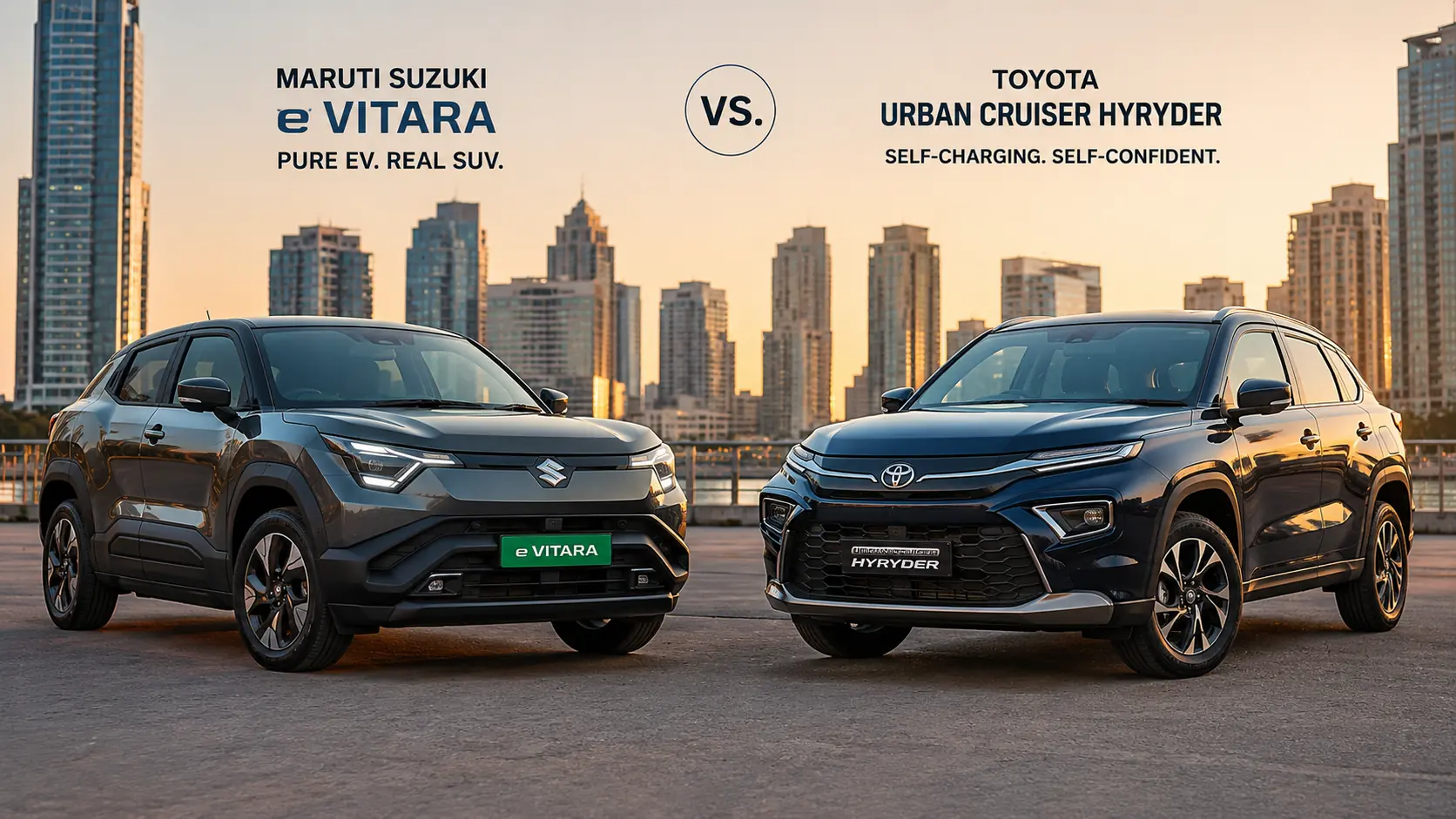

Maruti Suzuki e Vitara vs Toyota Hyryder Quick Overview
In 2026, the Maruti Suzuki e Vitara stands as a ground-up full-electric SUV priced from ₹15.99 Lakh to ₹20.01 Lakh (or from ₹10.99 Lakh via its unique Battery-as-a-Service model), delivering a zero-emission, real-world city range of 350 km to 450 km. Meanwhile, the Toyota Urban Cruiser Hyryder Strong Hybrid (priced from ₹16.66 Lakh to ₹19.99 Lakh) relies on a self-charging petrol-electric powertrain, completely eliminating public plug-in dependencies while delivering an exceptional real-world mileage of 22 to 25 km/l.
Maruti Suzuki e Vitara vs Toyota Urban Cruiser Hyryder: The Ultimate 2026 Green Mid-Size SUV Guide
For buyers looking to step away from traditional petrol and diesel expenses in the mid-size SUV segment, the choices are no longer straightforward. The market has moved past choosing between different fuel tanks. Today, the fundamental choice comes down to your primary powertrain technology: Full Electric (BEV) or Strong Hybrid (SHEV).
The Toyota Urban Cruiser Hyryder Strong Hybrid is the established king of mid-journey fuel packaging—a self-charging crossover that uses a smart engine-and-motor layout to offer diesel-beating fuel economy without ever needing a plug. The newly launched Maruti Suzuki e Vitara represents Suzuki’s global shift into full electrification. Built on a dedicated pure EV platform, it targets buyers who want a completely zero-emission lifestyle.
This complete guide outlines the real-world operational and technical differences between these two green mid-size crossovers.
1. Basic Information
The underlying engineering layouts establish distinct taxation and ownership paths for these two vehicles:
Maruti Suzuki e Vitara (Pure Electric BEV): Built on the specialized, ground-up HEARTECT-e electric skateboard platform. It benefits from India’s flat 5% EV GST rate and extensive state-level registration concessions, bringing on-road costs closer to the ex-showroom price.
Toyota Urban Cruiser Hyryder (Strong Hybrid SHEV): Developed on Suzuki’s global architecture using Toyota’s premium THS (Toyota Hybrid System) self-charging technology. It faces standard 43% hybrid GST and cess brackets, meaning it carries a higher on-road price premium despite similar ex-showroom numbers.
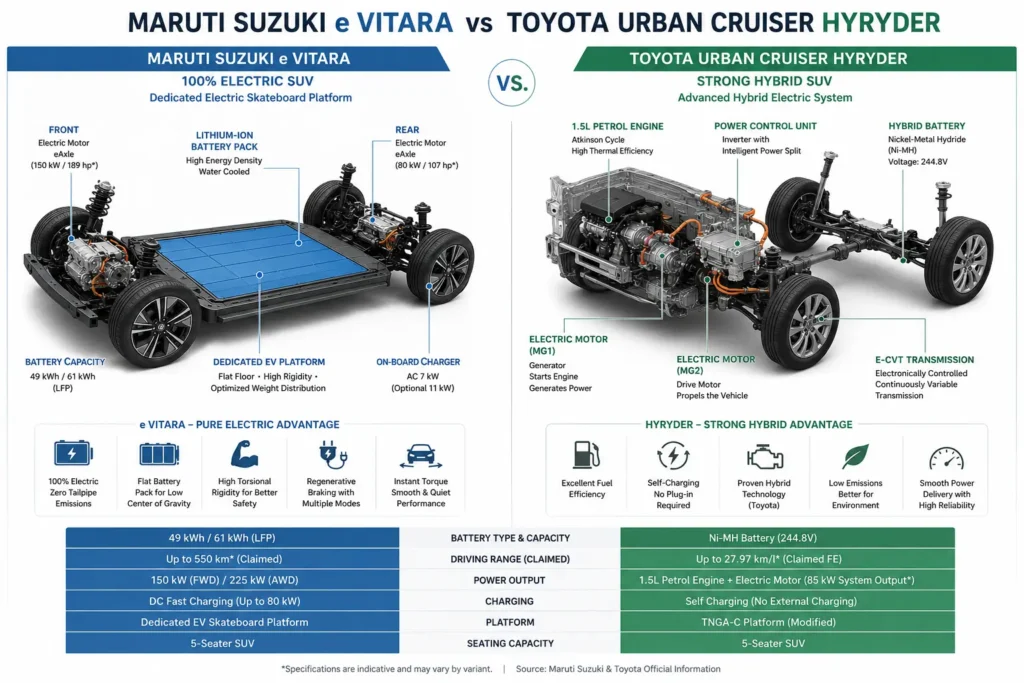
2. Engine & Powertrain Architecture
| Feature | Maruti Suzuki e Vitara (2026) | Toyota Hyryder Strong Hybrid (2026) |
| Powertrain Category | Full Electric Vehicle (BEV) | Self-Charging Strong Hybrid (SHEV) |
| Combustion Engine | None | 1.5-Litre 3-Cylinder TNGA Petrol (M15D-FXE) |
| Electric Motor Setup | Front-Mounted AC Permanent Magnet Synchronous | Front-Mounted AC Synchronous Assist Motor |
| Battery Chemistry | Lithium-Iron-Phosphate (LFP) Blade Pack | Sealed Lithium-Ion Matrix |
| Battery Pack Capacity | 49 kWh (Base) / 61 kWh (Long Range) | 0.76 kWh (High-voltage self-charging buffer) |
| Transmission Type | Single-Speed Automatic | Power-Split Electronic e-CVT Automatic |
3. Performance & Real-World Efficiency
The performance profiles prioritize immediate acceleration responses on one side, and long-range operational flexibility on the other:
Maruti Suzuki e Vitara: Delivers instant torque. The 49 kWh version puts out 144 PS, while the 61 kWh flagship trim delivers 174 PS and 193 Nm of instant torque, pulling cleanly from a standstill to 100 km/h in roughly 8.5 seconds.
Toyota Urban Cruiser Hyryder: Prioritizes continuous thermal efficiency. The system smoothly blends petrol and electric inputs for a combined output of 115.5 PS. While its 0-100 km/h sprint is a relaxed 12.2 seconds, it operates on electric power for up to 60% of urban commutes.
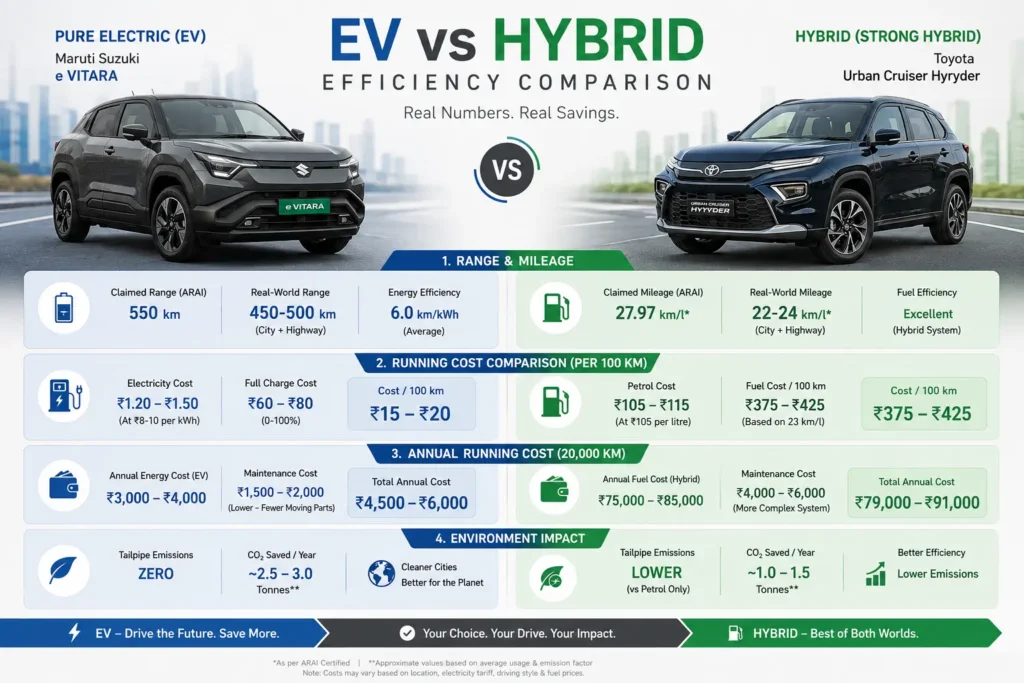
Efficiency & Range Realities
Maruti e Vitara (61 kWh): Claimed ARAI range stands at 543 km. In everyday use, expect a highly reliable city range of 420 km to 450 km, dropping to roughly 350 km during continuous 100 km/h highway cruising.
Toyota Hyryder Hybrid: Features an ARAI fuel economy rating of 27.97 km/l. In chaotic bumper-to-bumper urban gridlock, it excels by delivering a stable 22 to 25 km/l, giving it a massive single-tank cruising range of over 1,000 km.
4. Ride, Control & Dynamics
Maruti Suzuki e Vitara: The flat under-floor battery placement lowers the vehicle’s center of gravity significantly. Combined with an advanced independent multi-link rear suspension setup, it remains firmly planted and flat around high-speed highway curves. Its electronic steering feels light in the city but gains reassuring weight on the highway.
Toyota Urban Cruiser Hyryder: Uses a traditional, lightweight twist-beam rear suspension layout. The ride is tuned soft to prioritize cushiony low-speed comfort, absorbing sharp city potholes and broken expansion joints smoothly. Body roll is noticeable but well-contained, and it offers an agile 5.4-meter turning radius.
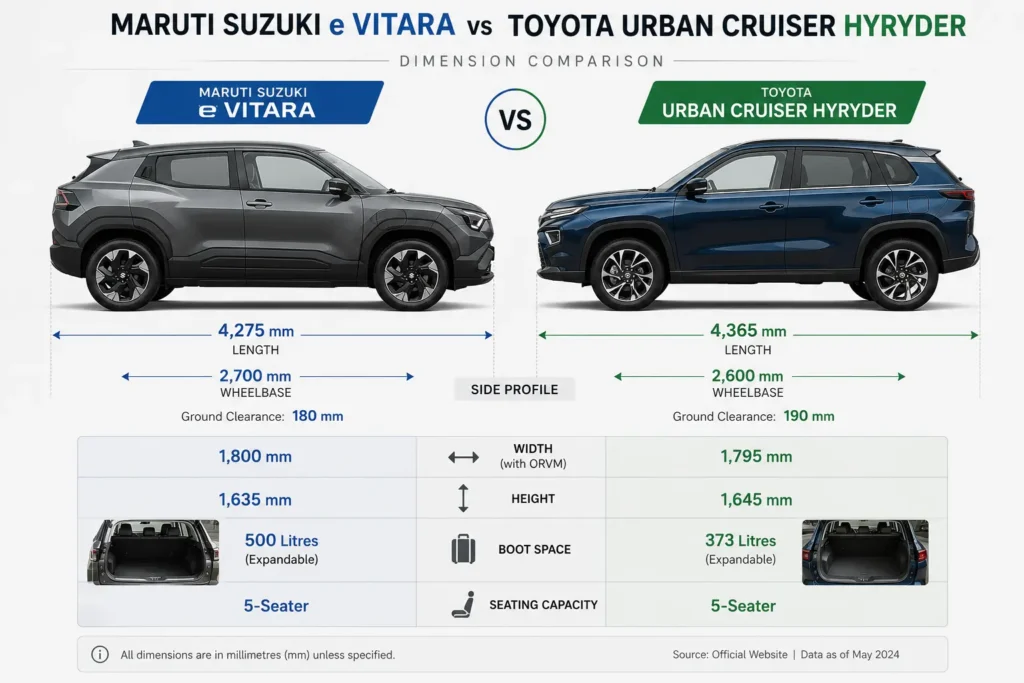
5. Dimensions & Packaging
| Dimensional Parameter | Maruti Suzuki e Vitara | Toyota Urban Cruiser Hyryder |
| Length | 4,275 mm | 4,365 mm (Longer body profile) |
| Width | 1,800 mm (Wider stance) | 1,795 mm |
| Height | 1,640 mm | 1,645 mm |
| Wheelbase Capacity | 2,700 mm (Pushed-out wheels) | 2,600 mm |
| Unladen Ground Clearance | 180 mm | 210 mm (Superior trail clearance) |
| Trunk Cargo Volume | 310 Liters (Flat floor layout) | 273 Liters (Raised by battery packaging) |
6. Comfort & Convenience
Maruti Suzuki e Vitara: Offers a highly premium, modern cabin layout. It includes a 10-way power-adjustable driver’s seat, ventilated front seats, automatic climate control with rear AC vents, a wireless charging dock, and an automatic electronic parking brake.
Toyota Urban Cruiser Hyryder: Matches its rival with ventilated front seats, automatic climate control, and cruise control. However, it cuts back slightly on electronic adjustments, utilizing manual levers for driver seat positioning. It retains a traditional mechanical handbrake lever on the center console.
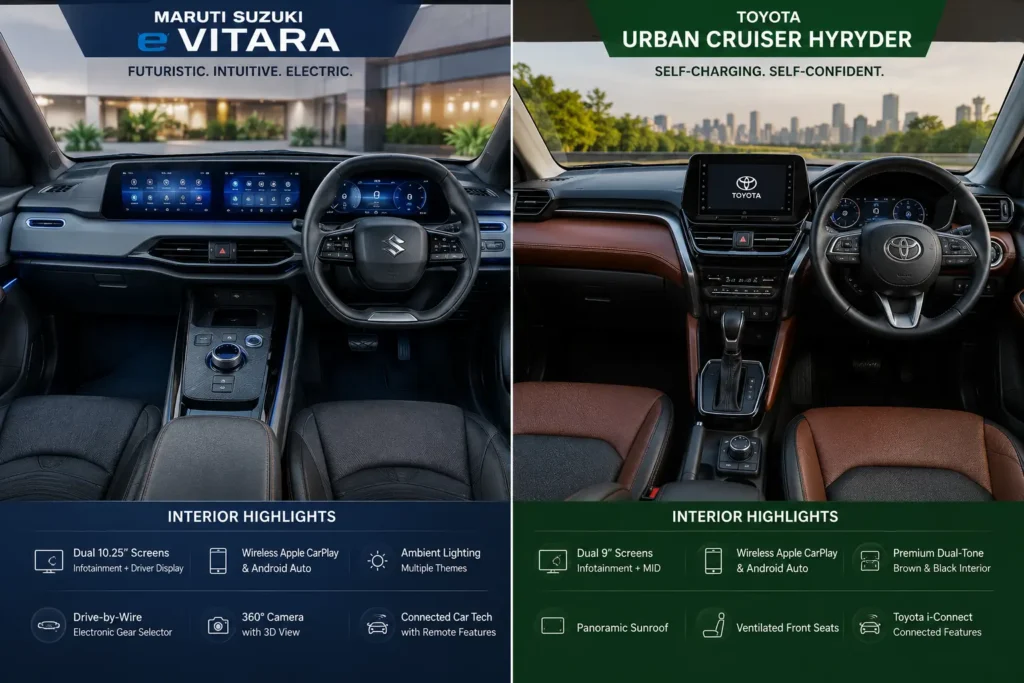
7. Interior Design & Materials
Maruti Suzuki e Vitara: Features a contemporary, upscale dashboard layout. Soft-touch materials stretch across the center line, complemented by a clean, gloss-black console panel that groups critical driving switches logically. The rear seats feature a flexible 40:20:40 split-folding system, allowing you to recline the backrest up to 20 degrees.
Toyota Urban Cruiser Hyryder: Features a classic, dual-tone black and rich brown interior theme with silver accents. The layout places straightforward physical buttons within easy reach. The rear seats utilize a standard 60:40 split arrangement with a two-step reclining function, prioritizing a durable, family-friendly design.
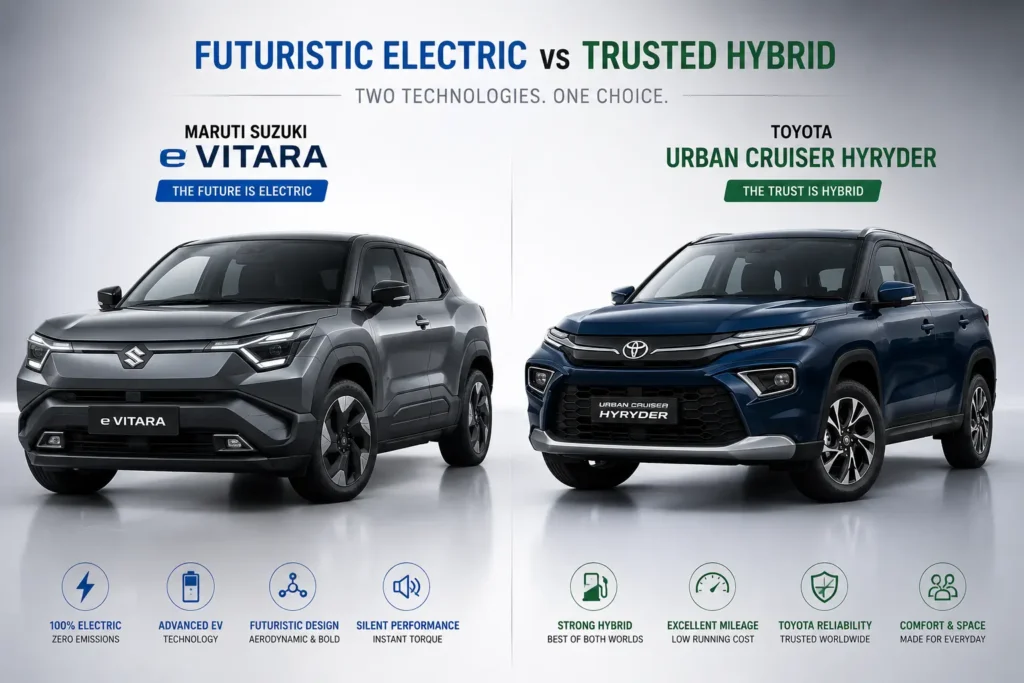
8. Exterior Styling Elements
Maruti Suzuki e Vitara: Carries an aggressive, futuristic concept-car look. It features slim, swept-back LED headlamps with integrated connected DRL signatures, thick body cladding, rear door handles hidden in the C-pillar, and standard 18-inch aerodynamic alloy wheels that give it a planted stance.
Toyota Urban Cruiser Hyryder: Retains a handsome, traditional SUV silhouette. It highlights Toyota’s signature crystal acrylic upper grille insert, flanked by split LED daytime running lights, a prominent front skid plate, chrome window accents, and standard 17-inch multi-spoke alloy wheels.
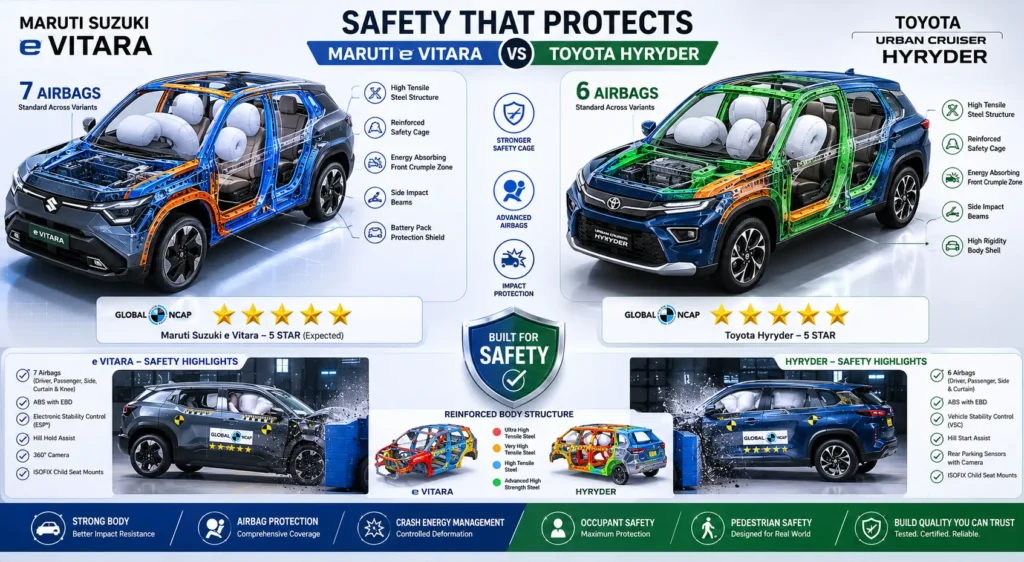
9. Safety Profile & Crash Protection
| Safety Feature | Maruti Suzuki e Vitara | Toyota Urban Cruiser Hyryder |
| Crash Test Validation | 5-Star Bharat NCAP Rating | 4-Star Global NCAP Rating (Platform baseline) |
| Standard Airbag Count | 7 Airbags standard (Includes far-side) | 6 Airbags (On top-spec G and V trims) |
| Braking Systems | Disc brakes on all four wheels | Disc brakes on all four wheels |
| Electronic Stability aids | ESP, Hill Hold, Traction Control | Vehicle Stability Control, Hill Hold Control |
| Pedestrian Alert (AVAS) | Yes (Acoustic alert under 20 km/h) | Yes (Approaching EV acoustic system) |
10. Advanced Connected Internet (Telematics)
Maruti Suzuki e Vitara: Runs the next-generation Next-Gen Suzuki Connect app architecture, supporting over 60+ connected features. It lets you monitor live charging cycles, map out nearby working fast chargers, and pre-cool the cabin remotely via your smartphone or smartwatch.
Toyota Urban Cruiser Hyryder: Utilizes the i-Connect telematics suite, offering roughly 55 connected functions. It supports remote air conditioning pre-conditioning, geofencing, vehicle health reports, walk-to-car navigation guides, and smart location updates.
11. Entertainment & Media Technology
Maruti Suzuki e Vitara: Features a massive dual-screen cockpit array, integrating a 10.25-inch digital instrument cluster next to a 10.1-inch floating infotainment touchscreen. It supports wireless Apple CarPlay and Android Auto, projecting audio through an immersive 8-speaker Infinity premium sound system by Harman.
Toyota Urban Cruiser Hyryder: Features a 7-inch digital driver display paired with a 9-inch Smart Playcast center touchscreen deck. It provides wireless Apple CarPlay and Android Auto connectivity, outputting sound through an excellent 6-speaker Arkamys audio configuration. It includes a convenient Heads-Up Display (HUD) that projects your live speed and navigation cues into your direct line of sight.
12. Energy Running Cost Comparison
Let’s calculate the true monthly budget math for an urban commuter covering 1,500 km per month using standard home charging tariffs versus fuel station pumps.
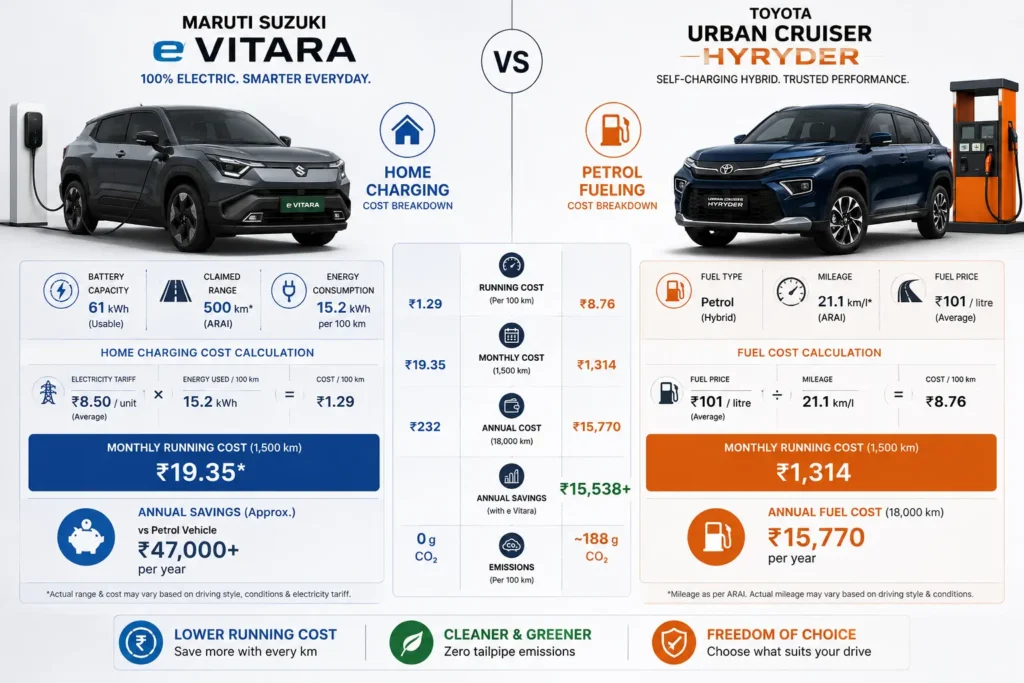
Scenario A: Maruti Suzuki e Vitara (61 kWh via Home AC Charging)
Average domestic power tariff: ₹8 per unit (kWh).
Fully topping up the 61 kWh battery pack takes roughly 66 units of electricity (accounting for minor charging inefficiencies), costing ₹528.
A real-world mixed range of ~400 km means covering 1,500 km requires roughly 3.75 charging cycles.
Monthly Power Bill: ~₹1,980 (Approx. ₹1.32 per km).
(Note: Choosing Maruti’s innovative BaaS model lowers the ex-showroom entry price to ₹10.99 Lakh, introducing a fixed battery rental fee of ₹3.99 per km).
Scenario B: Toyota Hyryder Hybrid (Petrol Filling Pump)
Average cost of standard fuel: ₹102 per liter.
Real-world urban mileage in dense traffic: 23 km/l.
Fuel needed for 1,500 km: 65.2 Liters.
Monthly Fuel Bill: ₹6,650 (Approx. ₹4.43 per km).
5-Year Cumulative Operational Savings Outlook
[Toyota Hyryder Hybrid Cost: ₹6,650/mo]
=======> 5-Year Total: ₹3.99 Lakh
[Maruti e Vitara EV Cost:     ₹1,980/mo]
==> 5-Year Total: ₹1.19 Lakh
-------------------------------------
Net Operational Family Energy Savings: ₹2.80 Lakh
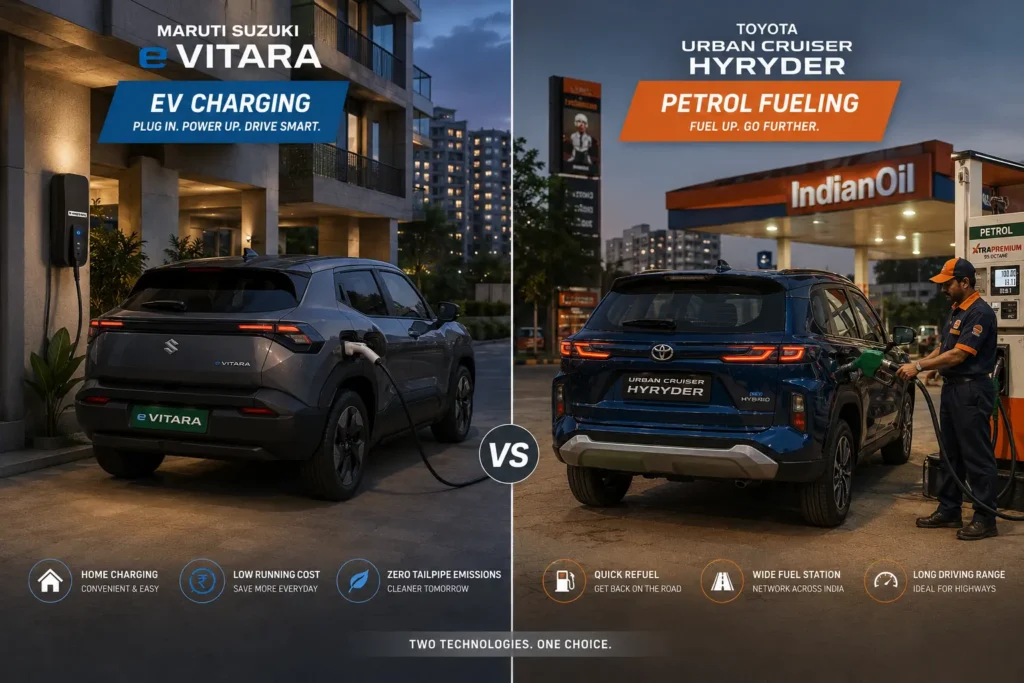
Final Verdict: Which Green SUV Fits Your Garage?
Choose the Maruti Suzuki e Vitara if:
You have a secure, designated parking spot at home or work to mount the bundled 7.4 kW AC fast-charging box.
Your monthly driving exceeds 1,200 km, and you want to lock in the absolute lowest possible running costs (under ₹1.40/km).
You prioritize an elite, top-tier safety package (5-star rating with 7 standard airbags) and want advanced Level 2 ADAS driver assistance suites.
Choose the Toyota Urban Cruiser Hyryder if:
You live in an apartment complex lacking reliable, private charging access.
You frequently take spontaneous, long-distance interstate road trips and want to avoid mapping out public charging networks.
You prefer a soft, cushiony low-speed ride profile and want the peace of mind that comes with Toyota’s proven, self-charging hybrid technology.
Helpful Resources for Indian EV Car Buyers
- Bharat NCAP Official Website — India’s official crash-testing and vehicle safety rating platform. Includes adult and child occupant scores, crash-test protocols, and tested vehicle lists.
- Global NCAP – Safer Cars for India — Global crash-test program that pushed Indian manufacturers toward safer vehicle structures and occupant protection standards.
- Reserve Bank of India (RBI) — Official source for repo rates, lending rules, and banking regulations in India. (rbi.org.in)
- TransUnion CIBIL — Check your credit score and track your loan eligibility before applying for a car loan.
- AutomotiveZone Mileage Cost Calculator — Estimate real fuel costs based on your driving mileage.
- AutomotiveZone Monthly Car Expense Calculator — Calculate total monthly car ownership cost including EMI, fuel, and maintenance.
- AutomotiveZone Fuel Cost Calculator — Instantly estimate petrol, diesel, or CNG expenses based on mileage, fuel price, and trip distance.
- AutomotiveZone EV vs Petrol Cost Calculator — Compare electric vehicle charging costs with petrol fuel expenses to see long-term savings.
- AutomotiveZone EV Charging Cost Calculator — Calculate home and fast-charging electricity costs for your EV using battery size and electricity tariff.
- AutomotiveZone Car Resale Value Estimator — Estimate your car’s current market resale value based on age, mileage, ownership, and condition.
Disclaimer: Prices, mileage, safety ratings, loan rates, and ownership costs are approximate and may vary by location, variant, and market conditions in 2026. Some visuals may be AI-generated for illustration. Please verify final details with authorized dealers before purchase.
Compare Maruti Suzuki e Vitara vs Toyota Hyryder
Explore detailed specifications, powertrain differences, real-world mileage, pricing, features, and technology to choose the right green SUV for your lifestyle.
Compare SUVs Now →