

Toyota Urban Cruiser Ebella EV Quick Overview
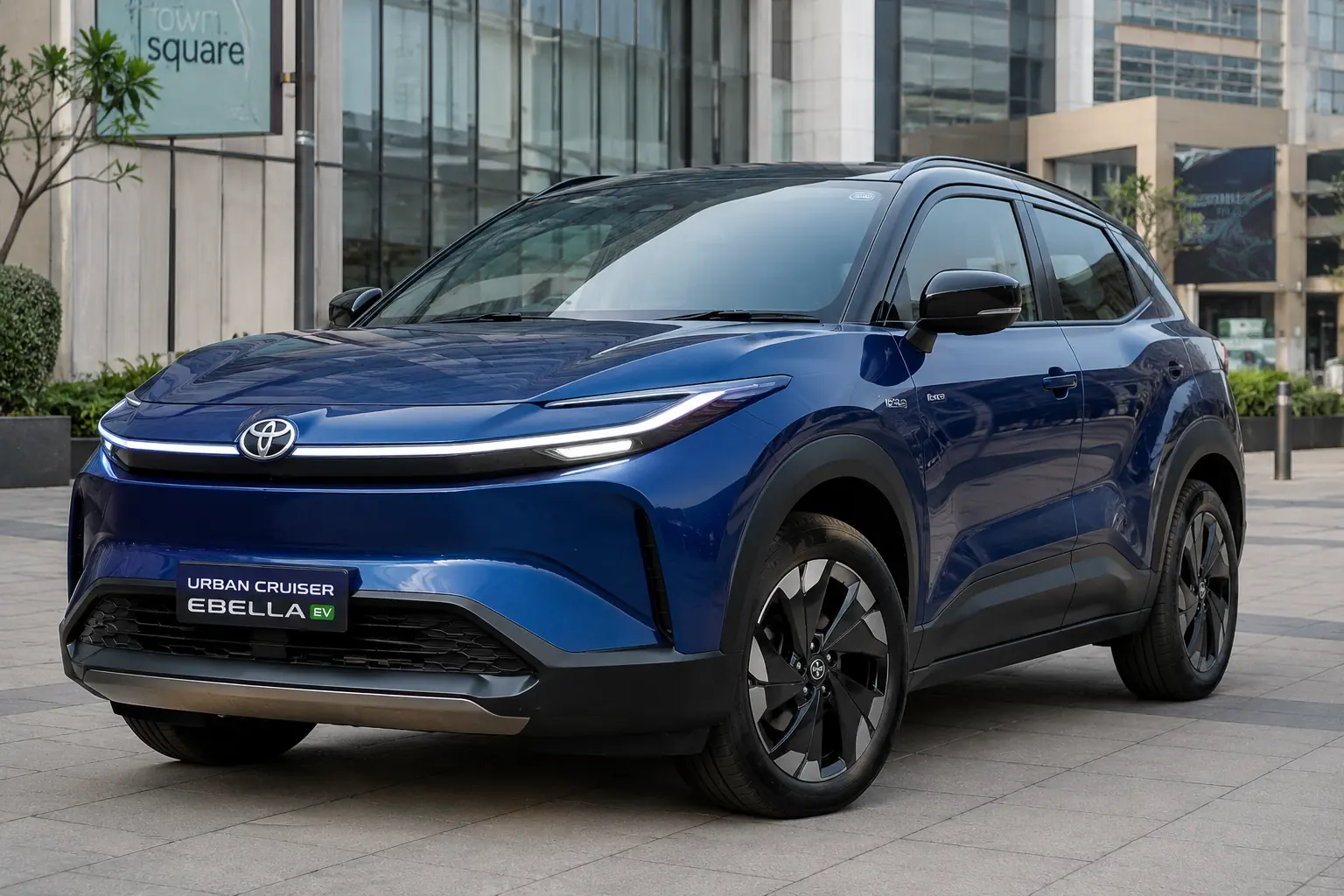
The 2026 Toyota Urban Cruiser Ebella is an all-electric mid-size family SUV priced at ₹23.60 Lakh (ex-showroom) for its flagship, fully loaded E3 trim. Built on a dedicated born-EV platform shared with Maruti’s e Vitara, it is also accessible via a Battery-as-a-Service (BaaS) subscription model that lowers the upfront cost to ₹15.25 Lakh plus a ₹4.99 per km battery rental fee. Utilizing a 61 kWh LFP Blade battery pack, it puts out 171.65 bhp and delivers a verified real-world city range of 410 km to 440 km.
Toyota Urban Cruiser Ebella EV Price Guide 2026: Real-World Range, BaaS Structure, Interior & Is It Worth Buying?
For years, Toyota India focused heavily on self-charging strong hybrids to bridge the gap between fossil fuels and clean energy. However, as metropolitan charging networks expand rapidly and buyer demand shifts decisively toward pure zero-emission powertrains, mass-market manufacturers are rolling out specialized global electric architectures.
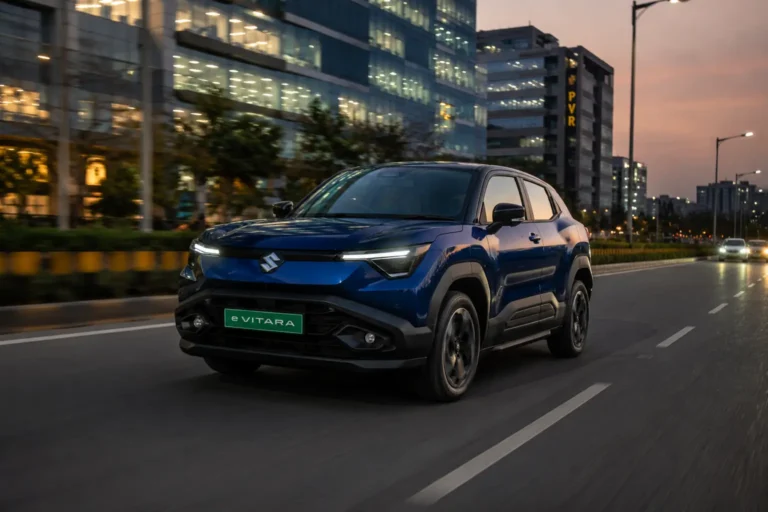
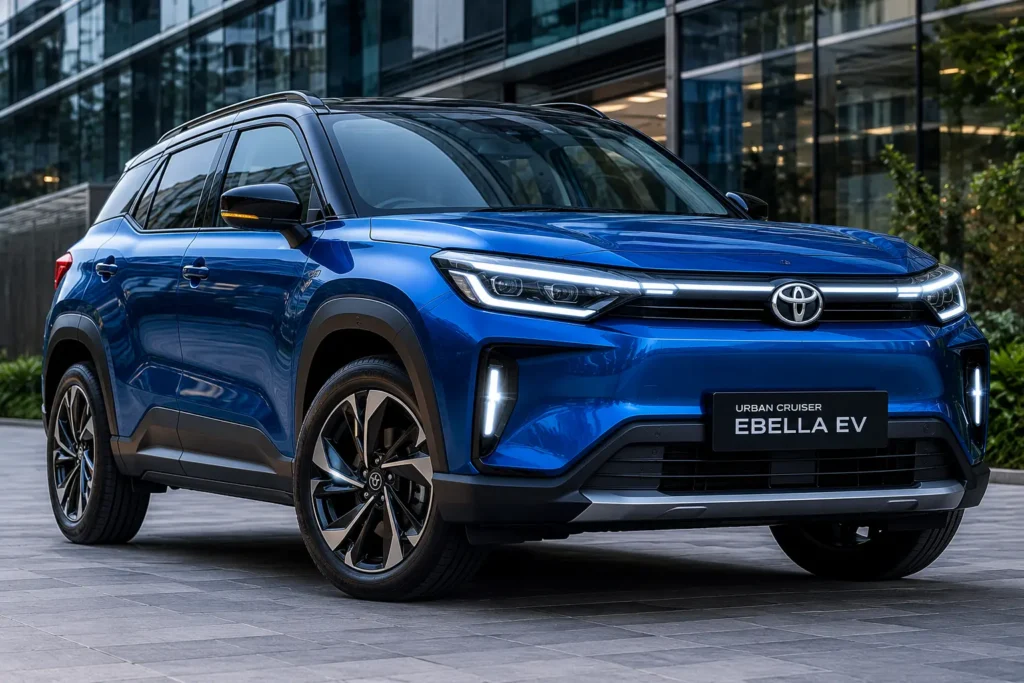
The Toyota Urban Cruiser Ebella represents the Japanese giant’s highly anticipated debut in India’s pure electric vehicle space. Sharing its platform, underpinnings, and electrical hardware with the Maruti Suzuki e Vitara, the Ebella steps out as a sleeker, more sophisticated sibling. Carrying Toyota’s signature design language and premium cabin touches, it targets modern tech-forward families looking for a durable, long-range electric crossover under a ₹25 Lakh budget.
Why the Urban Cruiser Ebella Is an Important Shift for Families
The Ebella EV marks a significant transition from old combustion vehicle engine layouts to highly optimized born-electric packaging:
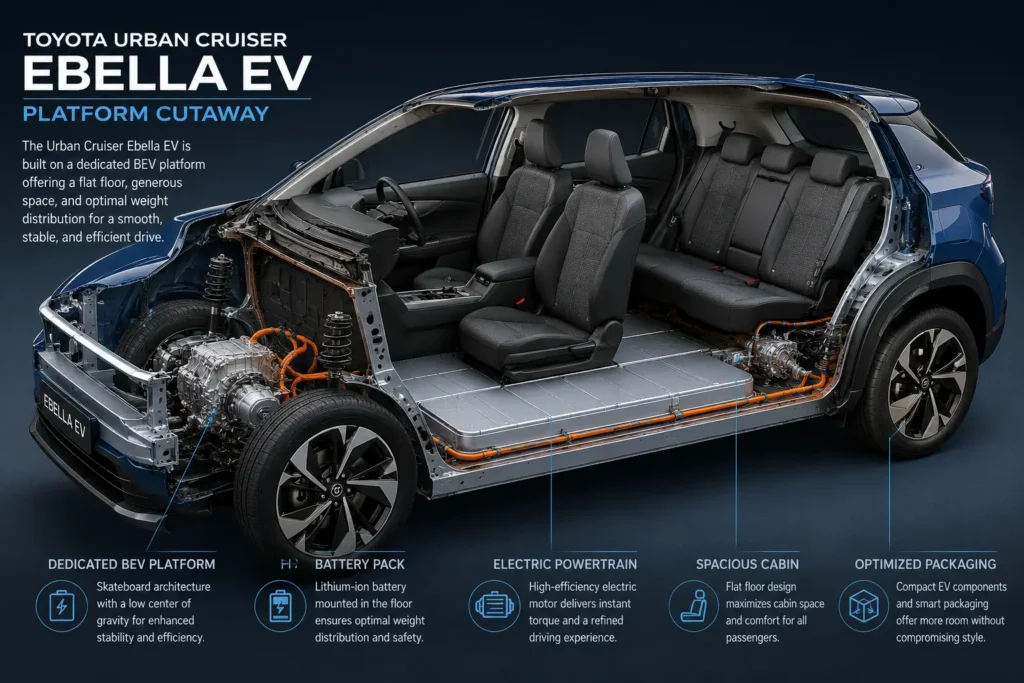
Dedicated Born-EV Platform: Because it drops the constraints of a traditional petrol engine firewall, the wheels are pushed straight out to the absolute outer corners, unlocking massive passenger room.
The Power of the Blade: By implementing a highly compact, robust Lithium-Iron-Phosphate (LFP) Blade battery format, it secures high thermal defense against severe Indian summer conditions.
Highly Flexible Buying Channels: By introducing an optional Battery-as-a-Service framework, Toyota lets buyers slice their initial acquisition investment by over ₹8 Lakh.
Toyota Urban Cruiser Ebella Price List & Variants (2026)
The Ebella portfolio divides its trim structure cleanly between standard purchase methods and the operational BaaS subscription grid.
Ex-Showroom India Price Architecture:
| Variant Grade | Battery Pack | Motor Output | Outright Purchase Price | BaaS Subscription Price |
| E1 (Base) | 49 kWh | 144 bhp | To Be Announced | To Be Announced |
| E2 (Mid) | 61 kWh | 171.65 bhp | To Be Announced | To Be Announced |
| E3 (Flagship) | 61 kWh | 171.65 bhp | ₹23.60 Lakh | ₹15.25 Lakh |
The Battery Rental Math: Opting for the BaaS model drops the upfront sticker price of the flagship E3 grade to just ₹15.25 Lakh. Owners then pay a continuous battery subscription fee of ₹4.99 per km driven, shifting a large part of the initial vehicle cost into a monthly operating metric.
Premium Interior Architecture, Technology & Space
Step inside the Ebella, and Toyota’s focus on structured minimalism takes center stage, delivering a premium and cohesive environment.
1. The Unified Digital Cockpit
The dashboard features clean, modern horizontal lines dominated by a sweeping dual-screen housing. It links a crisp 10.25-inch fully digital driver instrumentation cluster with a high-resolution 10.1-inch central multimedia touchscreen infotainment system. The deck seamlessly runs wireless Apple CarPlay and Android Auto, channelling audio through an elite, immersive JBL premium sound system with a dedicated subwoofer.
2. Cabin Comfort and Material Finish
The seating surfaces utilize a well-crafted combination of soft synthetic leatherette and durable fabric inserts. The front seats are set on the firmer side to optimize comfort during long journeys, featuring 3-stage cooling ventilation and a 10-way power-adjustable driver’s seat. The center console floats neatly, housing an intuitive smooth dial-style gear shifter, an electronic parking brake, and a cooled wireless charging pad.
3. Family Legroom and Luggage Flexibility
Thanks to a massive 2,700 mm wheelbase, passenger legroom and knee room in the rear row are extensive. The second row sets a high bar for flexibility, utilizing a segment-first 40:20:40 split-folding rear bench that slides and reclines to balance passenger comfort with irregular cargo sizes. Rear occupants get dedicated air vents and personal USB Type-A and Type-C fast-charging ports, though thick front headrests limit forward visibility slightly.
Real-World Range & Charging Experience
Laboratory metrics establish a standardized baseline, but the realities of Indian highway speeds and traffic crawls outline the true usable range.
Real Urban Loops vs. Expressway Consumption
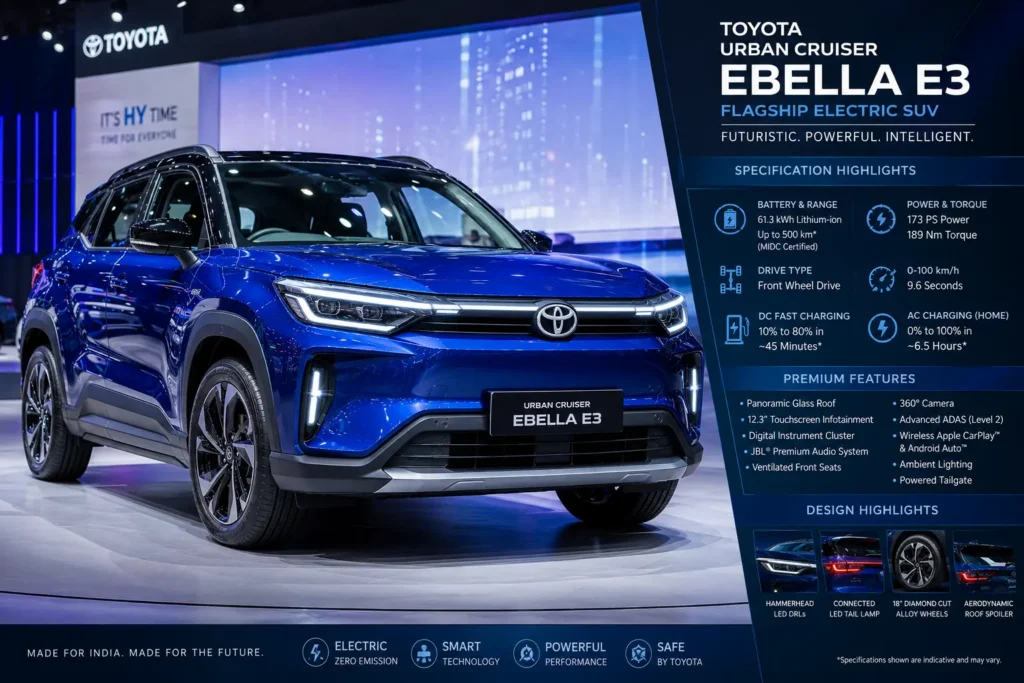
The Flagship 61 kWh Pack (E3 Grade): Carries an official certified ARAI range of 543 km.
True City Traffic Loops: In actual metropolitan driving with the dual-zone air conditioning running consistently, you can safely expect a highly dependable 410 km to 440 km of real-world range.
Open Expressway Cruising: Maintaining steady highway cruising speeds at around 100 km/h increases aerodynamic resistance, dropping the actual driving range down to roughly 350 km.
Intelligent Fast Charging Speeds
Public DC Fast Charging Infrastructure: Built on high-capacity electrical architectures, the Ebella supports up to 150 kW DC fast-charging input. Plugging into a compatible commercial highway fast charger replenishes the cell pack from 10% to 80% in a swift 45 minutes.
Standard AC Home Wall Box: Bundled standard with vehicle delivery, a standard home installation safely manages an overnight charge from empty to full in approximately 9.5 hours.
Toyota Urban Cruiser Ebella Technical Specifications
| Technical Parameter | Flagship Grade E3 Engineering Baseline |
| Powertrain Category | Born-Electric Skateboard Platform |
| Motor Configuration | Front-Wheel Drive (Single PMSM FWD) |
| Peak Power Output | 171.65 bhp (128 kW) |
| Peak Torque Output | 193 Nm (Instantaneous response) |
| Battery Cell Chemistry | Lithium-Iron-Phosphate (LFP) Blade Matrix |
| Battery Size (Usable) | 61 kWh |
| Certified Driving Range | 543 km (ARAI) |
| Real-World City Range | ~410 km – 440 km |
| Dimensions (L x W x H) | 4,285 mm x 1,800 mm x 1,640 mm |
| Wheelbase Capacity | 2,700 mm (Class Leading) |
| Turning Circle Radius | 5.2 Meters |
| Chassis Brake Assemblies | 18-inch Ventilated Disc Brakes (Front & Rear) |
Ebella EV Running Cost vs Petrol Mid-Size SUVs
Let’s calculate the operational math for a standard household commuter covering 1,200 km per month over a 5-year ownership tenure.
Scenario A: Outright Purchase Model (Home AC Charging Setup)
Average domestic power tariff: ₹8 per unit (kWh).
To fully top up the 61 kWh battery requires roughly 66 units of power (allowing for charging losses), costing ₹528.
Covering 1,200 km requires roughly 2.8 full home charging cycles.
Monthly Power Bill: ~₹1,478 (Approx. ₹1.23 per km).
Scenario B: The Battery-as-a-Service (BaaS) Model
Electricity charging cost: ₹1.23 per km.
BaaS battery subscription fee: ₹4.99 per km.
Combined operational expense: ₹6.22 per km.
Monthly BaaS Operating Cost: ₹7,464 (Includes electricity + rental).
Scenario C: Standard Petrol Automatic Mid-Size SUV
Average cost of standard fuel: ₹102 per liter.
Real-world urban fuel mileage in heavy traffic: 11 km/l.
Fuel required for 1,200 km: 109 Liters.
Monthly Fuel Bill: ₹11,118 (Approx. ₹9.26 per km).
Maintenance Cost & Long-Term Ownership
By dropping volatile mechanical moving parts like fuel injectors, turbochargers, multi-speed automated clutch assemblies, and exhaust particulate filters (DPF), long-term service liabilities drop dramatically.
Routine Workshop Outgo: Toyota’s periodic service schedules focus primarily on basic cabin air filter replacements, suspension lubrication, tire rotations, and high-voltage diagnostic software health scans. Standard service bills stay between ₹4,000 and ₹5,500.
Service Infrastructure: Toyota backs its entry into electrification by equipping over 500+ service touchpoints with advanced diagnostic tools, deploying 2,500+ master EV technicians to guarantee a 45-minute express maintenance option.
Battery Safety & Protection Warranty: The LFP Blade battery pack is insulated by an extensive 8-year factory warranty, backed by an optional Assured Buyback scheme to protect long-term resale value.
Toyota Urban Cruiser Ebella Pros & Cons
Advantages
Sleek Global Styling: The sharp ‘hammerhead’ front fascia treatment gives it an attractive, futuristic road presence.
Massive Rear Legroom: The 2,700mm wheelbase enables extensive legroom and sliding/reclining rear seating adjustments.
Elite 40:20:40 Rear Flexibility: Highly versatile seating options allow long items to slide down the center lane easily.
Premium Cabin Audio: The integrated JBL premium sound system delivers crisp, punchy audio quality.
Top-Tier Safety Suite: Comes heavily equipped with 7 standard airbags and a comprehensive Level 2 ADAS suite.
Disadvantages
Compromised Rear Under-Thigh Support: The raised floor structure forces a slightly high-knee posture for taller rear passengers.
Low-Quality 360-Degree Feed: The multi-camera camera parking view is grainy and hard to read in low light.
Clunky Regen Adjustments: Lacks physical paddle shifters, requiring you to adjust regenerative braking parameters through touchscreen menus when stationary.
Confined Rear Views: The dark interior upholstery combinations and thick front headrests make the rear row feel a bit snug.
Who Should Buy the Toyota Urban Cruiser Ebella?
Recommended For:
High-Mileage Tech Buyers: Drivers covering over 1,200 km monthly who want Toyota’s legendary reliability paired with exceptionally low operating costs.
Flexibility-Seeking Families: Perfect for a family of four needing advanced rear seating adjustments, a large digital cockpit, and class-leading safety.
BaaS Program Adopters: Ideal for buyers wanting to skip the steep initial upfront purchase premium of an EV by shifting battery costs into a usage-based subscription.
Not Recommended For:
Chauffeur-Driven Executives: If your primary objective is maximum rear-seat under-thigh support and an airy, expansive back-row environment.
Apartment Residents Lacking Private Charging Points: If you do not have dedicated home infrastructure to charge overnight, relying purely on commercial charging setups can become inconvenient.
Questions Buyers Commonly Ask about Toyota Urban Cruiser Ebella
What is the real on-road price of the Ebella E3 flagship in India?
While the ex-showroom price stands at ₹23.60 Lakh for outright purchase, local registration charges, comprehensive EV insurance, and documentation fees bring final metro on-road numbers to between ₹24.8 Lakh and ₹25.3 Lakh depending on state subsidies.
How does the BaaS option actually work on a monthly basis?
You purchase the car itself for a lower upfront price of ₹15.25 Lakh. You then pay a recurring fee of ₹4.99 for every kilometer you drive. For example, if you cover 1,000 km in a month, you will receive a separate battery rental invoice of ₹4,990 for that month.
What is the true real-world range of the 61 kWh battery pack?
In normal urban stop-and-go commuting traffic with the climate control running consistently, you can safely expect a highly dependable 410 km to 440 km of actual range.
Is the battery safe against heavy monsoon street flooding?
Yes. Both the front permanent magnet electric motor and the low-mounted LFP Blade battery enclosure are fully sealed, carrying a certified weatherproofing safety rating to withstand heavy road splashes.
How long does it take to charge at a public fast charger?
The Ebella supports high-capacity DC fast charging, allowing a commercial fast charging terminal to juice the battery pack from 10% to 80% in just 45 minutes.
Final Verdict: Is the Toyota Urban Cruiser Ebella Worth Buying in 2026?
The Toyota Urban Cruiser Ebella represents a highly polished and sensible step into pure electric driving. It avoids quirky styling gimmicks, focusing instead on sharp, sophisticated aesthetics, massive legroom flexibility, advanced Level 2 ADAS safety systems, and a rock-solid battery warranty.
If you have a secure parking space to install an AC home wall box, value a highly flexible rear cabin structure with premium JBL audio, and have a daily cross-city commute that impacts your budget, the outright purchase or innovative BaaS options make it an exceptional investment under a ₹25 Lakh budget. However, if you prefer a traditional, softly-sprung back seat with extensive under-thigh support or want tactile steering paddles to toggle regenerative braking on the move, other crossovers might fit your lifestyle better. Ultimately, let your real monthly driving distance and preference for battery subscription models guide your final choice.
“Running cost matters more than fuel type when daily commuting is involved.”
Calculate Toyota Urban Cruiser EV Charging Cost
Estimate your monthly charging expenses, electricity costs, and long-term savings with the Toyota Urban Cruiser EV.
Calculate EV Charging Cost →Helpful Resources for Indian EV Car Buyers
- Bharat NCAP Official Website — India’s official crash-testing and vehicle safety rating platform. Includes adult and child occupant scores, crash-test protocols, and tested vehicle lists.
- Global NCAP – Safer Cars for India — Global crash-test program that pushed Indian manufacturers toward safer vehicle structures and occupant protection standards.
- Reserve Bank of India (RBI) — Official source for repo rates, lending rules, and banking regulations in India. (rbi.org.in)
- TransUnion CIBIL — Check your credit score and track your loan eligibility before applying for a car loan.
- AutomotiveZone Mileage Cost Calculator — Estimate real fuel costs based on your driving mileage.
- AutomotiveZone Monthly Car Expense Calculator — Calculate total monthly car ownership cost including EMI, fuel, and maintenance.
- AutomotiveZone Fuel Cost Calculator — Instantly estimate petrol, diesel, or CNG expenses based on mileage, fuel price, and trip distance.
- AutomotiveZone EV vs Petrol Cost Calculator — Compare electric vehicle charging costs with petrol fuel expenses to see long-term savings.
- AutomotiveZone EV Charging Cost Calculator — Calculate home and fast-charging electricity costs for your EV using battery size and electricity tariff.
- AutomotiveZone Car Resale Value Estimator — Estimate your car’s current market resale value based on age, mileage, ownership, and condition.
Disclaimer: Prices, mileage, safety ratings, loan rates, and ownership costs are approximate and may vary by location, variant, and market conditions in 2026. Some visuals may be AI-generated for illustration. Please verify final details with authorized dealers before purchase.