
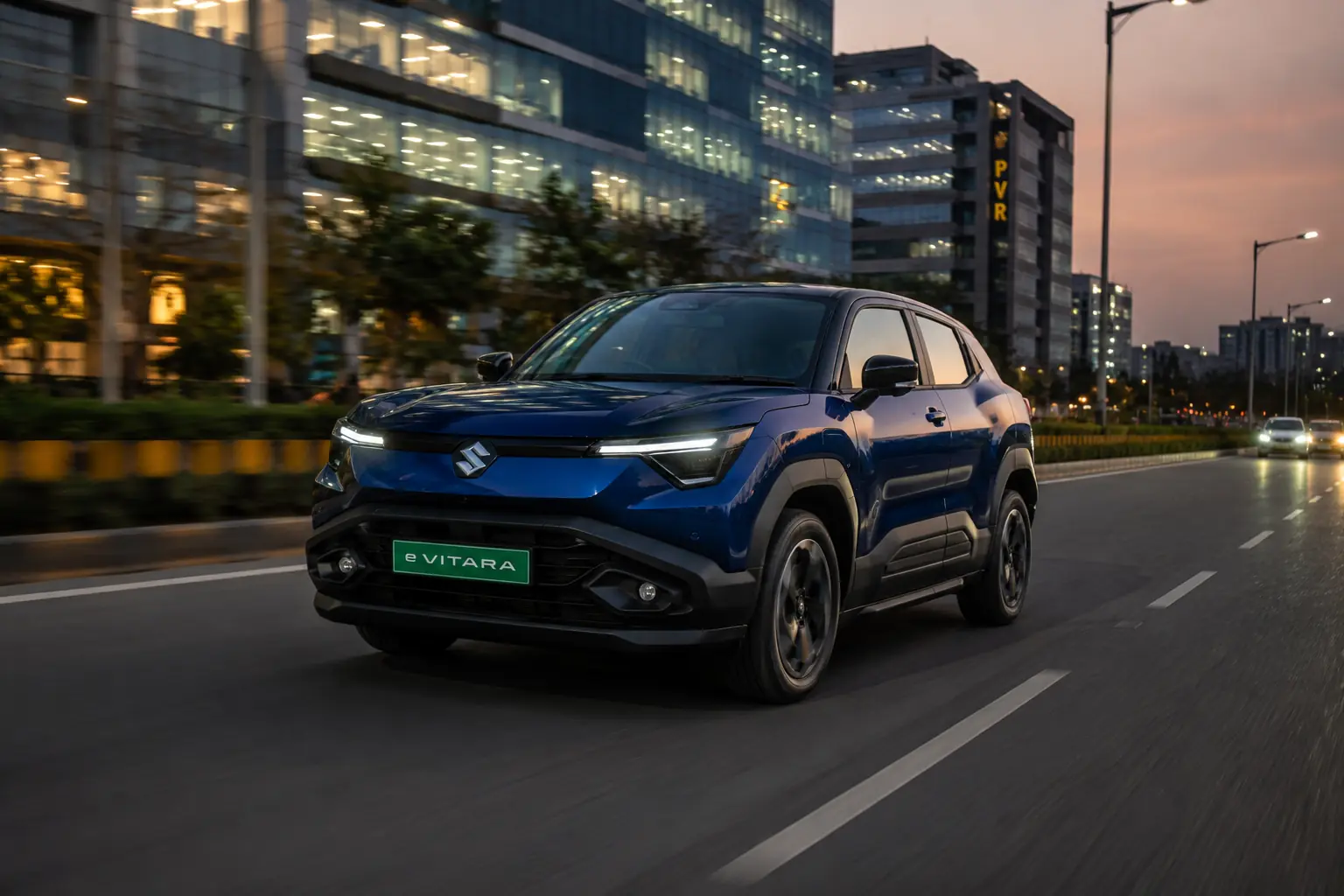

Maruti Suzuki e Vitara at a Glance
The Maruti Suzuki e Vitara is available in India with an ex-showroom price ranging from ₹15.99 Lakh to ₹20.01 Lakh. Alternatively, under Maruti’s Battery-as-a-Service (BaaS) platform, the upfront cost drops to ₹10.99 Lakh, with an additional running battery rental fee starting at ₹3.99 per km. Delivering a real-world city range of 350 km to 420 km, it represents Maruti’s first major move into the electric SUV India market.
Why Maruti Suzuki Entering the EV Segment Matters in India
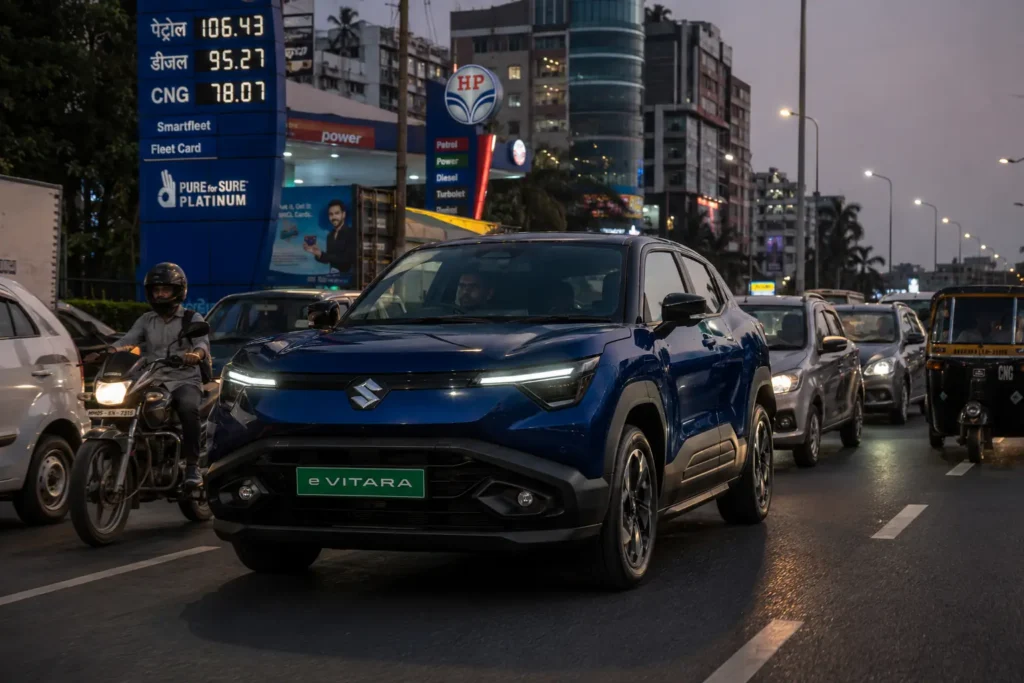
For years, Indian car buyers looking for electric vehicles under ₹20 Lakh had to look primarily at Tata Motors or MG. Maruti Suzuki’s entrance into the EV segment with the e Vitara changes the landscape, bringing its massive service network and long-term reliability into the electric conversation.
- Insulation from Fuel Costs: With traditional fuel prices heavily stressing middle-class household budgets, an efficient commuter vehicle is increasingly necessary.
- A Shift in Focus: Known historically for light, mileage-focused cars, Maruti built the e Vitara on a dedicated skateboard platform layout, prioritizing passenger space and frame strength.
- Immediate Market Acceptance: By launching directly into the highly competitive compact SUV class, Maruti is targeting buyers who want to switch from petrol to electric without losing corporate peace of mind.
Maruti Suzuki e Vitara Price List & Variants (2026)
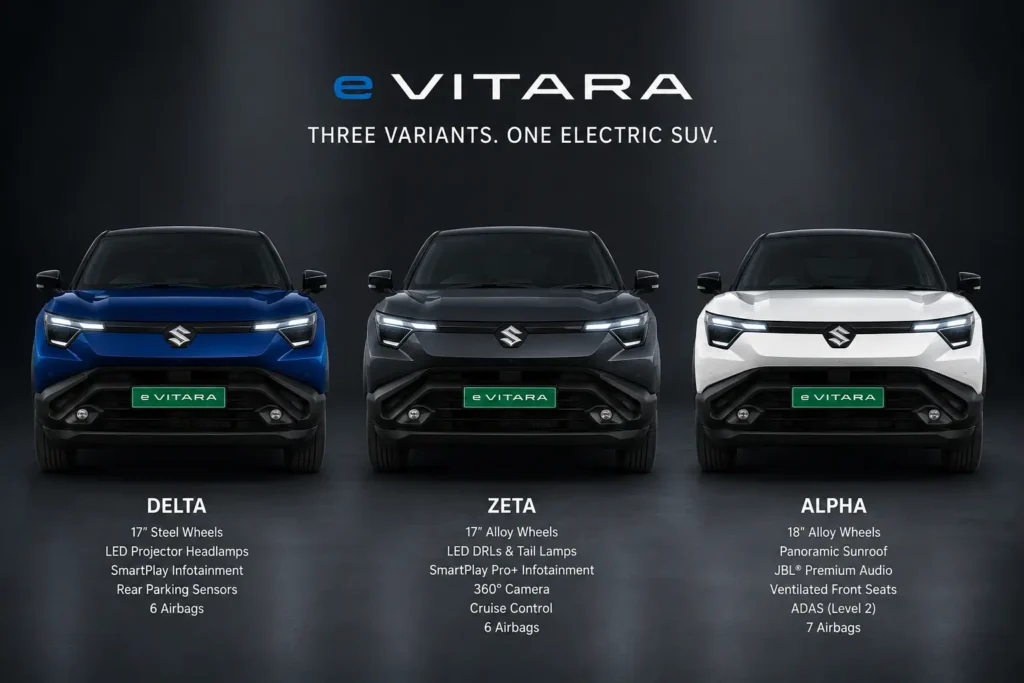
The e Vitara line-up is structured cleanly across three core variants with two lithium-iron-phosphate (LFP) blade battery pack choices: 49 kWh and 61 kWh.
Maruti electric car price list configurations:
| Variant | Battery Capacity | Claimed ARAI Range | Upfront Price (With BaaS) | Standard Price (Without BaaS) |
| Delta | 49 kWh | 440 km | ₹10.99 Lakh | ₹15.99 Lakh |
| Zeta | 61 kWh | 543 km | ₹11.99 Lakh | ₹17.49 Lakh |
| Alpha | 61 kWh | 543 km | ₹14.29 Lakh | ₹19.79 Lakh |
| Alpha Dual Tone | 61 kWh | 543 km | ₹14.51 Lakh | ₹20.01 Lakh |
Maruti Suzuki e Vitara Variant Breakdown
1. Delta (The Entry Foundation)
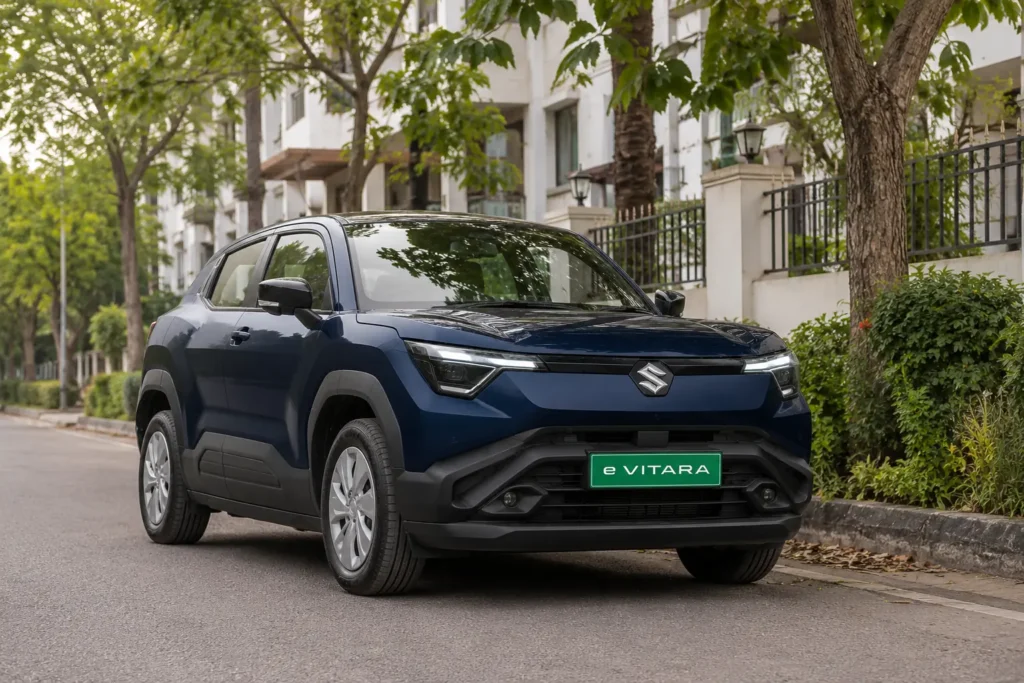
Priced at ₹15.99 Lakh (or ₹10.99 Lakh under BaaS), this base variant handles core requirements well. It features the 49 kWh battery pack, digital displays, automatic climate control, and dual airbags. It works well if your daily driving pattern remains strictly inside municipal boundaries.
2. Zeta (The Balanced Choice)
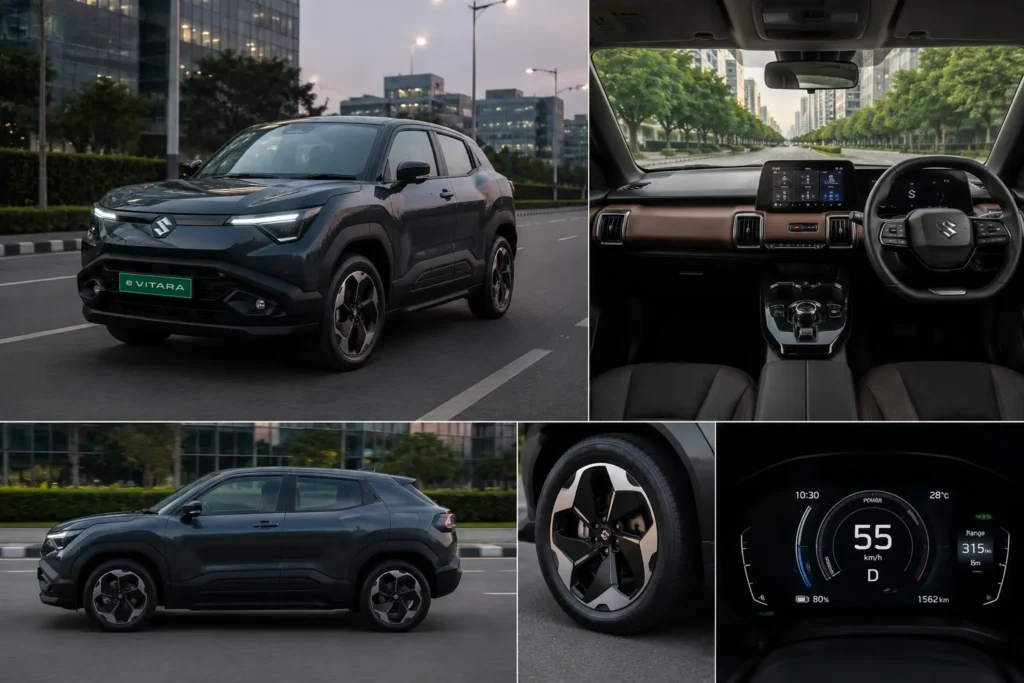
Priced at ₹17.49 Lakh, the mid-tier variant steps up to the larger 61 kWh battery pack. It expands the feature list with wireless smartphone integration, alloy wheels, and keyless start functionality, making it the value-for-money recommendation for mixed use.
3. Alpha & Alpha Dual Tone (The Flagship Trims)
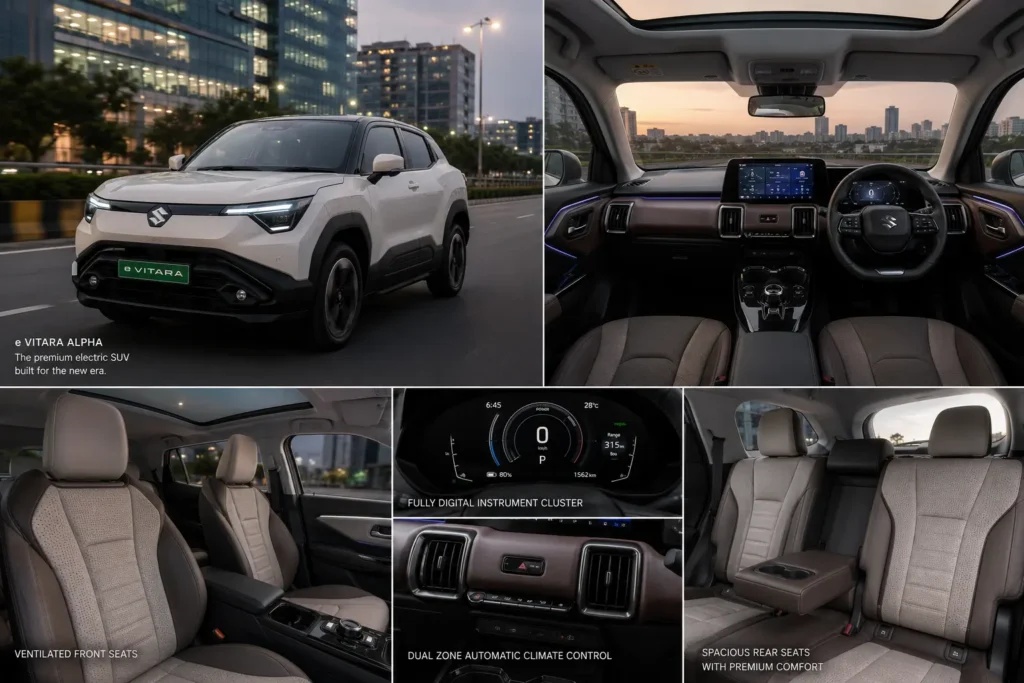
Topping out at ₹19.79 Lakh, the Alpha variant adds ventilated front seats, a 360-degree camera system, single-pane sunroof, semi-leatherette upholstery, and a Level 2 ADAS safety suite. It targets buyers who want a fully loaded modern cabin environment.
Maruti Suzuki e Vitara Specifications Table
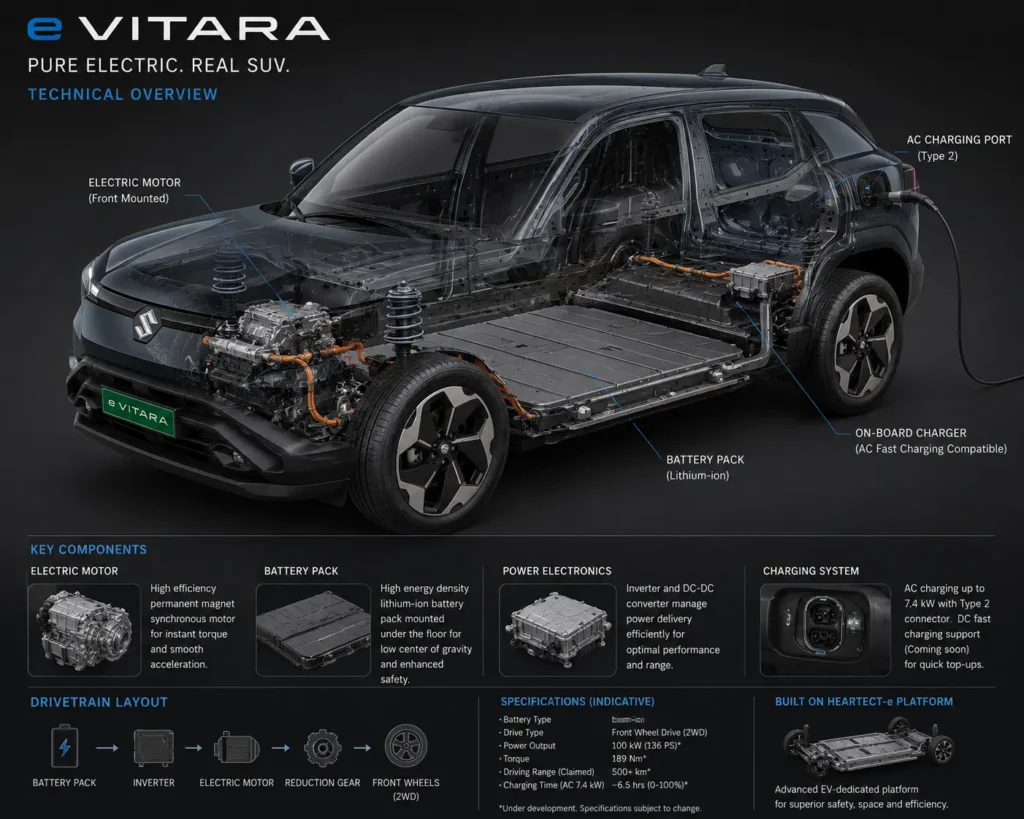
| Specification Parameters | Detail and Capabilities |
| Battery Pack Options | 49 kWh / 61 kWh LFP Blade Cells |
| ARAI Claimed Range | 440 km (49 kWh) / 543 km (61 kWh) |
| Real-World Range | ~350 km (Delta) / ~420 km (Zeta & Alpha) |
| Peak Power Output | 142 bhp (49 kWh) / 172 bhp (61 kWh) |
| Peak Torque Output | 193 Nm |
| Drivetrain Layout | Front-Wheel-Drive (FWD for India) |
| DC Fast Charging Time | 10% to 80% in 45 minutes via 70kW charger |
| AC Home Charging Time | 6.5 Hours (49 kWh) / 9.2 Hours (61 kWh) via 7.4kW box |
| Boot Space Volume | 310 Liters |
| Crash Safety Validation | 5 Star Rating (Bharat NCAP) |
Real-World Range & Charging Experience
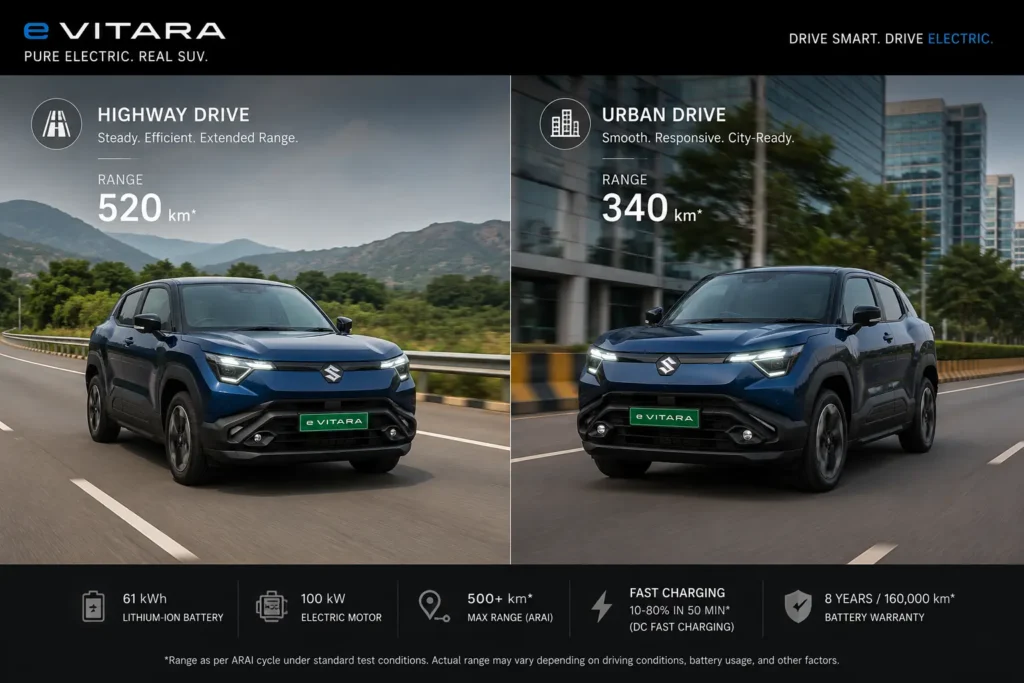
Laboratory estimates provide a good comparison benchmark, but real Indian roads introduce gridlock, summer heat, and varying driving styles that lower actual mileage.
Related: Tata Nexon EV
Urban Efficiency and Highway Drops
The 61 kWh battery delivers a reliable 420 km range inside typical city commuting environments. The electric motor is tuned smoothly, avoiding initial sudden jerks and providing a progressive throttle response that feels familiar to drivers transitioning from petrol vehicles.
However, sustained highway speeds past 95 km/h increase wind resistance and cause the range to drop to around 330–340 km. Furthermore, running the air conditioning during peak summer months puts a consistent load on the battery, resulting in a 12% efficiency drop.
The Charging Routine
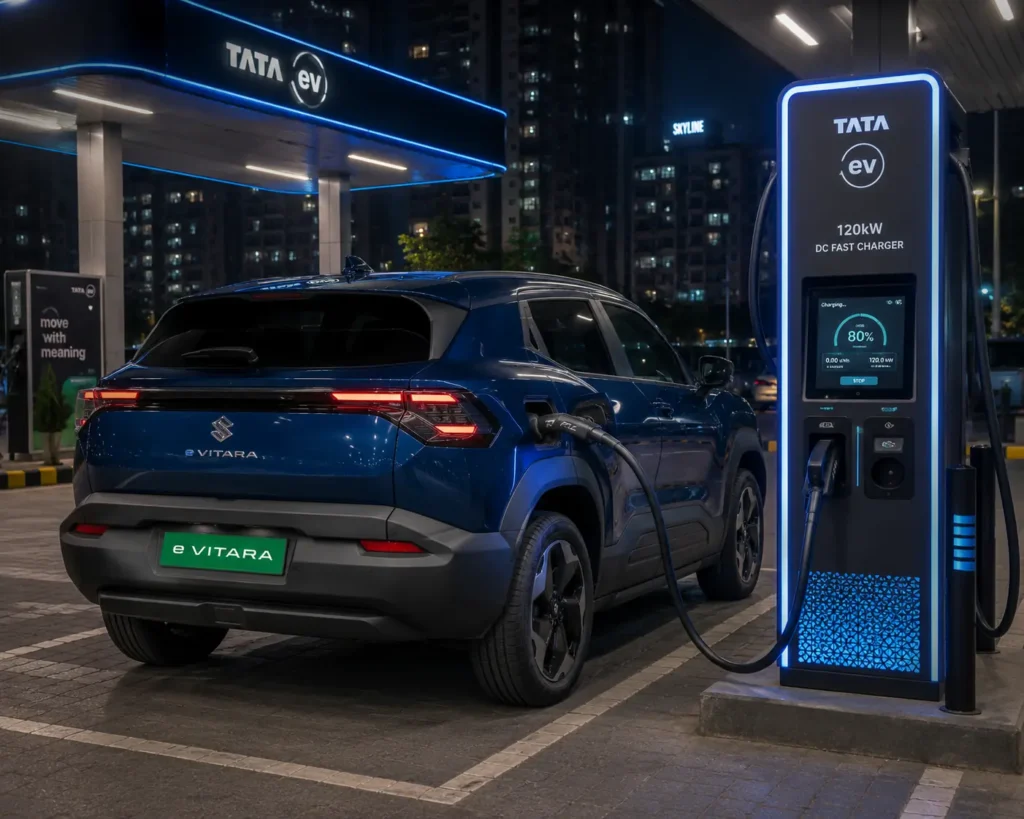
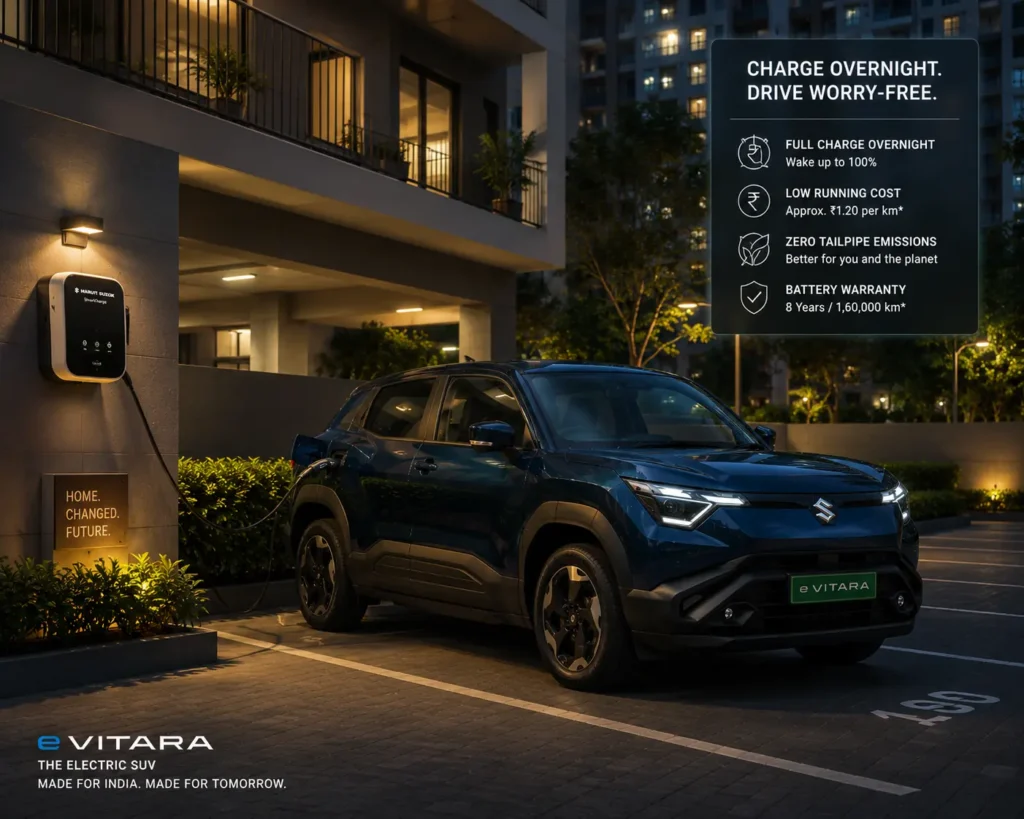
Charging your car overnight via a standard 7.4kW AC home wall box takes roughly 9 hours for the larger battery pack. For highway travel, the e Vitara handles up to 70kW DC fast charging, allowing you to top up from 10% to 80% in about 45 minutes. Apartment charging setups still require clear permission from local residential housing societies, which remains a key step to finalize before purchasing.
Maruti Suzuki e Vitara Running Cost vs Petrol SUVs
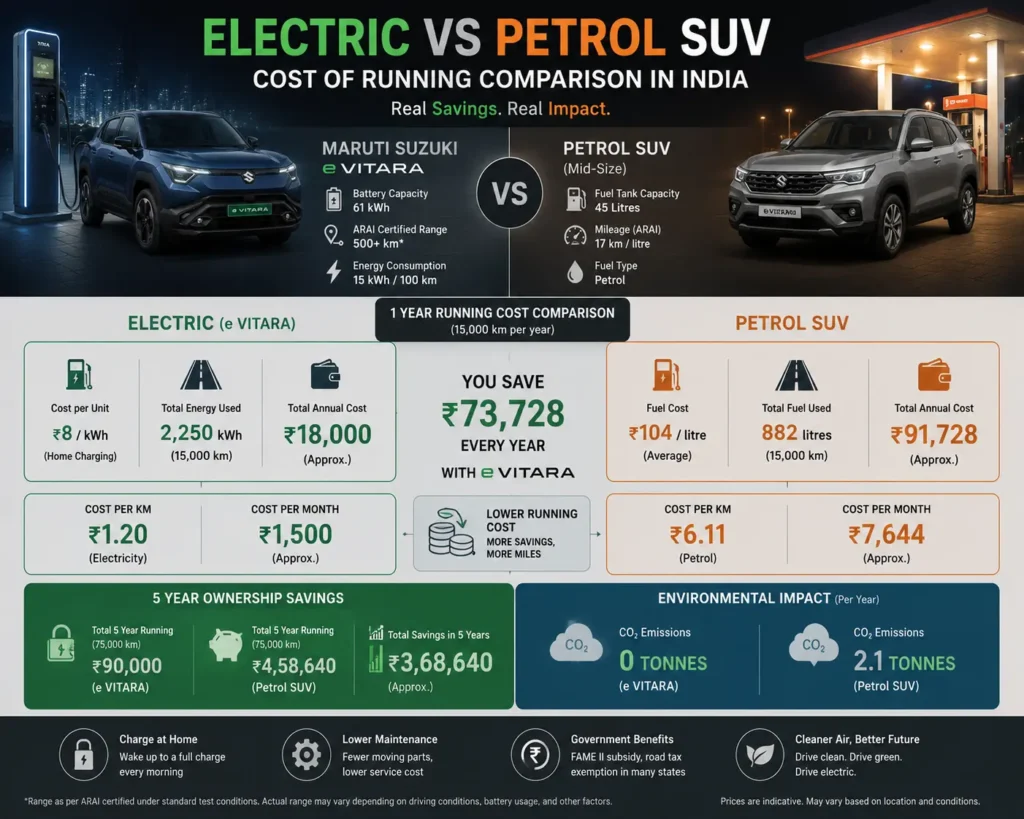
Let’s calculate the real ownership expenses for an urban commuter covering 1,200 km per month.
Scenario A: Outright Purchase Model (Home Charging)
- Average urban domestic power tariff: ₹8 per unit (kWh).
- A full charge of the 61 kWh pack takes around 65 units (allowing for minor transmission losses), costing ₹520.
- Covering 1,200 km requires roughly 3 full charging cycles.
- Monthly Power Bill: ~₹1,560 (Approx. ₹1.30 per km).
Scenario B: The BaaS Rental Alternative
- Upfront ex-showroom price drops by up to ₹5 Lakh, but you pay a fixed battery usage fee of ₹4.39 per km (for the 61 kWh pack).
- Monthly BaaS mileage fee for 1,200 km: ₹5,268 + home electricity consumption (~₹1,560).
- Monthly BaaS Outgo: ~₹6,828 (Approx. ₹5.69 per km).
Scenario C: Traditional Petrol Compact SUV
- Average fuel cost: ₹102 per liter.
- Real-world urban fuel economy: 12 km/l.
- Fuel required for 1,200 km: 100 Liters.
- Monthly Fuel Bill: ₹10,200 (Approx. ₹8.50 per km).
5-Year Cumulative Fuel Cost Comparison (Outright Purchase vs Petrol)
[Petrol Compact SUV Cost: ₹10,200/mo]  =====> 5-Year Total: ₹6.12 Lakh
[e Vitara Charging Cost:  ₹1,560/mo]   ==> 5-Year Total: ₹0.78 Lakh
-------------------------------------------------------------------------
Net Operational Savings over 5 Years: ₹5.34 Lakh
Maintenance Cost & Long-Term Ownership
Electric vehicles have far fewer moving parts than traditional internal combustion cars, doing away with complex gearboxes, engine pistons, fuel filters, and spark plugs.
- Periodic Servicing: Annual service check-ups focus primarily on fluid top-ups, suspension lubrication, cabin air filter replacements, and diagnostic scans. Expect bills to range between ₹3,000 and ₹5,000.
- Braking Systems: The mechanical brake pads last significantly longer (often past 55,000 km) because regenerative braking handles much of the initial stopping duty.
- Battery Warranty and Reliability: Maruti Suzuki protects the battery assembly with a solid 8-year or 1,60,000 km warranty. LFP blade cells are highly durable and are structurally designed to retain over 80% state-of-health across ten years of regular charging cycles.
Maruti Suzuki e Vitara Pros & Cons
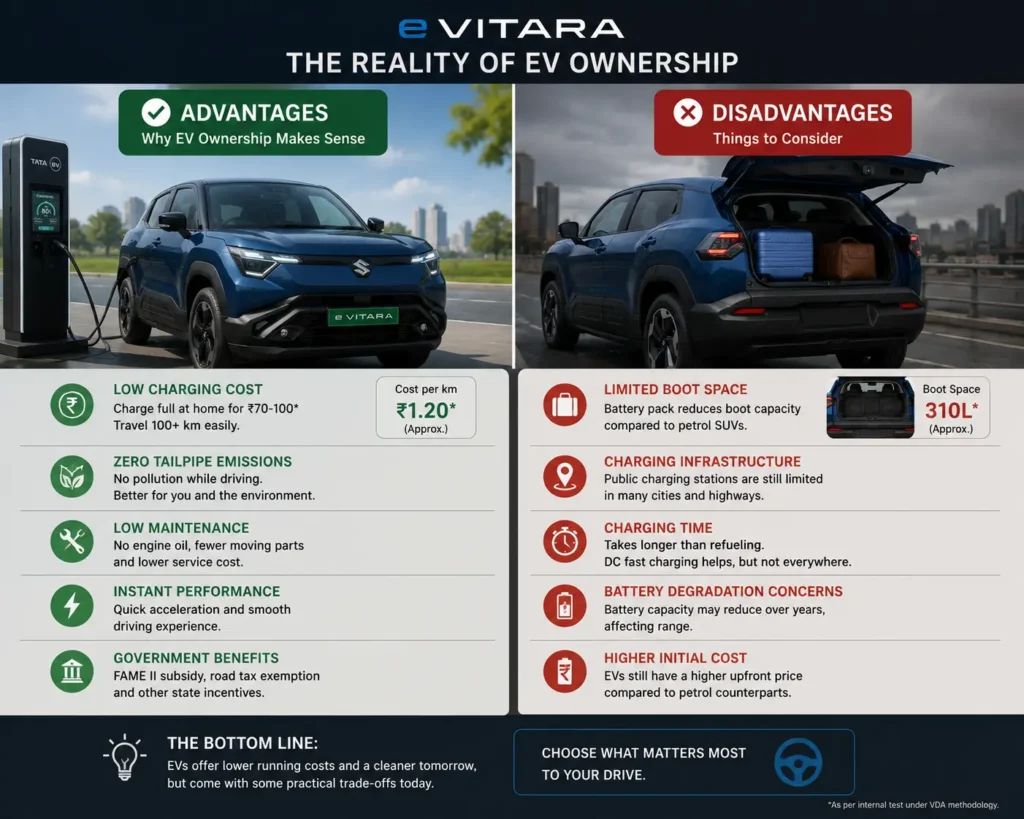
Advantages
- Low Operational Running Costs: Home electricity lowering fuel expenses down to nearly ₹1.30 per km.
- Top Safety Rating: Earned a full 5 Star validation in Bharat NCAP testing, making it structurally robust.
- Approachable Power Delivery: Smooth and linear acceleration that is easy to manage for first-time EV owners.
- Vast Brand Footprint: Backed by Maruti’s extensive service network across India.
- Flexible Ownership Structure: The BaaS option lowers the initial financial entry barrier for buyers.
Disadvantages
- Limited Luggage Room: The 310-liter boot space is tighter than many petrol and electric compact SUV alternatives.
- Conservative Features: The cabin layout lacks some of the flashy elements found in newer start-up vehicles.
- Highway Travel Pauses: Fast charging requires planning your long-distance road trips around working highway stations.
- Rear Cabin Width: The rear seat shape is highly optimized for comfort for two adults, making three passengers a tight fit.
Maruti Suzuki e Vitara vs. Petrol SUVs: Which Makes Sense?
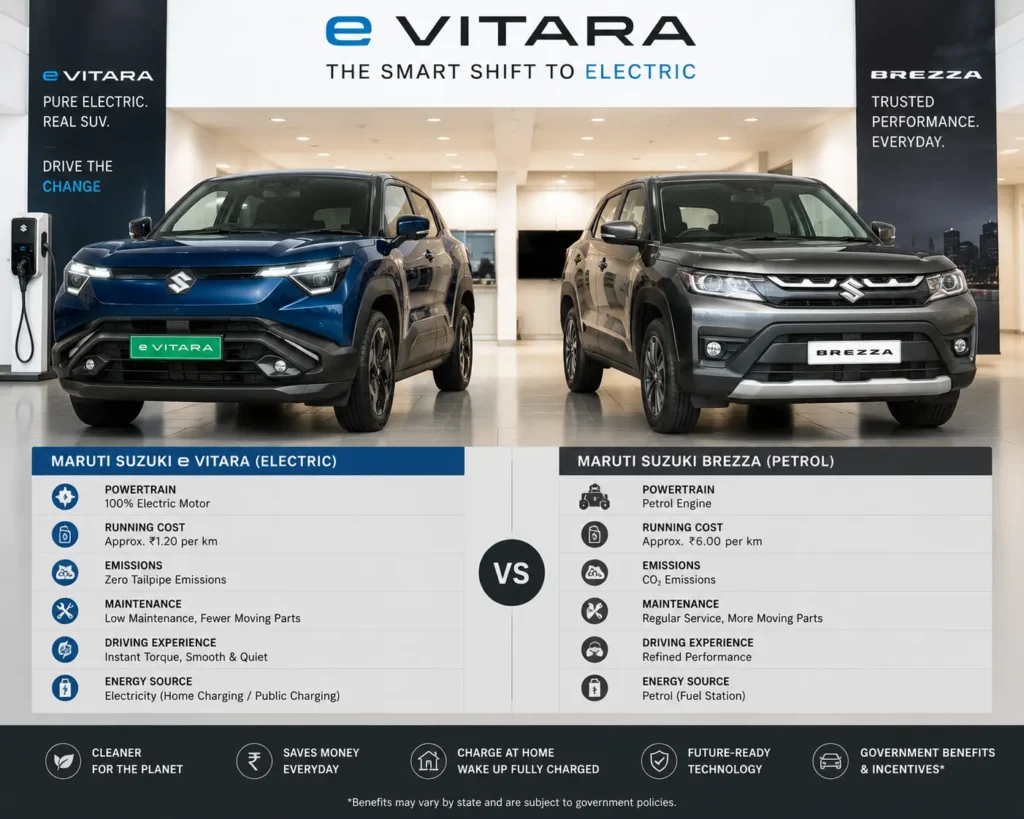
Your final decision should match your real-world usage patterns, rather than just vehicle specifications.
- The Urban Commuter Case: If your routine involves a 40–60 km daily cross-city trip through heavy town traffic, the e Vitara is highly practical. It removes gear-shift fatigue and lowers your monthly operational expenses.
- The Rare Long-Distance Case: If your household requires a single vehicle for spontaneous 600 km interstate highway journeys into areas with limited charging stations, a standard petrol SUV remains the simpler option for now.
Also Check out: MG Windsor EV Price
Who Should Buy the Maruti Suzuki e Vitara?
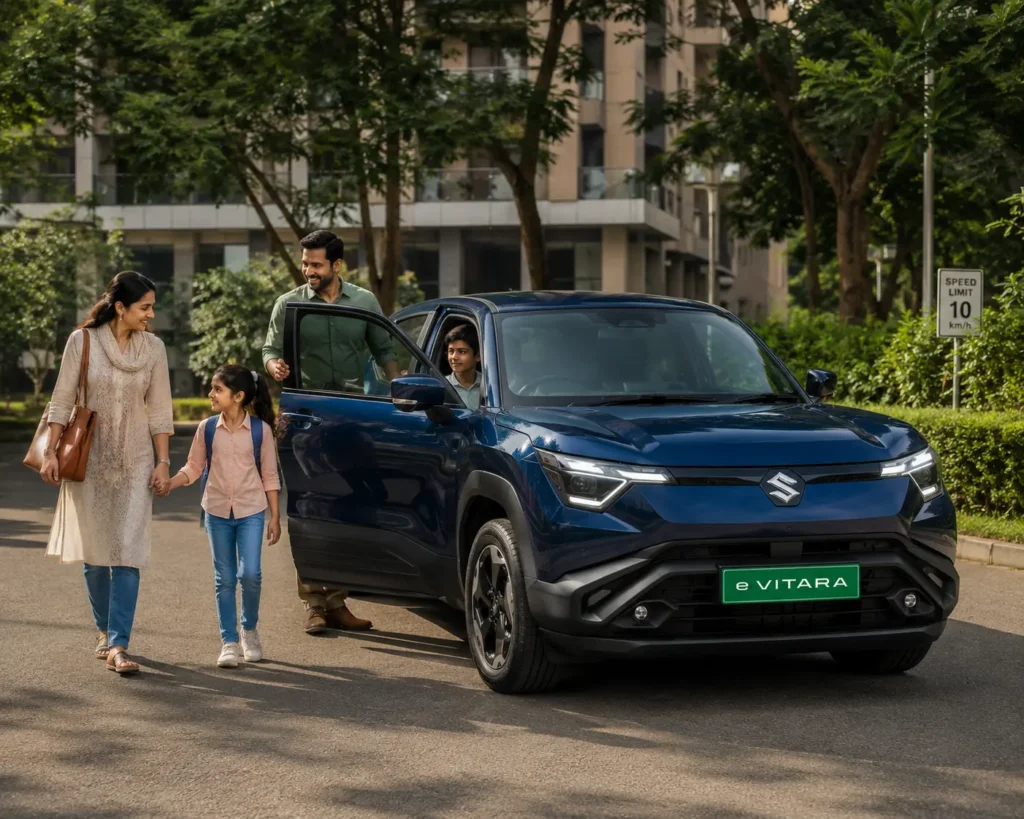
Recommended For:
- High-Mileage Commuters: Drivers covering more than 1,000 km monthly get a quick return on their initial investment.
- First-Time EV Buyers: Perfect for those who want to transition to electric power but require a predictable driving feel and a dependable brand name.
- Safety-Prioritizing Families: Buyers who value a proven 5-star crash test rating and a stable driving position.
Not Recommended For:
- Apartment Residents Lacking Private Power Points: Relying solely on public fast chargers increases your monthly running costs and lowers daily convenience.
- Heavy Luggage Travelers: Families who frequently take long road trips with multiple large suitcases will find the 310-liter boot restrictive.
Questions Buyers Commonly Ask
What is the entry-level Maruti e Vitara price in India?
The entry-level Delta variant (49 kWh) starts at ₹15.99 Lakh ex-showroom. Under the BaaS option, the vehicle price drops to ₹10.99 Lakh, with battery usage billed separately.
What is the real-world range of the Maruti Suzuki e Vitara?
The 49 kWh battery delivers roughly 350 km of real-world city range, while the larger 61 kWh variants provide a dependable 420 km under normal city driving conditions.
Can I charge the Maruti e Vitara comfortably at home?
Yes. Every variant comes with home charging compatibility, connecting to a standard 15A domestic wall plug or a dedicated 7.4kW AC charger box.
Is the e Vitara model safe for family use?
Yes, it is structurally robust and has secured a full 5 Star rating from Bharat NCAP, making it one of the safest vehicles in Maruti’s current lineup.
Is it cheaper to maintain than a traditional petrol SUV?
Yes, routine annual maintenance bills are roughly 40% lower over five years because the electric drivetrain has fewer moving mechanical parts.
Final Verdict: Is the Maruti Suzuki e Vitara Worth Buying in 2026?
The Maruti Suzuki e Vitara is an effective, practical choice for urban buyers. It doesn’t try to look overly futuristic; instead, it focuses on what daily commuters need most: smooth power, a highly refined driving experience, a 5-star safety layout, and predictable running costs.
If you have a dedicated garage space to charge overnight and your daily routine involves a clear cross-city commute, it stands out as an excellent option to lower your monthly transportation bills. However, if your family needs a massive boot for heavy luggage or plans to use it primarily for highway travel, ensure you plan your routes around commercial fast chargers. Running cost matters more than fuel type when daily commuting is involved, so let your monthly mileage guide your final choice.
Helpful Resources for Indian EV Car Buyers
- Bharat NCAP Official Website — India’s official crash-testing and vehicle safety rating platform. Includes adult and child occupant scores, crash-test protocols, and tested vehicle lists.
- Global NCAP – Safer Cars for India — Global crash-test program that pushed Indian manufacturers toward safer vehicle structures and occupant protection standards.
- Reserve Bank of India (RBI) — Official source for repo rates, lending rules, and banking regulations in India. (rbi.org.in)
- TransUnion CIBIL — Check your credit score and track your loan eligibility before applying for a car loan.
- SBI Car Loans — View latest interest rates, eligibility criteria, and loan offers from State Bank of India.
- HDFC Bank Car Loans — Explore car loan options, EMIs, and financing plans from HDFC Bank.
- ICICI Bank Car Loans — Compare new and used car loan offers along with repayment options.
- Policybazaar Car Insurance — Compare insurance plans, premiums, and add-on coverage options in one place.
- Acko Car Insurance — Get quick online quotes and renewal estimates for car insurance.
- AutomotiveZone Mileage Cost Calculator — Estimate real fuel costs based on your driving mileage.
- AutomotiveZone Monthly Car Expense Calculator — Calculate total monthly car ownership cost including EMI, fuel, and maintenance.
Disclaimer: Prices, mileage, safety ratings, loan rates, and ownership costs are approximate and may vary by location, variant, and market conditions in 2026. Some visuals may be AI-generated for illustration. Please verify final details with authorized dealers before purchase.