

BYD Seal Quick Overview
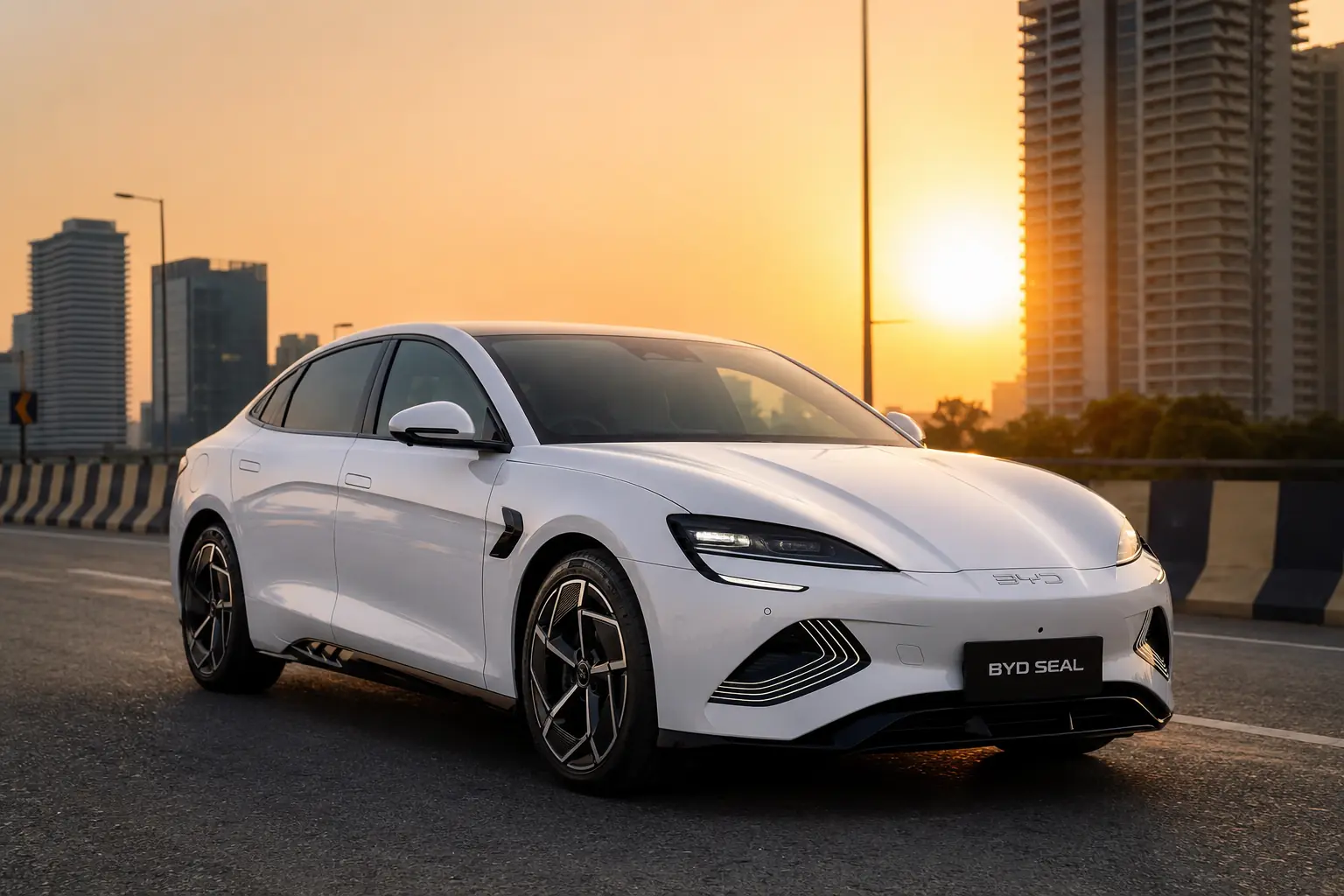
The 2026 BYD Seal is a premium luxury electric sedan priced between ₹41.00 Lakh and ₹53.15 Lakh (ex-showroom). Built on an advanced 800V structural Cell-to-Body (CTB) platform, it features 61.44 kWh and 82.56 kWh Blade battery options. It delivers a verified real-world range of 380 km to 520 km, with the flagship dual-motor AWD variant pushing 523 bhp and an astonishing 0–100 km/h sprint of 3.8 seconds.
BYD Seal Price Guide 2026: Real-World Range, Interior, Running Cost & Is It Worth Buying?
For years, entering the luxury sedan segment in India meant defaulting to traditional German luxury names. However, as high-end electric car architecture evolves, executive car buyers are realizing that converted petrol or diesel frames cannot match the sheer efficiency, range, and packaging of a purpose-built electric vehicle.
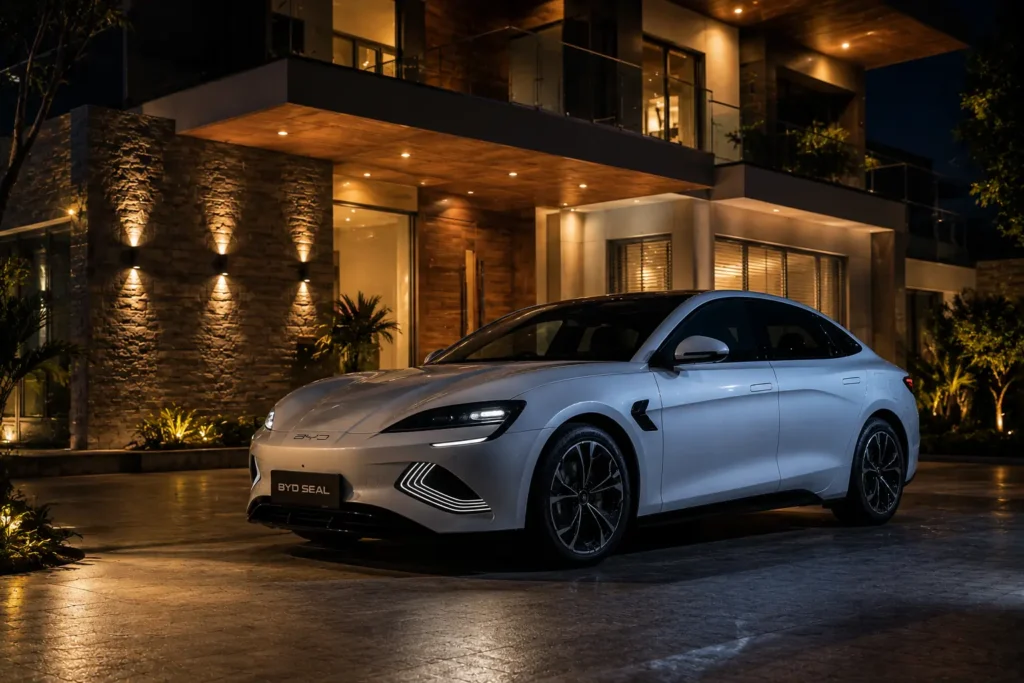
The BYD Seal has completely disrupted this landscape. It is not an upright, tall SUV; it is a low-slung, highly aerodynamic grand tourer built on BYD’s dedicated e-Platform 3.0 layout. In 2026, the Seal stands out as an exceptional alternative to conventional premium cars, offering legitimate sports-car acceleration, an expansive high-tech interior, and massive long-distance capability for an entry price under ₹45 Lakh.
Why the BYD Seal Is Forcing Luxury Brands to Adapt
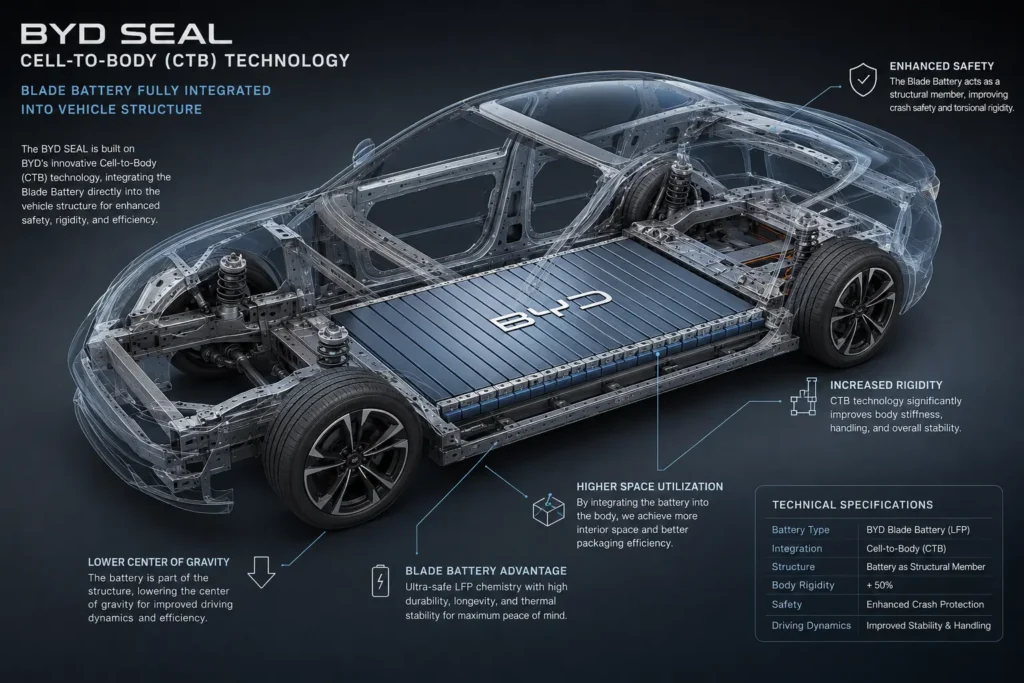
The Seal’s competitive advantage relies on advanced structural engineering that transforms the driving experience fundamentally.
Innovative Cell-to-Body (CTB) Tech: Unlike standard EVs that pack separate battery modules into a chassis frame, the Seal integrates the ultra-safe LFP Blade battery directly into the car’s structure. This drops the cabin floor height, maximizes interior room, and creates exceptional body stiffness.
Elite Aerodynamics: Sporting a sleek, sweeping body line, it achieves a remarkably low 0.219 Cd drag coefficient, allowing it to slice through wind resistance to protect high-speed highway range.
Unrivaled Value Math: It delivers the equipment list, interior premium plastics, and performance boundaries of European sports sedans that cost nearly double its initial asking price.
BYD Seal Price List & Variants (2026)
The lineup is clearly organized across three distinct performance setups using two specialized battery pack capacities: 61.44 kWh and 82.56 kWh.
| Variant Name | Battery Capacity | Drivetrain Layout | Ex-Showroom Price | Primary Variant Focus |
| Dynamic | 61.44 kWh | Single Motor RWD | ₹41.00 Lakh | Entry Luxury / Chauffeur Commuters |
| Premium | 82.56 kWh | Single Motor RWD | ₹45.70 Lakh | The Sweet Spot / Maximum Range |
| Performance | 82.56 kWh | Dual Motor AWD | ₹53.15 Lakh | Supercar Performance / Enthusiasts |
Because it sits beneath standard premium import pricing brackets due to targeted assembly, the vehicle benefits heavily from India’s flat 5% GST mandate on electric cars. Multiple progressive states also offer substantial road tax concessions, minimizing the final on-road price gap across major metros.
Premium Interior Architecture, Technology & Space
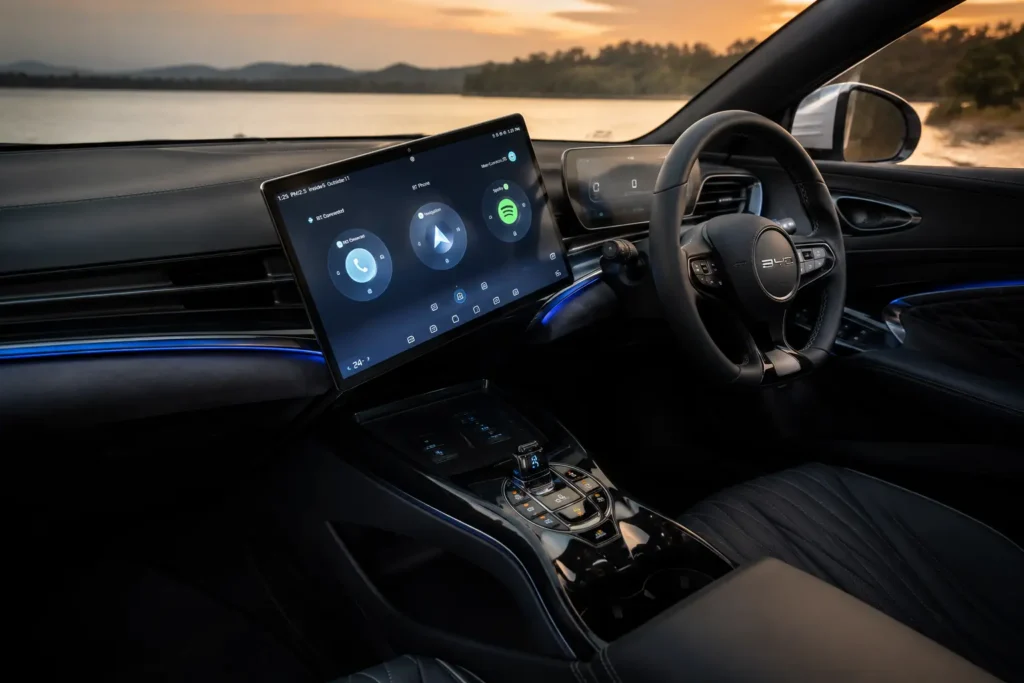
The interior of the BYD Seal copies the fluid styling of its “Ocean Aesthetics” design language, wrapping the driver in soft-touch luxury and crisp digital real estate.
1. The Rhythmic Rotating Display
The center of the clean dashboard houses BYD’s iconic 15.6-inch intelligent rotating touchscreen infotainment unit, which flips smoothly from landscape to portrait layouts based on your active navigation or media applications. This is backed by a separate 10.25-inch virtual driver’s instrument display and an expensive 12-speaker Dynaudio premium sound system that fills the quiet cabin with exceptional audio depth.
2. Cabin Quality and Layout Comfort
The interior uses extensive crystal-structured trim pieces and soft-touch suede wrapping across the door inserts. The front sports seats feature deep integrated bolstering with built-in ventilation, heating, and multiple electrical lumbar memory choices. The center tunnel floats cleanly, positioning dual wireless smartphone chargers directly beneath the driver’s hand line.
3. Rear Passenger Space and Cargo Practicality
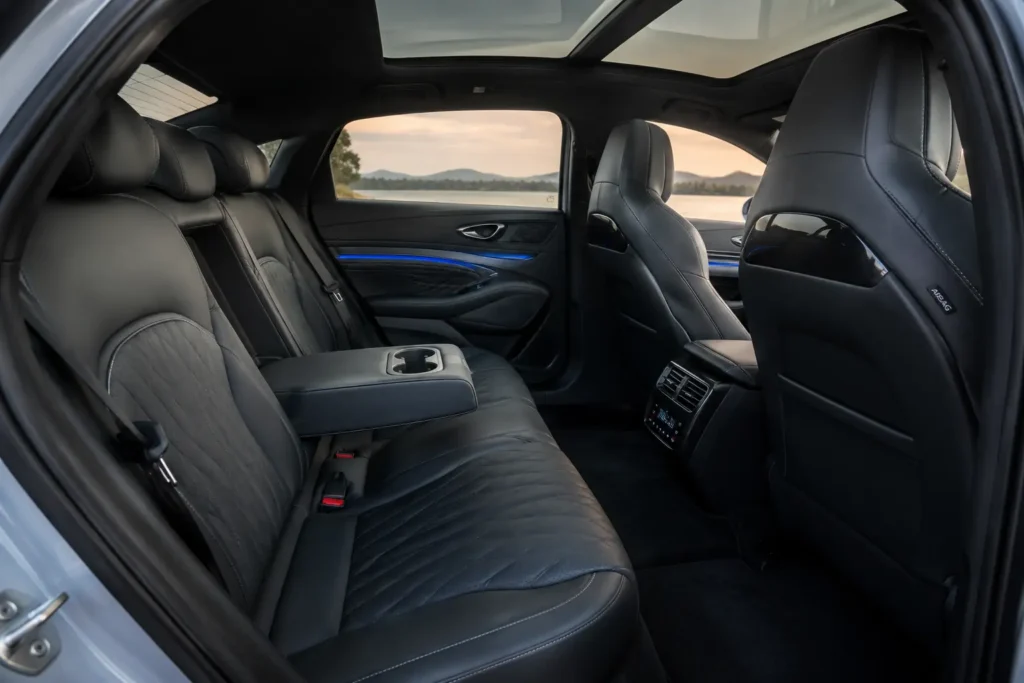
Thanks to a long 2,920 mm wheelbase, rear legroom and knee room are extensive. Because the CTB battery architecture removes the need for a thick sub-floor, passengers avoid the typical “knees-up” posture found in poorly designed EVs.
While head clearance is good for average adults, the sloping rear coupe-glass line means passengers over 6 feet tall might find headroom slightly snug. The rear boot handles 400 liters of luggage, supplemented by a handy 53-liter front “frunk” to stash charging equipment safely.
Real-World Range & Charging Experience
Laboratory estimates are helpful for comparisons, but the chaotic reality of Indian traffic networks paints a much more accurate picture of real-world efficiency.
Real Urban Loops vs. Expressway Consumption
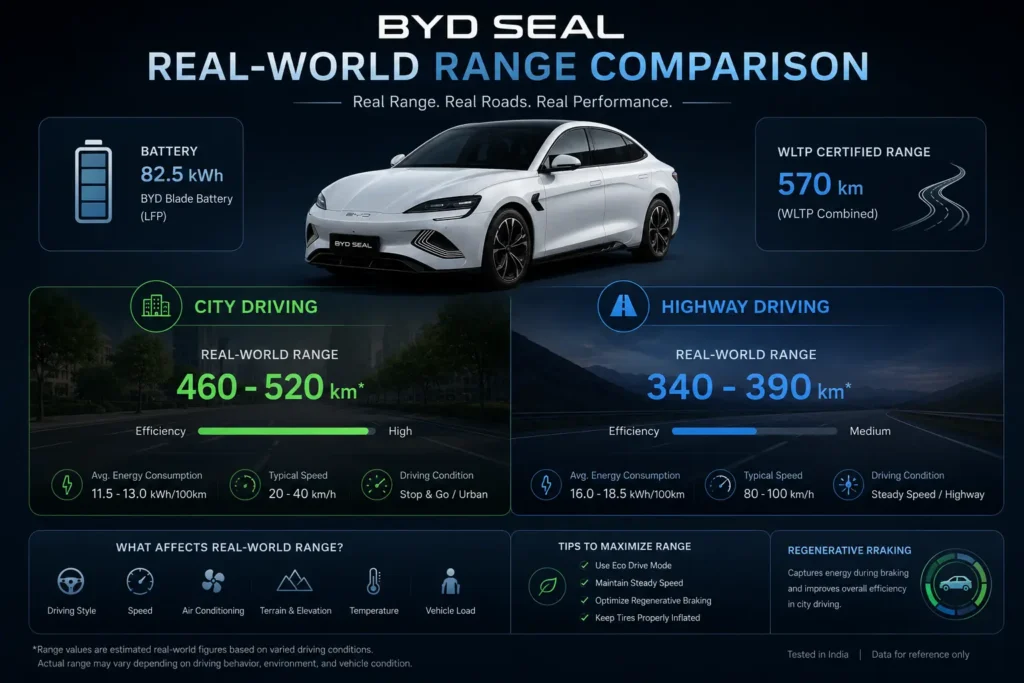
The 61.44 kWh Battery (Dynamic RWD): Delivers a highly realistic city range of 380 km to 400 km on a full charge.
The 82.56 kWh Battery (Premium RWD): This is the ultimate tourer version, delivering a highly dependable real-world city range of 500 km to 520 km.
The 82.56 kWh Battery (Performance AWD): Due to the massive power pull of the dual motors, real-world mixed usage settles closer to 440 km to 460 km.
Maintaining speeds above 100 km/h on open expressways increases wind drag and drops highway range on the Premium pack to around 420 km. Continuous AC usage during high summer heat results in a standard 12% efficiency drop.
Charging Infrastructure Timelines
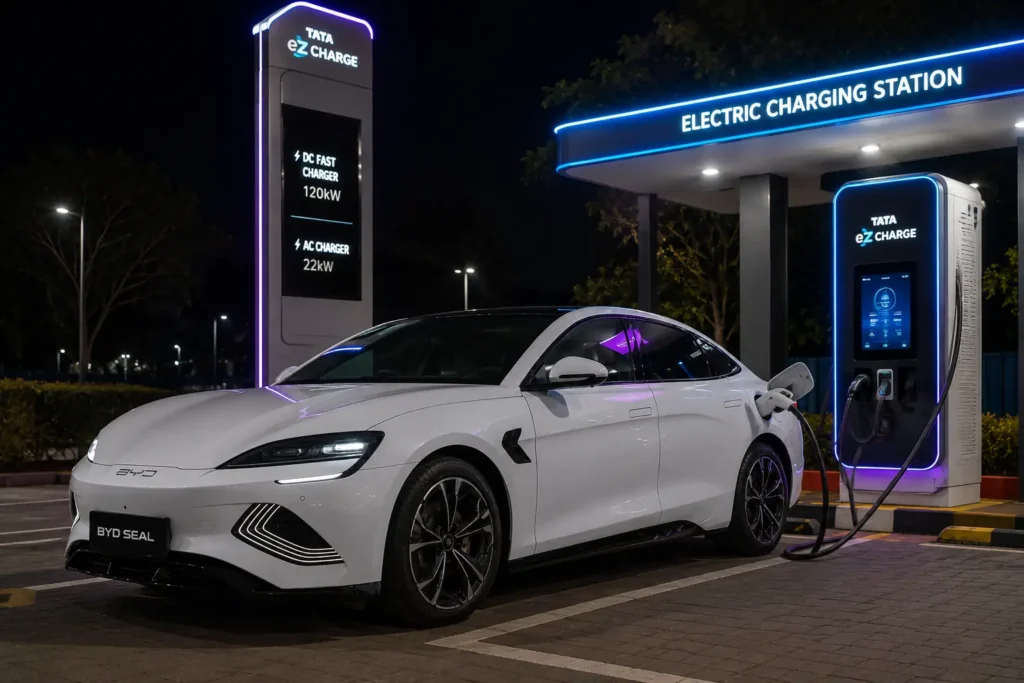
Home AC Charger (7.2 kW): Included with standard home installation, it fully replenishes the larger 82.56 kWh pack overnight in approximately 12 hours.
Public DC Fast Charging Support: Built on a high-voltage electrical network, the Seal handles up to 150 kW DC fast-charging input. Hooked up to a standard high-capacity public fast charger, it can juice from 10% to 80% in just 37 minutes.
BYD Seal Technical Specifications Table
| Technical Parameter | Dynamic RWD Variant | Premium RWD Variant | Performance AWD Variant |
| Motor Layout | Single (Rear-Wheel Drive) | Single (Rear-Wheel Drive) | Dual (All-Wheel Drive) |
| Peak Power Output | 201 bhp (150 kW) | 308 bhp (230 kW) | 523 bhp (390 kW) |
| Peak Torque Output | 310 Nm | 360 Nm | 670 Nm (Combined) |
| ARAI Claimed Range | 510 km | 650 km | 580 km |
| C75 Real-World Range | ~380 – 400 km | ~500 – 520 km | ~440 – 460 km |
| Acceleration (0-100 km/h) | 7.5 Seconds | 5.9 Seconds | 3.8 Seconds (Supercar Class) |
| Dimensions (L x W x H) | 4,800 x 1,875 x 1,460 mm | 4,800 x 1,875 x 1,460 mm | 4,800 x 1,875 x 1,460 mm |
| Unladen Ground Clearance | 145 mm | 145 mm | 145 mm |
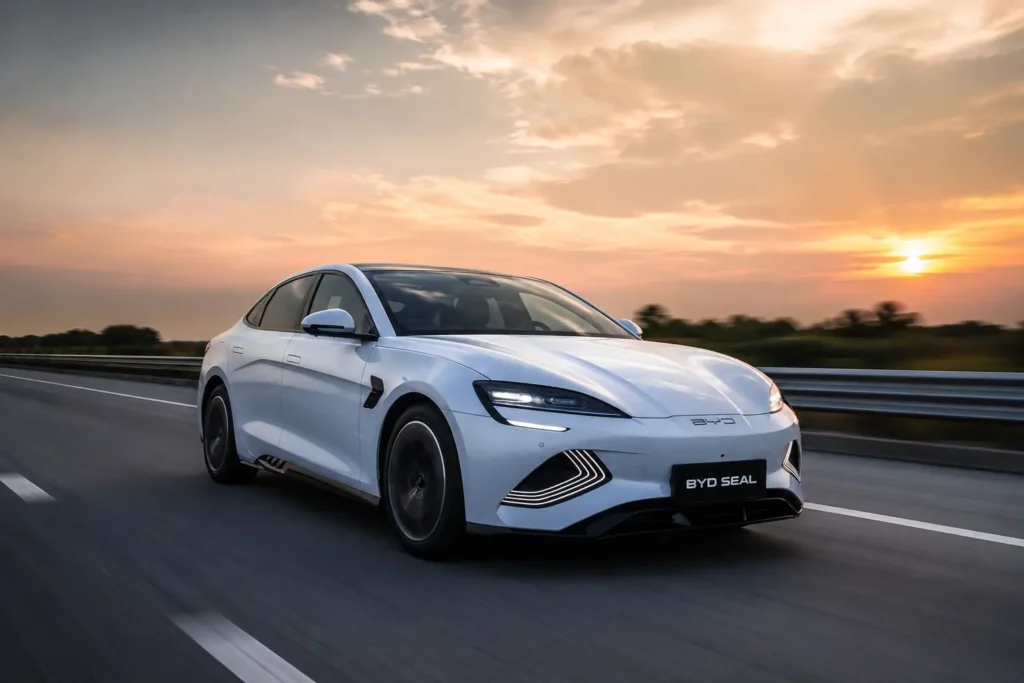
BYD Seal Running Cost vs Petrol Luxury Sedans
Let’s calculate the operational math for an executive commuter covering 1,500 km per month over a 5-year ownership period.
Scenario A: The BYD Seal Premium (Home AC Charging Setup)
Average domestic power tariff: ₹8 per unit (kWh).
Fully topping up the 82.56 kWh pack takes roughly 88 units of power (allowing for standard minor charging losses), costing ₹704.
Covering 1,500 km requires roughly 3 full home charging cycles.
Monthly Electricity Bill: ~₹2,112 (Approx. ₹1.41 per km).
Scenario B: Traditional Petrol Luxury Sedan (2.0L Turbo / Six-Cylinder Class)
Average cost of premium fuel: ₹105 per liter.
Real-world urban fuel economy in city traffic: 10 km/l.
Fuel required for 1,500 km: 150 Liters.
Monthly Fuel Bill: ₹15,750 (Approx. ₹10.50 per km).
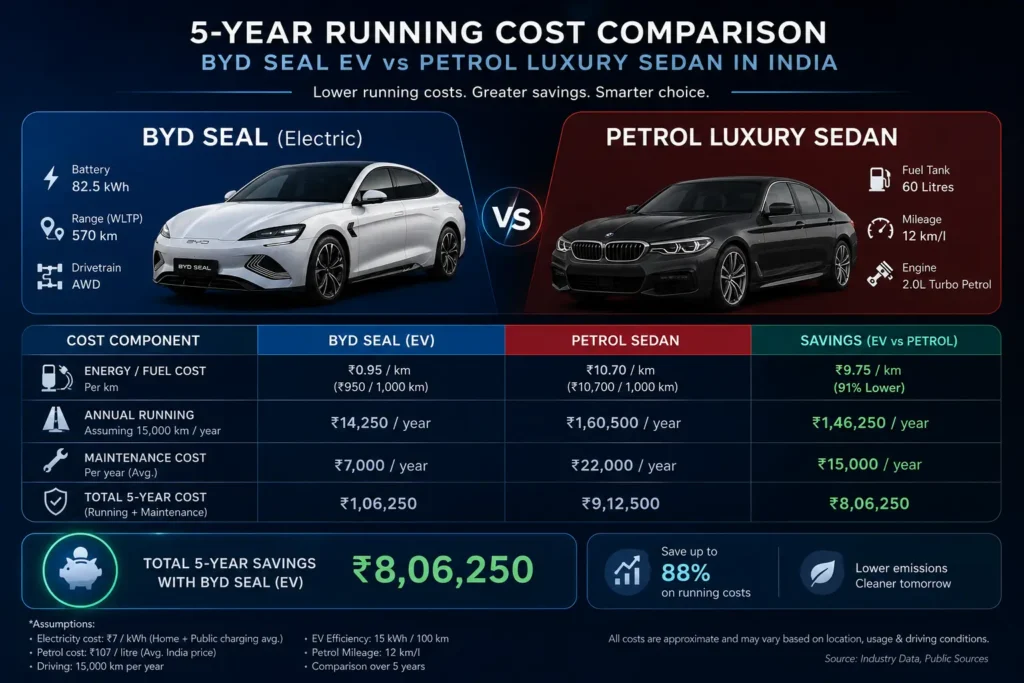
5-Year Cumulative Operational Fuel Cost Savings
[Petrol Luxury Sedan: ₹15,750/mo]
=======> 5-Year Total: ₹7.87 Lakh
[BYD Seal EV Charging:  ₹2,112/mo]
==> 5-Year Total: ₹1.05 Lakh
------------------------------
Net Operational Savings over 5 Years: ₹6.82 Lakh
Maintenance Cost & Long-Term Ownership
By dropping complex mechanical components like turbos, engine valve timings, fuel filters, and multi-speed gearboxes, periodic garage maintenance is heavily simplified.
Routine Servicing Outgo: Annual maintenance checkups focus primarily on basic cabin air filter replacements, suspension lubrication, tire rotations, and full high-voltage software diagnostics. Expect bills to range between ₹5,000 and ₹7,500.
Battery Safety and Warranty: The structural LFP Blade cells are backed by an extensive 8-year or 1,60,000 km warranty, providing strong long-term security and helping hold a stable resale profile.
BYD Seal Pros & Cons
Advantages
Mind-Blowing Performance: The AWD variant hits 0-100 km/h in 3.8 seconds, delivering sports-car speed.
Exceptional Real-World Range: The Premium variant comfortably clears 500 km of actual driving on a full charge.
Ultra-Safe Battery Engineering: Structural Blade battery configuration provides elite thermal safety.
Highly Premium Cockpit: Rotating 15.6-inch screen, Dynaudio speakers, and ventilated leather seats look and feel expensive.
Top Safety Credentials: Earned a full 5-star Euro NCAP safety rating and comes equipped with 9 standard airbags.
Disadvantages
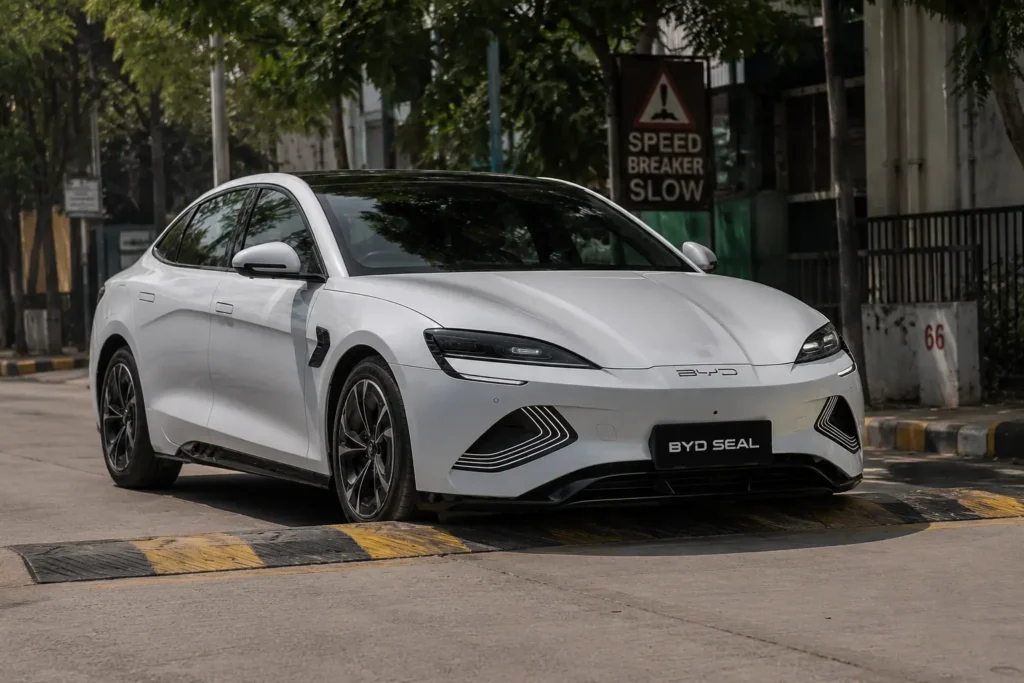
Low Ground Clearance: The 145mm unladen clearance demands extreme care over tall, sharp speed breakers.
Firm Ride Quality: The suspension is tuned firm to handle the performance, making sharp potholes noticeable.
Rear Seat Headroom: The sloping rear glass roof profile cuts vertical headroom for passengers over 6 feet tall.
Low Profile Tyres: The large alloy wheels use low-profile rubber that can be vulnerable to sharp road imperfections.
Who Should Buy the BYD Seal?
Recommended For:
High-Mileage Luxury Buyers: Executives covering over 1,200 km monthly who want sports-car performance alongside massive operational savings.
Inter-State Grand Tourers: Perfect for drivers who take frequent highway trips and want a highly dependable 500 km range.
Driving Enthusiasts: Buyers who appreciate an athletic, rear-wheel-drive or all-wheel-drive handling platform with instant torque.
Not Recommended For:
Rural Locations with Broken Tarmac: The 145mm ground clearance and low-profile tires are not designed for rough unpaved roads or large deep potholes.
Apartment Residents Lacking Private Power Points: Relying purely on public commercial fast chargers reduces daily convenience.
Questions Buyers Commonly Ask about BYD Seal
What is the real on-road price of the BYD Seal in India?
While ex-showroom pricing starts at ₹41.00 Lakh, comprehensive luxury insurance, local registration documentation, and essential accessories bring final metro on-road numbers to between ₹43.2 Lakh and ₹55.9 Lakh depending on the variant and state taxes.
Does the low ground clearance cause regular scraping?
It requires careful driving. You will need to take tall, sharp urban speed breakers slowly and at a slight angle when the vehicle is fully loaded with passengers to avoid touching the underbody shield.
How safe is the Blade battery against crash impacts?
The Blade battery serves as an actual structural part of the vehicle frame. This setup provides excellent side-impact safety and maximizes the sedan’s torsional rigidity to meet elite global crash standards.
Is it expensive to maintain compared to traditional luxury sedans?
No, annual periodic service costs are roughly 50% cheaper over five years because the electric platform lacks complex moving mechanical components like turbos and intricate valvetrains.
Can you charge the BYD Seal safely during heavy monsoon rains?
Yes. Both the charging port mechanism and the under-floor battery enclosure carry a strict IP67 weatherproof safety rating, completely sealing high-voltage assemblies against moisture entry.
Final Verdict: Is the BYD Seal Worth Buying in 2026?
The BYD Seal is a highly convincing option if you have the budget for a premium executive sedan. It doesn’t treat electric power as an afterthought; it uses a purpose-built structural battery architecture that maximizes cabin floor space, body stiffness, and high-speed stability.
If you have a dedicated parking space to charge overnight and your daily routine involves long cross-city commutes or regular interstate road trips, the massive fuel savings and effortless performance make it an exceptional investment. However, if you frequently travel through rural areas with broken tarmac or require a high, cushiony SUV ride height, other body styles might fit your garage better. Ultimately, let your real-world daily driving distance and route conditions guide your final choice.
“Running cost matters more than fuel type when daily commuting is involved.”
Helpful Resources for Indian EV Car Buyers
- Bharat NCAP Official Website — India’s official crash-testing and vehicle safety rating platform. Includes adult and child occupant scores, crash-test protocols, and tested vehicle lists.
- Global NCAP – Safer Cars for India — Global crash-test program that pushed Indian manufacturers toward safer vehicle structures and occupant protection standards.
- Reserve Bank of India (RBI) — Official source for repo rates, lending rules, and banking regulations in India. (rbi.org.in)
- TransUnion CIBIL — Check your credit score and track your loan eligibility before applying for a car loan.
- SBI Car Loans — View latest interest rates, eligibility criteria, and loan offers from State Bank of India.
- HDFC Bank Car Loans — Explore car loan options, EMIs, and financing plans from HDFC Bank.
- ICICI Bank Car Loans — Compare new and used car loan offers along with repayment options.
- Policybazaar Car Insurance — Compare insurance plans, premiums, and add-on coverage options in one place.
- Acko Car Insurance — Get quick online quotes and renewal estimates for car insurance.
- AutomotiveZone Mileage Cost Calculator — Estimate real fuel costs based on your driving mileage.
- AutomotiveZone Monthly Car Expense Calculator — Calculate total monthly car ownership cost including EMI, fuel, and maintenance.
- AutomotiveZone Fuel Cost Calculator — Instantly estimate petrol, diesel, or CNG expenses based on mileage, fuel price, and trip distance.
- AutomotiveZone EV vs Petrol Cost Calculator — Compare electric vehicle charging costs with petrol fuel expenses to see long-term savings.
- AutomotiveZone EV Charging Cost Calculator — Calculate home and fast-charging electricity costs for your EV using battery size and electricity tariff.
- AutomotiveZone Car Resale Value Estimator — Estimate your car’s current market resale value based on age, mileage, ownership, and condition.
Disclaimer: Prices, mileage, safety ratings, loan rates, and ownership costs are approximate and may vary by location, variant, and market conditions in 2026. Some visuals may be AI-generated for illustration. Please verify final details with authorized dealers before purchase.
Calculate BYD Seal Charging Cost
Check monthly charging cost and EV running expenses for the BYD Seal.
Check EV Charging Cost →