

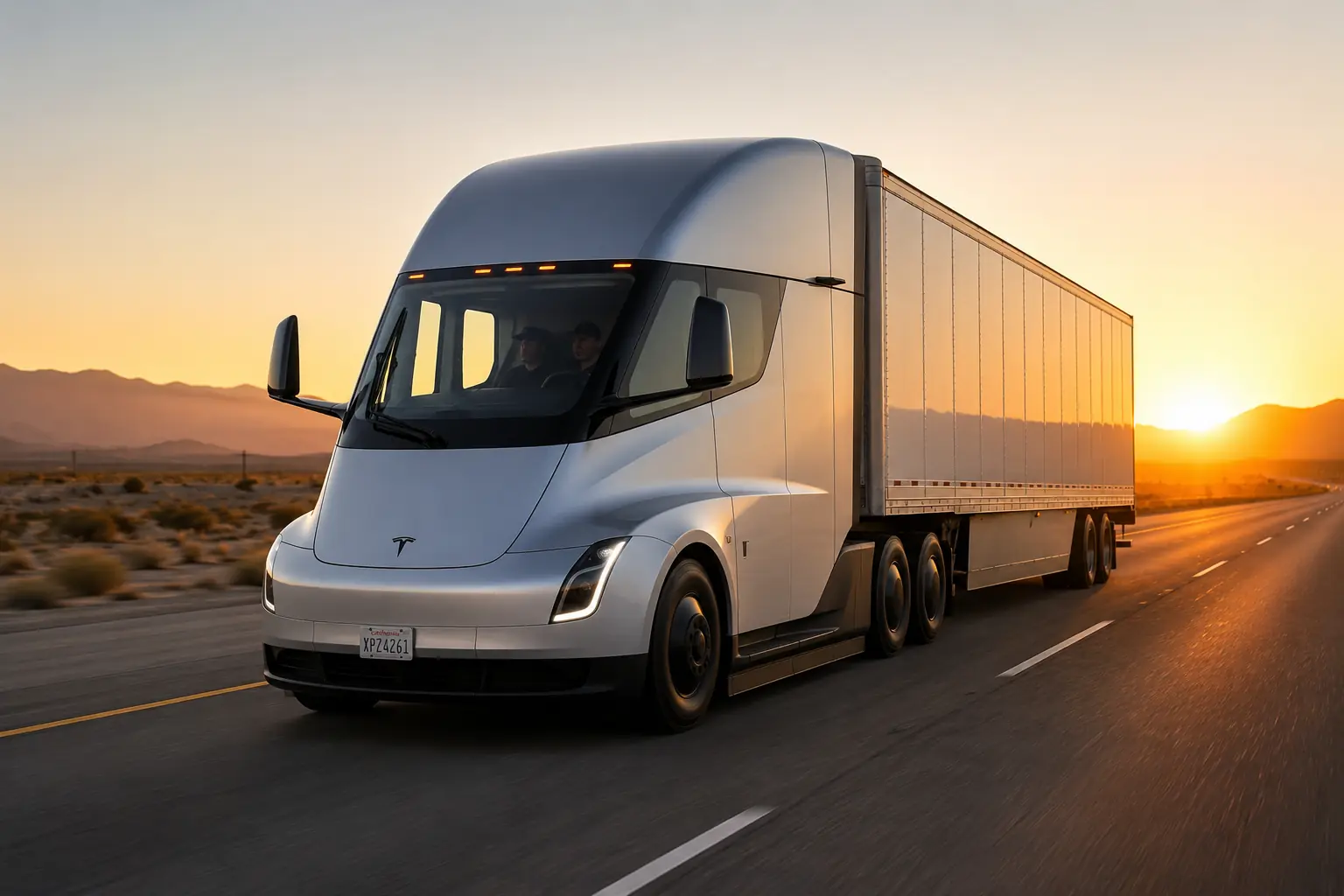
Tesla Semi Quick Overview
The 2026 Tesla Semi marks the entry of high-volume mass production for the all-electric Class 8 commercial trucking segment, carrying a market list price between $250,000 and $290,000 before regional government incentives. Moving past dirty diesel engines, it utilizes three independent electric motors on the rear axles generating 800 kW (1,088 hp) of drive power. It comes across two massive high-density battery cell choices: a 548 kWh Standard Range model (325 miles) and an 822 kWh Long Range model (500 miles), delivering an ultra-efficient consumption track of 1.7 kWh per mile at a maximum 82,000-lb gross combination weight.
Tesla Semi Guide 2026: Real-World Commercial Range, Megacharger Speeds, 48V Steer-By-Wire & Is It Worth the Fleet Switch?
Traditional Class 8 freight transport has long relied on a heavy-duty, internal combustion formula. They depend on massive, loud 13-to-15-litre turbo-diesel engines that require complex, frequent multi-speed gearboxes, high-maintenance emissions scrubbing systems (DEF/DPF), and accumulate heavy fuel expenses during idle times at freight hubs. Conversely, standard alternative energy pilot trucks have struggled to haul maximum legal cargo weights without running out of battery breath or forcing drivers into massive multi-hour charging delays on critical long-haul corridors.
The Tesla Semi completely fundamentally overhauls commercial freight transport. Following extensive pilot loops with fortune 500 fleets and entering high-volume line assembly at an expanded Gigafactory Nevada facility, the Semi drops all classic truck compromises. By building the tractor from a ground-up electric architectural layout featuring a central cockpit driver position, an active 48-volt electronic steer-by-wire system, and a hyper-aerodynamic bullet nose, it bridges the gap between massive torque pulling capability and drastically lowered operational overhead.
Why the Tesla Semi Commands the Heavy-Duty Fleet Space
The Tesla Semi skips historical commercial truck templates to center entirely on uncompromised weight packaging and rock-bottom operating economics:
Aerodynamic Bullet Train Nose: Pushing the cabin forward drop its drag coefficient to a remarkably sleek 0.36 Cd (slashing wind resistance by nearly half compared to boxy conventional diesel tractors) to conserve critical battery juice at highway speeds.
The Total Cost of Ownership Flip: It records an energy consumption baseline averaging 1.7 kWh per mile. At commercial power matrices, this drops fueling footprints to roughly $0.17 to $0.20 per mile, easily crushing standard diesel operating expenses ($0.50 to $0.70 per mile).
Centralized Cockpit Command: Placing the driver directly in the center of the cabin architecture optimizes visibility maps across both front corners, radically minimizing roadside blind spots.
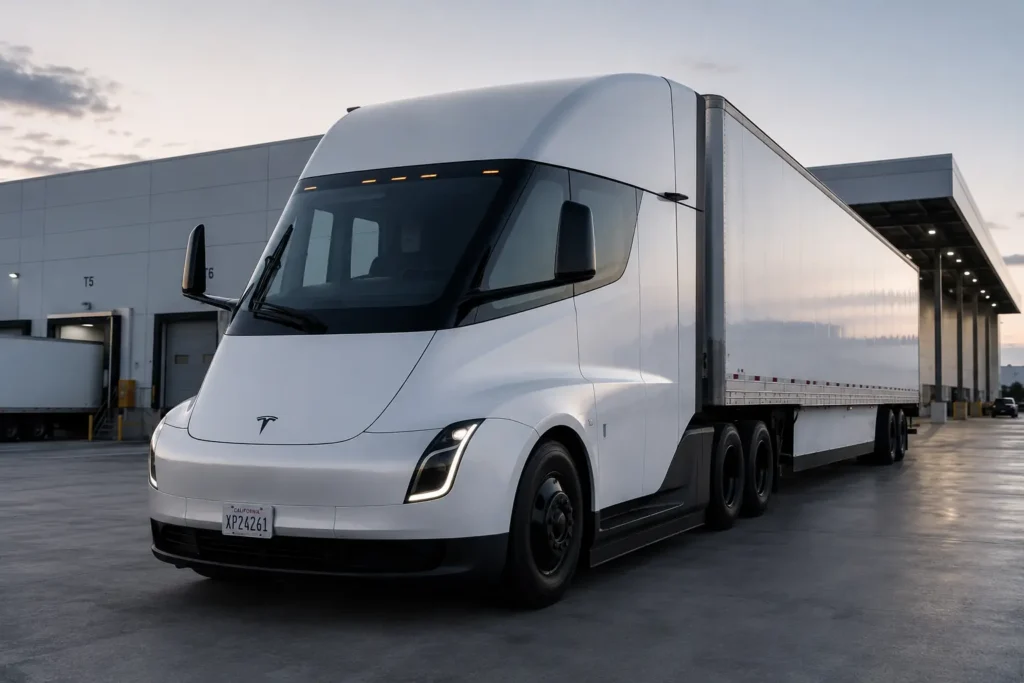
Tesla Semi Price List & Commercial Variants (2026)
With volume production scaling to meet massive fleet logistics order stacks, the Semi structures its commercial offerings across two specific distance capacities.
Commercial Market Price Architecture (Estimated Initial Baseline):
| Variant Grade Configuration | Usable Battery Pack | Max Legal Weight Range | Base List Price Target | Primary Freight Deployment Profile |
| Tesla Semi Standard Range | 548 kWh Pack | 82,000 lbs (GCW) | $250,000 | Cross-Town Delivery / Heavy Regional Logistics |
| Tesla Semi Long Range | 822 kWh Pack | 82,000 lbs (GCW) | $290,000 | Inter-State Freight / Long-Haul Trucking Loops |
The Incentive Equation: While the upfront price is higher than a new $175,000 diesel tractor, regional clean air grants alter the math completely. In regions like California, specialized vehicle voucher subsidies (HVIP) range from $84,000 to over $300,000. When coupled with a $40,000 Federal Commercial Clean Vehicle tax credit, the immediate out-of-pocket acquisition gap can narrow down to zero before calculating fuel savings.
Interior Architecture: The Centralized Digital Command Deck
Step inside the cabin, and the Semi completely ditches tight, crowded, instrument-heavy diesel sleeper layouts to create an ultra-spacious, minimalist workflow environment.

1. Symmetric Dual 15-Inch Fleet Command Displays
The entire operator station revolves around a singular centered driving seat flanked symmetrically by two large 15-inch touchscreen panels. These consoles act as the central computing hub—projecting high-definition blind-spot camera feeds, live commercial navigation routing maps, asset tracking diagnostic logs, and electronic logging device (ELD) hours-of-service compliance data directly in the driver’s peripheral line of sight.
2. High-Capacity Stand-Up Space & Comfort Mechanics
Dropping a bulky combustion engine housing tunnel below the floor leaves the cabin with a completely flat, walk-through floor. Drivers can stand up completely straight inside the rear cabin space to stretch or manage cabin equipment easily. Every unit comes standard with a high-efficiency independent climate control system, multiple high-output USB Type-C power lines, and automated air-ride seating to isolate the operator from long-distance highway vibrations.
3. Integrated ePTO Utility Packaging
Built directly onto the main frame rails, the tractor packages an advanced high-voltage Electric Power Take-Off (ePTO) sub-system outputting up to 25 kW. This allows logistics fleets to directly power high-capacity refrigeration compressors on cold-chain trailers (“reefers”) straight from the main battery pack, eliminating the need for independent noisy auxiliary diesel generator engines.
Real-World Engine Performance & Megacharging Speeds
The Tri-Motor powertrain trades sluggish low-end gear-hunting pauses for instantaneous torque and effortless highway merging authority.
Powertrain Performance Profiles:
800 kW Class-8 Power Output: Utilizes three independent electric motors derived from the Model S/X Plaid lines on the rear axles. It develops up to 1,088 hp of peak system power, letting a fully loaded 82,000-lb rig accelerate from 0 to 60 mph in a swift 20 seconds flat—effortlessly keeping pace with standard traffic flow on steep mountain highway inclines.
Regenerative Braking Security: Going down long, steep mountain descents, the electric motors reverse polarity to act as high-output generators. This recharges the battery pack with massive kinetic energy blocks while preventing the traditional air-friction drum brakes from overheating and failing.
True Real-World Range Tracking (Fleet Pilot Metrics)
| Selected Battery Specification | Official Target Range | True Fully Loaded Mixed Route | Light-Medium Cargo Fleet Route |
| Standard Range (548 kWh) | 325 Miles (523 km) | 280 mi to 300 mi | 325 mi to 350 mi |
| Long Range (8220 kWh) | 500 Miles (804 km) | 440 mi to 475 mi | 500 mi to 535 mi (Frito-Lay Trial) |
Next-Gen 1.2 Megawatt (MW) Charging Curves
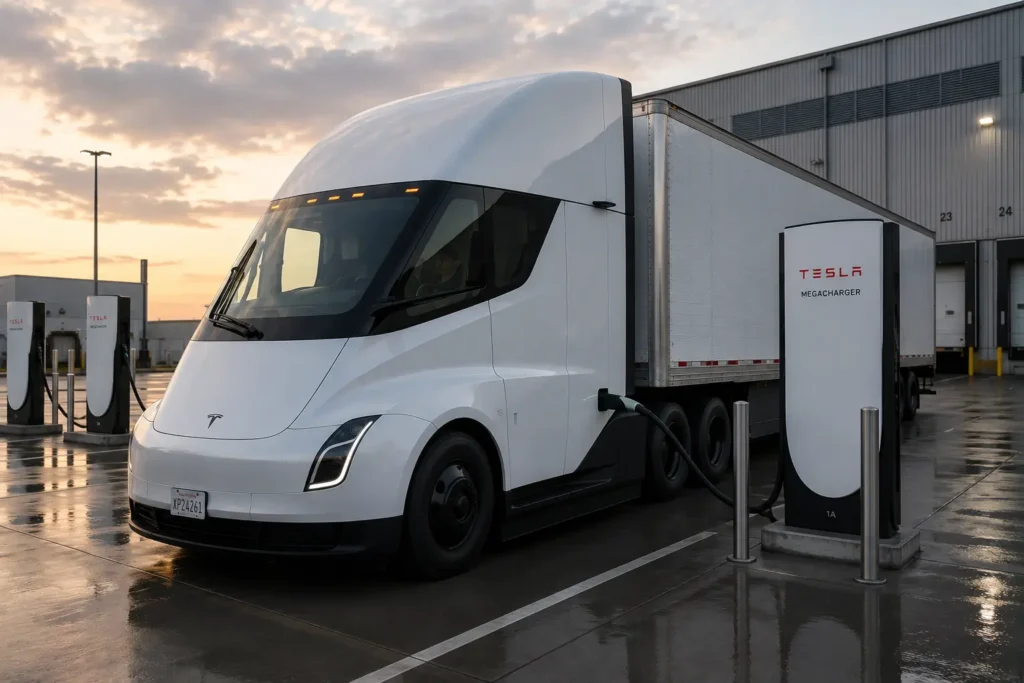
- The Megacharger Charging Speed: Built around the cutting-edge MCS 3.2 (Megawatt Charging System) plug architecture, the Long Range Semi can pull up to a blistering 1.2 Megawatts (1,200 kW) of direct current juice. This aggressive power input replenishes the massive battery pack from 10% to 60% in a swift 30 minutes—matching up with required driver rest breaks.
Tesla Semi Full Technical Specifications
| Technical Parameter | Standard Range Specification | Long Range Specification |
| Vehicle Class Configuration | Class 8 Heavy-Duty Commercial Tractor | Class 8 Heavy-Duty Commercial Tractor |
| Powertrain Setup | 3 Independent Motors on Rear Axles | 3 Independent Motors on Rear Axles |
| Peak Usable Battery Capacity | 548 kWh | 822 kWh High-Voltage Pack |
| Peak Drive System Power | Up to 800 kW (~1,088 hp) | Up to 800 kW (~1,088 hp) |
| Tractor Unladen Curb Weight | Under 20,000 lbs (~9,070 kg) | Approx. 23,000 lbs (~10,430 kg) |
| Energy Consumption Average | 1.7 kWh per Mile (Fully Loaded) | 1.7 kWh per Mile (Fully Loaded) |
| Steering Control System | Full Steer-by-Wire (Fully Electric) | Full Steer-by-Wire (Fully Electric) |
Running Cost Comparison: Tesla Semi vs Fleet Diesel Tractors
Let’s calculate the monthly operational fuel math for a high-utilization commercial logistics route covering a standard distance of 8,000 miles per month over a standard commercial operational cycle.
Scenario A: Tesla Semi Long Range (Commercial Fleet Charging Dock)
- Average commercial electricity rate: $0.10 per kWh.
- With a consumption profile of 1.7 kWh per mile, traveling 100 miles requires 170 kWh, costing $17.00.
- Energy cost to clear 8,000 miles per month: $1,360.
Scenario B: Standard Class 8 Diesel Tractor (Cascadia/VNL Class)
- Average cost of commercial fleet diesel: $3.85 per gallon.
- Real-world mixed weight fleet fuel economy: 6.5 mpg.
- Diesel fuel required to clear 8,000 miles: 1,230.7 Gallons.
- Monthly Diesel Fuel Bill: ~$4,738.
Annual Cumulative Fleet Energy Cost Savings
[Traditional Class 8 Diesel Tractor: $4,738/mo]
=======> Annual Total: $56,856
[Tesla Semi Electric Tractor:        $1,360/mo]
==> Annual Total: $16,320
----------------------------------------
Net Operational Energy Savings per Tractor Annually: $40,536
Compare Tesla Semi EV vs Diesel Costs
Compare Tesla Semi electricity costs against diesel semi-trucks and Class 8 commercial tractors. Calculate energy expenses, fuel savings, cost per mile, annual operating costs, and long-term fleet savings to see how much an electric truck can reduce transportation expenses.
Compare EV vs Diesel Costs →Tesla Semi Pros & Cons
Advantages
Massive Fuel Operational Savings: Cuts monthly operational energy overhead down by over 70% compared to diesel pumps.
Unmatched Mountain Merging Power: 1,088 hp tri-motor layout avoids mid-climb transmission gear hunts entirely.
Blistering 1.2 MW Charging Speeds: Megawatt charging handles 60% battery depth replenishment within standard 30-minute rest windows.
Drastically Lowered Maintenance Overhead: Eliminates complex diesel aftertreatment networks, engines filters, and oil changes.
Superior Center Visibility Guard: Centralized steering chair offers expansive front layout views to cut down roadside lane risks.
Disadvantages
Significant Upfront Price Barrier: Unsubsidized sticker prices demand a steep $115,000 upfront premium over entry-level diesel rigs.
Curb Weight Payload Penalty: The massive 822 kWh battery adds roughly 3,000 lbs to the empty tractor weight, slightly lowering the maximum legal cargo weight limits for ultra-dense freight.
Megacharger Infrastructure Footprint: Demands high-capacity facility utility grid drops to run multi-megawatt charging hardware lines.
No Sleeper Berth Configuration: The initial high-volume production cabin is strictly a day-cab setup, restricting cross-country overnight solo hauls.
Who Should Buy the Tesla Semi?
Recommended For:
High-Utilization Regional Freight Fleets: Ideal for logistics lines covering 200-to-450-mile hub-and-spoke routes daily where the truck can return to a central yard for scheduled charging.
Sustainability-Driven Corporations: Perfect for enterprise organizations aiming to aggressively slash corporate carbon emissions targets across their primary logistics networks.
Cold-Chain Refrigerator Haulers: Excellent for operators needing heavy auxiliary ePTO electric outputs to run trailer cooling systems cleanly without standalone diesel generators.
Not Recommended For:
Unplanned Cross-Country Independent Owner-Operators: If your trucking routine relies on highly erratic, long-distance routes through remote territories that lack heavy-duty megawatt charging grids.
Ultra-Heavy Cargo Weight Maximizers: If your primary freight operations constantly max out the extreme legal weight thresholds with dense cargo (like steel coils or liquid tankers), where a tractor’s empty curb weight directly impacts maximum payload profits.
Questions Buyers Commonly Ask about Tesla Semi
Does the centralized driver position make processing highway toll booths complex?
While positioning the driver’s seat exactly in the middle of the track structure alters the entry geometry for physical cash exchange booths, the cabin’s symmetric dual-window roll-down setup is highly optimized for modern electronic transponders. Commercial fleets deploying the Semi rely almost exclusively on automated transponder loops (PrePass/E-ZPass) to bypass toll lines entirely.
How does the Semi handle jackknife prevention on slick winter roads?
The Semi leverages its independent multi-motor traction framework to maximize safety. The high-speed vehicle computing brain reads individual wheel speed changes within milliseconds. If it traces the initial indicators of a trailer slide or wheel lockup under heavy braking, it dynamically modulates negative torque across the rear drive axles to pull the rig straight automatically.
What is the expected long-term lifespan of the structural battery pack?
Tesla builds the Semi using highly durable commercial-grade chemistry architectures targeting a high-voltage operational lifecycle benchmark of up to 1,000,000 miles. This helps protect long-term asset value throughout the typical lifecycle of a Class 8 commercial fleet tractor.

Final Verdict: Is the Tesla Semi Worth the Switch in 2026?
The Tesla Semi represents an exceptionally powerful, disruptive, and highly logical financial calculation for commercial fleet operations. It completely bypasses high-maintenance diesel emissions components, complex multi-gear transmissions, and expensive diesel fuel stops; instead, it focuses on delivering unmatched pulling power, high-efficiency aerodynamic savings, and massive operational energy savings.
If your freight networks operate on structured hub-and-spoke routes under 450 miles daily, your regional infrastructure can support high-capacity charging upgrades, and you can leverage regional environmental incentive vouchers to lower upfront acquisition barriers, the Tesla Semi Long Range stands out as a milestone upgrade that can pay for its capital difference within the first two years of operation. However, if your business requires long-distance solo irregular routes across remote states without structured fast-charging corridors, traditional cleaner combustion platforms may remain your bridge for now. Ultimately, let your daily route distances, access to facility power drops, and local voucher incentives guide your final fleet upgrade choice.
Helpful Resources for Indian EV Car Buyers
- Bharat NCAP Official Website — India’s official crash-testing and vehicle safety rating platform. Includes adult and child occupant scores, crash-test protocols, and tested vehicle lists.
- Global NCAP – Safer Cars for India — Global crash-test program that pushed Indian manufacturers toward safer vehicle structures and occupant protection standards.
- Reserve Bank of India (RBI) — Official source for repo rates, lending rules, and banking regulations in India. (rbi.org.in)
- TransUnion CIBIL — Check your credit score and track your loan eligibility before applying for a car loan.
- AutomotiveZone Mileage Cost Calculator — Estimate real fuel costs based on your driving mileage.
- AutomotiveZone Monthly Car Expense Calculator — Calculate total monthly car ownership cost including EMI, fuel, and maintenance.
- AutomotiveZone Fuel Cost Calculator — Instantly estimate petrol, diesel, or CNG expenses based on mileage, fuel price, and trip distance.
- AutomotiveZone EV vs Petrol Cost Calculator — Compare electric vehicle charging costs with petrol fuel expenses to see long-term savings.
- AutomotiveZone EV Charging Cost Calculator — Calculate home and fast-charging electricity costs for your EV using battery size and electricity tariff.
- AutomotiveZone Car Resale Value Estimator — Estimate your car’s current market resale value based on age, mileage, ownership, and condition.
Disclaimer: Prices, mileage, safety ratings, loan rates, and ownership costs are approximate and may vary by location, variant, and market conditions in 2026. Some visuals may be AI-generated for illustration. Please verify final details with authorized dealers before purchase.