

Mahindra XUV400 EV Quick Overview
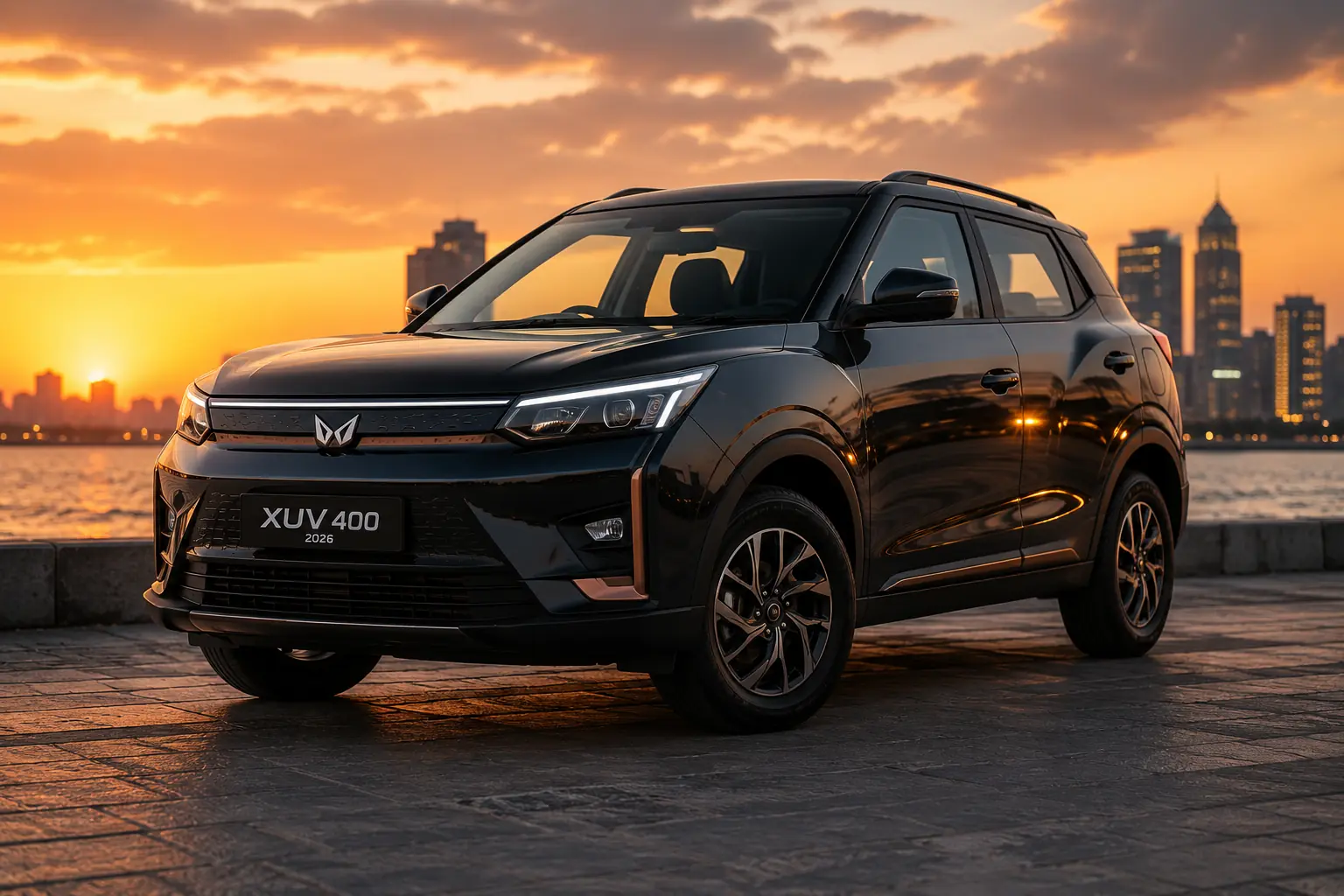
The 2026 Mahindra XUV400 EV is a spacious family electric SUV priced between ₹15.49 Lakh and ₹17.69 Lakh (ex-showroom). Available with 34.5 kWh and 39.4 kWh NMC battery options, it puts out an impressive 150 PS (147.5 bhp) and 310 Nm of torque. It delivers a highly predictable real-world city range of 240 km to 290 km, standing out for its segment-exclusive cabin width and punchy straight-line acceleration.
Mahindra XUV400 EV Price Guide 2026: Real-World Range, Interior, Running Cost & Is It Worth Buying?
Many modern compact electric SUVs compromise on cabin width and rear-seat comfort to squeeze into sub-4-meter tax brackets. This poses a distinct challenge for traditional Indian families who need a primary vehicle that can comfortably seat three adults across the rear bench without forcing everyone’s shoulders together.
The Mahindra XUV400 EV directly solves this space constraint. Unlike its petrol sibling (the XUV 3XO), the XUV400 skips sub-4-meter length restrictions entirely, stretching out to 4,200 mm in length. Following its extensive “Pro” updates, it matches its class-leading cabin space with a completely modernized digital dashboard. In 2026, with highly aggressive pricing, it presents a practical, performance-driven choice for households transitioning away from high fuel bills.
Why the Mahindra XUV400 EV Remains a Sensible Family Pick
The XUV400 EV relies on traditional SUV packaging strengths rather than overly experimental body styling, delivering high real-world utility:
Legitimate Mid-Size Dimensions: By utilizing an extended platform, it offers a wider rear bench track and significantly more legroom than typical sub-4-meter electric crossovers.
Enthusiastic Performance: Packing 310 Nm of instant torque, it launches from 0 to 100 km/h in just 8.3 seconds, providing effortless high-speed overtaking power.
Insulation from Fuel Price Volatility: Commuting daily across town in a petrol or diesel mid-size automatic SUV can severely dent a household budget. The XUV400 swaps that recurring expense for low-cost electricity.
Mahindra XUV400 EV Price List & Variants (2026)
The lineup organizes cleanly around the modernized “Pro” cabin tech trims and two distinct battery capacities: 34.5 kWh and 39.4 kWh.
| Variant Name | Battery Capacity | Charger Included | Ex-Showroom Price | Primary Variant Focus |
| EC Pro | 34.5 kWh | 3.3 kW AC | ₹15.49 Lakh | Fleet / Entry-Level Budget Buyers |
| EL Pro (34.5) | 34.5 kWh | 7.2 kW AC Fast | ₹16.74 Lakh | Tech Features / Value City Commuters |
| EL Pro DT (34.5) | 34.5 kWh | 7.2 kW AC Fast | ₹16.94 Lakh | Mid-Trim with Dual-Tone Styling |
| EL Pro (39.4) | 39.4 kWh | 7.2 kW AC Fast | ₹17.49 Lakh | The Sweet Spot / Maximum Range |
| EL Pro DT (39.4) | 39.4 kWh | 7.2 kW AC Fast | ₹17.69 Lakh | Flagship / Fully Loaded Dual-Tone |
Completely Upgraded Interior, Tech & Space
Early editions of the XUV400 faced criticism for a basic cabin. Mahindra completely fixed this with the revised Pro Series interior layout, turning it into a contemporary digital workspace.
1. The Dual 10.25-Inch Screen Layout
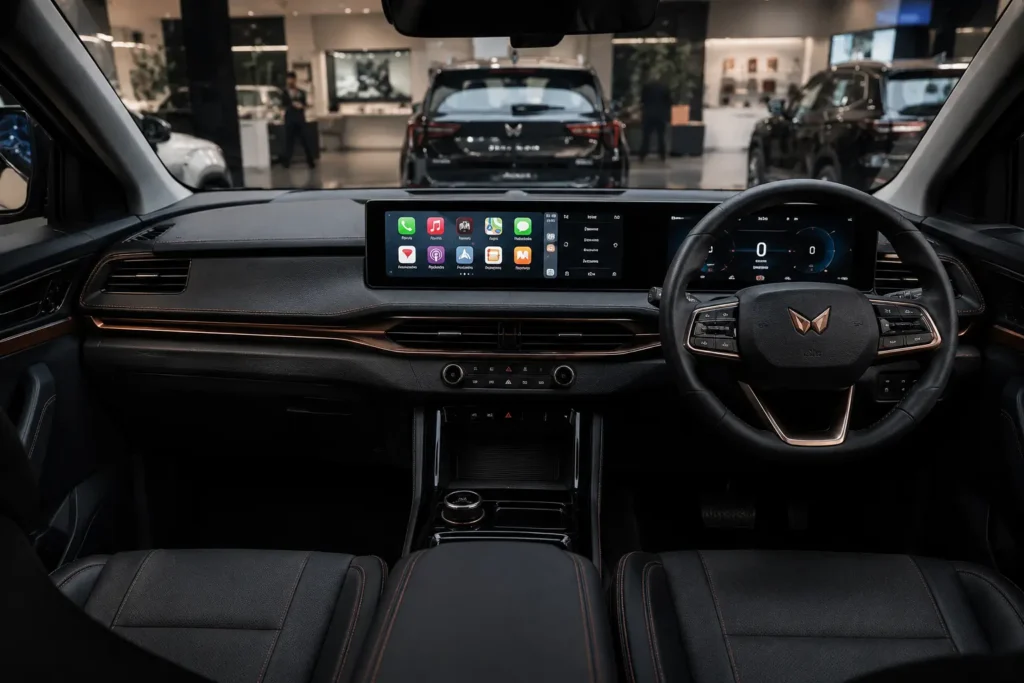
The center of the cabin features a floating 10.25-inch high-definition touchscreen infotainment center running highly responsive, lag-free software. It fully supports wireless Apple CarPlay and Android Auto. This is paired with a matching 10.25-inch fully digital driver instrumentation cluster that cleanly displays navigation data, battery metrics, and energy consumption cycles.
2. Cabin Materials & Comfort Enhancements
The interior steps up its premium feel with rich dual-tone textures, highlighted by premium leatherette upholstery with distinctive copper contrast stitching. The center console includes a modern dial-style drive selector and a handy wireless smartphone charging dock. Dual-zone automatic climate control comes standard on upper trims, allowing the driver and front passenger to set separate temperature zones.
3. Class-Leading Rear Legroom and Boot Practicality
Thanks to a wide 1,821 mm body track and a generous wheelbase layout, rear passenger space is the best in its class. Three adults can sit side-by-side across the rear bench comfortably without rubbing shoulders, assisted by a flat floor architecture and dedicated rear AC vents.
The extended body style also expands cargo capacity significantly, unlocking a highly practical 368-liter boot volume that easily swallows large family travel bags.
Real-World Range & Charging Experience
Laboratory estimates provide a good comparison benchmark, but actual Indian road traffic tells a more accurate story.
Real Urban Loops vs. Highway Drops
Unlike many mass-market EVs that utilize LFP cell chemistry, Mahindra uses high-energy-density NMC (Nickel Manganese Cobalt) battery cells for the XUV400, prioritizing punchy performance delivery:
The 34.5 kWh Battery Pack: Delivers a realistic, everyday city range of 240 km to 250 km on a full charge.
The 39.4 kWh Battery Pack: Delivers a dependable real-world city range of 280 km to 295 km with the air conditioning running consistently.
Maintaining high cruising speeds above 100 km/h on open expressways increases aerodynamic drag on the boxy SUV body, dropping highway range on the larger pack to around 230 km. Continuous AC operation in peak 42°C summer heat results in a standard 12% efficiency drop.
Faster DC Fast Charging
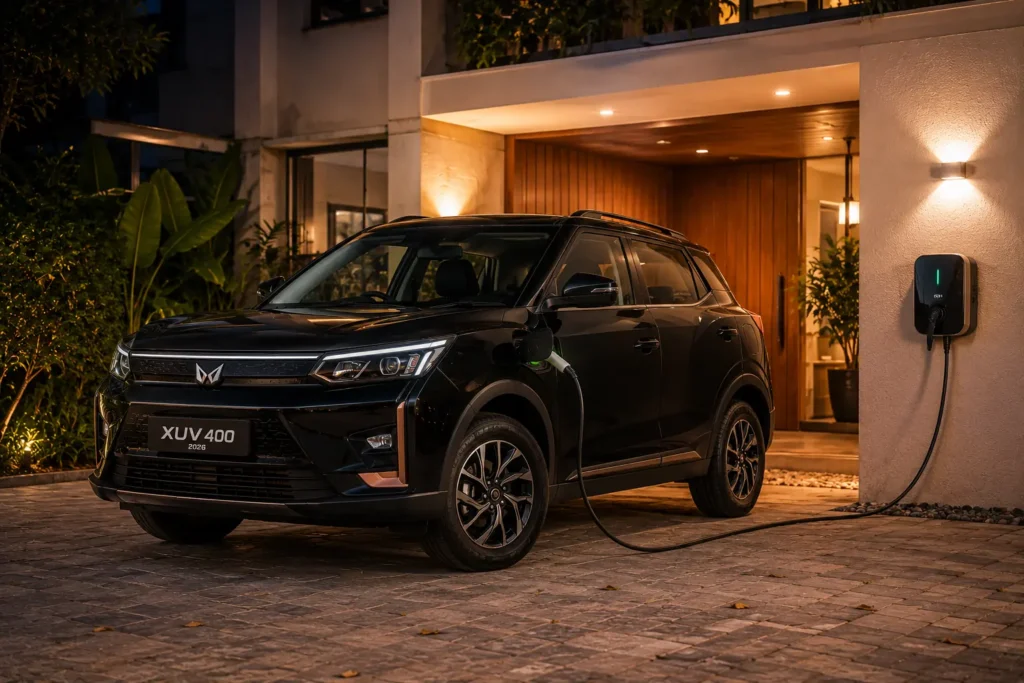
7.2 kW AC Home Wall Box Charger: Included standard with the EL Pro trims, it replenishes the 39.4 kWh battery from empty to 100% at home in approximately 6 hours and 30 minutes.
Public DC Fast Charging Support: The XUV400 handles up to 45 kW DC fast-charging input. Hooked up to a standard public fast station, it can juice the battery from 10% to 80% in just 50 minutes.
Mahindra XUV400 EV Technical Specifications Table
| Technical Parameter | 34.5 kWh Pro Specification | 39.4 kWh Pro Specification |
| Drivetrain Configuration | Front-Wheel Drive (Single PMSM) | Front-Wheel Drive (Single PMSM) |
| Peak Power Output | 150 PS (147.5 bhp) | 150 PS (147.5 bhp) |
| Peak Torque Output | 310 Nm (Instantaneous) | 310 Nm (Instantaneous) |
| Battery Cell Chemistry | Nickel Manganese Cobalt (NMC) | Nickel Manganese Cobalt (NMC) |
| Claimed MIDC Range | 375 km | 456 km |
| Real-World City Range | ~240 – 250 km | ~280 – 295 km |
| Acceleration (0-100 km/h) | 8.3 Seconds (Class Leading) | 8.3 Seconds (Class Leading) |
| Dimensions (L x W x H) | 4,200 x 1,821 x 1,634 mm | 4,200 x 1,821 x 1,634 mm |
| Braking Systems | All-Wheel Disc Brakes standard | All-Wheel Disc Brakes standard |
XUV400 EV Running Cost vs Petrol Mid-Size SUVs
Let’s calculate the operational math for an urban household covering 1,200 km per month over a 5-year ownership period.
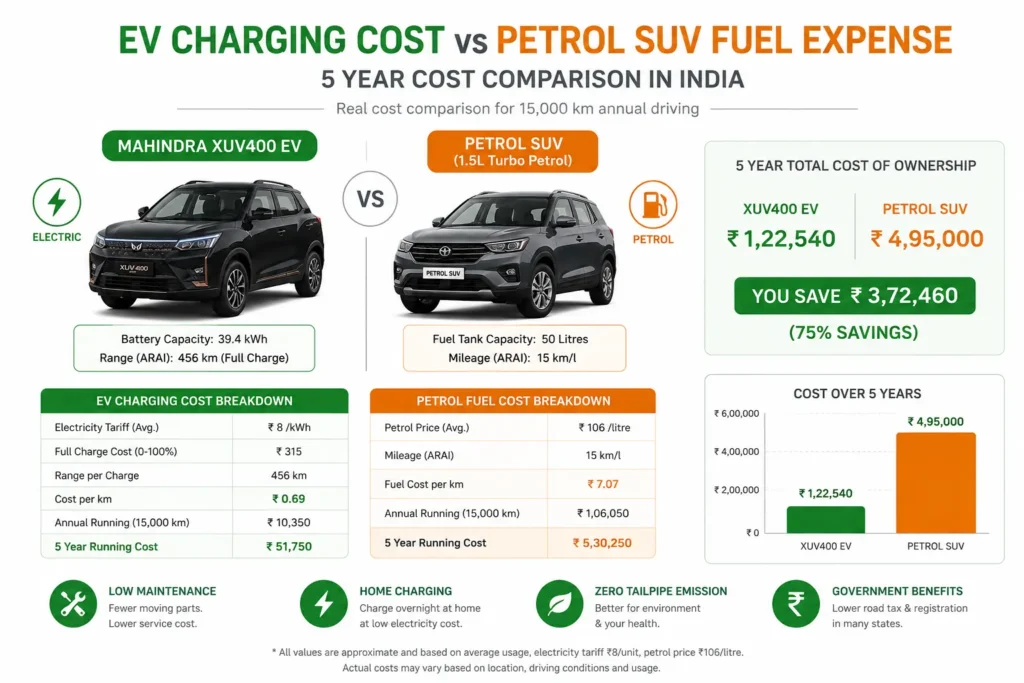
Scenario A: The XUV400 EV (39.4 kWh Pack via Home AC Charging)
Average domestic power tariff: ₹8 per unit (kWh).
Fully topping up the 39.4 kWh battery takes roughly 44 units of electricity (accounting for minor charging inefficiencies), costing ₹352.
Covering 1,200 km requires roughly 4.2 full home charging cycles.
Monthly Power Bill: ~₹1,478 (Approx. ₹1.23 per km).
Scenario B: Traditional Petrol Automatic Mid-Size SUV
Average cost of standard fuel: ₹102 per liter.
Real-world urban mileage in dense traffic: 11 km/l.
Fuel needed for 1,200 km: 109 Liters.
Monthly Fuel Bill: ₹11,118 (Approx. ₹9.26 per km).
5-Year Cumulative Savings Outlook
[Petrol Mid-Size SUV: ₹11,118/mo]
=======> 5-Year Total: ₹6.67 Lakh
[XUV400 EV Charging:  ₹1,478/mo]
==> 5-Year Total: ₹0.89 Lakh
-----------------------------
Net Operational Fuel Savings over 5 Years: ₹5.78 Lakh
Maintenance Cost & Long-Term Ownership
By dropping volatile mechanical components like fuel injectors, turbo chargers, exhaust particulate filters (DPF), and multi-speed gearboxes, long-term maintenance is heavily simplified.
Routine Garage Visits: Annual periodic maintenance covers basic cabin air filter replacements, suspension lubrication checkups, and diagnostic software health scans. Standard bills generally stay between ₹3,500 and ₹5,000.
Battery Safety and Protection: Mahindra provides a reassuring 8-year or 1,60,000 km warranty on the liquid-cooled battery pack, ensuring robust long-term insulation against cell degradation.
Mahindra XUV400 EV Pros & Cons
Advantages
Unmatched Rear Cabin Width: Legitimate space to seat three adults across the rear bench comfortably.
Incredibly Low Running Costs: Home electrical charging limits driving expenses to just ₹1.23 per km.
Excellent Power Delivery: 310 Nm of instant torque delivers immediate overtaking performance.
Upgraded Tech Cabin: The dual 10.25-inch screen layout looks highly contemporary and runs lag-free.
Robust All-Wheel Discs: Comes equipped with disc brakes on all four wheels for confident stopping power.
Disadvantages
Misses Premium Feel-Good Tech: Lacks certain premium features like ventilated front seats, a 360-degree camera, or a panoramic sunroof.
No Active ADAS Suite: Lacks advanced driver assistance safety systems found on newer platform rivals.
Firm Low-Speed Ride: The suspension is tuned slightly firm to handle the under-floor battery cells over sharp potholes.
Highway Range Drops: The NMC battery drops range significantly if pushed past steady highway speeds.
Who Should Buy the Mahindra XUV400 EV?
Recommended For:
Space-Prioritizing Families: Ideal for households that regularly carry three passengers in the rear seat and require legitimate mid-size cabin width.
High-Mileage Commuters: Drivers covering over 1,000 km monthly who want a commanding SUV driving stance alongside substantial fuel savings.
Performance Enthusiasts on a Budget: Perfect for drivers who appreciate linear, neck-snapping torque and quick overtaking acceleration under ₹18 Lakh.
Not Recommended For:
Apartment Residents Lacking Private Power Access: Relying solely on public fast chargers reduces daily convenience and increases costs.
Feature-Obsessed Tech Buyers: If you prioritize features like ventilated seats, premium branded audio, and advanced radar ADAS systems over pure cabin space.
Questions Buyers Commonly Ask about Mahindra XUV400 EV
What is the real starting price of the Mahindra XUV400 EV on-road?
While the ex-showroom base price starts at ₹15.49 Lakh, local registration charges, insurance, and handling fees bring final on-road metro prices to between ₹16.3 Lakh and ₹18.8 Lakh depending on your state’s EV tax incentives.
What is the true real-world range of the Mahindra XUV400 39.4 kWh?
In normal city traffic with the air conditioning running consistently, you can safely expect a highly dependable 280 km to 295 km of actual range on a single charge.
Does it come standard with a fast charger?
The entry-level EC Pro comes with a basic 3.3 kW charger, while upgrading to the highly recommended EL Pro trims bundles a high-efficiency 7.2 kW AC fast wall box to minimize home charging times.
Is the cabin comfortable for senior citizens?
Yes. Because the platform layout spreads the battery cells flat beneath the frame without raising the floor angle significantly, entry and exit heights remain natural, ensuring an easy seating position for elderly passengers.
How long does the NMC battery last?
The advanced cell management and liquid-cooling configuration are engineered to handle over 1,500 full charging cycles, providing a reliable operational lifespan of 8 to 10 years of regular daily service.
Final Verdict: Is the Mahindra XUV400 EV Worth Buying in 2026?
The Mahindra XUV400 EV represents a highly practical and sensible financial decision. It skips flashy visual body shapes or complex radar menus; instead, it focuses on delivering excellent cabin space, punchy performance, a modernized screen layout, and highly predictable running costs.
If you have a secure parking space to install an AC home charger, require legitimate width to comfortably carry a full family of five, and have a daily cross-city commute that impacts your monthly budget, the massive fuel savings and effortless torque make it an exceptional investment. However, if you place premium feature details like seat ventilation or active ADAS systems over pure physical cabin space, newer alternative configurations might fit your garage better. Ultimately, let your real family space needs and monthly driving distance guide your final choice.
Helpful Resources for Indian EV Car Buyers
- Bharat NCAP Official Website — India’s official crash-testing and vehicle safety rating platform. Includes adult and child occupant scores, crash-test protocols, and tested vehicle lists.
- Global NCAP – Safer Cars for India — Global crash-test program that pushed Indian manufacturers toward safer vehicle structures and occupant protection standards.
- Reserve Bank of India (RBI) — Official source for repo rates, lending rules, and banking regulations in India. (rbi.org.in)
- TransUnion CIBIL — Check your credit score and track your loan eligibility before applying for a car loan.
- AutomotiveZone Mileage Cost Calculator — Estimate real fuel costs based on your driving mileage.
- AutomotiveZone Monthly Car Expense Calculator — Calculate total monthly car ownership cost including EMI, fuel, and maintenance.
- AutomotiveZone Fuel Cost Calculator — Instantly estimate petrol, diesel, or CNG expenses based on mileage, fuel price, and trip distance.
- AutomotiveZone EV vs Petrol Cost Calculator — Compare electric vehicle charging costs with petrol fuel expenses to see long-term savings.
- AutomotiveZone EV Charging Cost Calculator — Calculate home and fast-charging electricity costs for your EV using battery size and electricity tariff.
- AutomotiveZone Car Resale Value Estimator — Estimate your car’s current market resale value based on age, mileage, ownership, and condition.
Disclaimer: Prices, mileage, safety ratings, loan rates, and ownership costs are approximate and may vary by location, variant, and market conditions in 2026. Some visuals may be AI-generated for illustration. Please verify final details with authorized dealers before purchase.
Calculate Mahindra XUV400 EV Charging Cost
Estimate your monthly charging expenses, electricity costs, and long-term savings with the Mahindra XUV400 EV.
Calculate EV Charging Cost →