
Tesla S vs X vs Y Quick Overview
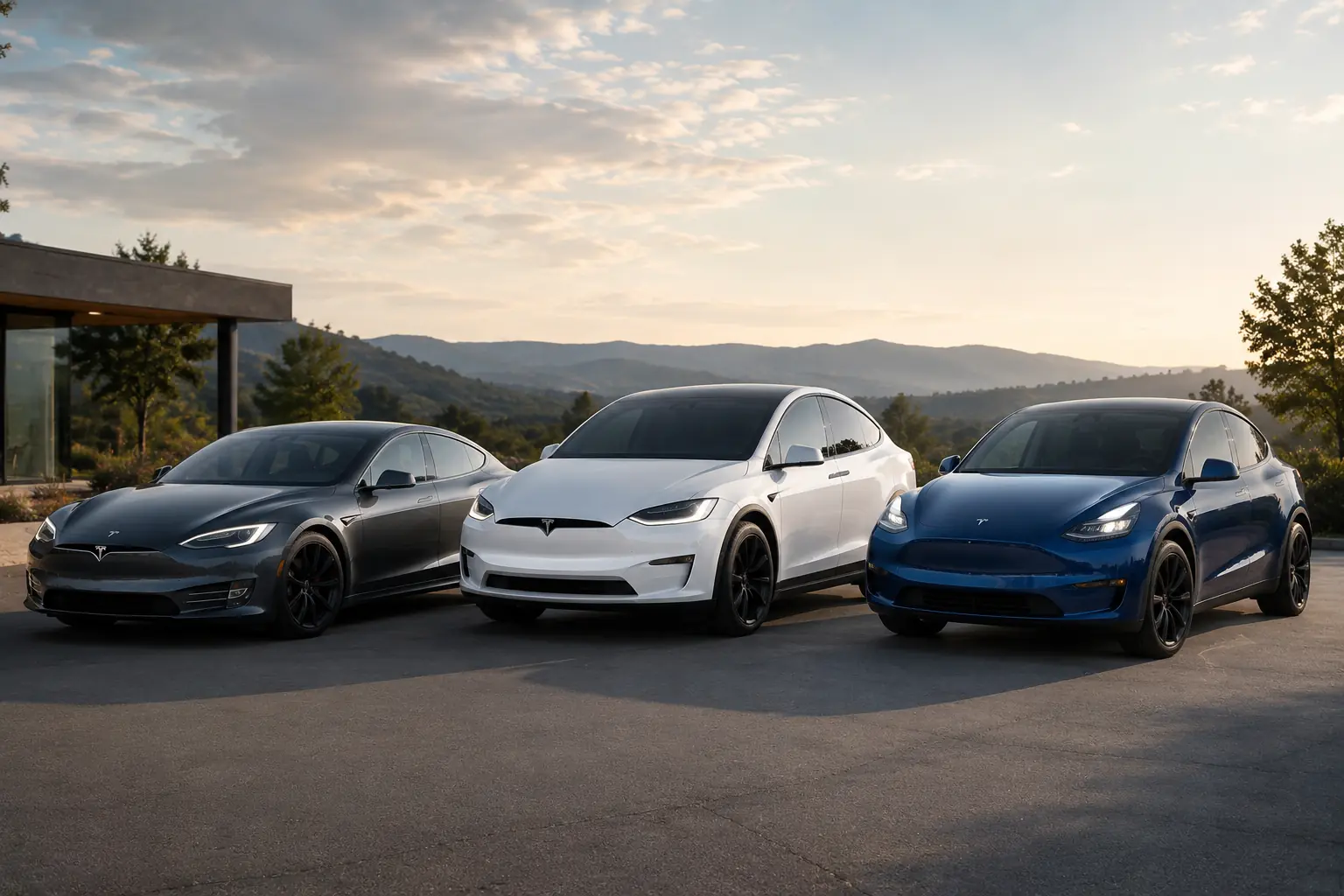
The choice between the Tesla Model S, Model X, and Model Y maps directly to specific budgets, body style preferences, and utility needs. The Model S is a low-slung, high-performance executive fastback sedan optimized for maximum range and track speed. The Model X stands as a full-size flagship luxury SUV defined by motorized Falcon Wing doors and premium 3-row seating flexibility. Conversely, the mass-market Model Y functions as a smaller, highly efficient, and practical mid-size crossover, delivering the brand’s best value footprint without the steep pricing of its premium stablemates.
Tesla S vs X vs Y: Deciphering Performance, Layout Cabin Space, and Everyday Value in the 2026 Lineup
Tesla’s product architecture can look deceptively simple from the outside, utilizing shared, slippery design curves and matching minimalist single-screen interior templates across multiple vehicle segments. However, beneath the matching software interfaces lie entirely different vehicle platforms built for very separate types of drivers. Choosing the wrong model can leave a family dealing with a vehicle that sits too low for easy child-seat access, commands an unnecessarily large parking footprint in tight city lanes, or strains family budgets past the breaking point.
To clear up this confusion, this side-by-side comparison evaluates the premium fastback sedan (Model S), the flagship heavy-duty SUV (Model X), and the globally dominant mass-market crossover (Model Y). By testing real-world distance metrics, physical cabin seating configurations, mechanical chassis setups, and real running dynamics, this guide aims to map the ideal electric vehicle straight to your garage.
1. Core Visual Personas & Body Philosophies
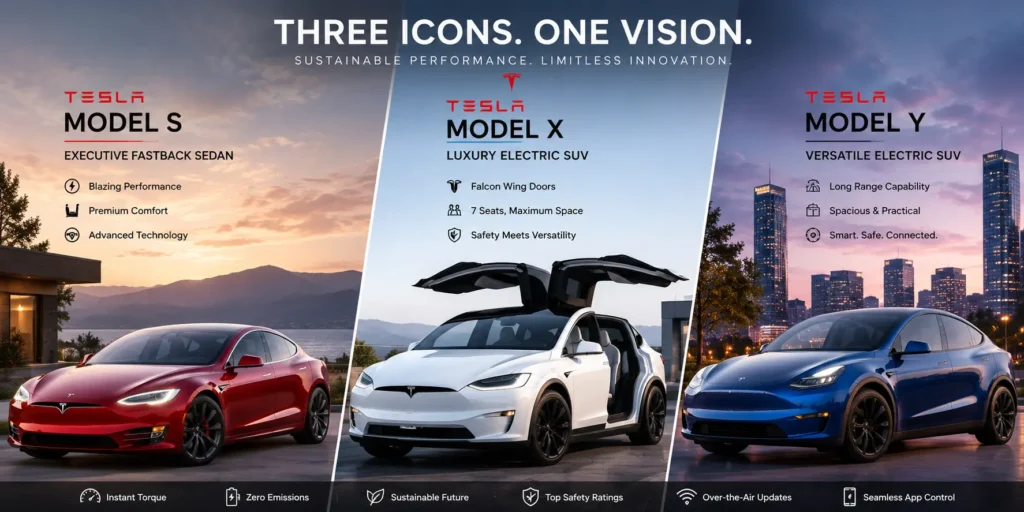
The three platforms split across three distinct design directions that dictate how they slice through the air and occupy pavement space:
Tesla Model S (The Executive Fastback): A low-slung, ultra-aerodynamic luxury sedan featuring a functional liftback rear tailgate. Siting low to the ground, its windswept roofline drops its drag coefficient to a mere 0.208 Cd, making it the absolute sleekest body style in the lineup.
Tesla Model X (The Flagship Luxury SUV): A massive, commanding full-size SUV that stands out instantly with its motorized double-hinged Falcon Wing rear doors. These doors lift vertically using built-in ultrasonic sensors, allowing full walk-in access to the rear rows even in tight parking spaces.
Tesla Model Y (The All-Rounder Crossover): A compact-to-midsize crossover SUV built on a lighter, more agile footprint. It drops complex motorized mechanisms for standard conventional doors, functioning as a practical, easy-to-park daily commuter.
2. 2026 Price Architecture & Target Segments
The financial gap between the mass-market crossover and Tesla’s premium flagship lines represents a major deciding factor.
Market Price Architecture Comparison:
| Vehicle Platform | Primary Body Type Class | Global Base MSRP Bracket | Estimated India CBU Price | Target Buyer Demographics |
| Tesla Model Y | Mid-Size Crossover SUV | $42,990 – $52,490 | ₹50.89 L – ₹61.99 L | Value-First Families & Commuters |
| Tesla Model S | Premium Executive Sedan | $74,990 – $89,990 | ₹1.40 Cr – ₹1.60 Cr | Performance Lovers & Long Tourers |
| Tesla Model X | Full-Size Luxury 3-Row SUV | $79,990 – $94,990 | ₹1.50 Cr – ₹2.00 Cr | Chauffeur Executives & Large Families |
3. Interior Configurations & Seating Practicality
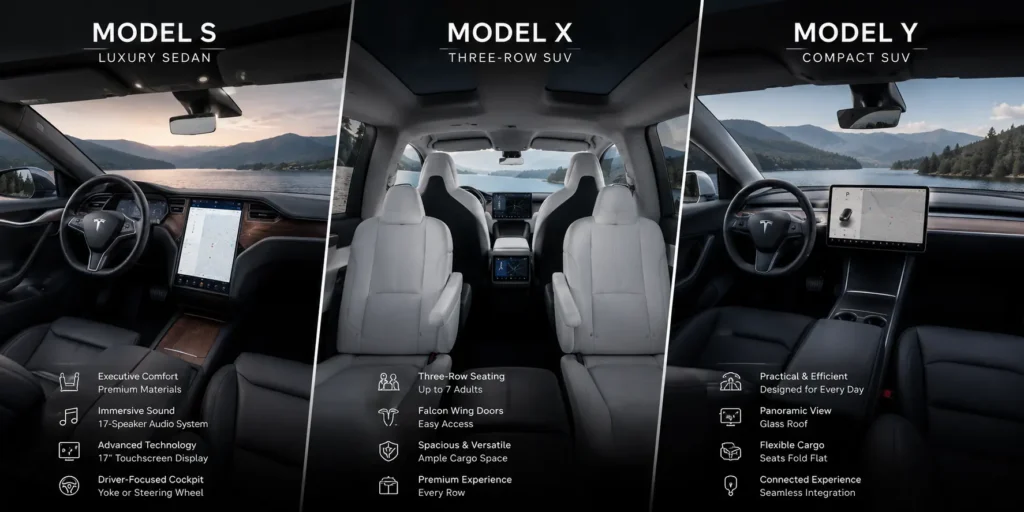
While all three cabins embrace the brand’s signature minimalist design layout, their seating capacities and passenger spaces handle passenger loads very differently.
Cockpit Displays and Layout Tracking
The premium Model S and Model X feature an expansive dashboard layout combining a massive 17.4-inch tilt-adjustable central touchscreen display with a separate, dedicated 12.3-inch driver instrumentation cluster right behind the steering column or Yoke. The mass-market Model Y drops the driver’s display entirely, funneling all speedometers, navigation tracks, and vehicle settings through a single, centralized 15.4-inch screen.
Seating Flexibility and Cargo Bounds
Model S Space: A strict 5-seater sedan setup offering massive front legroom. It utilizes a long liftback cargo floor that opens up 61.4 cubic feet of loading room with the rear rows dropped flat.
Model X Space: The ultimate space champion. It can be configured as a standard 5-seater, a hyper-luxurious 6-seater with independent second-row captain’s chairs, or a full 7-seater family layout. Folding all rows completely flat frees up a cavernous 91.6 cubic feet of furniture-hauling volume.
Model Y Space: Primarily optimized as a spacious 5-seater. While a compact 3-row 7-seater configuration exists (and a stretched 6-seater Model Y L variant serves specific international markets), its third row is tightly restricted, making it best suited for young children. Max cargo room peaks at a respectable 76.2 cubic feet.
4. Powertrain Muscle, Performance & Real Range
Tesla uses two distinct battery chemistries across these lines. Lower-tier Model Y variants implement durable Lithium Iron Phosphate (LFP) cells, while the long-distance Model S, X, and high-tier Y variants deploy high-density Nickel Manganese Cobalt (NMC) packs.
Performance & Range Engineering Matrix:
| Technical Parameters | Tesla Model Y (Long Range AWD) | Tesla Model S (Long Range AWD) | Tesla Model X (Standard AWD) |
| Motor Configuration | Dual Motor Active AWD | Dual Motor Active AWD | Dual Motor Active AWD |
| Peak Horsepower | 384 hp | 670 hp | 670 hp |
| Hypercar Plaid Option | Not Available | Yes (1,020 hp Tri-Motor) | Yes (1,020 hp Tri-Motor) |
| 0 – 100 kmph Sprint | 4.8 Seconds (3.5s Perf) | 3.2 Seconds (2.1s Plaid) | 3.8 Seconds (2.5s Plaid) |
| Official Certified Range | 308 Miles (495 km) | 410 Miles (660 km) | 352 Miles (566 km) |
| True Mixed City Range | 265 mi to 285 mi | 370 mi to 395 mi | 310 mi to 330 mi |
| Peak DC Fast Charge | Up to 250 kW | Up to 250 kW | Up to 250 kW |
The Model S capitalizes heavily on its low-slung, ultra-sleek fastback shape to secure the absolute longest real-world range track in the lineup, comfortably clearing real-world cross-country stretches over 370 miles on a single charge. Conversely, the heavier, boxier Model X and Y crossovers experience higher aerodynamic drag, resulting in elevated battery drain during high-speed highway cruising.
5. Mechanical Chassis & Ride Isolation
The driving dynamics and suspension tuning reveal a deep separation between utility-focused engineering and elite, first-class luxury.
The Smart Air Suspension Advantage (Model S & X): Both premium flagships come equipped standard with a highly sophisticated Smart Adaptive Air Suspension system. This setup continuously monitors the road surface in real-time, softening automatically to completely isolate the cabin from sharp pothole thuds, and tightening up at highway speeds to prevent floating body roll.
The Steel Spring Balance (Model Y): The mass-market Model Y utilizes a traditional fixed steel coil suspension layout. While tuned for a highly responsive, fun, and car-like handling feel around tight city corners, it delivers a noticeably firmer ride, transferring sharp pavement cracks and concrete ridges directly inside the cabin when driving over broken asphalt unladen.
6. Running Costs & Maintenance Realities
Let’s calculate the projected monthly operational energy expenses for an urban commuter covering a standard cross-town distance of 1,200 miles (approx. 1,930 km) per month using home AC power lines.
Monthly Power Billing Breakdown:
Average domestic power tariff: $0.16 per unit (kWh).
Model Y Crossover Loop: Pulls an ultra-frugal average of ~26 kWh per 100 miles.Monthly Power Outgo: ~$49.92
Model S Sedan Loop: Leverages its low aerodynamic drag to consume roughly ~28 kWh per 100 miles.Monthly Power Outgo: ~$53.76
Model X Heavy SUV Loop: Due to its substantial 5,100 lbs unladen mass, consumption rises to ~33 kWh per 100 miles.Monthly Power Outgo: ~$63.36
The Long-Term Maintenance Factor: While all three vehicles lower monthly energy bills to a fraction of a gasoline engine, the Model Y wins the long-term maintenance equation. Because it avoids complex luxury components like adaptive air bags, automatic front motorized doors, or motorized Falcon Wing seals, it carries the lowest long-term maintenance risk in the EV world.
Compare EV vs Fuel Running Costs
Compare EV charging costs with petrol and diesel vehicles. Estimate energy expenses, fuel savings, cost per mile, monthly running costs, and long-term ownership savings to see how much money an electric vehicle can save.
Compare EV vs Fuel Costs →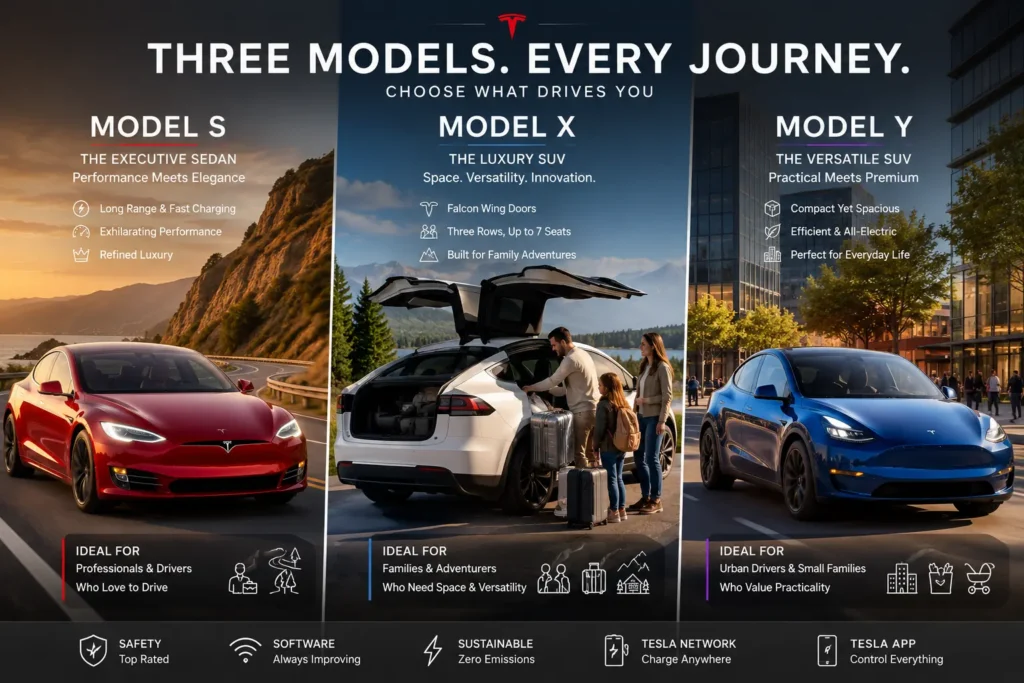
7. Final Buyers Verdict: Which Tesla Fits Your Garage?
Choose the Tesla Model Y if:
You are looking for the absolute highest return on investment (“bang for your buck”) in the premium electric vehicle ecosystem. If your daily lifestyle revolves around standard city commutes, hassle-free tight street parking, low long-term mechanical maintenance bills, and you simply want a highly practical, spacious family crossover that handles daily utility seamlessly, the Model Y stands out as the most sensible, highly popular choice.
Choose the Tesla Model S if:
You refuse to compromise on driving performance, low-slung executive style, and raw driving range. If you regularly take multi-hour interstate road trips where maximizing every mile of battery depth matters, and you want a sports-car-rivaling, 670-to-1,020 hp machine that tracks flat and razor-sharp through high-speed expressway curves while enveloping you in a noise-insulated dual-screen theater lounge, the Model S is the definitive flagship fastback sedan to buy.
Choose the Tesla Model X if:
You require a legitimate luxury 3-row cruiser built with an absolute “Wow” theatrical factor. If your family needs executive 6-seater captain’s chair layouts that offer seamless, walk-in access for children, heavy-duty 5,000 lbs towing capabilities to haul trailers or boats, and the plush, cloud-like isolation of smart adaptive air suspension, the Model X represents the ultimate pinnacle of premium electric utility utility engineering.
Helpful Resources for Indian EV Car Buyers
- Bharat NCAP Official Website — India’s official crash-testing and vehicle safety rating platform. Includes adult and child occupant scores, crash-test protocols, and tested vehicle lists.
- Global NCAP – Safer Cars for India — Global crash-test program that pushed Indian manufacturers toward safer vehicle structures and occupant protection standards.
- Reserve Bank of India (RBI) — Official source for repo rates, lending rules, and banking regulations in India. (rbi.org.in)
- TransUnion CIBIL — Check your credit score and track your loan eligibility before applying for a car loan.
- AutomotiveZone Mileage Cost Calculator — Estimate real fuel costs based on your driving mileage.
- AutomotiveZone Monthly Car Expense Calculator — Calculate total monthly car ownership cost including EMI, fuel, and maintenance.
- AutomotiveZone Fuel Cost Calculator — Instantly estimate petrol, diesel, or CNG expenses based on mileage, fuel price, and trip distance.
- AutomotiveZone EV vs Petrol Cost Calculator — Compare electric vehicle charging costs with petrol fuel expenses to see long-term savings.
- AutomotiveZone EV Charging Cost Calculator — Calculate home and fast-charging electricity costs for your EV using battery size and electricity tariff.
- AutomotiveZone Car Resale Value Estimator — Estimate your car’s current market resale value based on age, mileage, ownership, and condition.
Disclaimer: Prices, mileage, safety ratings, loan rates, and ownership costs are approximate and may vary by location, variant, and market conditions in 2026. Some visuals may be AI-generated for illustration. Please verify final details with authorized dealers before purchase.