
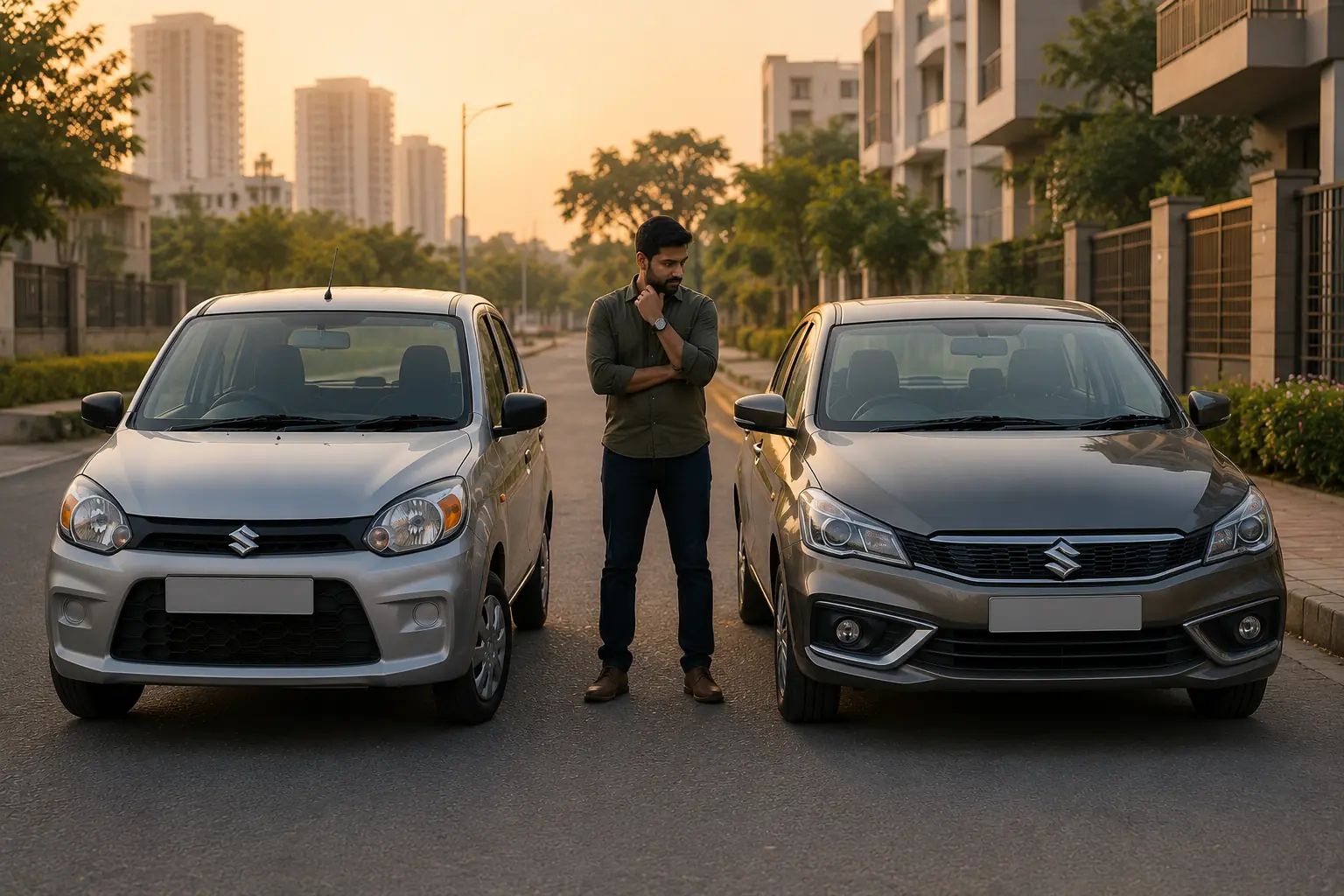
In 2026, the choice between a hatchback and an entry sedan under ₹5 lakh is largely a trade-off between city agility and boot space. Hatchbacks like the Maruti Alto K10 or S-Presso dominate this budget, offering superior mileage and easier parking. Entry sedans, while offering better “status” and highway stability, are nearly impossible to find new at this price, often requiring a stretch or looking at the used market.
1. Hatchback vs Sedan: What Really Changes?
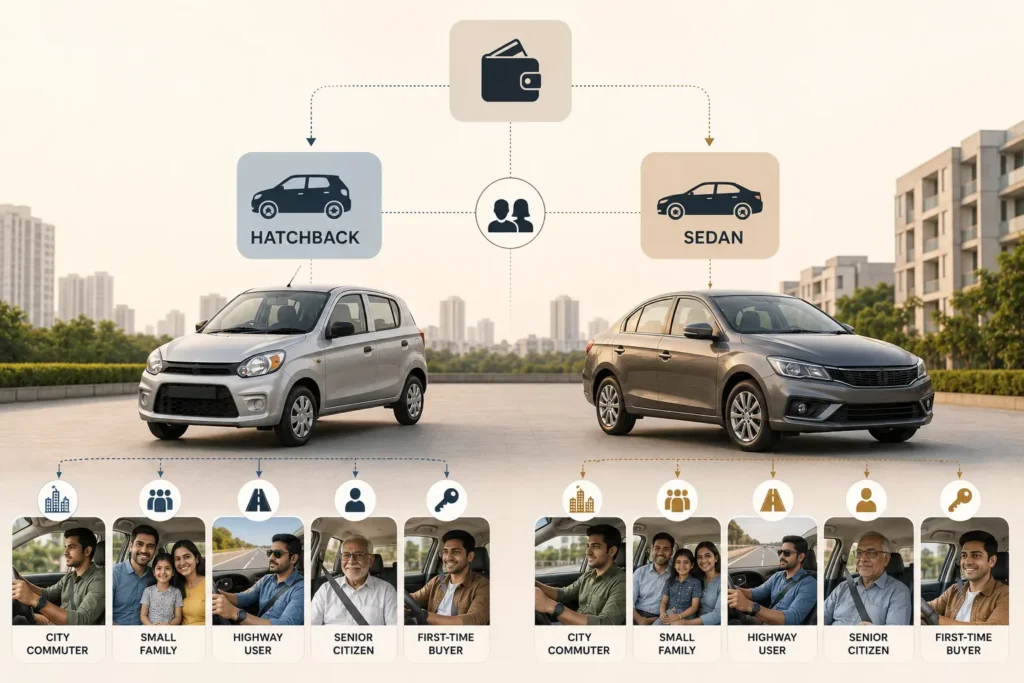
For the Indian middle-class buyer, the car isn’t just transport; it’s an extension of the family. The fundamental difference between these two body styles lies in the three-box vs. two-box design.
A hatchback is a “two-box” car where the passenger and luggage areas are one. A sedan is a “three-box” car with a dedicated boot. In the real world, this means a sedan offers more “prestige” and a quiet trunk for luggage, while a hatchback offers the flexibility of folding seats and a compact footprint that is a godsend in bumper-to-bumper city traffic.
2. Price Reality Under ₹5 Lakh in India (2026)
Let’s be investigative: In 2026, the “₹5 Lakh Sedan” is a disappearing species. Due to rising input costs and safety mandates, most entry-level sedans like the Maruti Dzire, Tata Tigor, or Honda Amaze now start well above ₹6.5 Lakh on-road.
If you are strictly under a ₹5 Lakh budget (ex-showroom), you are realistically looking at:
- Top-spec Hatchbacks: Maruti Alto K10, Maruti S-Presso, or Renault Kwid.
- Base-spec Sedans: Virtually non-existent in the new car market; you might only find base trims during massive year-end clearances.
- The Used Market: This is where the “Sedan under 5L” dream actually lives in 2026.
3. Space & Practicality Comparison
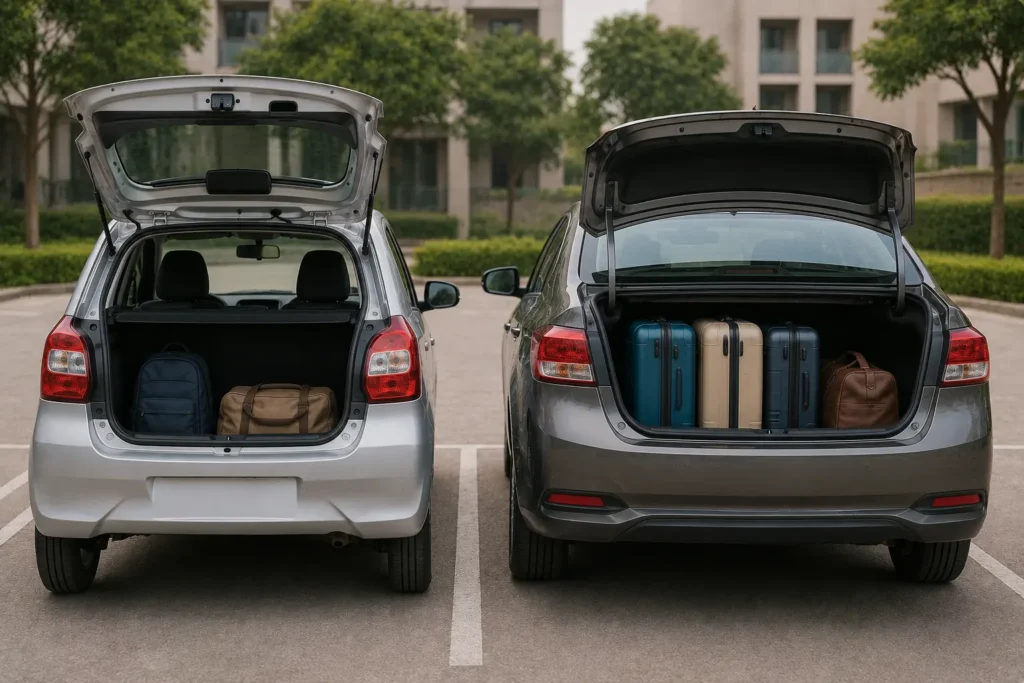
When you’re carrying a family of four plus a weekend’s worth of luggage, the sedan’s boot is its biggest weapon. However, for daily city runs, the hatchback’s “tall-boy” design (like in the S-Presso) can sometimes offer more headroom than a low-slung sedan.
| Feature | Budget Hatchback (e.g., Alto K10) | Entry Sedan (e.g., Base Tigor) |
| Boot Space | ~214 Liters | ~419 Liters |
| Seating | Best for 4 adults | Comfortable for 4 + a child |
| Parking | Fits in the tightest spots | Needs a proper parking slot |
| Turning Radius | ~4.5 Meters | ~4.9 – 5.1 Meters |
4. Mileage Comparison: Which is More Fuel Efficient?
In India, “Kitna deti hai?” remains the ultimate question. Hatchbacks are lighter and typically use smaller 1.0L engines, giving them a clear edge in fuel economy.
| Scenario | Hatchback (1.0L) | Entry Sedan (1.2L) |
| City Traffic | 18 – 20 kmpl | 14 – 16 kmpl |
| Highway | 23 – 25 kmpl | 19 – 21 kmpl |
| AC Load Impact | Noticeable power drop | More stable performance |
The Reality: If your commute is primarily in city traffic, a hatchback will save you roughly ₹1,500–₹2,000 per month in fuel costs compared to a sedan.
Related Reading: 7 Tips to Increase Car Fuel Efficiency by 20%
5. Maintenance & Ownership Cost
As a journalist who has spoken to hundreds of fleet owners and mechanics, I can confirm: Hatchbacks are the cheapest to keep.
- Service Costs: A Maruti hatchback service typically costs ₹4,500–₹6,000. Sedans, even entry-level ones, use slightly more expensive parts and more engine oil.
- Insurance: Sedans attract a higher “Third Party” premium and have a higher IDV (Insured Declared Value), making the annual renewal 15-20% more expensive than a hatchback.
- Spare Parts: Front and rear bumpers for hatchbacks are mass-produced and significantly cheaper to replace after those inevitable city scratches.
6. Driving Experience in Indian Conditions
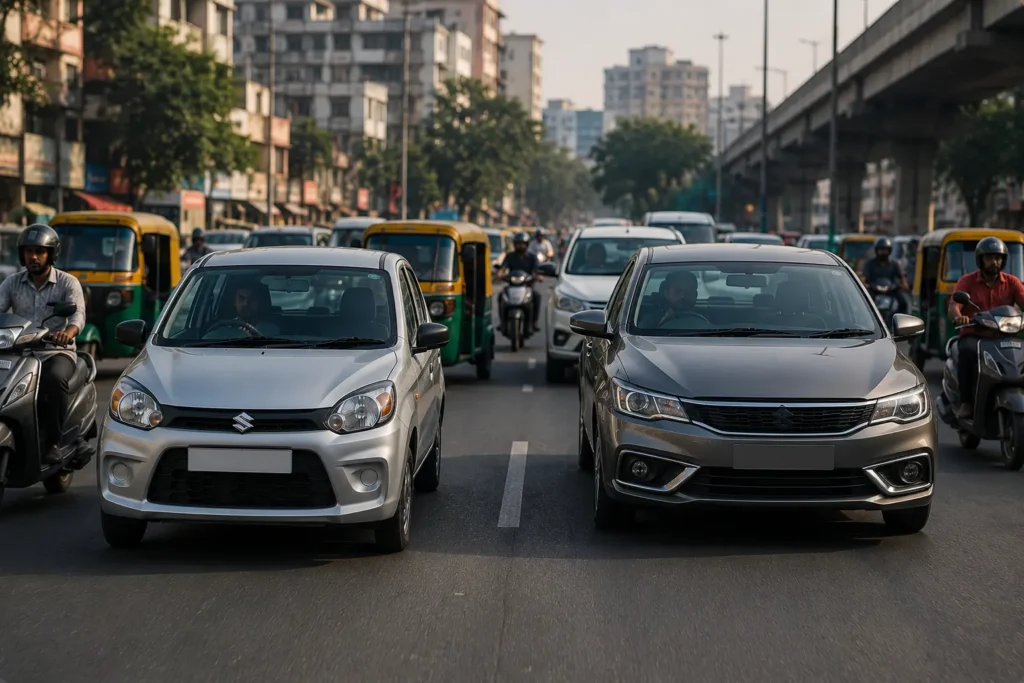
The Hatchback Advantage: It is the “Urban Ninja.” You can squeeze into gaps in traffic and park in spots that a sedan owner would drive past in frustration. For beginners, the visibility in a hatchback is usually superior.
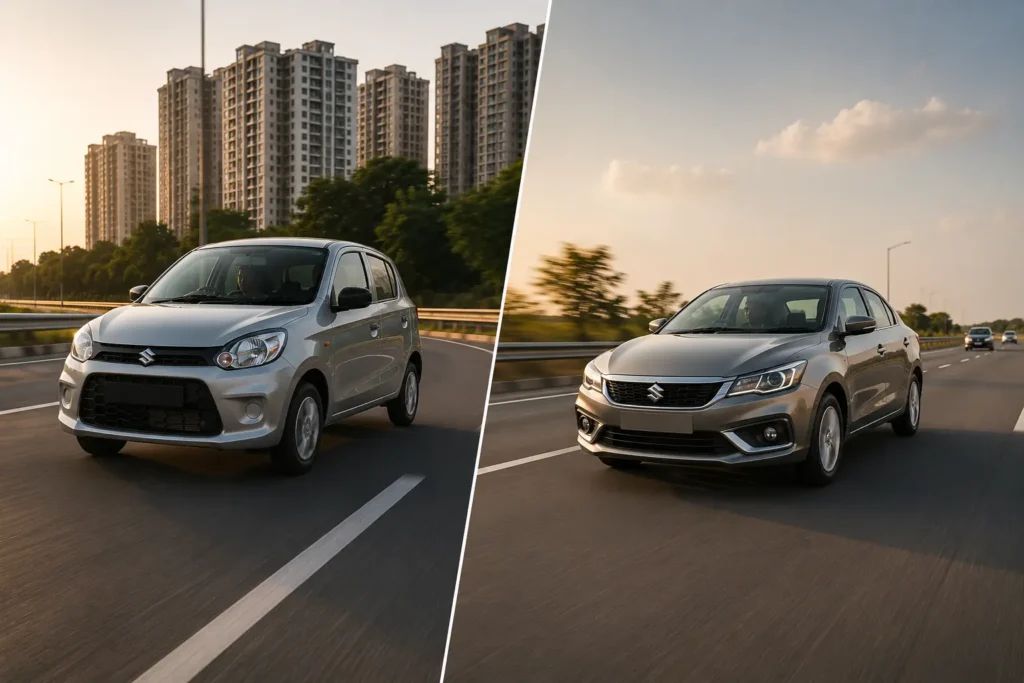
The Sedan Advantage: It is the “Highway Cruiser.” Because of the longer wheelbase and the extra “box” at the back, sedans feel more planted at speeds of 80-100 kmph. They suffer less from the “bouncing” effect that lightweight hatchbacks experience on flyover joints or undulating roads.
7. Safety Comparison
Don’t be fooled by the extra length; a sedan isn’t automatically safer.
- Structural Safety: Most cars under ₹5 Lakh (hatchbacks) are built to meet minimum safety standards.
- The Boot Factor: In a rear-end collision, the sedan’s extra boot acts as a “crumple zone,” providing a layer of protection for rear-seat passengers that a hatchback lacks.
- Stability: Sedans are less prone to tipping during sudden lane changes at high speeds due to their lower center of gravity.
8. Which Makes More Sense for Different Buyers?
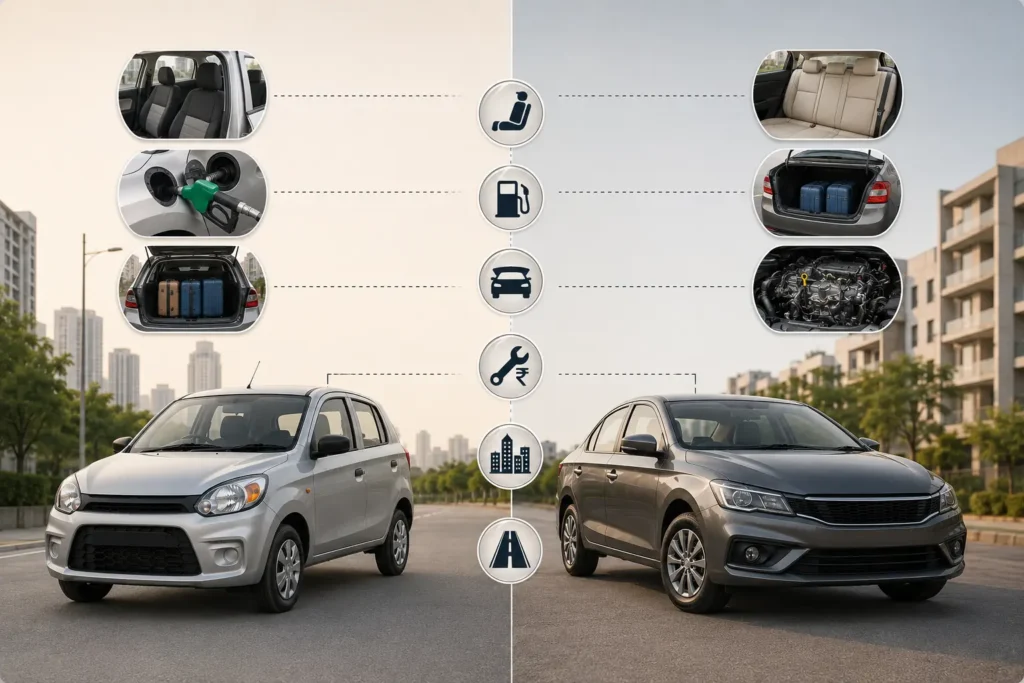
- First-Time Buyers: Hatchback. It’s easier to learn on, cheaper to dent/scratch, and fits your initial budget comfortably.
- Small Families (2 Adults + 2 Kids): Hatchback. You don’t need a massive boot for school runs or grocery shopping.
- Frequent Highway Users: Sedan. If you travel between cities once a month, the extra stability and luggage space are worth the stretch.
- Senior Citizens: Tall-boy Hatchback. The higher seating of an S-Presso is much easier on the knees than the low seats of a sedan.
Explore more: How Your CIBIL Score Affects Auto Loan Approval in India

9. Hatchback vs Sedan Under ₹5 Lakh Pros & Cons
Hatchback
- Pros: Exceptional mileage, easiest to park, lowest maintenance, light clutch for traffic.
- Cons: Limited boot space, feels “basic” on highways, low status appeal.
Entry Sedan
- Pros: Massive luggage space, better highway poise, higher “big car” status, safer in rear-end hits.
- Cons: Higher purchase price, harder to park, lower city mileage, higher insurance costs.
What Most Car Buyers Want to Know
Is a hatchback better than a sedan in India?
For 90% of urban Indians, yes. The ease of parking and higher fuel efficiency make it the more logical daily driver.
Which is cheaper to maintain under ₹5 Lakh?
The hatchback is consistently cheaper to maintain due to lower part costs and lower insurance premiums.
Is boot space worth choosing a sedan?
Only if you travel with 3-4 bags frequently. For daily use, most people find that a hatchback’s 200-liter boot is sufficient for groceries and a laptop bag.
What is the best first car under ₹5 Lakh?
The Maruti Alto K10 or Renault Kwid are the most balanced choices for first-time owners in 2026.
Final Decision: What Should You Actually Buy?

The choice depends on your usage, not just the body style.
If you are a first-time buyer living in a crowded metro like Mumbai or Bangalore, the Hatchback is the most sensible financial and practical decision. It saves you money at the pump and time in the parking lot.
However, if you are a “one-car family” that takes frequent road trips to your hometown or likes the social prestige of a “three-box” car, the Entry Sedan is worth the extra investment—even if it means looking at a 2-year-old certified used model to stay under that ₹5 Lakh cap.
my Take: Under ₹5 Lakh, buy the best Hatchback you can afford, rather than the cheapest Sedan you can find.
Helpful Resources for Indian Car Buyers
- Bharat NCAP Official Website — India’s official crash-testing and vehicle safety rating platform. Includes adult and child occupant scores, crash-test protocols, and tested vehicle lists.
- Global NCAP – Safer Cars for India — Global crash-test program that pushed Indian manufacturers toward safer vehicle structures and occupant protection standards.
- Reserve Bank of India (RBI) — Official source for repo rates, lending rules, and banking regulations in India. (rbi.org.in)
- TransUnion CIBIL — Check your credit score and track your loan eligibility before applying for a car loan.
- SBI Car Loans — View latest interest rates, eligibility criteria, and loan offers from State Bank of India.
- HDFC Bank Car Loans — Explore car loan options, EMIs, and financing plans from HDFC Bank.
- ICICI Bank Car Loans — Compare new and used car loan offers along with repayment options.
- Policybazaar Car Insurance — Compare insurance plans, premiums, and add-on coverage options in one place.
- Acko Car Insurance — Get quick online quotes and renewal estimates for car insurance.
- AutomotiveZone Mileage Cost Calculator — Estimate real fuel costs based on your driving mileage.
- AutomotiveZone Monthly Car Expense Calculator — Calculate total monthly car ownership cost including EMI, fuel, and maintenance.
Disclaimer: Prices, mileage, safety ratings, loan rates, and ownership costs are approximate and may vary by location, variant, and market conditions in 2026. Some visuals may be AI-generated for illustration. Please verify final details with authorized dealers before purchase.